CPEC 2.0 Joint Statement: What China and Pakistan Agreed in May 2026
The 26 May 2026 China-Pakistan statement names four CPEC 2.0 items. See what it says on Gwadar, the Karakoram Highway and Khunjerab, and what it leaves out.
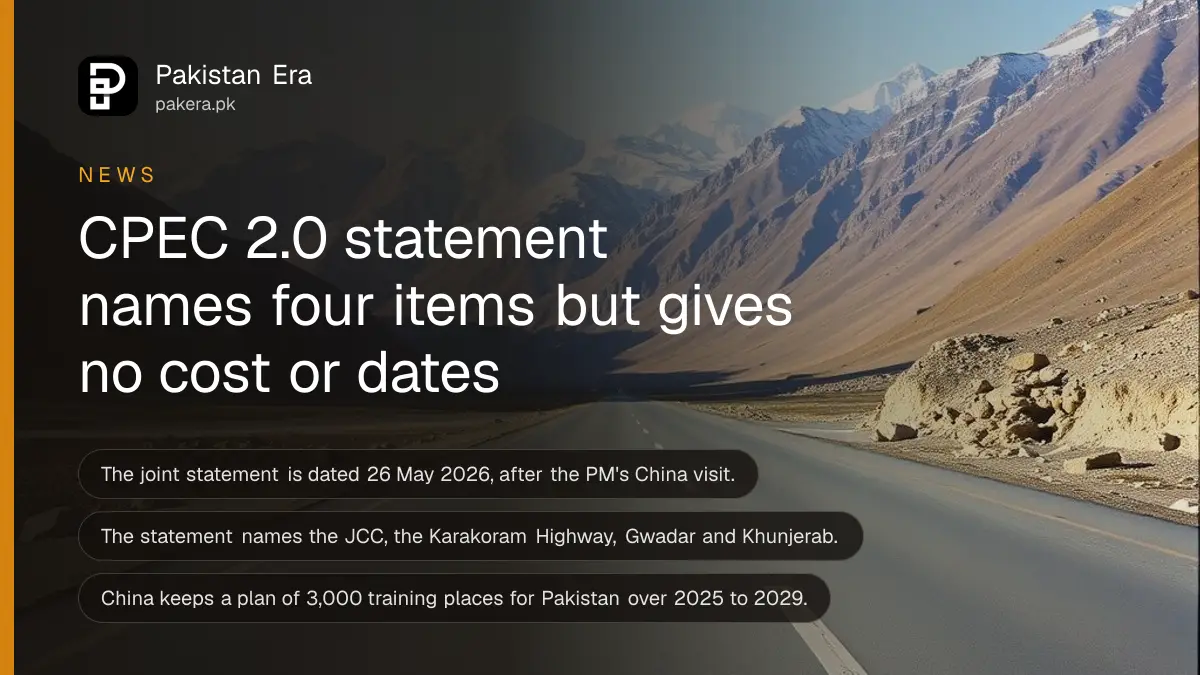
Short answer: The China-Pakistan joint statement of 26 May 2026 names four CPEC 2.0 items: a Joint Cooperation Committee (JCC) meeting, a phased realignment of the Karakoram Highway between Thakot and Raikot, Gwadar as a regional connectivity hub, and use of the Khunjerab Pass. It gives no money figure and no completion date for any of them.
CPEC means the China-Pakistan Economic Corridor, the set of road, power, port and industry projects that the two countries run together. The "2.0" label means the upgraded version. We read the full text on the Ministry of Foreign Affairs website and list what it says, and what it leaves out.
The statement follows the Prime Minister's visit to China from 23 to 26 May 2026
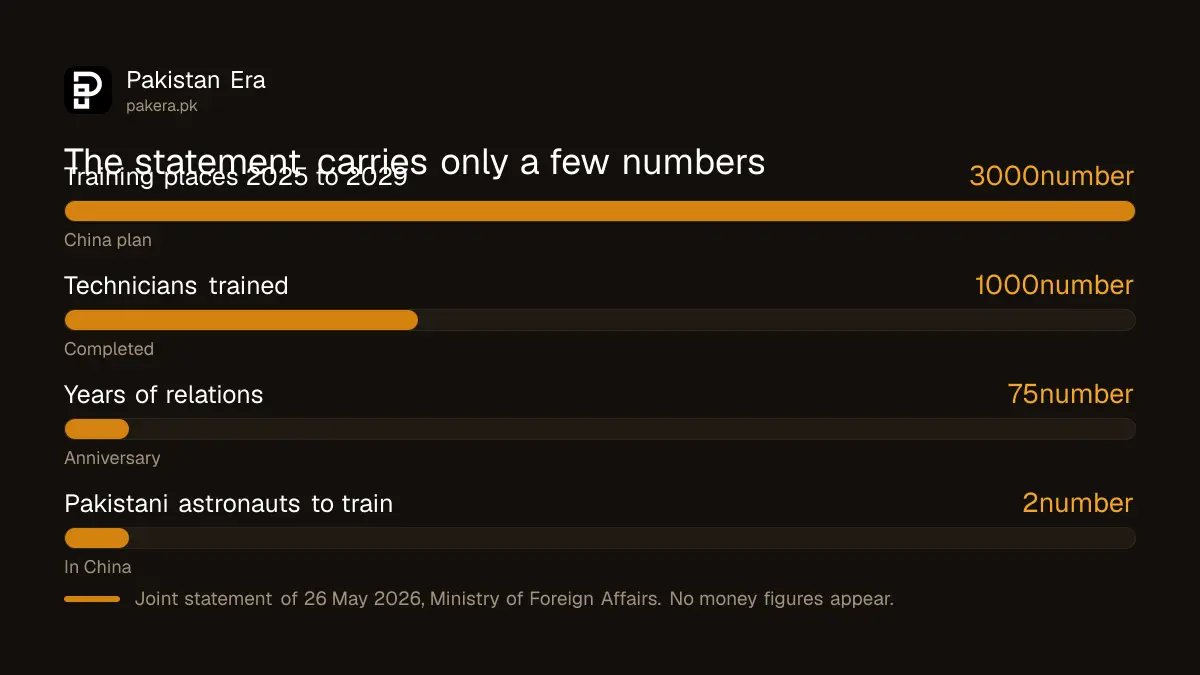
Prime Minister Shehbaz Sharif visited China from 23 to 26 May 2026 at the invitation of Premier Li Qiang. He met President Xi Jinping, attended the commemoration of 75 years of diplomatic relations, and visited Hangzhou. The joint statement is dated 26 May 2026.
This is a diplomatic text, so it records what both sides "agreed to" do. It is not a contract, a budget or a notification of projects. That distinction decides how much weight each line can bear.
Four CPEC 2.0 items are named, and none has a date or a price
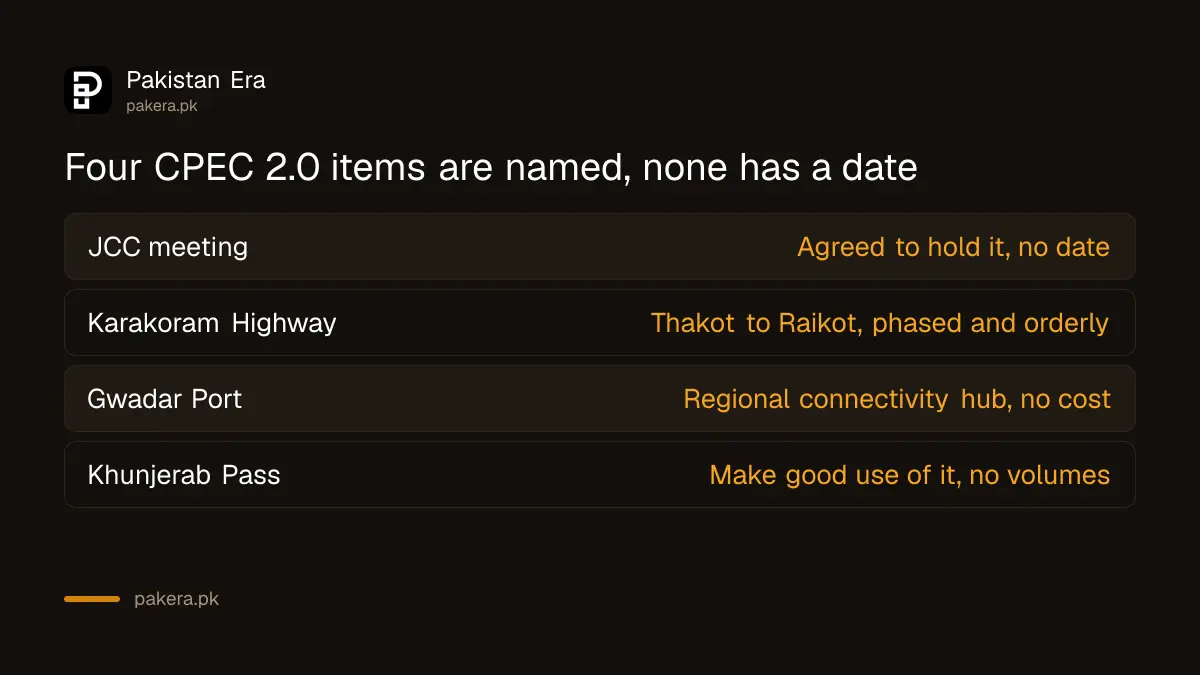
The statement says both sides agreed to hold the JCC meeting, advance the Thakot-Raikot realignment of the Karakoram Highway in a phased and orderly manner, build Gwadar into a regional connectivity hub, and make good use of the Khunjerab Pass. Third parties are welcomed under an agreed model.
| Item | What the text says | What it does not say |
|---|---|---|
| JCC meeting | Both sides agreed to hold it | No date or venue |
| Karakoram Highway, Thakot to Raikot | Realignment to advance "in a phased and orderly manner" | No cost, phases or finish date |
| Gwadar Port | Leverage its potential and build it into a regional connectivity hub | No investment, no new facility named |
| Khunjerab Pass | Make good use of it for land connectivity | No opening hours or trade volumes |
Industry, farming and minerals get named sectors and a few numbers
The statement mentions industrial parks "adapted to local conditions" with demonstration projects in textiles and home appliances, and cooperation in mining and in oil and gas exploration "in an orderly manner". It also records that 1,000 young Pakistani agricultural technicians have completed training in China.
Two other numbers appear. China will keep to its plan of 3,000 training opportunities for Pakistan over 2025 to 2029. The statement also says China will help to facilitate market access for more high-quality Pakistani agricultural products. No product list or quota is given.
On trade, both sides agreed only to "consult on advancing trade liberalization". That is a promise to talk, not a tariff cut. Exporters should not read it as a new concession.
Security of Chinese personnel is a stated Pakistani commitment
The statement says Pakistan will take targeted steps to strengthen security measures and cooperation to ensure the safety of Chinese personnel, projects and institutions in Pakistan. China, for its part, supports Pakistan in its fight against terrorism and will work on the Global Security Initiative.
On Afghanistan, Pakistan spoke positively of the informal China, Afghanistan and Pakistan talks held in Urumqi in April 2026 and welcomed China as a dialogue platform. Both sides said no group, including the TTP and ETIM, should use any territory to threaten regional security.
The statement says the two sides signed "a number of cooperation documents in various fields" during the visit. It does not list them, so their content is not public in this text.
The text also covers space cooperation. It welcomes two Pakistani astronauts to China for training and looks forward to a Pakistani astronaut becoming the first foreign astronaut at the China Space Station.
Read a joint statement by its verbs, not its headlines
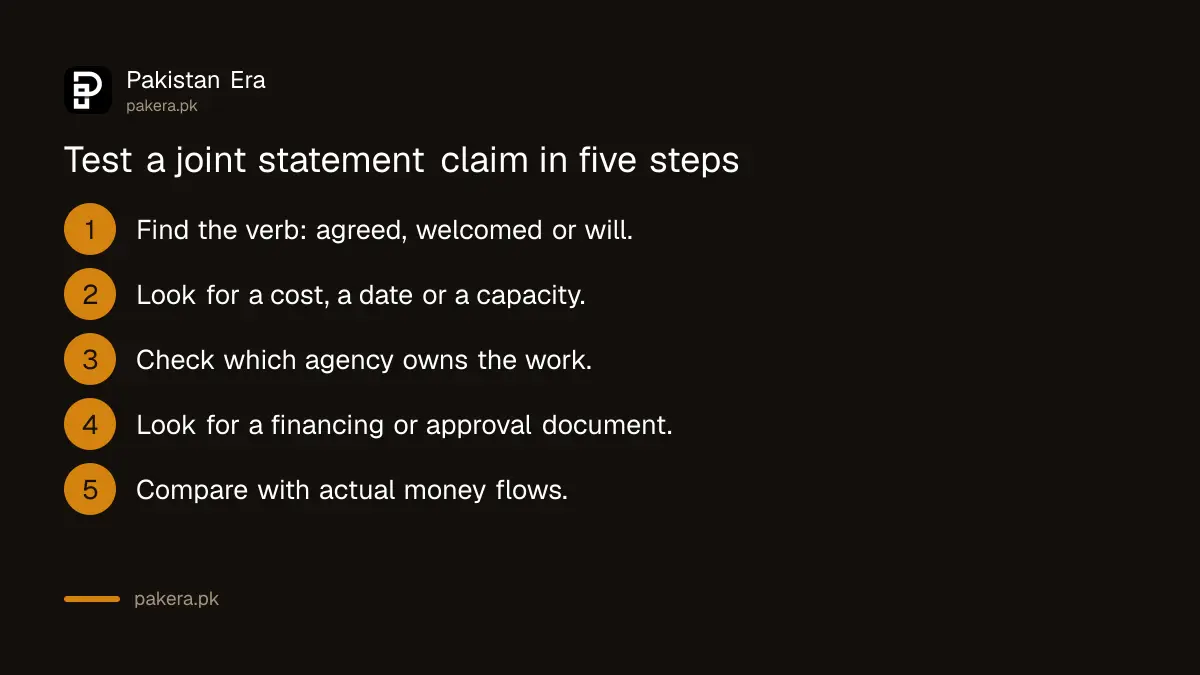
Words such as "agreed to advance" and "will make good use" mark intent. A project is real when a notified approval, a financing agreement or a contract follows. Use the list below to test any claim you see about a CPEC announcement.
- Find the verb. "Agreed to hold", "agreed to advance" and "welcomed" are intentions.
- Look for a number: a cost, a date or a capacity. If there is none, treat the line as a plan.
- Check who is named. A statement that names a project but no agency does not set an owner.
- Look for the follow-up document, such as a JCC minute, a financing agreement or a notification.
- Compare with actual flows. See, for example, foreign investment in July and August 2026, with China leading.
For readers with personal plans linked to China, the study and travel routes are separate from CPEC. Our pages on applying for a China visa from Pakistan and the Chinese Government Scholarship cover those.
Common questions
What is CPEC 2.0?
It is the name used in the statement for the upgraded version of the China-Pakistan Economic Corridor. The text does not define it beyond the four items above.
Does the statement give any investment amount?
No. We read the full text and found no figure in dollars or yuan for any project.
Has the JCC meeting been held?
The statement only says both sides agreed to hold it. We did not find a date in the document, and we did not search for a later notice.
Does it change tariffs on Pakistani goods?
No. It says both sides will consult on advancing trade liberalization, which is a talks commitment only.
Is Gwadar getting a new facility?
The text says Gwadar will be built into a regional connectivity hub. It names no new facility, cost or schedule.
Where can I read the statement?
On the Ministry of Foreign Affairs website under press releases, titled Joint Statement between the People's Republic of China and the Islamic Republic of Pakistan, dated 26 May 2026.
How we verified this
What we checked, where we read it, and what we could not confirm.
Last checked on 11 October 2026. We read the full joint statement dated 26 May 2026 on the Pakistan Ministry of Foreign Affairs press releases page. We did not check later JCC notices or project approvals.
About the author

Global Affairs & Political Economy Writer
Muhammad Hatim is a book lover who started writing because he enjoys it. At Pakistan Era he writes about international relations, geopolitics and the global economy, with a particular interest in South Asia and the forces behind current events.