Lost Share Certificate in Pakistan: Get a Duplicate Within 30 Days Under Section 73, Then Move It to CDC
Get a duplicate share certificate in Pakistan within 30 days under section 73: apply to the registrar with your CNIC, meet its terms, then convert it to CDC.
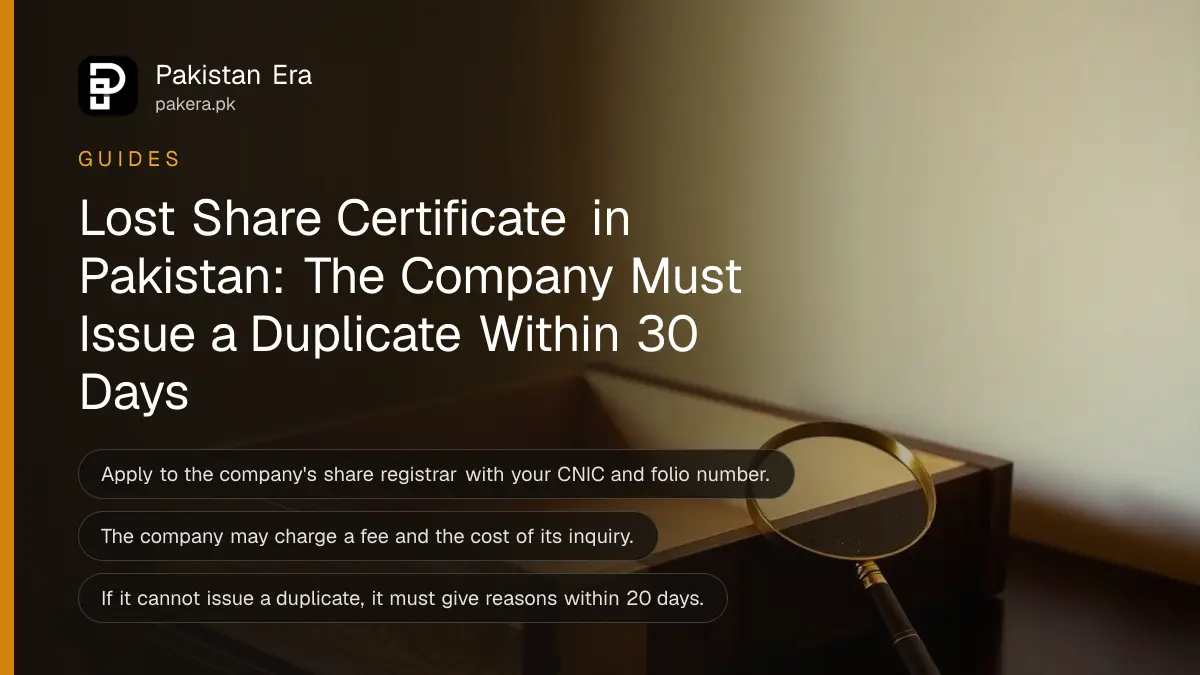
Short answer: If a share certificate is lost, destroyed, torn or defaced in Pakistan, apply to the company's share registrar for a duplicate. Under section 73 of the Companies Act, 2017, the company must issue it within 30 days once the loss is proved or the damaged certificate is handed back. If it cannot, it must give you written reasons within 20 days.
Take your CNIC and, if you have it, the folio number. The Pakistan Stock Exchange (PSX) says the registrar can find your record from the folio number and issue the shares again. The company may charge a fee and the cost of its inquiry.
The company must issue a duplicate within 30 days
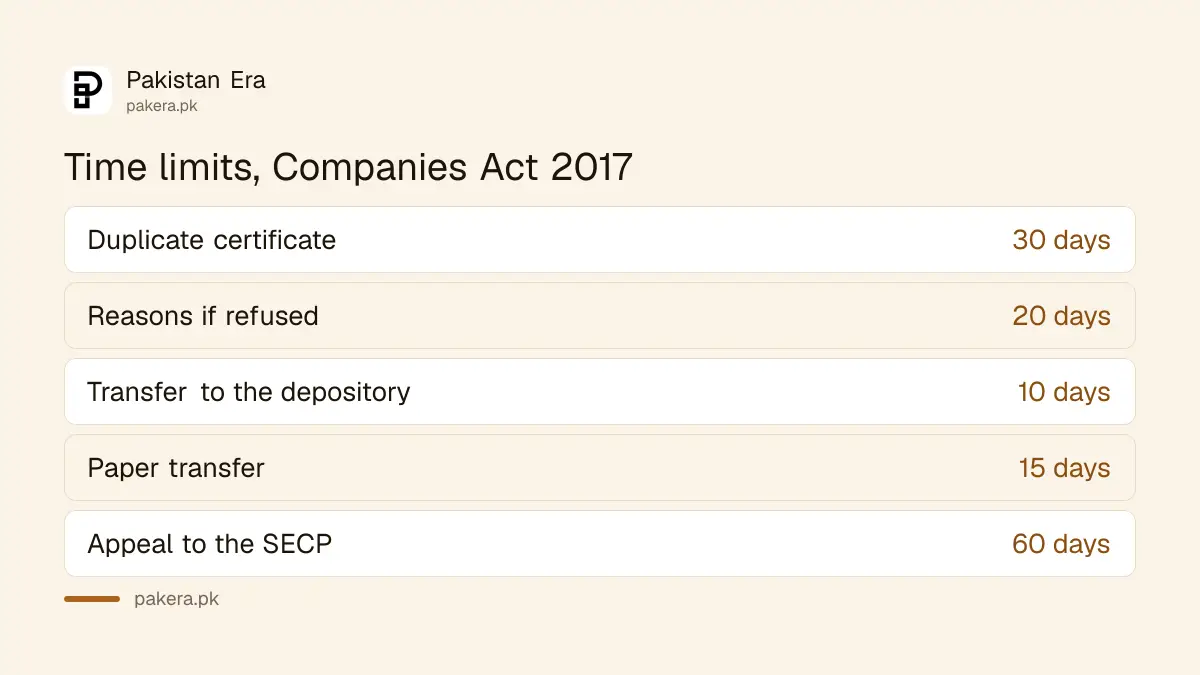
Section 73 gives the company 30 days from your application to issue a duplicate certificate. That applies when the original is proved lost or destroyed, or when a defaced, mutilated or torn certificate is surrendered. The company can make its own inquiry and set reasonable conditions first.
| Rule in section 73 | What it means |
|---|---|
| Duplicate within 30 days of the application | The clock starts when the registrar receives your complete application |
| Original lost or destroyed | You must prove the loss to the company's satisfaction |
| Original torn, defaced or mutilated | Hand the damaged certificate back with the application |
| Inquiry and conditions | The company may inquire and set terms before issuing |
| Fee | A fee plus the actual cost of the inquiry may be charged |
| Company cannot issue | It must tell you, with reasons, within 20 days |
| Breach of the section | Penalty of level 1 on the standard scale |
Fraud is treated seriously. A company that issues a duplicate with intent to defraud faces a fine of up to Rs 100,000. Each officer in default faces up to 180 days in prison, a fine of up to Rs 50,000, or both.
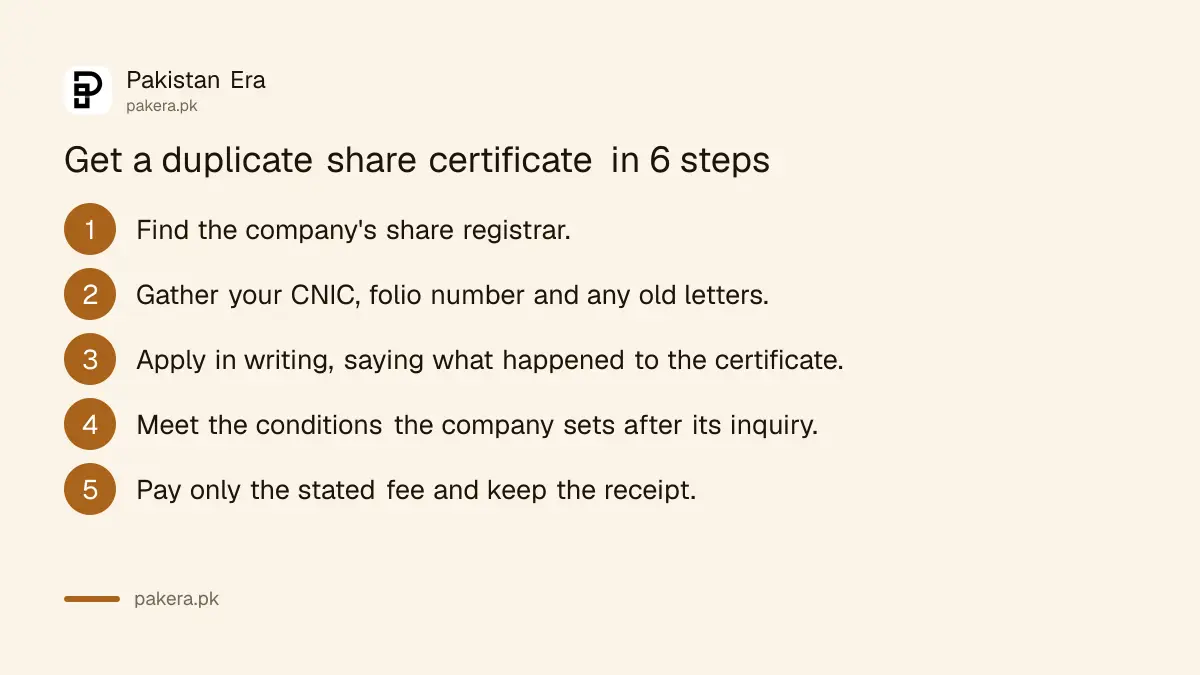
Six steps to get a duplicate share certificate
The application goes to the company's share registrar, not to PSX or a broker. You identify yourself with your CNIC, explain what happened to the certificate, and meet any conditions the company sets. Then the registrar issues the duplicate.
- Find the share registrar. Every listed company names its registrar in its annual report. The CDC website also lists registrars in its "List of Securities".
- Gather what you have. Your CNIC, the folio number, any old dividend warrant or letter from the company, and the damaged certificate if it is torn rather than lost.
- Write the application. Say which certificate is affected, how many shares it covers, and whether it was lost, destroyed or damaged.
- Meet the company's conditions. The company may ask for proof of loss or other terms after its inquiry. Ask the registrar for the list in writing.
- Pay the fee. Pay only the fee and inquiry cost the registrar states, and keep the receipt.
- Collect the duplicate. It should come within 30 days of your complete application. Note the date you applied.
If the holder has died, the heirs first need the shares transferred into their names. That starts with a succession certificate, which NADRA can issue, as set out in our page on getting a succession certificate.
Convert the duplicate to CDC so it cannot be lost again
Once you have the duplicate, move the shares into electronic form in a Central Depository Company (CDC) account. Electronic shares cannot be lost, torn or stolen like paper, and only electronic shares can be sold on PSX.
The conversion also goes through the registrar. You open a CDC Investor Account or a broker account with a CDC sub-account, and the registrar transfers the shares to the depository. Section 74 gives the company 10 days to register that transfer once it receives it. A broker account is the quicker route if you plan to sell; our PSX Sahulat account steps show how to open one with a CNIC.
A lost transfer deed can also be replaced
If the transfer deed, not the certificate, is lost before it was lodged, section 74(2) lets the company still register the transfer. The buyer must prove the deed was properly signed and then lost, and the company may ask for an indemnity first.
An indemnity is a written promise to cover the company if someone else later turns up with the original deed. The application must also carry the same stamp duty as a transfer deed.
| Problem | Rule | Time limit |
|---|---|---|
| Certificate lost or torn | Duplicate under section 73 | 30 days, or reasons within 20 days |
| Transfer deed lost before lodging | Section 74(2), indemnity may be asked | No fixed period stated |
| Ordinary paper transfer | Section 74(1) | 15 days |
| Transfer to the central depository | Section 74(1) proviso | 10 days |
| Transfer refused for a defect | Section 75 | Notice in 15 days, or 5 days for the depository |
| Appeal against refusal | Section 80, to the SECP | Within 60 days of refusal |
What to do if the company delays or refuses
If 30 days pass with no duplicate and no letter of reasons, write to the company secretary with a copy of your application and its date. A refused share transfer can be appealed to the Securities and Exchange Commission of Pakistan (SECP) within 60 days under section 80.
In a section 80 appeal, the SECP hears both sides and can order the company to register the transfer. The company then has 15 days to comply. Directors and officers who ignore the order face a penalty of level 3 on the standard scale.
Old paper shares also hide old money. Dividends that were never collected can be traced by the registrar against the same folio number. For dividends on shares already in a CDC account, the steps in claiming a PSX dividend that never arrived apply.
One safety rule: deal only with the registrar named by the company. Do not hand original certificates, a signed blank transfer deed or copies of your CNIC to an agent who promises a faster duplicate. A signed blank deed can be used to transfer the shares away.
Common questions
How long does a duplicate share certificate take in Pakistan?
Section 73 of the Companies Act, 2017 gives the company 30 days from your application. If it cannot issue one, it must tell you why within 20 days.
Where do I apply for a duplicate share certificate?
To the company's share registrar. The registrar is named in the company's annual report and in the CDC website's list of securities.
Is there a fee for a duplicate share certificate?
The company may charge a fee and the actual cost of its inquiry into the loss. Ask the registrar for the amount in writing.
I lost my share certificate but know the company. Can I still get my shares?
Yes. Take your CNIC to the registrar. With your folio number, or your name and CNIC, the registrar can trace your record and issue the shares again.
Should I keep the duplicate as paper?
It is better to convert it into electronic shares in a CDC account. Electronic shares cannot be lost and can be sold on PSX.
What if the company refuses to transfer my shares?
It must tell you the defect in the transfer deed within 15 days, or 5 days where the depository is the transferee. If it still refuses, appeal to the SECP within 60 days.
How we verified this
What we checked and where we read it.
Last checked 17 November 2026. The 30 day and 20 day limits, the fee, the inquiry and the penalties come from section 73 of the Companies Act, 2017; the transfer limits, the lost deed rule and the indemnity from sections 74 and 75; and the SECP appeal from section 80, all in the text as amended to 2021 published on Pakistan Code. Tracing lost shares by CNIC and folio number, uncollected dividends and finding the registrar through CDC's list of securities come from the PSX Knowledge Center article on physical shares. Each company sets its own conditions and fee for a duplicate, so ask the registrar for them in writing. This is general information, not legal advice.
About the author

Global Affairs & Political Economy Writer
Muhammad Hatim is a book lover who started writing because he enjoys it. At Pakistan Era he writes about international relations, geopolitics and the global economy, with a particular interest in South Asia and the forces behind current events.