FBR STGO 36 of 2026: OGDCL, PPL, Mari and 10 Other Oil and Gas Companies Must Issue Digital Invoices From the December Return
FBR STGO 36 of 2026, issued 13 November, makes each partner in an oil or gas field issue a digital invoice for its share from the December 2026 sales tax return

The Federal Board of Revenue (FBR) issued Sales Tax General Order 36 of 2026 on 13 November 2026. It sets how 13 oil and gas exploration and production (E&P) companies, including OGDCL, PPL, Mari Energies and POL, must issue digital sales tax invoices. The order applies from the sales tax return for December 2026. Each joint venture partner now issues a digital invoice for its own share, on or before the day it files the monthly return.
A Sales Tax General Order, or STGO, is an FBR instruction on how the sales tax law is applied. This one is called the STGO for Digital Invoicing Compliance, 2026 for E&P companies.
FBR's STGO 36 sets digital invoicing rules for 13 E&P companies
STGO 36 of 2026, dated 13 November 2026, is issued under section 55 of the Sales Tax Act, 1990, which lets the Board remove a difficulty in applying the law. It applies only to the 13 E&P companies listed in its Table-I.
The difficulty is a practical one. Oil and gas fields in Pakistan are usually run under a Petroleum Concession Agreement (PCA). One company, the operator, runs the field and bills the buyer. The other partners, called non-operators, own shares of the same sale. Under the electronic invoicing rules, every registered person must report each sale to the FBR system in real time. The order settles who issues which invoice.
Who issues the invoice under the new order
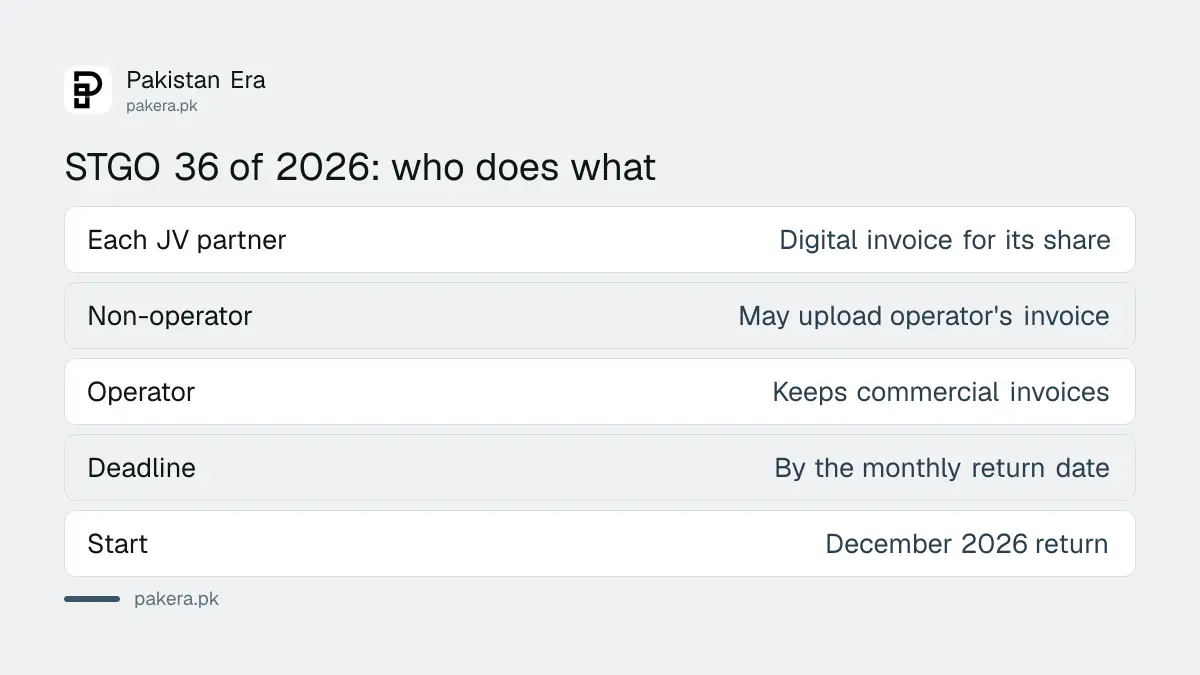
Each joint venture partner issues a digital invoice for its own share, based on the invoice the operator raises. A non-operator may upload the invoice the operator issued on its behalf to get its own FBR invoice number and QR code.
| Who | What STGO 36 says |
|---|---|
| Each joint venture partner | Issues a digital invoice for its own share, based on the operator's invoice |
| Non-operator | May upload the invoice issued on its behalf by the operator, to get a unique FBR invoice number and QR code |
| Operator of the PCA or lease | Keeps issuing commercial invoices under its contracts and current arrangements |
| Deadline for each invoice | On or before the date the monthly sales tax return is filed |
| Start | Sales tax return for December 2026 and later months |
The unique invoice number and QR code are what make an invoice a digital invoice in the FBR system. A buyer claiming input tax will look for them.
The 13 oil and gas companies named in Table-I
Table-I of the order lists 13 E&P companies with their NTNs. They include the large state-linked producers OGDCL, PPL, Mari Energies and GHPL, and private and foreign operators such as POL, MOL and United Energy Pakistan.
- Oil and Gas Development Company Limited (OGDCL)
- Government Holdings (Private) Limited (GHPL)
- Mari Energies Limited
- Polish Oil and Gas Company (POGC)
- Khyber Pakhtunkhwa Oil and Gas Company Limited (KPOGCL)
- United Energy Pakistan Limited
- Orient Petroleum Inc.
- Prime Global Energy
- Saif Energy Limited
- Pakistan Oilfields Limited (POL)
- MOL Pakistan Oil and Gas Co. B.V.
- Pakistan Petroleum Limited (PPL)
- Al-Haj Enterprises Limited
What E&P companies can do in Annexure C before filing
The order lets the listed companies fetch a parked invoice from the digital invoicing dashboard into Annexure C, and delete or amend an invoice reported in Annexure C, as long as they do it before the monthly sales tax return is submitted.
Annexure C is the sales part of the monthly sales tax return. A parked invoice is one saved on the digital invoicing dashboard but not yet pulled into the return. In plain terms, a company can correct its invoice list right up to filing, but not after.
- Fetch a parked invoice from the DI dashboard into Annexure C.
- Delete or amend an invoice already reported in Annexure C.
- Do both only before the return for that month is submitted.
What this changes for buyers and the December return
Buyers of crude oil, gas and LPG from these fields should expect invoices with an FBR number and QR code from each partner for its share, starting with December 2026 supplies reported in the December return.
The December 2026 sales tax return is filed in January 2027. So the first invoices under this order must be on the FBR system by that filing date. Finance teams at refineries, gas utilities and other buyers should check that each partner's share matches the operator's commercial invoice, because input tax follows the digital invoice.
It follows other FBR sales tax orders issued this month, including STGO 35 on packaged tea monitoring and STGO 34 on steel units. For how any business connects to the system, see the steps for FBR digital invoicing through PRAL or a licensed integrator. Every order of the year is listed on the FBR sales tax general orders 2026 page.
Common questions
What is STGO 36 of 2026?
It is an FBR Sales Tax General Order of 13 November 2026 that sets digital invoicing rules for 13 oil and gas exploration and production companies.
When does STGO 36 start?
It applies to the sales tax return for December 2026 and every month after that.
Does the operator stop issuing invoices?
No. The operator keeps issuing commercial invoices under its contracts. Each partner then issues its own digital invoice for its share.
Can a non-operator use the operator's invoice?
Yes. A non-operator may upload the sales tax invoice issued on its behalf by the operator, to get an FBR invoice number and QR code.
Can an invoice be changed after filing the return?
The order allows fetching, deleting or amending invoices in Annexure C only before the monthly return is submitted.
How we verified this
What we checked and where we read it.
Last checked on 14 November 2026. We read the order itself, C.No. 10(3)/IR/TDU/2026 dated 13 November 2026, "Sales Tax General Order No. 36 of 2026, IR Operations", on the FBR website, where it is listed as "Removal of Difficulty in Issuance of Electronic Sales Tax Invoices and Integration with the Federal Board of Revenue Computerized System, Oil and Gas Exploration and Production Companies". The order cites sections 23 and 55 of the Sales Tax Act, 1990 and Chapter XIV of the Sales Tax Rules, 2006 (rules 150Q to 150XQ). The company list is Table-I of the same order.
About the author

Tax, Bills and Technology Writer
Ali Akhtar is a young and curious voice here at Pakistan Era. He is currently pursuing his A-Levels and has a growing interest in Pakistan’s changing industrial landscape and educational trends. Ali likes to write in a way that helps him explain and explore the world around him. His writing reflects the perspective of the new generation navigating the evolving trends of Pakistan where technology, youth innovation, and shifting opportunities are reshaping the country’s future.