Federal Constitutional Court Rules Sindh's Age-65 Limit Cannot End an Anti-Terrorism Judge's Fixed Term
The Federal Constitutional Court set aside a Sindh order removing anti-terrorism judges over 65, holding the 2025 age limit does not end existing fixed terms.
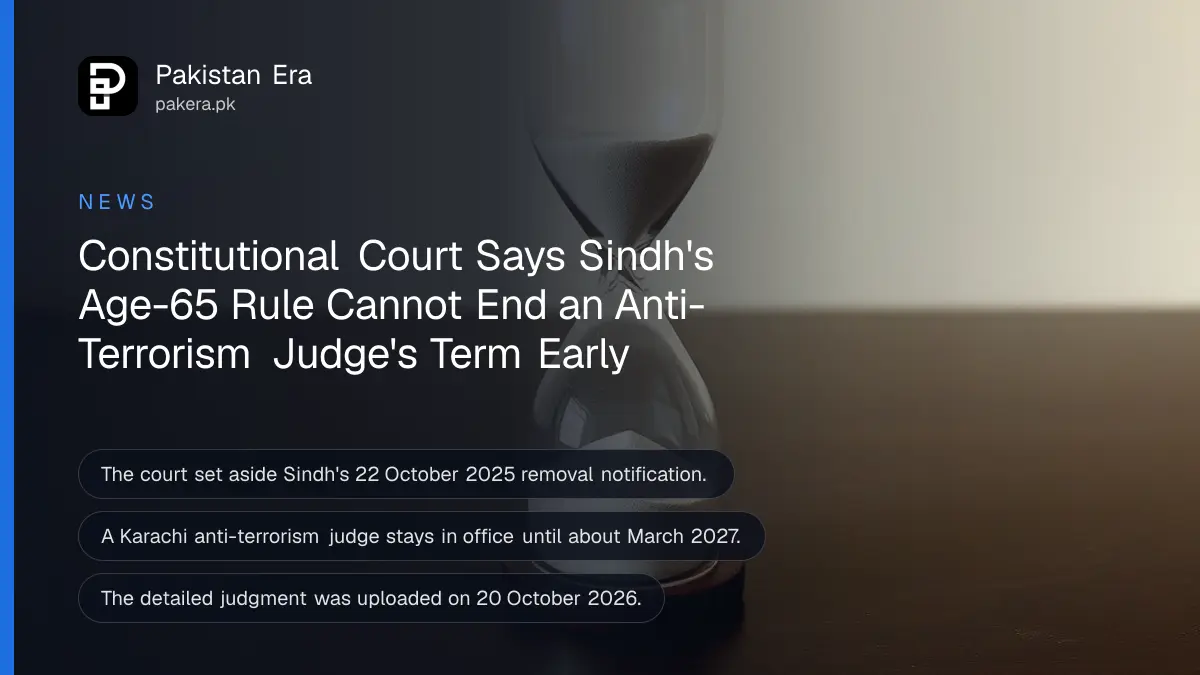
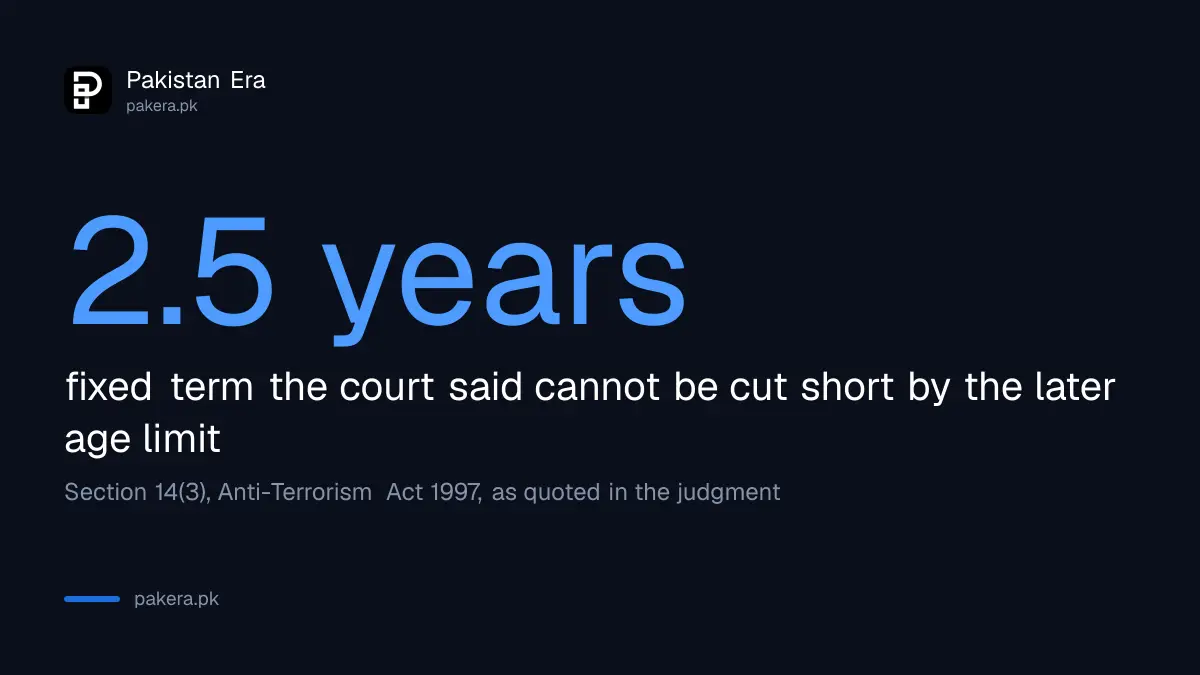
Short answer: The Federal Constitutional Court has ruled that Sindh's new upper age limit of 65 for anti-terrorism court judges does not cut short a fixed term that began before the law changed. The court restored a retired judge to Anti-Terrorism Court-IV, Karachi, until his two and a half year term ends. Its detailed judgment was uploaded on 20 October 2026.
The decision in F.C.P.L.A. No. 581 of 2026, Muhammad Yameen versus Government of Sindh, was heard on 9 October 2026 by Justice Syed Hasan Azhar Rizvi and Justice Muhammad Karim Khan Agha. The court announced a short order that day. We downloaded the 15 page judgment from the court's judgments page on 20 October 2026, the day it was uploaded. It is marked approved for reporting.
The court set aside a Sindh notification that removed three judges
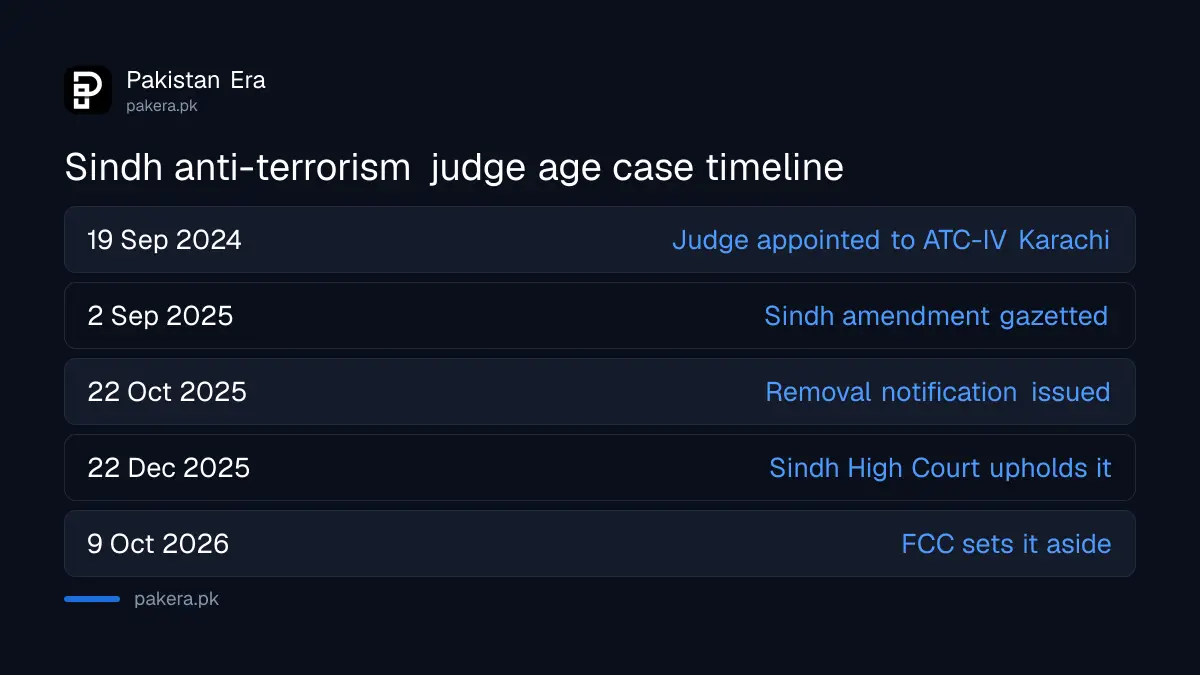
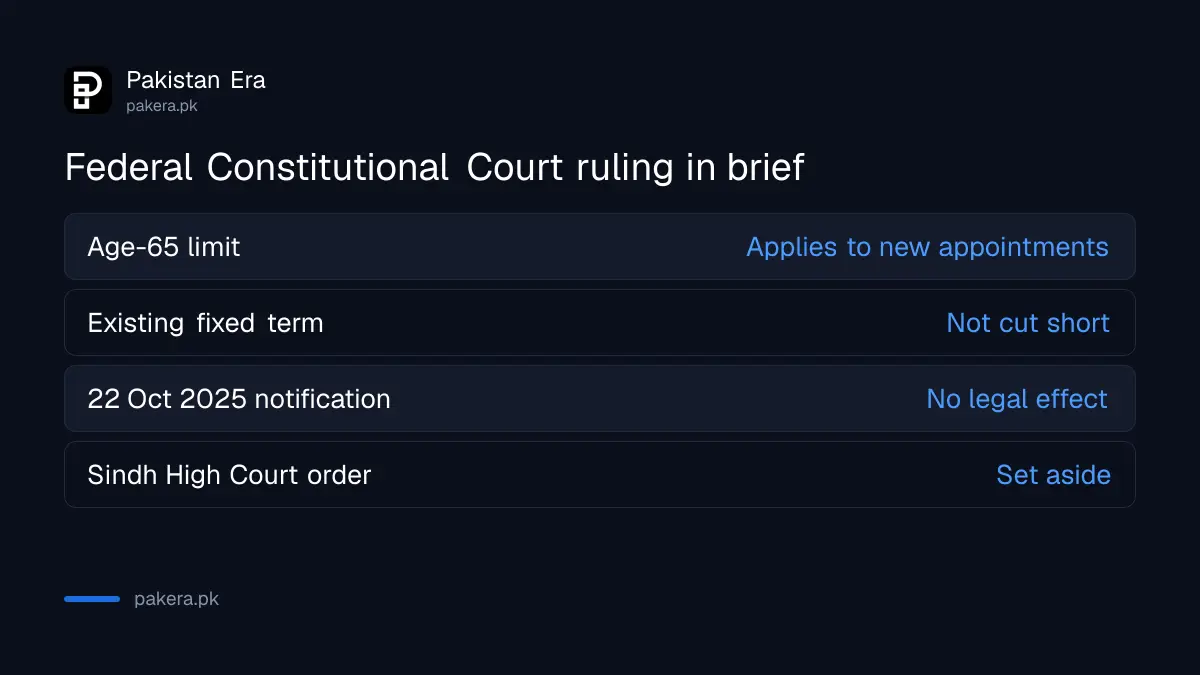
The Sindh government's notification of 22 October 2025 ended the service of three anti-terrorism court judges who had passed 65. The court declared it "without lawful authority and of no legal effect" and set aside a Sindh High Court order that had upheld it.
The petitioner, a retired District and Sessions Judge, was appointed Judge of Anti-Terrorism Court-IV, Karachi on 19 September 2024. He was about 70 at the time. His term was due to run to March 2027. The court said he "shall be deemed to have continued in office" despite the notification.
The judgment names the other two judges affected by the notification. One of them had brought the original case in the Sindh High Court, and the court allowed that petition too "in the above terms".
Sindh's 2025 amendment added an age limit of 65
The Anti-Terrorism (Sindh Amendment) Act 2025, gazetted on 2 September 2025, changed section 14 of the Anti-Terrorism Act 1997 for Sindh. It barred appointing anyone aged 65 or over and said a judge appointed "under this section" leaves office at 65.
| Point | Before the 2025 amendment | After the 2025 amendment |
|---|---|---|
| Who appoints | Government after consulting the Chief Justice of the High Court | Sindh government from a panel of three, with the Chief Justice's concurrence |
| Upper age | None | 65, for appointment and for staying in office |
| Term | Two and a half years, further terms possible | Two and a half years, one further term only |
The Sindh High Court, on 22 December 2025, read the age limit as covering judges already in office. It held that this did not make the law retrospective. The Federal Constitutional Court disagreed.
The court held a new law does not end existing fixed terms by implication
The court said an amending law operates prospectively unless it says otherwise or the intent is necessarily implied. The Sindh amendment says neither, and a judge appointed for a fixed term had a vested right to finish it.
The judgment quotes several earlier Supreme Court rulings on the same principle, including cases from 2000, 2016, 2018, 2023 and 2024. It also dealt with the Sindh government's reliance on a 2024 tax ruling and found that case supported the petitioner's reading instead. The court said that where a provision allows two reasonable readings, the one that protects an existing right is preferred.
The judgment also comments on certainty in law. In its words, retrospective legislation is "generally the exception rather than the rule and is expressly stated to be the case in the relevant law". The court left the petitioner's other arguments, including judicial independence, undecided because the interpretation point settled the case.
The ruling turns on how laws apply to people already in office
The point decided is about timing, not about whether Sindh may set an age limit. The court said the question "was not whether the legislature was competent to prescribe an upper age limit", only whether the new rule reached appointments already made.
That matters beyond anti-terrorism courts. Officials, contract appointees and licence holders often face rule changes in the middle of a term. The principle the court applied is that a later law will not cut an existing fixed-term right short unless it clearly says so. Whether any other case fits depends on the exact wording of the law involved.
Readers who want to read decisions like this one themselves can follow how to find a Federal Constitutional Court judgment online. Another recent appeal decided by the court is the Khyber Pakhtunkhwa constable ruling.
What happens next for the Karachi court
The judge is entitled to continue in Anti-Terrorism Court-IV, Karachi until his two and a half years end, subject to the conditions of his appointment. We have not seen a fresh Sindh notification giving effect to the order.
- The short order was announced on 9 October 2026 in Karachi.
- The detailed reasons were uploaded on 20 October 2026.
- The petitioner's term under the 19 September 2024 notification runs to about March 2027.
- Any later appointment to the court must follow the amended section 14, including the age limit.
The last point is our reading of the judgment. It addresses only appointments made before the amendment, so new appointments are governed by the 2025 Act as written.
Common questions
What did the Federal Constitutional Court decide on 9 October 2026?
It held that Sindh's age limit of 65 does not end the fixed term of an anti-terrorism court judge appointed before the 2025 amendment.
Which notification was struck down?
The Sindh government's notification of 22 October 2025 that ended the service of three anti-terrorism court judges.
Did the court say Sindh cannot set an age limit?
No. It said the question was not the legislature's power to set a limit, only whether the limit applied to existing appointments.
When was the full judgment published?
It was uploaded to the court's judgments page on 20 October 2026, with an upload date of that day.
Does the age limit apply to new anti-terrorism court judges in Sindh?
The judgment deals only with appointments made before the amendment, so new appointments fall under the amended section 14.
How we verified this
What we checked, where we read it, and what we could not confirm.
Last checked 20 October 2026. We read the full judgment in F.C.P.L.A. No. 581 of 2026, downloaded from the Federal Constitutional Court's judgments page on 20 October 2026, where it shows an upload date of 20 October 2026 and "Approved for Reporting". The quoted wording of the 2025 Sindh amendment comes from the judgment itself. We did not read the Anti-Terrorism (Sindh Amendment) Act 2025 in the Sindh Gazette, and we could not confirm whether the Sindh government has issued an order giving effect to the ruling.
About the author

Global Affairs & Political Economy Writer
Muhammad Hatim is a book lover who started writing because he enjoys it. At Pakistan Era he writes about international relations, geopolitics and the global economy, with a particular interest in South Asia and the forces behind current events.