Foreign Exchange Law Penalties in Pakistan: 5 Years Jail for Illegal Dealing, Up to 5 Times the Amount, Rs 500,000 Licence Fines (FERA 1947)
Pakistan's FERA 1947 penalties: up to 5 years jail for illegal currency dealing, fines of 5 times the amount, Rs 500,000 licence fines, and 30 days to appeal.
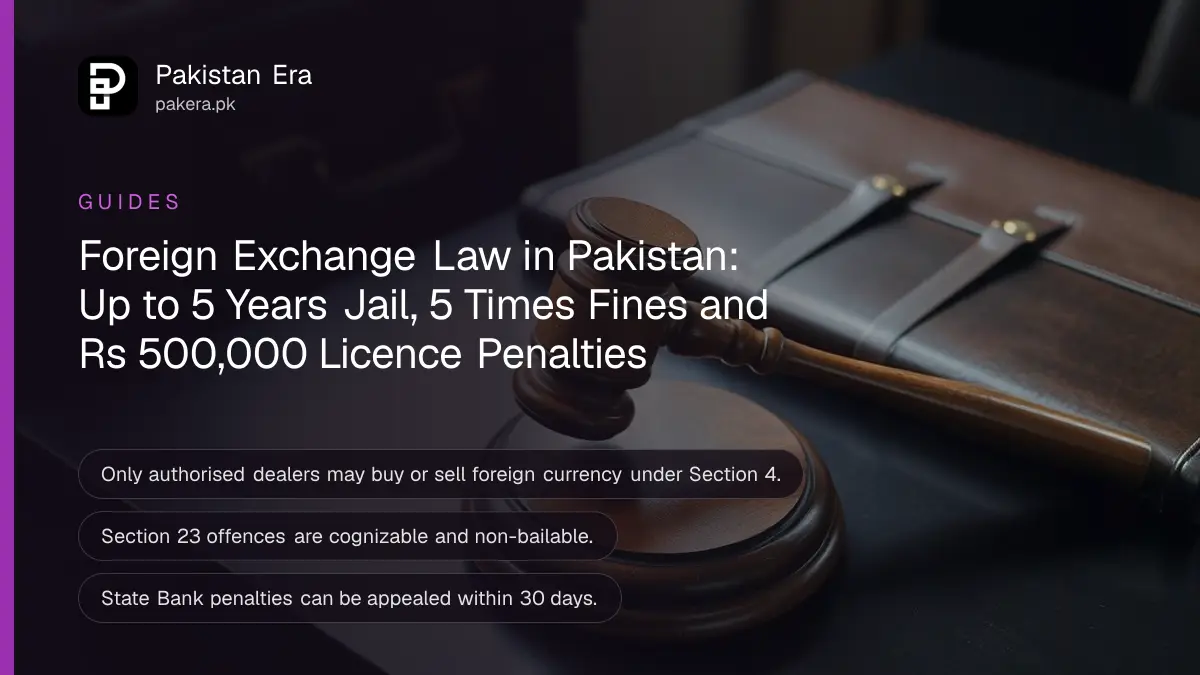
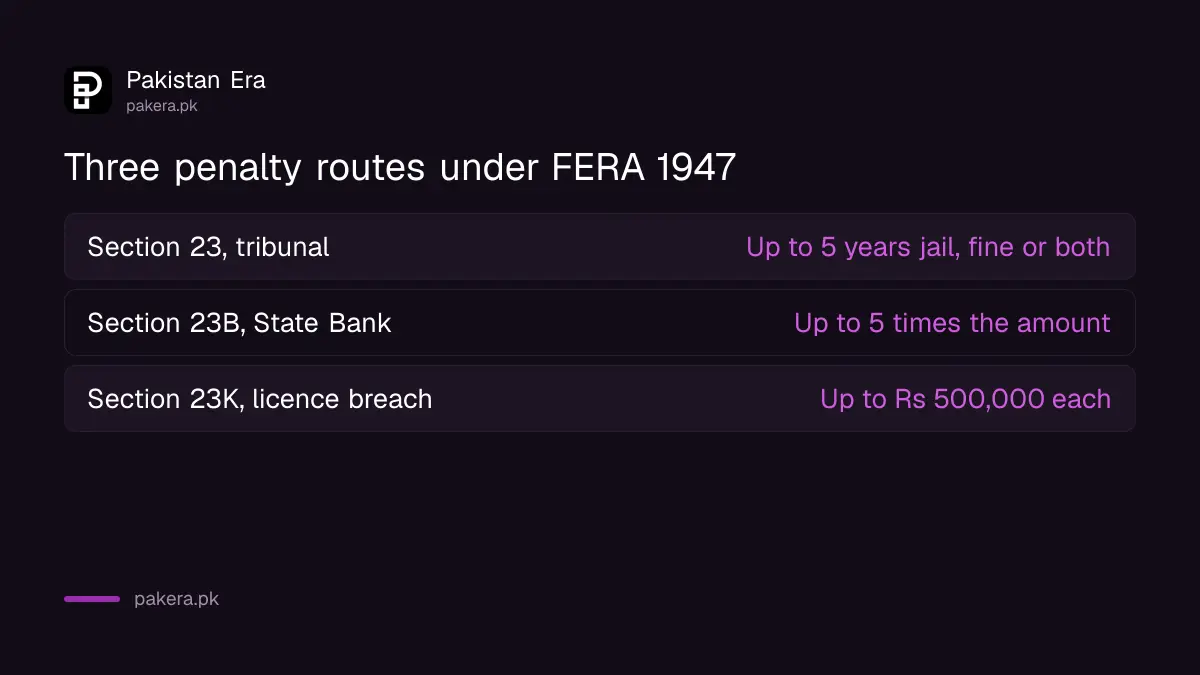
Short answer: Under Pakistan's Foreign Exchange Regulation Act 1947 (FERA), buying or selling foreign currency through anyone other than a State Bank-authorised dealer can bring up to 5 years of rigorous imprisonment, a fine, or both. The offence is cognizable and non-bailable. Some other violations go to State Bank adjudication, with penalties of up to 5 times the amount involved. Licensed exchange companies face fines of up to Rs 500,000 per breach.
These are the rules in force on 14 November 2026. On 13 November the cabinet's law committee approved a Foreign Exchange Regulation (Amendment) Bill 2026 that reviews these penalties, as reported in our cabinet committee decisions of 13 November. Until Parliament passes it, the 1947 Act below is the law.
FERA allows only authorised dealers to buy and sell foreign currency
Section 4(1) of FERA says no one in Pakistan except an authorised dealer may buy, sell, borrow, lend or exchange foreign currency with someone who is not an authorised dealer, unless the State Bank permits it. Banks are authorised dealers, and exchange companies and money changers are licensed separately by the State Bank under Sections 3A and 3AA.
So a dollar bought from a licensed exchange company is legal. A dollar bought from a man in a market who holds no licence is a breach for both sides. The same applies to hundi and hawala, the informal systems that move money across borders outside banks.
Other duties in the Act matter for ordinary people too:
- Section 5: payments to people living outside Pakistan must follow State Bank permissions.
- Section 8: bringing in or taking out currency, gold and silver is controlled. The current travel cash limit is in our page on foreign currency limits when leaving Pakistan.
- Section 10: anyone owed foreign currency must not delay or give up receiving it.
- Section 12: exporters must bring home payment for exported goods.
The criminal route: up to 5 years in jail
Most FERA violations are crimes under Section 23. A Sessions Judge, acting as a special tribunal, can give rigorous imprisonment of up to five years, a fine, or both. The tribunal can also confiscate the currency, gold, silver or goods involved.
Four rules make this route serious:
- Cognizable and non-bailable. Under Section 23(2), the police can arrest without a warrant, and bail is not a right.
- Complaint by the State Bank. A tribunal acts on a written complaint by someone the State Bank authorises. This step is skipped when the accused is running an illegal foreign exchange business without a licence.
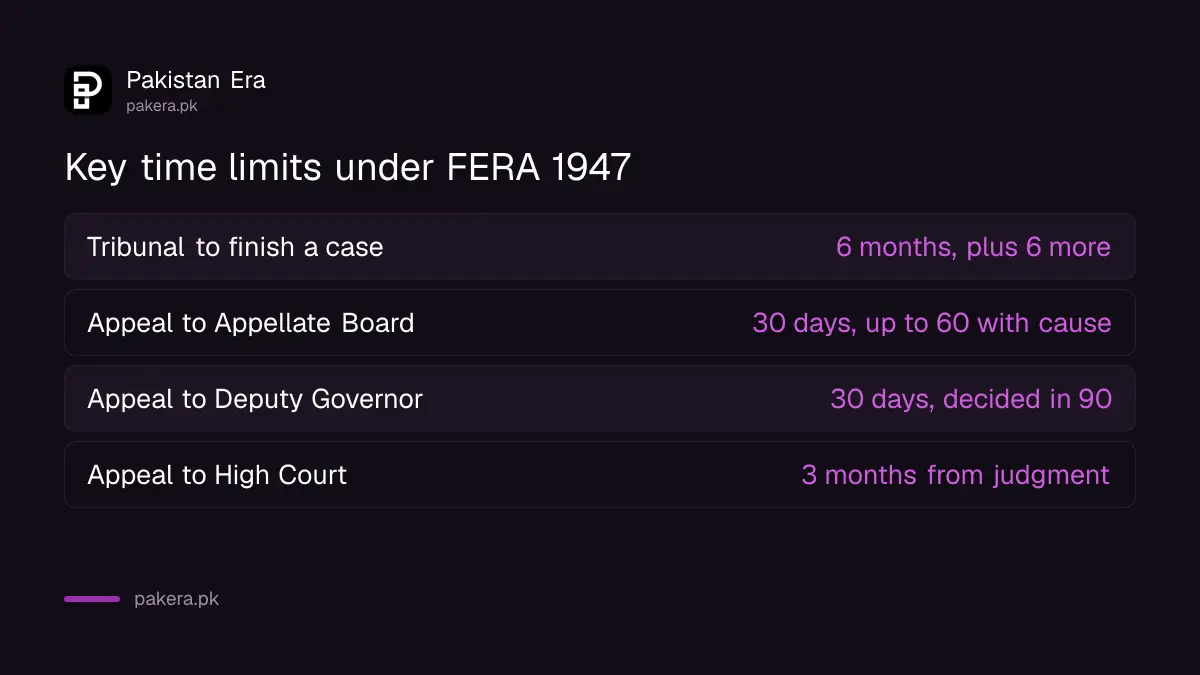
- Six months to finish. Section 23(3B) asks the tribunal to end the case in six months, with one extension of six months for written reasons.
- Burden of proof. Under Section 24, if you say you had permission, you must prove it.
Directors and managers of a company are also liable if they knowingly took part, under Section 23(4).
The State Bank route: up to 5 times the amount
Some violations are not tried in court. They go to State Bank adjudicating officers under Section 23B. These include delaying foreign currency owed to you (Section 10) and failing to bring home export proceeds (Section 12(1)).
The penalty can be up to five times the amount involved, or Rs 5,000, whichever is more. If the breach continues, a further penalty of up to Rs 2,000 a day can be added. The officer can also confiscate the money or property involved under Section 23H.
| Route | Who decides | Maximum penalty | Appeal |
|---|---|---|---|
| Criminal, Section 23 | Sessions Judge as tribunal | 5 years rigorous jail, fine, or both, plus confiscation | High Court within 3 months |
| Adjudication, Section 23B | State Bank adjudicating officer | 5 times the amount or Rs 5,000, whichever is more, plus Rs 2,000 a day | Appellate Board within 30 days |
| Licence breach, Section 23K | State Bank officer, Senior Joint Director or above | Rs 500,000 per breach, plus Rs 10,000 a day | Deputy Governor within 30 days |
Officers of Customs, the Federal Investigation Agency, the police and other government bodies must assist adjudicating officers, under Section 23D.
Exchange companies face up to Rs 500,000 per breach
Section 23K covers banks, exchange companies and money changers that break the terms of their State Bank licence. A State Bank officer can fine them up to Rs 500,000 for each breach and Rs 10,000 for every day it continues. A show-cause notice and a hearing must come first.
The State Bank can also suspend or cancel the licence under Section 3B. If a fine is not paid on time, the State Bank can recover it from money held for the company by a bank. Directors and managers who knew of the breach are treated as guilty too.
How to appeal a FERA penalty
You can challenge a State Bank penalty, but the deadlines are short. Miss them and the order becomes final. For an adjudication penalty under Section 23B, the appeal goes to a Foreign Exchange Regulation Appellate Board.
- File the appeal within 30 days of the order. The Board can accept it up to 60 days if you show good cause for the delay.
- Deposit the penalty in cash with the Board, or give security of the same value if the Board allows it. Without this, the appeal is not heard.
- Attend the hearing. The Board can confirm, change or cancel the order.
- If the Board cuts the penalty, the extra money you deposited is refunded.
For a licence fine under Section 23K, the appeal goes to a Deputy Governor of the State Bank within 30 days, and must be decided within 90 days. That decision is final. A judgment of the criminal tribunal under Section 23 can be appealed to the High Court within three months, under Section 23A(6).
How to stay on the right side of FERA
The safest rule is simple: deal in foreign currency only through a bank or a licensed exchange company, and keep the receipt. Money from abroad should come through a bank, a licensed money service or a wallet linked to a bank.
- Ask the exchange company for a receipt for every purchase or sale.
- Never let someone else use your bank account to receive or send money for them. That is how many people get caught in hundi cases, as explained in our page on lending your bank account to someone else.
- Exporters should track every shipment's payment and report delays to their bank early.
The latest text of any federal law, including this one, can be read for free using the steps in our guide to checking a federal law on Pakistan Code.
Common questions
Is buying dollars in the open market illegal in Pakistan?
Buying from a licensed exchange company is legal. Buying from an unlicensed person breaks Section 4 of FERA and can lead to criminal charges.
What is the punishment for hundi or hawala in Pakistan?
Running or using an unlicensed foreign exchange channel can be tried under Section 23 of FERA, with up to five years of rigorous imprisonment, a fine, or both, and confiscation of the money.
Is a FERA offence bailable?
No. Section 23(2) makes offences under that section cognizable and non-bailable.
Who tries FERA cases?
Every Sessions Judge is a FERA tribunal for their area, under Section 23A. Some cases go to State Bank adjudicating officers instead.
How long do I have to appeal a State Bank FERA penalty?
Thirty days for both routes. The Appellate Board can accept a late appeal up to 60 days with good cause.
Has the 2026 amendment changed these penalties yet?
No. The Foreign Exchange Regulation (Amendment) Bill 2026 was approved by a cabinet committee on 13 November 2026. It must still pass Parliament.
How we verified this
What we checked and where we read it.
We checked every section on 14 November 2026 in the text of the Foreign Exchange Regulation Act 1947 on Pakistan Code, including amendments made by Act XXXIII of 2016 and Act X of 2020. The amendment bill is from the Press Information Department release of 13 November 2026 on the Cabinet Committee for Disposal of Legislative Cases.
About the author

Global Affairs & Political Economy Writer
Muhammad Hatim is a book lover who started writing because he enjoys it. At Pakistan Era he writes about international relations, geopolitics and the global economy, with a particular interest in South Asia and the forces behind current events.