How to Get Your Electricity Security Deposit Back in Pakistan
Your electricity security deposit comes back only on permanent disconnection. Who applies, the final bill, NEPRA's 30 day refund rule and what to do if stuck.
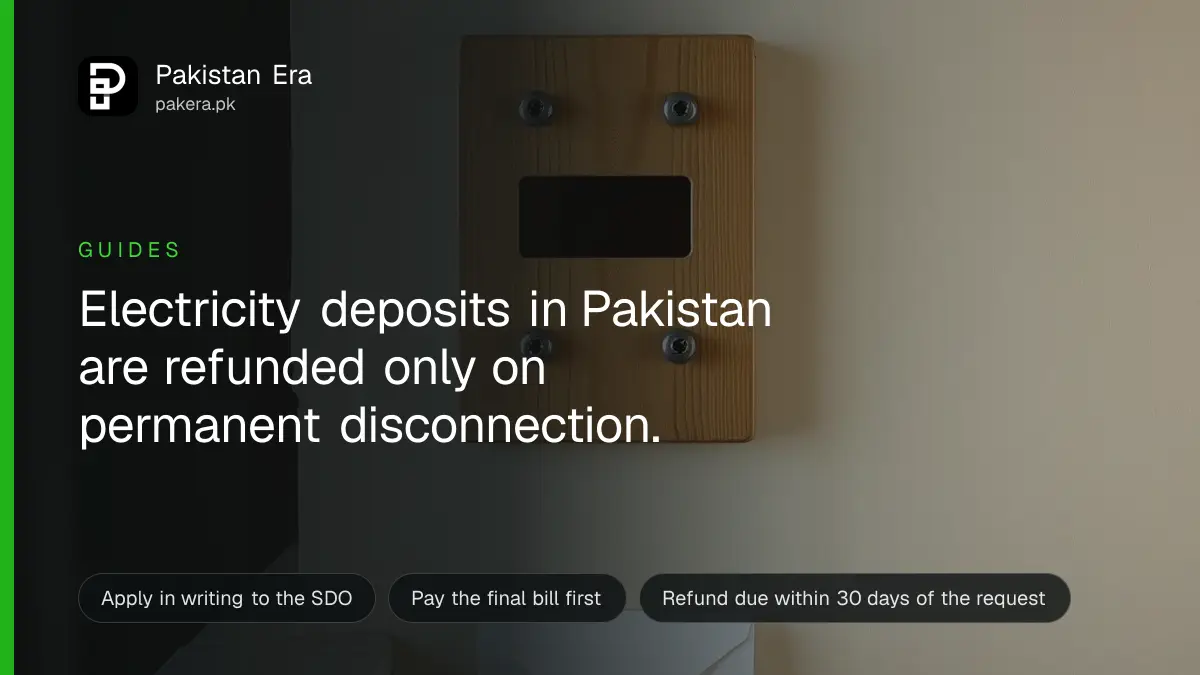
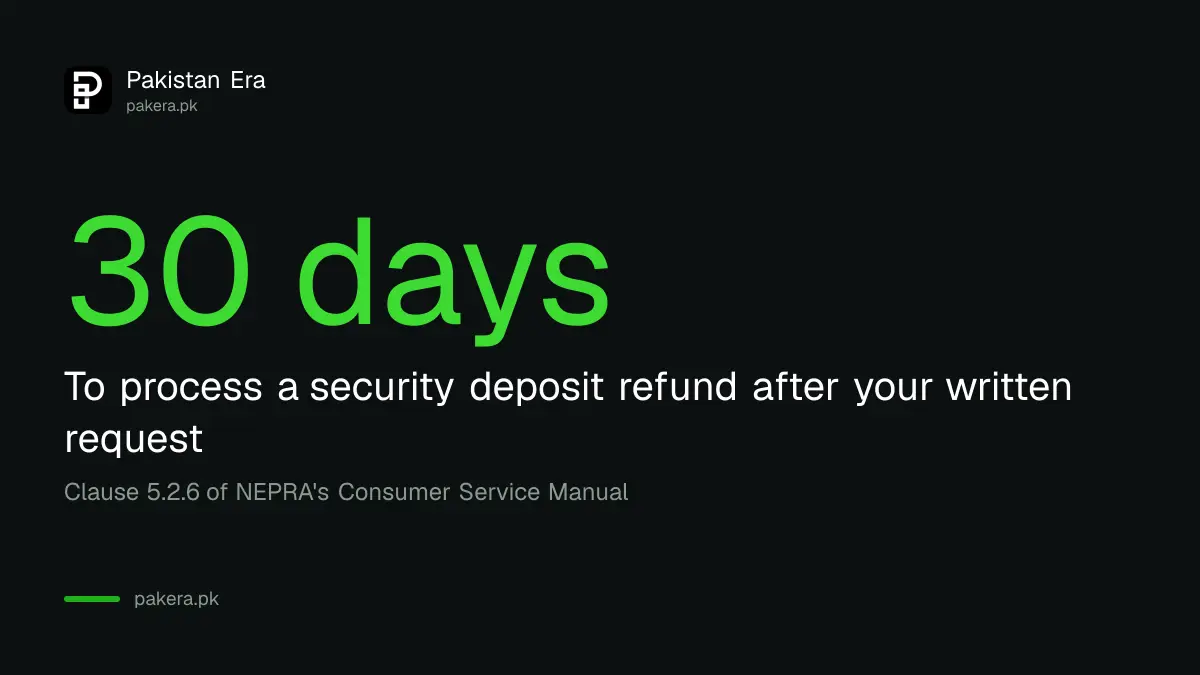
You get your electricity security deposit back only when the connection is permanently disconnected. Apply in writing to the officer who sanctioned the load, usually the SDO, pay the final bill, and then ask for the refund. NEPRA's rules say the refund must be processed within 30 days of your request, as long as nothing is owed.
People usually remember the deposit when they sell a house, close a shop or leave a rented flat. The deposit was paid years ago, nobody kept the receipt, and the bill still carries the old owner's name. We read the NEPRA rule book that every distribution company follows, so the steps below are the official ones, not office habit.
The security deposit is refundable at permanent disconnection
A security deposit is the amount you paid when the meter was first installed. It protects the company if you leave without paying. It is not a fee, so it comes back to you when the connection ends for good.
The rule is clause 5.2.6 of NEPRA's Consumer Service Manual, revised and sent to all companies on 26 November 2025. It says the deposit "shall be refunded at the time of permanent disconnection" if the consumer applies for it, after approval from the load sanctioning officer, and if there are no outstanding dues. It also sets the time: "within thirty (30) days of receipt of such request."
That rule applies to every company that follows the manual, including LESCO, IESCO, FESCO, GEPCO, MEPCO, PESCO, HESCO, SEPCO, QESCO, TESCO, HAZECO and K-Electric.
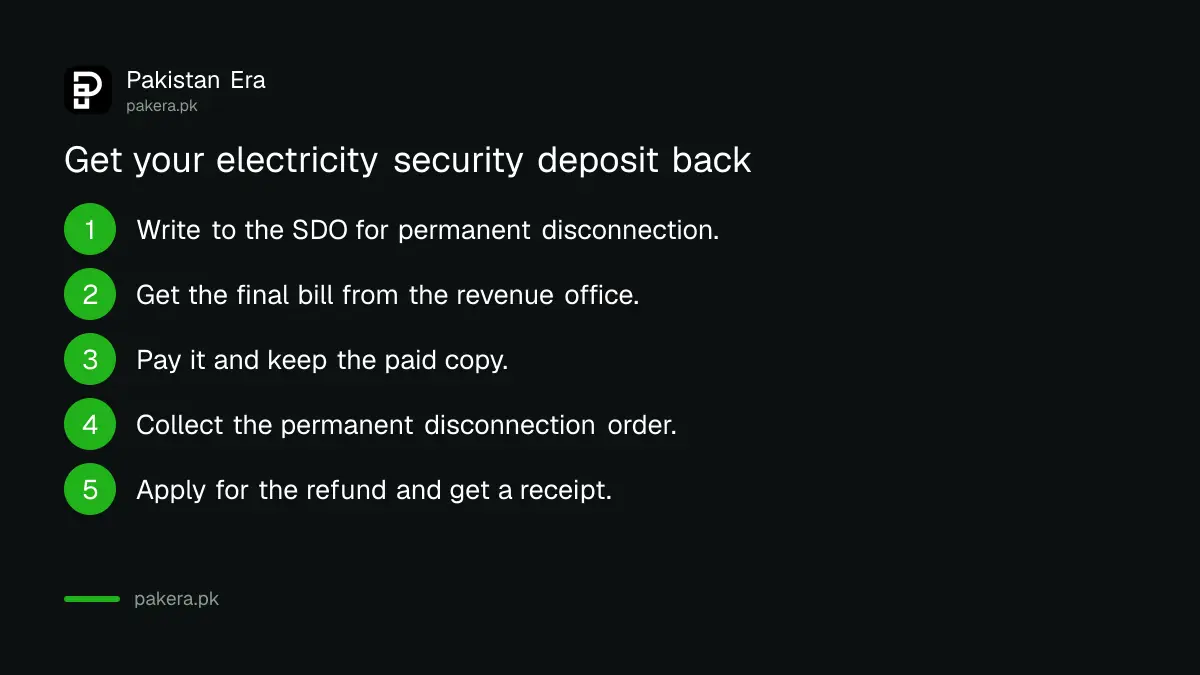
Apply for permanent disconnection and the refund in five steps
There is no online refund form. The ENC portal handles new connections and changes, not refunds, and the PITC complaint portal has no refund category. So this is a written application at your sub division office.
- Write to the load sanctioning officer. For a house, shop or general services connection up to 15 kW, that is the SDO. Above 15 kW it is the XEN. Ask for permanent disconnection of the connection with your reference number.
- Get the final bill. Under clause 8.4, the officer arranges your final bill from the revenue office. It covers use up to the disconnection.
- Pay the final bill in full. The refund is only allowed when there are no dues. Keep the paid copy.
- Collect the permanent disconnection order. After payment the officer issues it, and the meter is removed through an equipment removal order (ERO).
- Apply for the refund in writing. Attach the paid final bill, the disconnection order, your CNIC copy and any deposit receipt you have. Get a stamped receipt for this letter, because the 30 days run from it.
Ask the office to confirm the deposit amount on its records before you leave. You get back what was paid, which may be far less than today's rate if the meter is old.
Only the consumer on record gets the deposit
The manual refunds "the security deposit paid by the consumer". In practice, that means the person in whose name the connection stands. This is where most refunds get stuck.
| Your situation | What to do first |
|---|---|
| Bill in your own name | Apply directly, as above |
| Bill in a seller's or landlord's name | The named person applies, or the name is changed first |
| Bill in a dead relative's name | Heirs need legal proof, such as a succession certificate |
| Bill with arrears | Pay or settle them; no refund while dues remain |
| You only want less load | Apply for reduction of load instead |
A change of name does not hand the old deposit to the new person for free. Clause 5.2.1 says that on a change of name, the deposit is updated at current rates, with the old payment adjusted. The paperwork for that is covered in our page on changing the name on an electricity bill. For a deceased owner, the route runs through a succession certificate.
Temporary disconnection does not return the deposit
If you are leaving for a few months, you may not want a permanent disconnection at all. The manual offers a temporary one, and it works differently.
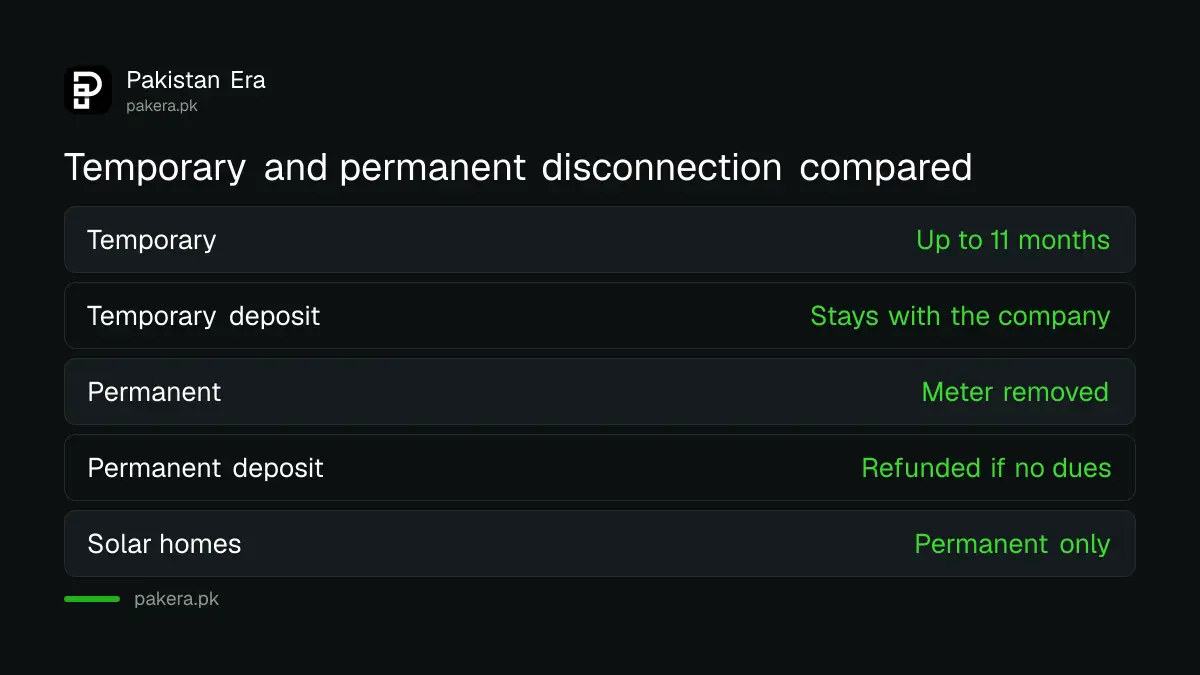
- It lasts up to 11 months. You must pay the final bill up to the day before the request, with no arrears.
- You skip the minimum or fixed charges for the period the supply is off.
- The company must disconnect within 4 working days of your written request, and reconnect within 4 working days after formalities.
- No reconnection fee if you apply within 7 days after the period ends.
- Homes with solar or another second source cannot use it. Clause 8.3.6 says so directly.
The deposit stays with the company during a temporary disconnection. Clause 5.2.6 ties the refund only to a permanent one.
The deposit earns no interest for you
Clause 5.4 tells each company to keep deposits in a separate bank account and not to use the money. Any profit on that account is to be shown in the company's tariff petition, so it is passed to all consumers through the tariff. The manual does not provide for interest paid to you.
For scale, the current rates in Annexure IV are Rs 1,220 a kW for an urban home and Rs 610 a kW for a rural one. A 5 kW city house paying today would deposit Rs 6,100. Older connections often paid much less. You can also get part of the deposit back without disconnecting: under clause 5.2.4, reducing your sanctioned load recalculates the deposit, and the difference is refunded.
If the refund does not arrive in 30 days
Write to the SDO again, quoting the date on your stamped receipt and clause 5.2.6 of the Consumer Service Manual. If that fails, take it to the XEN. If it is still not paid, file with NEPRA's online complaint system, which the steps in our page on complaining to NEPRA walk through. Keep copies of every letter.
One caution. Once a connection is permanently cut, getting it back costs money. Reconnection is allowed for up to 10 years, but fixed charges and a reconnection fee may apply, and after more than 365 days off, the deposit is charged again at current rates. So do not close a connection just to collect a small deposit if you may need it again.
Common questions
When do I get my electricity security deposit back?
When the connection is permanently disconnected and no dues remain. NEPRA's manual says the refund is processed within 30 days of your request.
Can I apply for the deposit refund online?
We found no online route. The ENC portal and the PITC complaint portal have no refund option, so apply in writing at your sub division.
Who signs the refund application?
The consumer named on the bill. If the bill is in someone else's name, that person applies, or the name is changed first.
Do I get interest on my security deposit?
No. The manual sends any profit on the deposit account into the tariff for all consumers, not to individual accounts.
Is the deposit refunded on temporary disconnection?
No. Temporary disconnection lasts up to 11 months and the deposit stays with the company. The refund is tied to permanent disconnection.
Can I get part of my deposit back without disconnecting?
Yes. If you reduce your sanctioned load, the deposit is recalculated and the difference is refunded under clause 5.2.4.
How we verified this
What we checked, where we read it, and what we could not confirm.
Last checked on 1 October 2026. We read NEPRA's revised Consumer Service Manual, sent to companies on 26 November 2025: clauses 2.10.1, 5.2, 5.4, 8.3, 8.4 and 8.5, and Annexure IV. We checked the ENC portal and the list of complaint types on the PITC complaint portal for a refund option and found none. We did not apply for a refund ourselves, so we cannot say how long offices take in practice.
About the author

Tax, Bills and Technology Writer
Ali Akhtar is a young and curious voice here at Pakistan Era. He is currently pursuing his A-Levels and has a growing interest in Pakistan’s changing industrial landscape and educational trends. Ali likes to write in a way that helps him explain and explore the world around him. His writing reflects the perspective of the new generation navigating the evolving trends of Pakistan where technology, youth innovation, and shifting opportunities are reshaping the country’s future.