Hotel Bed Tax in Islamabad and Khyber Pakhtunkhwa: 5 Per Cent and 10 Per Cent of Room Rent, Who Pays
Hotel bed tax in Islamabad is 5 per cent of each room's rent; KP charges 10 per cent per bed per day, hill stations May to August only. Rules and papers.
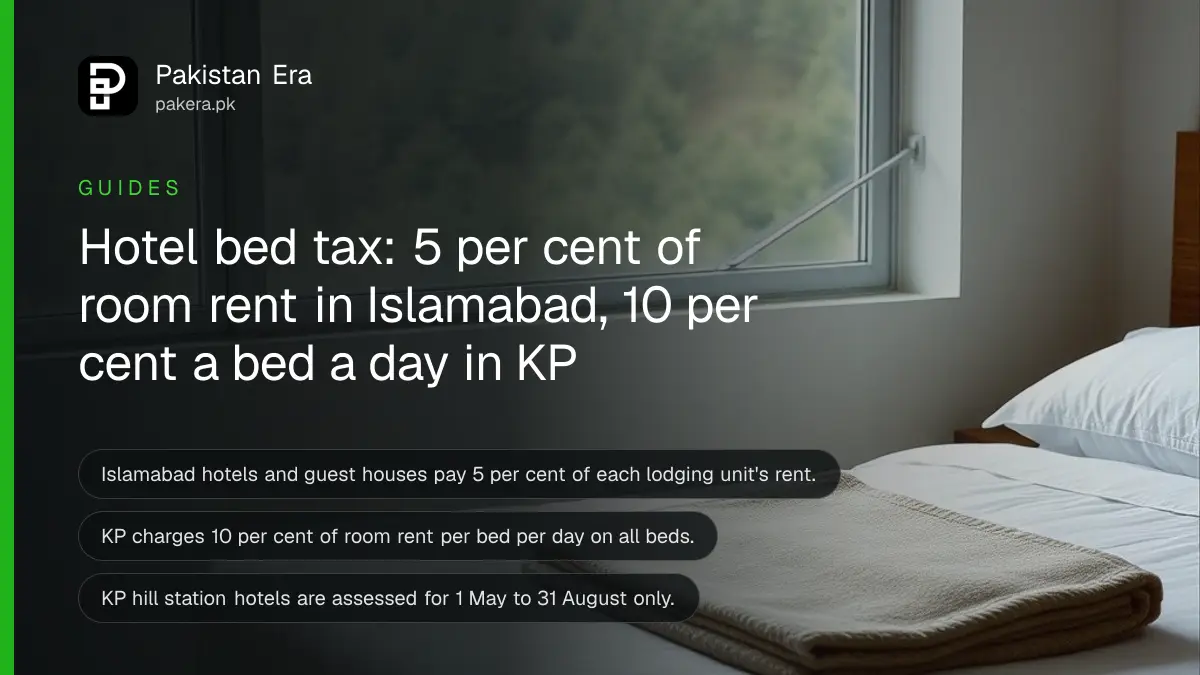
Short answer: hotels and guest houses in Islamabad pay a bed tax of 5 per cent of the rent of each lodging unit to the Islamabad Excise department. In Khyber Pakhtunkhwa, the hotel tax is 10 per cent of the room rent per bed per day, worked out on all the beds in the hotel. KP hotels at hill stations are assessed for 4 months only, 1 May to 31 August. We read both rules on the two Excise departments' websites on 9 November 2026.
Anyone who runs a hotel, motel or guest house in Islamabad or in KP towns such as Peshawar, Abbottabad, Naran or Swat pays this tax on top of income tax. It is easy to miss, because it is collected by the provincial or capital Excise office, not by FBR. This guide sets out the hotel bed tax in Islamabad and KP, who pays, what counts as a room, and the papers each office asks for.
Hotel bed tax in Islamabad and KP at a glance
Islamabad charges 5 per cent of the rent of each lodging unit. KP charges 10 per cent of the room rent per bed per day, on 100 per cent of the beds, with a 4 month season for hill stations. The two rules come from different laws and are worked out differently.
| Point | Islamabad | Khyber Pakhtunkhwa |
|---|---|---|
| Collected by | Islamabad Excise and Taxation Department | KP Excise, Taxation and Narcotics Control Department |
| Name | Bed tax | Tax on hotels |
| Rate | 5 per cent of the rent of each lodging unit | 10 per cent of room rent per bed per day |
| Basis | Each night of accommodation | 100 per cent of the lodging units in the hotel |
| Hill stations | Not mentioned | Assessed for 1 May to 31 August only |
| Law named | West Pakistan Finance Act 1965, section 12 | KP Finance Ordinance 2002, amended up to 2019 |
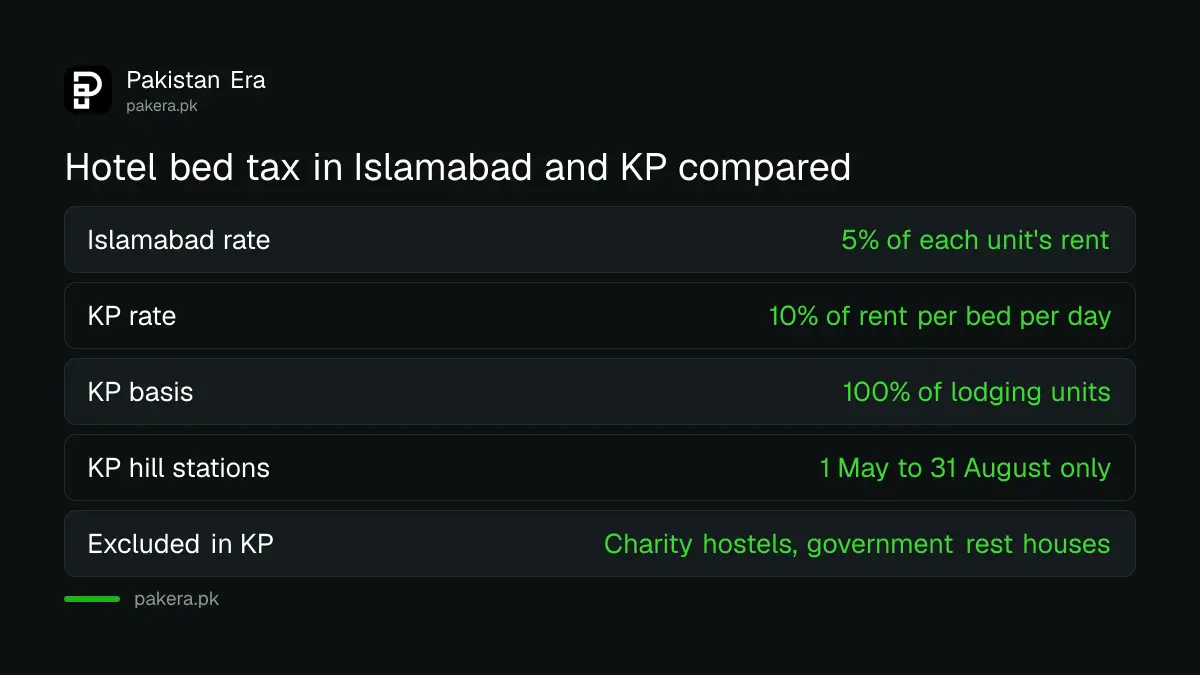
Islamabad bed tax: 5 per cent of each lodging unit's rent
The Islamabad Excise website says bed tax applies to hotels, guest houses and motels within the capital territory, for each night of accommodation. The tax is 5 per cent of the rent of each lodging unit, deposited in a government account.
The website names the law as the West Pakistan Finance Act 1965, section 12. It says the tax is to be deposited at the State Bank of Pakistan, Islamabad, or the National Bank of Pakistan's Excise and Taxation branch in Islamabad, in account number B-03056.
Take a guest house that charges Rs 8,000 a night for a room. The bed tax on that night is Rs 400. Over a month with that room let for 20 nights, the tax is Rs 8,000.
To register for bed tax, the Islamabad Excise website lists these papers:
- An application to the Excise and Taxation Officer (ETO) on your letterhead.
- A copy of the CNIC of the taxpayer or the authorised person.
- Details of your lodging units on the prescribed form.
- A registration certificate from the tourism department.
- Proof of a liquor sales licence, if you hold one.
- The deposited fee challan.
The Islamabad Excise office is in Sector H-9, open 8 am to 4 pm, Monday to Friday. The helpline is 051-111-383-383. Our page on Islamabad Excise office timings has the counter details. A hotel that also hosts ticketed shows owes a separate duty, covered in our guide to Islamabad entertainment duty.
KP hotel tax: 10 per cent of room rent per bed per day
The KP Excise website says hotel tax is charged at 10 per cent of the room rent per bed per day, on the basis of 100 per cent of the hotel's lodging units. The main recovery areas it names are Peshawar, Abbottabad and Mansehra.
The basis changed over time. The KP Finance Ordinance 2002 first set the tax on 50 per cent of the lodging units. The website says a 2019 amendment moved it to 100 per cent of the units. So the tax is now worked out as if every bed were let, every day.
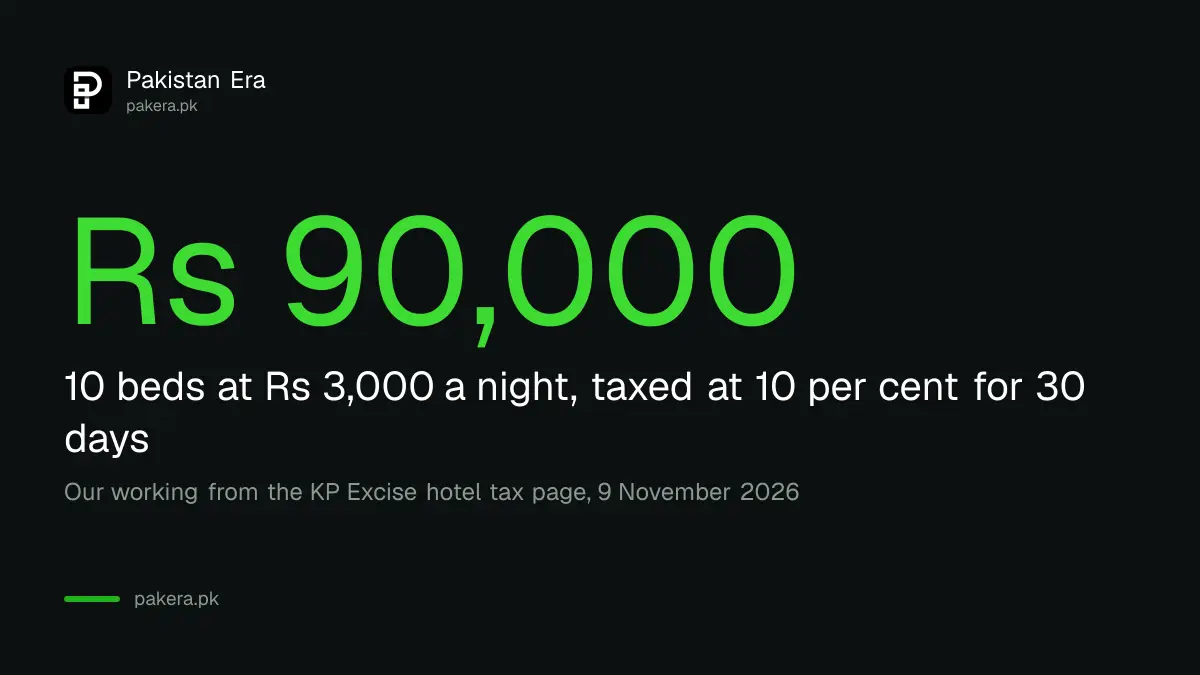
Here is how that works for a small hotel with 10 beds at Rs 3,000 each a night, using the rule as the website states it:
- Tax per bed per day: 10 per cent of Rs 3,000 = Rs 300
- Tax for 10 beds per day: Rs 3,000
- Tax for a 30 day month: Rs 90,000
That is a large bill, so check the assessment the ETO gives you line by line. The district office numbers are on the KP Excise district directory.
KP hill station hotels pay for 4 months a year
KP gives hotels at hill stations a shorter tax year. The KP Excise website says they are assessed for 4 months only, from 1 May to 31 August. The older 2002 rule gave them 6 months, from April to September.
The page does not list which towns count as hill stations. Summer resorts such as Naran, Kalam and Nathia Gali are the obvious candidates, but ask the district ETO whether your hotel qualifies. A hotel that does is taxed on the four summer months only. Before a trip, our guide to KP road status for Naran, Swat and Chitral helps with access.
The website also mentions an old exemption for Kaghan Valley hotels from July 2010 to June 2012. That period is over and no longer applies.
What counts as a hotel and as room rent
KP's law defines a hotel as any place giving lodging, with or without meals, for money. Room rent includes fans, air conditioning, light, heating, phone and bedding, but not the food part of the bill. Old people's homes, charity hostels and government rest houses are left out.
The KP definitions, as the website prints them:
- Hotel: a place where lodging with board or other service is given for money. It does not include homes or hostels run only for the aged, the sick or students by a charity, medical or education body.
- Excluded too: rest houses and messes of the federal or provincial government used by officials or the armed forces.
- Lodging unit: a bed or other sleeping place for one person staying overnight.
- Room rent: includes fans, air conditioning, light, heat, telephone, bedding and every other payment linked to the room, except the part for food.
The Islamabad website does not print its own definitions. KP's property and commercial building taxes are separate again, as our guide to KP property tax for shops and commercial buildings explains.
Common questions
What is the bed tax rate for hotels in Islamabad?
5 per cent of the rent of each lodging unit, according to the Islamabad Excise website. It applies to hotels, guest houses and motels in the capital territory.
What is the hotel tax rate in Khyber Pakhtunkhwa?
10 per cent of the room rent per bed per day, worked out on 100 per cent of the lodging units, according to the KP Excise website.
Do hill station hotels in KP pay hotel tax all year?
No. The KP Excise website says hotels at hill stations are assessed for 4 months only, from 1 May to 31 August.
Where is Islamabad bed tax deposited?
At the State Bank of Pakistan, Islamabad, or the National Bank of Pakistan's Excise and Taxation branch in Islamabad, in account B-03056, as the Excise website states.
Does food count in the room rent for KP hotel tax?
No. KP's definition of room rent covers fans, air conditioning, light, heat, phone and bedding, but leaves out the part of the bill for food.
Do guest houses pay bed tax in Islamabad?
Yes. The Islamabad Excise website names hotels, guest houses and motels, for each night of accommodation provided.
How we verified this
What we checked, where we read it, and what we could not confirm.
Last checked on 9 November 2026. The Islamabad rate, law, deposit account and documents are from the Bed Tax section of the Islamabad Excise and Taxation Department website. The KP rate, basis, hill station months, recovery areas and definitions are from the KP Excise hotel tax page. The worked examples are our own arithmetic. We did not file a return or call either office.
About the author

Tax, Bills and Technology Writer
Ali Akhtar is a young and curious voice here at Pakistan Era. He is currently pursuing his A-Levels and has a growing interest in Pakistan’s changing industrial landscape and educational trends. Ali likes to write in a way that helps him explain and explore the world around him. His writing reflects the perspective of the new generation navigating the evolving trends of Pakistan where technology, youth innovation, and shifting opportunities are reshaping the country’s future.