LHC: Magistrate Cannot Send a Girl to Dar-ul-Aman on a Section 164 Statement in Punjab
The Lahore High Court set aside Dar-ul-Aman orders for two girls on 27 November 2026 and explained the Punjab Child Marriage Act 2026. What it means for you.
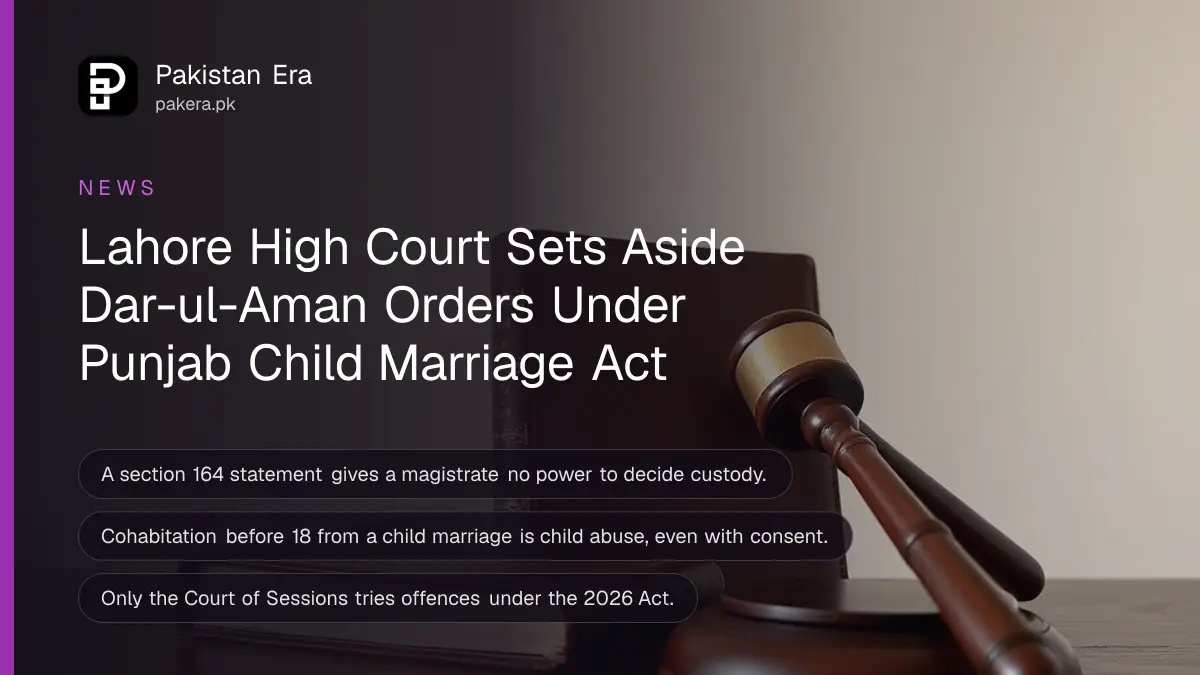
Short answer: A Judicial Magistrate who records a girl's statement under section 164 of the Code of Criminal Procedure cannot, on that basis alone, order her to live in Dar-ul-Aman. The Lahore High Court, Multan Bench, held this in an order released on 27 November 2026. It also said that under Punjab's Child Marriage Restraint Act 2026, a girl under 18 cannot live with the man she married, even with her consent.
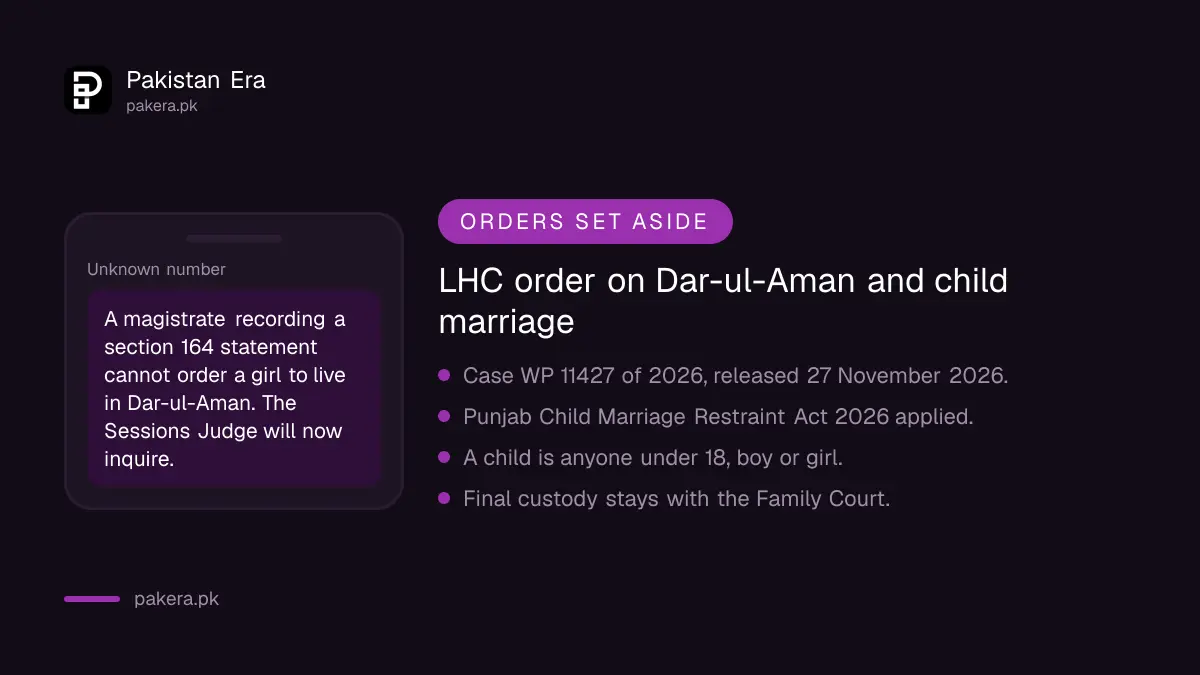
The order came in three linked writ petitions, led by Writ Petition No. 11427 of 2026, decided by Justice Tariq Saleem Sheikh and approved for reporting as 2026 LHC 9173. Two girls from Multan and Muzaffargarh districts had been sent to Dar-ul-Aman, Multan, after they told a magistrate they had married of their own free will.
The Lahore High Court set aside the Dar-ul-Aman orders
The High Court set aside the magistrate's orders that sent two girls to Dar-ul-Aman, because recording a statement under section 164 gives a magistrate no power to decide custody. The girls stay in Dar-ul-Aman only for a short interim period while the Sessions Judge, Multan, inquires into their safety.
In each case a parent had registered an FIR under section 365-B of the Pakistan Penal Code, which covers abduction of a woman to compel marriage. Each girl then came before a magistrate and said she had married by choice. The parents produced NADRA Form-B records showing the girls were under 18. The magistrate relied on those records and ordered them to Dar-ul-Aman "till she attains lawful age".
| Point | Detail |
|---|---|
| Case | Writ Petitions 11427, 11728 and 11013 of 2026, 2026 LHC 9173 |
| Court | Lahore High Court, Multan Bench |
| Judge | Justice Tariq Saleem Sheikh |
| Hearing | 22 October 2026 |
| Released | 27 November 2026, approved for reporting |
| Law applied | Punjab Child Marriage Restraint Act 2026, in force from 11 May 2026 |
A section 164 statement does not give a magistrate custody powers
Section 164 lets a magistrate record a confession or statement during an investigation. The court said neither that section nor the idea of the state acting as a child's protector gives the magistrate power to order compulsory residence anywhere. Placing someone in Dar-ul-Aman against her will needs a specific legal power.
The court did not leave the child without protection. It said that where the facts show an offence under the 2026 Act, the investigating officer should follow the procedure in that Act. If the child needs immediate protection, the officer should go to the court or authority that the law makes competent for it. The Act also lets a Child Protection Officer take a child into custody and produce her before the competent court within 24 hours.
The court also rejected an argument that a magistrate could send such cases on to the Sessions Court. Section 8 of the 2026 Act says only the Court of Sessions can take cognizance of, or try, an offence under the Act.
Under the 2026 Act, cohabitation under 18 is child abuse even with consent
The Punjab Child Marriage Restraint Act 2026 defines a child as anyone under 18, boy or girl. Section 5 says any form of cohabitation before 18 that results from a child marriage is child abuse, with or without consent. The court said this covers living together, not only sexual relations.
That is why the court refused to release the girls to the men who said they were their husbands, even under conditions and monitoring. Living with them would itself breach section 5. A psychologist from the Violence Against Women Centre, Multan, had suggested a conditional release. The court said no undertaking could permit what the law forbids.
The court also made a point many families get wrong. Section 5 does not say the marriage is void or voidable. The Act punishes the marriage and bans the cohabitation, but the validity of the nikah is a separate question for the proper court.
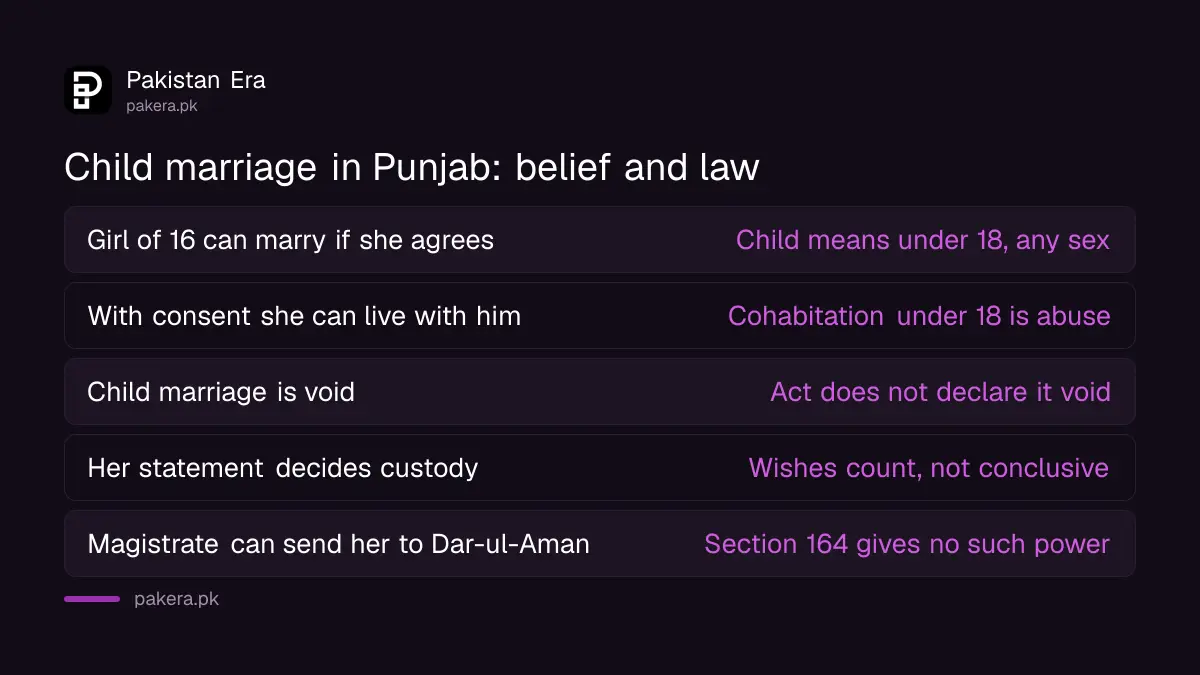
| What people believe | What the court said |
|---|---|
| A girl of 16 can marry in Punjab if she agrees. | Under the 2026 Act a child is anyone under 18, boy or girl. |
| If she consents, she can live with her husband. | Cohabitation before 18 is child abuse with or without consent. |
| A child marriage is automatically void. | Section 5 does not declare the marriage void or voidable. |
| Her statement decides where she lives. | Her wishes count but are not conclusive under section 13. |
| Any magistrate can send her to Dar-ul-Aman. | A section 164 statement gives no such power. |
The child's wishes matter but do not decide custody
Section 13 of the 2026 Act says that where a child was taken from lawful guardians for marriage, her statement or consent to go with the adult cannot decide custody or residence on its own. The court must make an independent, reasoned assessment of her safety, welfare and best interests.
The court applied this to both sides. The girls objected to staying in Dar-ul-Aman. One mother said her daughter had later asked to come home. The judge said the record did not allow a safe decision either way. So he ordered these steps:
- The girls are produced before the Sessions Judge, Multan, within two days of the order.
- The Sessions Judge hears each girl separately, and hears the families and the men claiming custody.
- He reports on each girl's age evidence, the risks of each custody claim and other safe places to live.
- Dar-ul-Aman ensures the girls' safety, healthcare and counselling, and supervised contact with family.
- The petitions return to the High Court ten days after the order.
Final custody and guardianship stay with the Family Court. The order says nothing on criminal liability or on whether the marriages are valid.
What families in Punjab should do now
If you fear a child marriage is being arranged, act before the nikah. The Court of Sessions can issue an injunction to stop it under section 9 of the Act. If the marriage has already happened, the case belongs in the Sessions Court, and custody belongs in the Family Court, not in a magistrate's order.
The steps to stop or report a child marriage in Punjab set out the injunction route, the 1121 helpline and who can be prosecuted. For a child who needs a safe home while the case runs, the Child Protection and Welfare Bureau in Punjab is the body the amicus in this case suggested over a long stay in Dar-ul-Aman.
Age disputes are common in these cases. One side often says the Form-B is false. The High Court said the official records had not been displaced so far, so families should keep the birth certificate, Form-B and school records ready for the Sessions Judge.
Common questions
Can a magistrate send a girl to Dar-ul-Aman after recording her statement?
No, not on the strength of a section 164 statement alone. The Lahore High Court said compulsory placement needs a specific legal power, which section 164 does not give.
What is the minimum marriage age in Punjab now?
18 for both boys and girls. The Punjab Child Marriage Restraint Act 2026 defines a child as anyone under 18 and came into force on 11 May 2026.
Is a child marriage void in Punjab?
The Act does not say so. The court noted that section 5 does not declare the marriage void or voidable, though it bans cohabitation before 18.
Can a married girl under 18 live with her husband if she agrees?
No. Section 5 makes any cohabitation before 18 that results from a child marriage child abuse, with or without consent.
Which court hears a case under the Punjab Child Marriage Restraint Act 2026?
The Court of Sessions. Section 8 says no other court can take cognizance of or try an offence under the Act.
Who decides permanent custody of the girl?
The Family Court, as the guardian court. The High Court's order does not affect its jurisdiction over guardianship and custody.
How we verified this
What we checked and where we read it.
We read the full order on 28 November 2026: Lahore High Court, Multan Bench, Writ Petition No. 11427 of 2026 and connected petitions (2026 LHC 9173), listed on the court's judgments approved for reporting page as uploaded on 27 November 2026. The PDF gives the hearing date of 22 October 2026 but no separate pronouncement date. The Act's sections are as quoted in the order; the Act itself is published on the Punjab Code. We have not named the girls or their families.
Free on WhatsApp
Get the next change first on WhatsApp
Price changes, new rules and deadlines that affect your money, in a few short posts a day.
Follow Pakera on WhatsAppOther followers cannot see your number.
About the author

Global Affairs & Political Economy Writer
Muhammad Hatim is a book lover who started writing because he enjoys it. At Pakistan Era he writes about international relations, geopolitics and the global economy, with a particular interest in South Asia and the forces behind current events.