UNHCR Assisted 484 Afghan Returns From Pakistan in the Week to 17 October 2026
UNHCR assisted 484 Afghan returnees from Pakistan between 11 and 17 October 2026, 86% of the week's total. 733,734 registered refugees remain in the country.
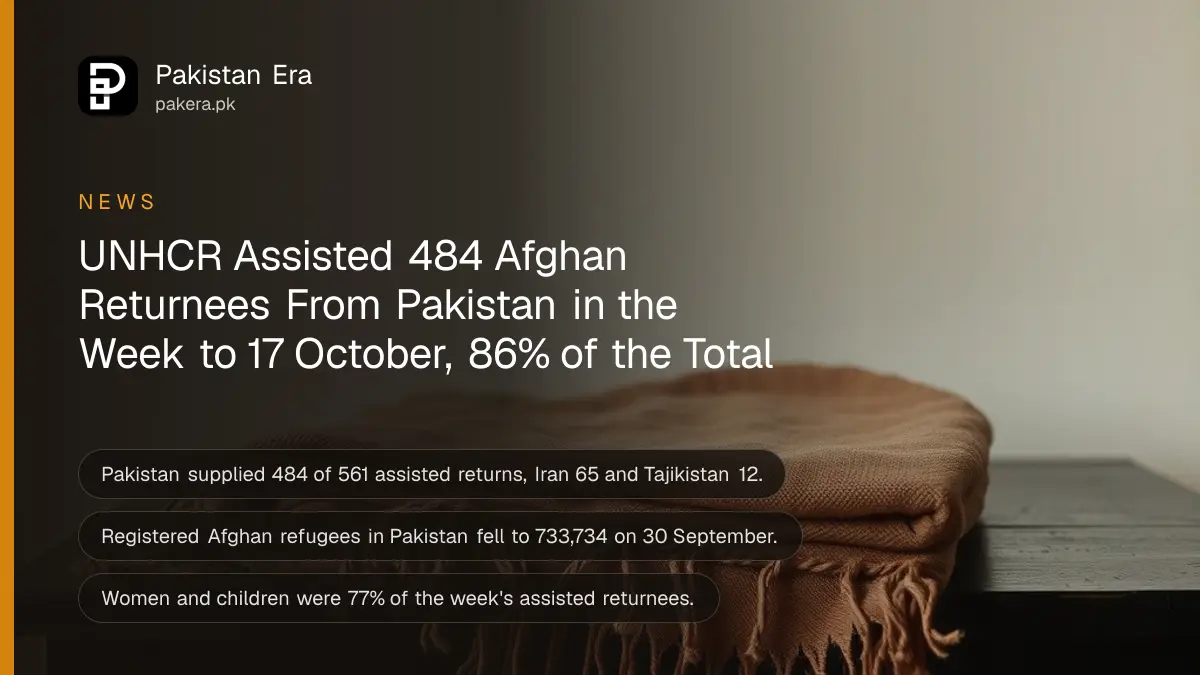
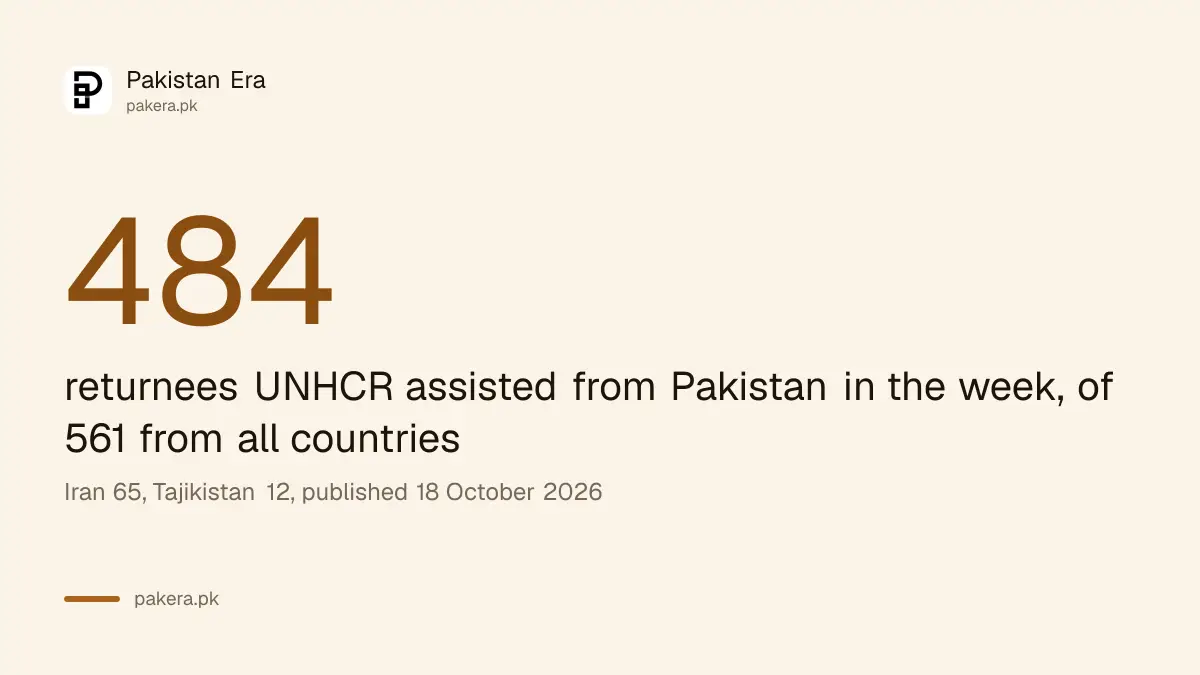
UNHCR assisted 484 Afghan returnees from Pakistan in the week of 11 to 17 October 2026, out of 561 it helped home from all countries, according to its weekly update published on 18 October. Pakistan supplied 86 per cent of the week's assisted returns, Iran 65 people and Tajikistan 12. Separately, UNHCR's Pakistan page now counts 733,734 registered Afghan refugees in the country as of 30 September, down from 735,891 a month earlier.
We read the weekly sheet, "Assisted Afghan Returnees from Pakistan, Iran and other countries, 11 October to 17 October 2026", on 19 October 2026, and the UNHCR Pakistan data page the same day. These are UNHCR's own figures for people it assisted with cash, transport, relief items or meals. They are not a count of everyone who crossed the border.
Pakistan accounted for 484 of 561 assisted returns in the week
The sheet's headline says 600 assisted returnees for the week, while its own table adds to 561, with 484 from Pakistan. We use the table, because it is the one broken down by country and document. The previous week's sheet, in our report on Afghan returns from Pakistan in 2026, showed 507 of 592 from Pakistan, so the Pakistan share is steady at between 85 and 86 per cent.
| Country of asylum | Assisted returnees, 11 to 17 October 2026 | Share |
|---|---|---|
| Pakistan | 484 | 86.3% |
| Iran | 65 | 11.6% |
| Tajikistan | 12 | 2.1% |
| Other countries | 0 | 0% |
| Total | 561 | 100% |
The shares are our arithmetic from the table. A few hundred assisted returns a week is a small number against the 715,400 total returns from Pakistan that UNHCR and IOM had counted for 2026 by 3 October. The weekly assisted count tracks only the people who came through UNHCR's own centres.
Undocumented Afghans were the largest group, PoR card holders the second
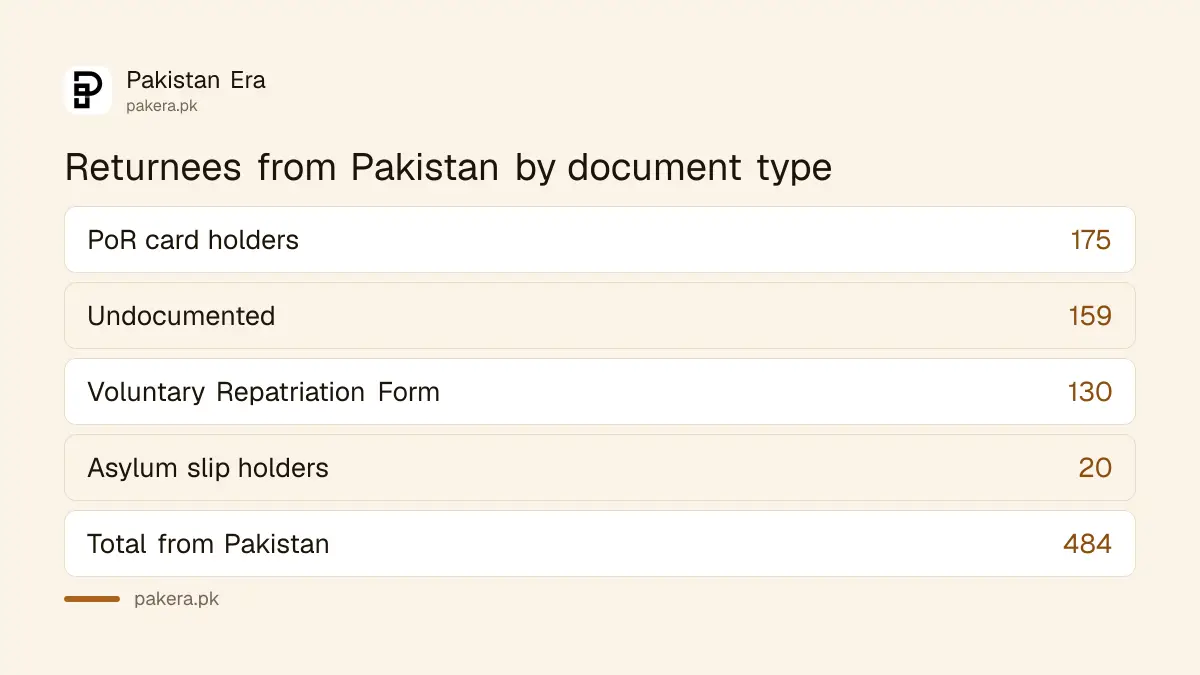
Of the 561 people assisted, 236 were undocumented, 175 held a Proof of Registration card, 130 held a Voluntary Repatriation Form and 20 were asylum slip holders. In the Pakistan column the sheet records 175 PoR card holders, 159 undocumented, 130 VRF holders and 20 slip holders, which adds to the 484.
| Document held | From Pakistan | All countries |
|---|---|---|
| Proof of Registration (PoR) card | 175 | 175 |
| Undocumented | 159 | 236 |
| Voluntary Repatriation Form (VRF) | 130 | 130 |
| Asylum slip holder | 20 | 20 |
| Total | 484 | 561 |
A PoR card is the NADRA-issued card that marks a registered Afghan refugee. A VRF is the form UNHCR issues to a registered refugee who chooses to go home with its help. The PoR card matters in daily life in Pakistan too, because it is one of the documents PTA accepts when an Afghan national wants to buy a SIM as an Afghan national.
Women and children were 77 per cent of the people assisted
The sheet says 54 per cent of the week's returnees were female, 51 per cent were under 18 and 35 per cent of households were headed by a woman. UNHCR sums it up as 77 per cent women and children. These are families moving, not single workers.
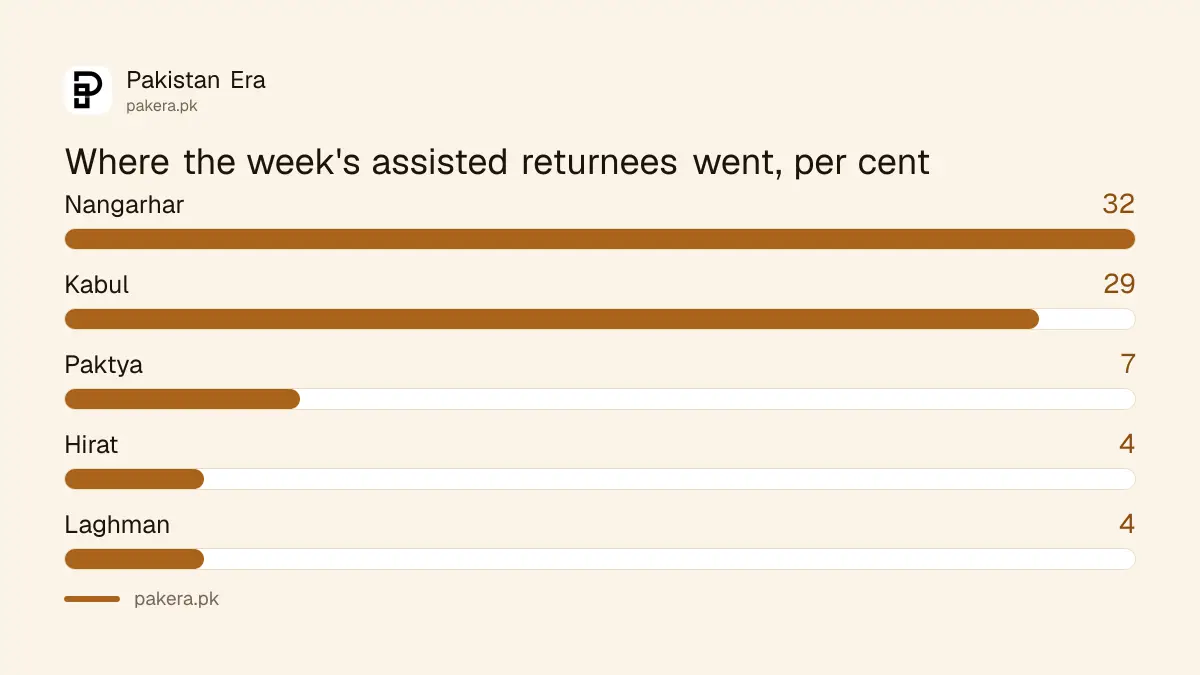
Where they were going is also recorded. Nangarhar, the province across from Torkham, took 32 per cent of the week's assisted returnees, Kabul 29 per cent, Paktya 7 per cent, and Hirat and Laghman 4 per cent each. Nangarhar and Kabul together take six in ten, which fits a flow that still runs mainly through the Khyber Pakhtunkhwa crossings even though Pakistan's land trade with Afghanistan has been shut for a year.
Registered Afghan refugees in Pakistan fell to 733,734 by 30 September
UNHCR's Pakistan page now gives 733,734 registered Afghan refugees as of 30 September 2026, against 735,891 as of 31 August. That is a fall of 2,157 in a month, our arithmetic. Khyber Pakhtunkhwa holds 374,922 of them, 51.1 per cent, Balochistan 206,914, Punjab 92,903, Sindh 37,549 and Islamabad 19,355.
The same page puts facilitated voluntary repatriation in 2026 at 128,862 as of 30 September, against 127,422 as of 31 August, so 1,440 registered refugees went home with UNHCR's help in September. UNHCR and IOM's wider count of total returns from Pakistan in 2026 stood at 715,400 on 3 October, with 68,800 of those recorded as deportations.
What the week's figures mean for Afghans in Pakistan and the families they leave
Assisted returns from Pakistan are running at about 500 a week in October. Since 1 January 2026 UNHCR has assisted 433,189 returnees from all countries, and 1,217,737 since 15 September 2023, when Pakistan announced its repatriation plan. The flow has slowed from its peaks, but it has not stopped, and most of it still comes from Pakistan.
If you are an Afghan national in Pakistan, or you employ or rent to one, the documents matter more than the headlines. UNHCR's sheet shows PoR holders, VRF holders and undocumented people all leaving through its centres in the same week. We could not read UNHCR's help page for Pakistan, which carries the current rules on card validity and the cash grant, because it blocked our request on 19 October.
How to read the weekly UNHCR returns sheet yourself
- Open UNHCR's Afghanistan situation page and find the documents list.
- Download the latest "Assisted Afghan Returnees" PDF. Each covers one week and carries its publication date on the page footer.
- Read the table "Return category by country of return", not the headline number, for the Pakistan figure.
- Compare the "Since 1 January" line across weeks to see the pace.
- For the number of registered refugees still in Pakistan, open the UNHCR Pakistan page and note its "as of" date.
Common questions
How many Afghans returned from Pakistan in the week to 17 October 2026?
UNHCR assisted 484 returnees from Pakistan, out of 561 from all countries, according to its sheet published on 18 October 2026. Total crossings were higher, because the sheet counts only people UNHCR helped.
How many registered Afghan refugees are in Pakistan now?
733,734 as of 30 September 2026, according to UNHCR's Pakistan page, down from 735,891 at the end of August.
What is the difference between assisted returns and total returns?
Assisted returns are people UNHCR helped with cash, transport, relief items or meals. Total returns, counted by UNHCR and IOM together, include everyone who crossed, and stood at 715,400 from Pakistan for 2026 on 3 October.
Which documents did the returnees hold?
From Pakistan, 175 held a PoR card, 159 were undocumented, 130 held a Voluntary Repatriation Form and 20 were asylum slip holders.
Where in Afghanistan are returnees going?
Nangarhar took 32 per cent and Kabul 29 per cent of the week's assisted returnees, followed by Paktya, Hirat and Laghman.
How we verified this
What we checked, where we read it, and what we could not confirm.
Last checked 19 October 2026. The weekly figures are from UNHCR's sheet "Assisted Afghan Returnees from Pakistan, Iran and other countries, 11 October to 17 October 2026", published 18 October 2026 and listed on the UNHCR Afghanistan situation page, which we downloaded and read on 19 October. The registered refugee and facilitated repatriation figures are from the UNHCR Pakistan page, read the same day. The 2026 total returns and deportation figures are from the situation page, last updated 3 October. The shares and the month-on-month changes are our arithmetic. We could not read UNHCR's Pakistan help page on card validity because it blocked our request, and the sheet's headline of 600 does not match its table total of 561, which we have used.
About the author

Global Affairs & Political Economy Writer
Muhammad Hatim is a book lover who started writing because he enjoys it. At Pakistan Era he writes about international relations, geopolitics and the global economy, with a particular interest in South Asia and the forces behind current events.