Afghan Returns From Pakistan Reach 715,400 in 2026, UNHCR and IOM Data Shows
UNHCR data shows 715,400 Afghans returned from Pakistan in 2026, 55% of all returns, with 68,800 deportations. See the numbers, the dates and how to check them.
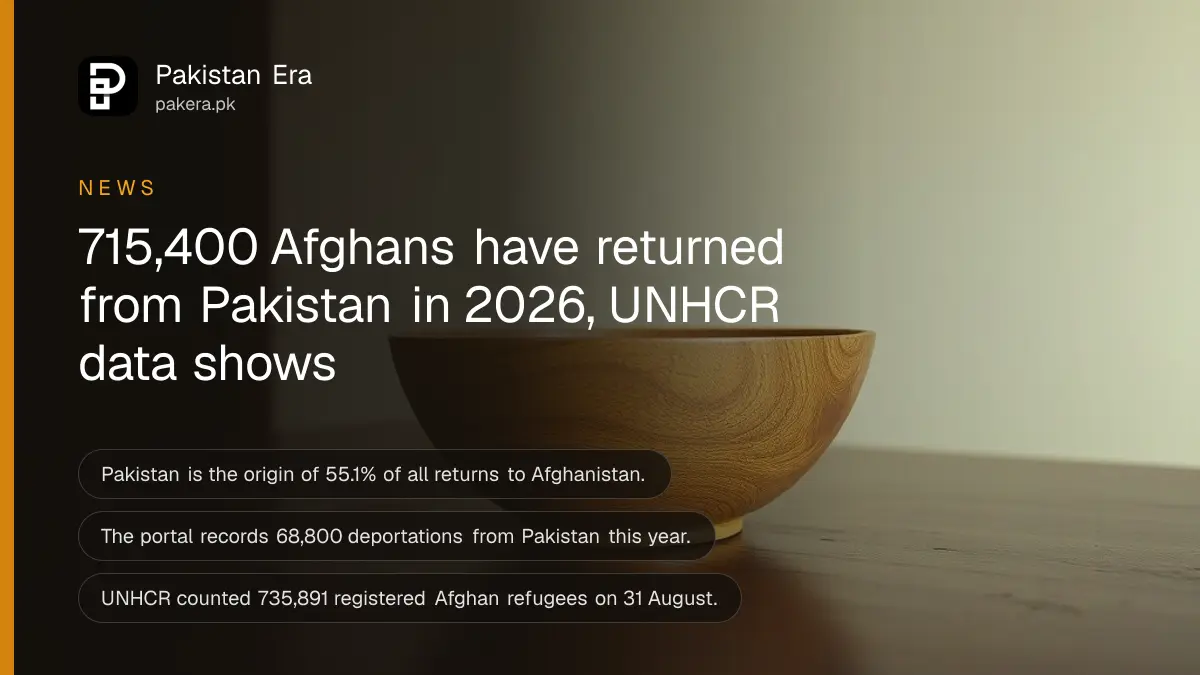
Short answer: UN refugee agency (UNHCR) and IOM data shows 715,400 Afghans returned to Afghanistan from Pakistan in 2026 up to 3 October. That is 55.1 per cent of all 1,298,370 returns to Afghanistan this year. Of the Pakistan total, 68,800 were deportations.
The number matters for Pakistan more than for any other country except Iran. It tells you how many people have left Pakistani cities, camps and workplaces in nine months. It also shows how much of that movement is forced.
We opened the UNHCR data portal pages for the Afghanistan situation and for Pakistan on 12 October 2026, and the weekly Afghan Returns update for 4 to 10 October, which UNHCR published on 11 October. The figures below come from those pages. Where we did the arithmetic, we say so.
Pakistan accounts for 715,400 of 1,298,370 returns to Afghanistan
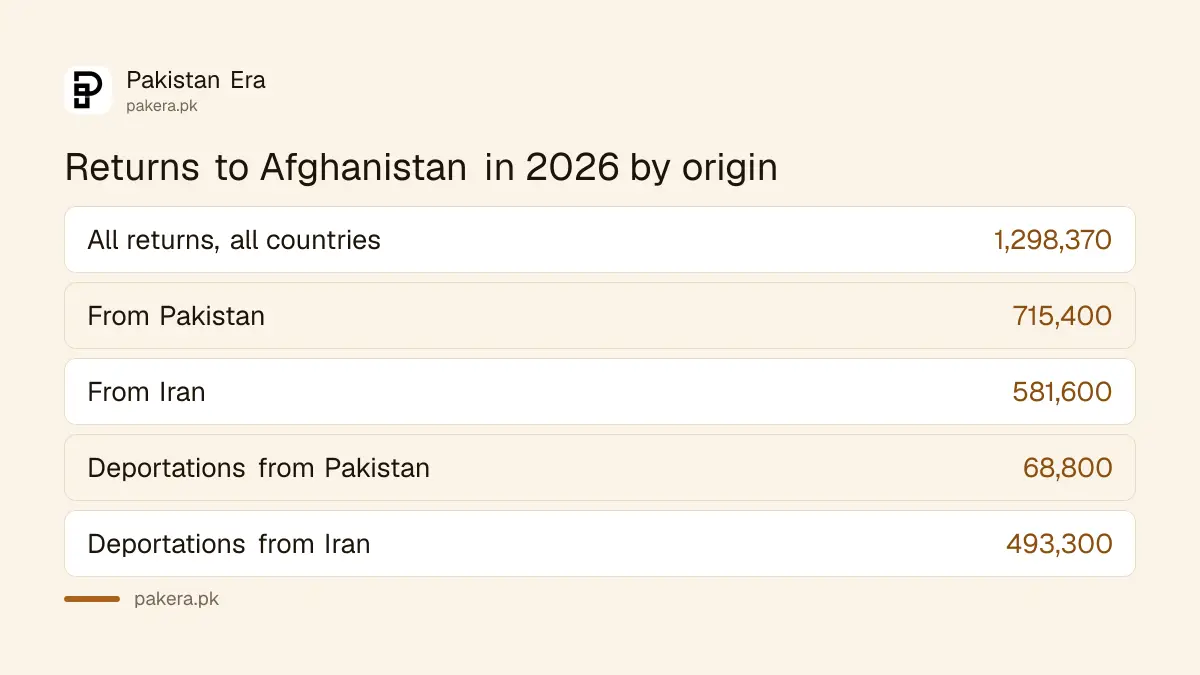
The portal lists 1,298,370 total returns to Afghanistan in 2026, last updated 3 October. Pakistan is the origin of 715,400 of them. Iran accounts for 581,600. A further 1,370 came from other countries.
The portal says "total returns" is an umbrella term. It includes deportations, assisted voluntary repatriation and other returns of Afghans of all statuses. That covers Proof of Registration (PoR) cardholders, other card holders and undocumented people. It leaves out people who travel on a passport and visa.
| Measure, 2026 up to 3 October | Pakistan | Iran |
|---|---|---|
| Total returns to Afghanistan | 715,400 (55.1%) | 581,600 (44.8%) |
| Deportations to Afghanistan | 68,800 (12.2%) | 493,300 (87.5%) |
Only 68,800 of the Pakistan returns are recorded as deportations
The portal records 563,460 deportations to Afghanistan in 2026. Pakistan's share is 68,800, or 12.2 per cent. Iran's is 493,300. Most people leaving Pakistan are therefore counted under other kinds of return, not deportation.
By our arithmetic, 715,400 minus 68,800 leaves about 646,600 returns from Pakistan that are not deportations. The portal does not break that block down further on the page we read. It could include assisted voluntary returns and people who left on their own. So we cannot say how many left freely and how many left under pressure.
That gap is worth saying plainly. A return that is not recorded as a deportation is not always a free choice. UNHCR's weekly update reports that 43 per cent of its assisted returnees that week were undocumented, 32 per cent held a PoR card, 18 per cent had a voluntary repatriation form and 7 per cent held an asylum slip.
735,891 registered Afghan refugees were still in Pakistan on 31 August
UNHCR's Pakistan page shows 735,891 registered Afghan refugees with valid PoR cards as of 31 August 2026. The cards are issued by NADRA. More than half, 376,600, live in Khyber Pakhtunkhwa. Balochistan has 207,176.
| Province or area | Registered Afghan refugees, 31 August 2026 |
|---|---|
| Khyber Pakhtunkhwa | 376,600 |
| Balochistan | 207,176 |
| Punjab | 93,031 |
| Sindh | 37,631 |
| Islamabad | 19,361 |
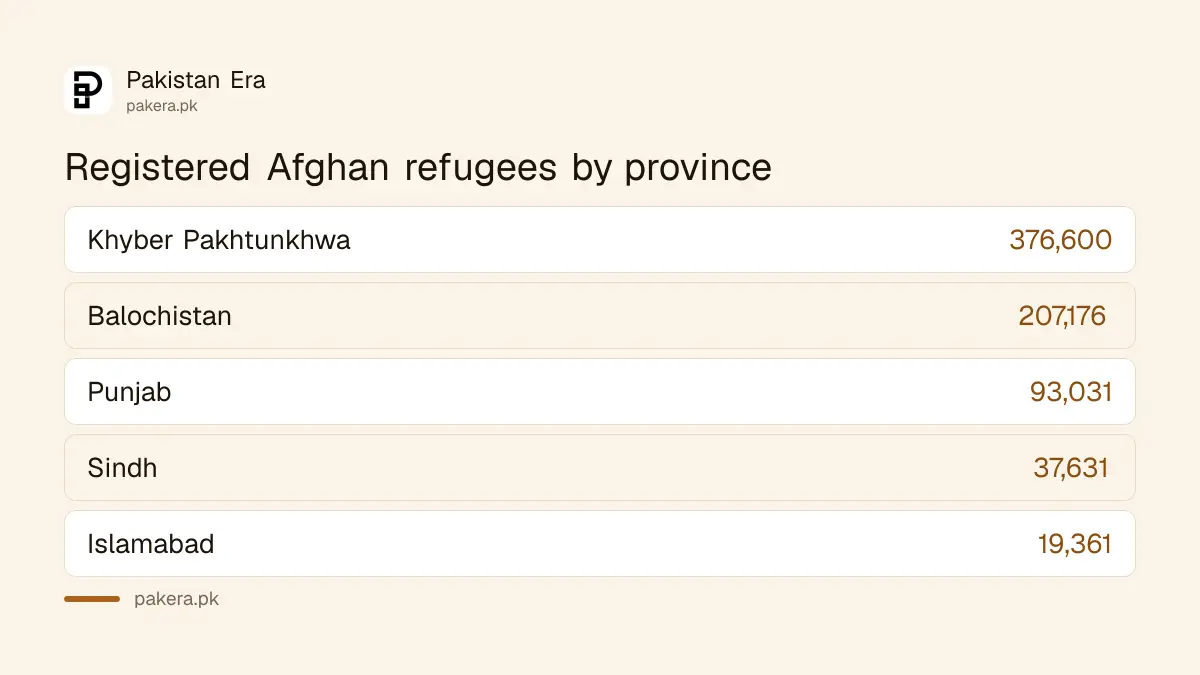
Note the dates. The returns figure runs to 3 October and the registered figure to 31 August. They are not a before and after pair, so do not subtract one from the other. The count of Afghans in Pakistan who are not registered is not on these pages.
The latest weekly update shows 507 of 592 assisted returnees came from Pakistan
UNHCR's weekly dashboard for 4 to 10 October 2026 reports about 600 assisted returnees. Its table gives 592, of whom 507 left Pakistan, 54 left Iran and 31 left Tajikistan. Since 1 January, UNHCR has assisted 432,106 returnees across all countries.
This is the assisted count, not the full count. It covers people who received cash help, transport, relief items or hot meals from UNHCR. It is much smaller than the 715,400 headline, which includes people UNHCR did not assist. Do not compare the two numbers as if they measured the same thing.
The weekly sheet also says 76 per cent of the assisted were women and children, and that half of returnees were under 18. About 31 per cent of returnee households were female-headed.
What the data means for Pakistan, and what it leaves out
The data confirms a very large movement across the Pakistan and Afghanistan border in one year. It does not explain the causes, and it does not measure what the move costs either country. Be careful with any claim that goes beyond the counts.
The same border is closed to regular trade, as we reported in our piece on the one-year closure of the Afghan crossings. Returns and trade are separate flows, and the pages we read do not say which crossings carried the returnees. Security tension also continues, as the October air strike reports and the Corps Commanders' Conference statement show.
The Pakistani government has its own count, and it may differ from UNHCR's. We have not read an official Pakistani figure for 2026 on a government page, so we do not state one here.
How to read the UNHCR returns pages yourself
You can check every number above in a few minutes. The portal is free and updates weekly. Look at the date next to each figure, because pages update at different times.
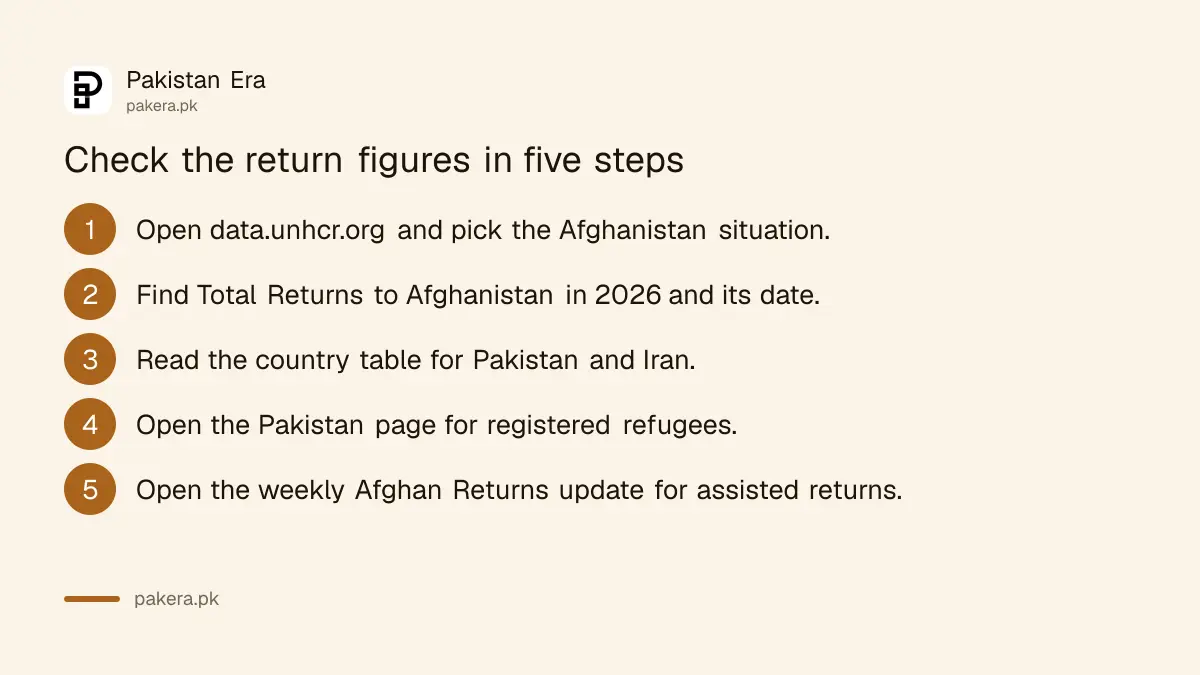
- Open data.unhcr.org and choose the Afghanistan situation page.
- Find "Total Returns to Afghanistan in 2026" and note its "last updated" date.
- Read the country table under it to see Pakistan and Iran separately.
- Open the Pakistan country page for registered refugees and provinces.
- Open the latest "Afghan Returns" weekly update for assisted returns only.
Common questions
How many Afghans have returned from Pakistan in 2026?
The UNHCR data portal shows 715,400 returns from Pakistan to Afghanistan in 2026, last updated 3 October. That includes deportations, assisted voluntary returns and other returns, and excludes people travelling on passports.
How many of those were deportations?
The same portal lists 68,800 deportations from Pakistan in 2026. That is 12.2 per cent of all deportations to Afghanistan this year. Iran accounts for 493,300.
How many registered Afghan refugees are left in Pakistan?
UNHCR reported 735,891 registered Afghan refugees in Pakistan on 31 August 2026. Registered means they hold a valid PoR card issued by NADRA.
Are the UNHCR and Pakistani government numbers the same?
We cannot say. We did not read an official Pakistani figure for 2026 on a government page. UNHCR numbers come from UNHCR and IOM and use their own definitions, so they may differ.
Why is the weekly figure so much smaller?
The weekly update counts only people UNHCR assisted, about 600 in the week of 4 to 10 October. The 715,400 figure is a year total that includes returns UNHCR did not assist.
How often does the data update?
The weekly Afghan Returns update covers Sunday to Saturday and was published on 11 October for the week ending 10 October. The headline totals carry their own dates, and the one we read was 3 October.
How we verified this
What we checked, where we read it, and what we could not confirm.
We read the UNHCR Afghanistan situation page, the UNHCR Pakistan country page and the weekly Afghan Returns update for 4 to 10 October 2026 on 12 October 2026. The portal can revise figures later. We did not verify any Pakistani government returns figure.
About the author

Global Affairs & Political Economy Writer
Muhammad Hatim is a book lover who started writing because he enjoys it. At Pakistan Era he writes about international relations, geopolitics and the global economy, with a particular interest in South Asia and the forces behind current events.