Pakistan Says Air Strikes on Terrorist Hideouts in Afghanistan Killed 22
Pakistan says its air strikes on terrorist hideouts in Afghanistan killed 22 by initial reports. What the official statement says and what is unconfirmed.
Pakistan says it carried out "well planned and calibrated" air strikes on terrorist hideouts at two locations in Afghanistan. Pakistan's Ministry of Information and Broadcasting said on Thursday 1 October 2026 that initial reports suggest 22 terrorists were killed and that no collateral damage occurred.
Update, 10 October 2026: The Foreign Office has explained why the Moscow talks on Afghanistan ended with no joint statement. Read the update.
Update, 1 October 2026: Afghan authorities say the strikes killed nine civilians in Kunar and Helmand, and Pakistan says only terrorist hideouts were hit. Read the update.
The ministry made the statement in a post on X. Radio Pakistan, the state broadcaster, carried its text the same day, and we read that report on 1 October. The statement did not name the two locations or say when the strikes took place.
Pakistan's information ministry announced the air strikes on 1 October
Pakistan's Ministry of Information and Broadcasting announced the air strikes in Afghanistan on Thursday 1 October 2026. It said the strikes hit camps and hideouts at two locations, based on "credible intelligence", and that initial reports suggest 22 terrorists were killed.
The ministry said the targets belonged to Fitna al Khawarij, Fitna al Hindustan and their affiliates. It said the targets were "destroyed with precision". It also said large quantities of weapons and ammunition stored at the hideouts were destroyed.
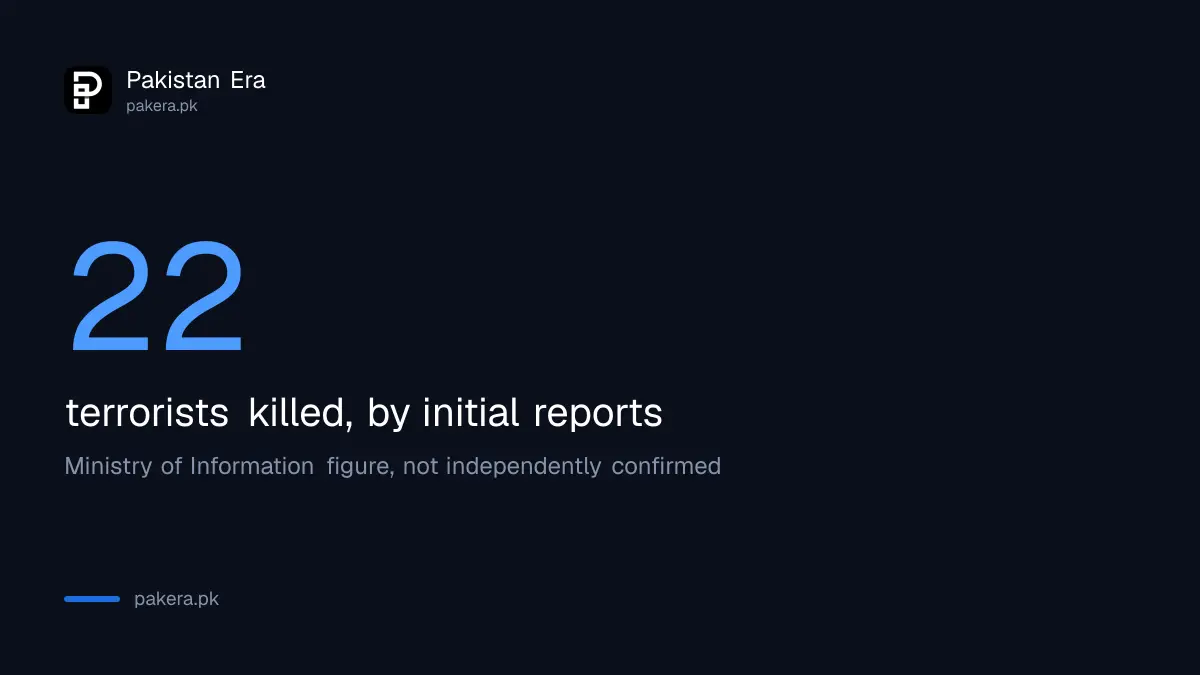
The death toll is the government's own early figure. The ministry itself called it an initial report. No independent body has confirmed it, and we could not check it.
The official statement made five main points
The Radio Pakistan report of the statement makes five main points. Pakistan says it struck two locations, killed 22 terrorists by initial reports, destroyed weapons, avoided collateral damage, and will keep up its counter terrorism campaign at home.
- The targets. Camps and hideouts at two locations in Afghanistan, which the ministry linked to Fitna al Khawarij, Fitna al Hindustan and their affiliates.
- The toll. "Initial reports suggest killing of twenty two terrorists," the ministry said.
- Weapons. Large stores of weapons and ammunition at the hideouts were destroyed, it said.
- Civilians. "Maximum precautions were taken" and no collateral damage occurred, according to the ministry.
- What comes next. The counter terrorism campaign Ghazab lil Haq, under the vision of Azm e Istehkam, "will continue at full pace", it said.
The ministry also gave Pakistan's reason. It said the safety and security of Pakistani citizens is the "foremost priority", and that the threat to Pakistan "emanates from Afghanistan". It said Pakistan has always worked for peace and stability in the region.
Fitna al Khawarij and Fitna al Hindustan are names the Pakistani government uses for armed groups it blames for attacks inside the country. The government uses the first for the banned Tehreek-e-Taliban Pakistan, known as the TTP. It uses the second for armed groups operating in Balochistan.
The statement did not name the places or the timing
The official statement leaves several things open. It does not name the two locations, give a date or time for the strikes, name the groups' leaders, or say which forces carried out the strikes. We found no separate press release on the strikes from the Foreign Office by 1 October afternoon.
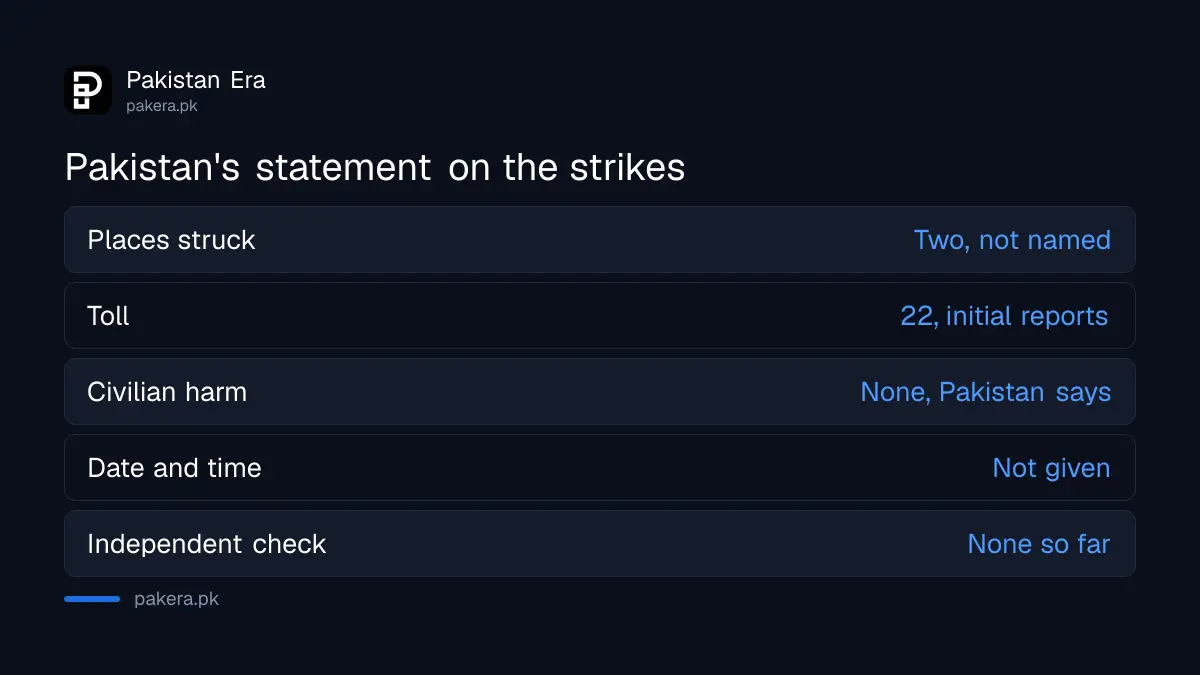
| Question | What the official statement says |
|---|---|
| Who announced it | Ministry of Information and Broadcasting, on X |
| How many places | Two locations in Afghanistan |
| Deaths | 22 terrorists, by initial reports |
| Civilian harm | Says no collateral damage occurred |
| Exact places | Not named |
| Date and time of strikes | Not given |
| Independent check | None so far |
The military's media wing, Inter-Services Public Relations (ISPR), usually reports on security operations. Its website blocked our automated request on 1 October, so we could not read whether it issued its own statement. We have not relied on any ISPR text here.
Reports say Afghan authorities have responded to the strikes. We could not read their statement at an official source, so we do not repeat its claims here.
The strikes follow a tense week between Pakistan and Afghanistan
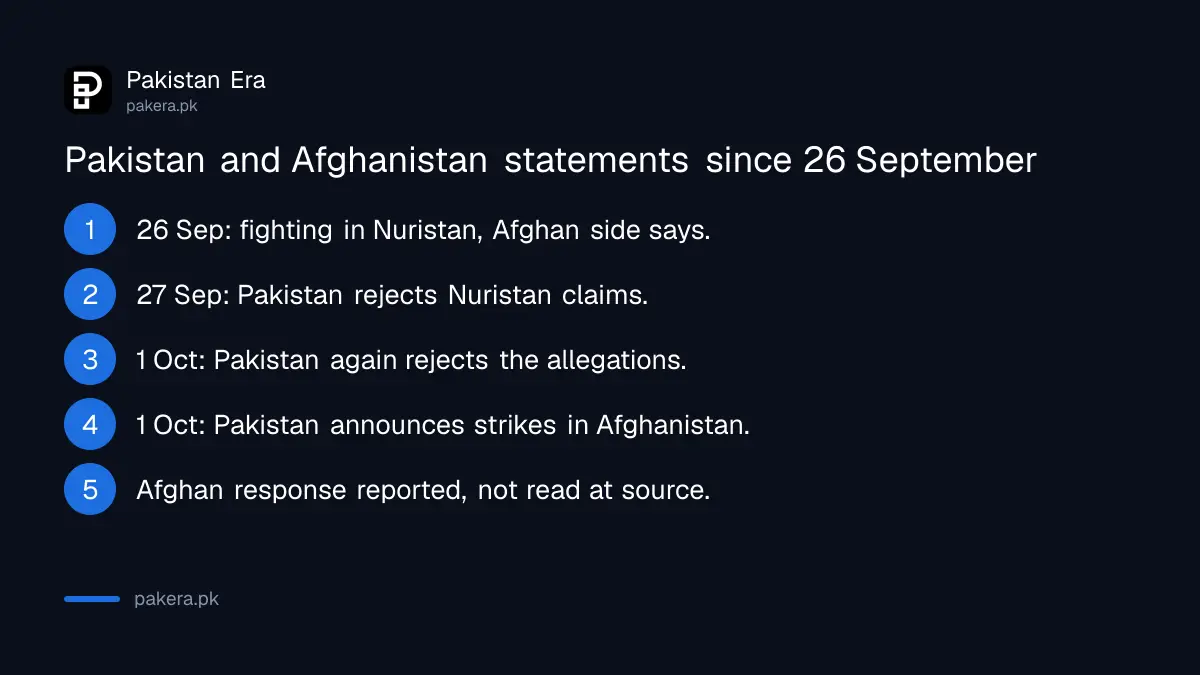
The strikes come days after a public dispute between the two governments. On 27 September, Pakistan's information ministry rejected Afghan claims that it sent armed groups into Nuristan province. On 1 October, the same ministry again rejected Afghan allegations about the Nuristan fighting.
In the Nuristan dispute, Afghanistan's defence ministry had said, as reported, that fighters crossed from Pakistan into Kamdesh district. Pakistan called that claim "frivolous, baseless and devoid of any truth" and said no evidence was produced.
Inside Pakistan, the past week has also been hard. A suicide blast in the Dera Ismail Khan checkpost attack on 26 September killed 11 people. Security forces have also reported dozens of militants killed in operations in Balochistan since 21 September.
Travellers should follow official notices only
We found no official notice on 1 October about the Torkham or Chaman border crossings linked to the strikes. People travelling near the border, or across it, should rely on government announcements and not on forwarded messages or unverified videos.
Rules near the border can change within hours. If you live in or plan to travel through the border districts:
- Check the Ministry of Interior and the Foreign Office for any announcement.
- Check with the district administration in Khyber, Chaman or your own district.
- Do not share unverified videos or casualty claims.
- Carry all your normal travel documents, and none that have expired.
- Check again on the day you travel.
Common questions
Did Pakistan carry out air strikes in Afghanistan?
Yes, according to Pakistan's Ministry of Information and Broadcasting. On 1 October 2026 it said Pakistan struck terrorist hideouts at two locations in Afghanistan.
How many people were killed?
The ministry said initial reports suggest 22 terrorists were killed. This is the government's early figure. It has not been independently confirmed.
Which groups did Pakistan target?
The ministry named Fitna al Khawarij, Fitna al Hindustan and their affiliates. These are the government's names for the banned TTP and for armed groups active in Balochistan.
Were civilians harmed?
Pakistan says maximum precautions were taken and no collateral damage occurred. Reports say Afghan authorities have responded, but we could not read their statement at source.
Where exactly were the strikes?
The official statement does not name the two locations. We have not named any place because no Pakistani official source we read gave one.
How we verified this
What we checked, where we read it, and what we could not confirm.
Last checked on 1 October 2026 at about 14:00 PKT. Every Pakistani government statement here, including the 22 figure, the two locations, the weapons, the collateral damage line and the Ghazab lil Haq campaign, is from the Ministry of Information and Broadcasting statement as carried by Radio Pakistan. The Foreign Office press releases list showed no statement on the strikes when we checked. The ISPR website blocked our request. The Afghan response is as reported, because we could not read it at an official source.
About the author

Senior Writer, Public Services and Technology
Shahid joined us in 2024 as an author. He is a senior contributor to Pakistan's leading technology websites. He writes detailed articles, mostly covering his expertise in the latest tech, mobiles, apps, gadgets, and step-by-step guides. His ideology is to help people understand the latest trends and explain complex methods through very easy-to-understand guides.