A Licensed Broker Ran a Ponzi Scheme. Check the Return, Not the Licence.
SECP has referred Blink Capital to the FIA over Rs 446.6 million. It held a PMEX licence, so the usual advice would have passed it.
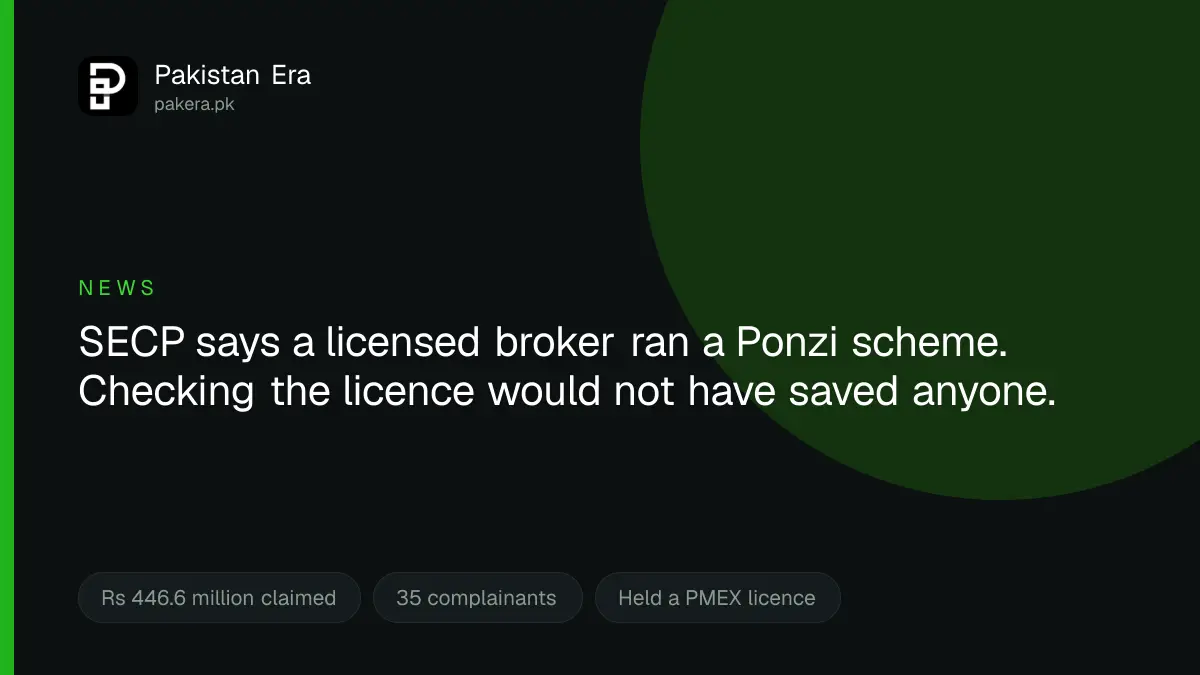
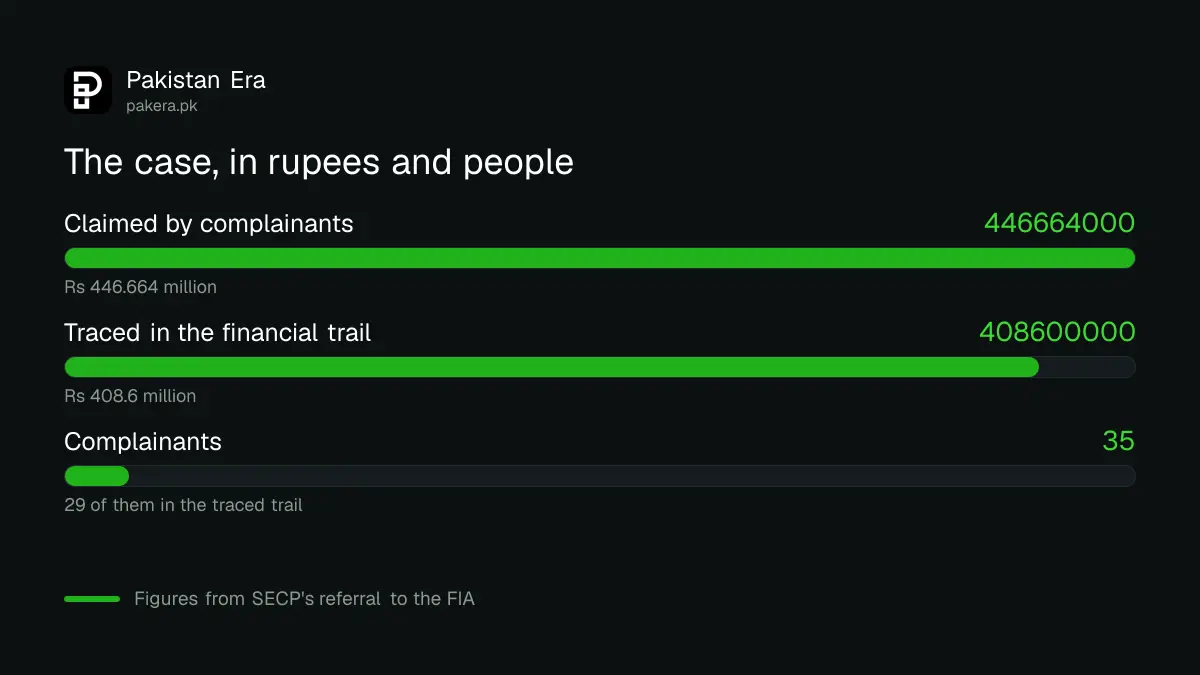
The Securities and Exchange Commission of Pakistan has referred Blink Capital Management to the Federal Investigation Agency over an alleged Ponzi scheme. 35 complainants have claimed Rs 446.664 million.
Here is the part that should change how you think about this. Blink held a licence. It was a licensed futures broker and market maker of the Pakistan Mercantile Exchange.
Every guide to avoiding investment fraud in Pakistan, including things we have written ourselves, tells you to check whether the firm is registered. That check would have passed.
What SECP says happened
A financial trail covering 29 of the complainants and Rs 408.6 million showed substantial funds moved into accounts of the company, its then chief executive and director, and accounts linked to certain employees and associated persons.
SECP's investigation concluded that Blink was allegedly operating a Ponzi-type fraudulent investment scheme involving illegal deposit-taking.
Nothing has been proved in court. A referral to the FIA is the start of a criminal investigation, not the end of one, and the word alleged is doing real work in every sentence above.
The offer that should have been the warning
Investors signed agreements offering predetermined returns of 3.7 per cent a month, up to 48 per cent a year. Post-dated cheques were issued as security.
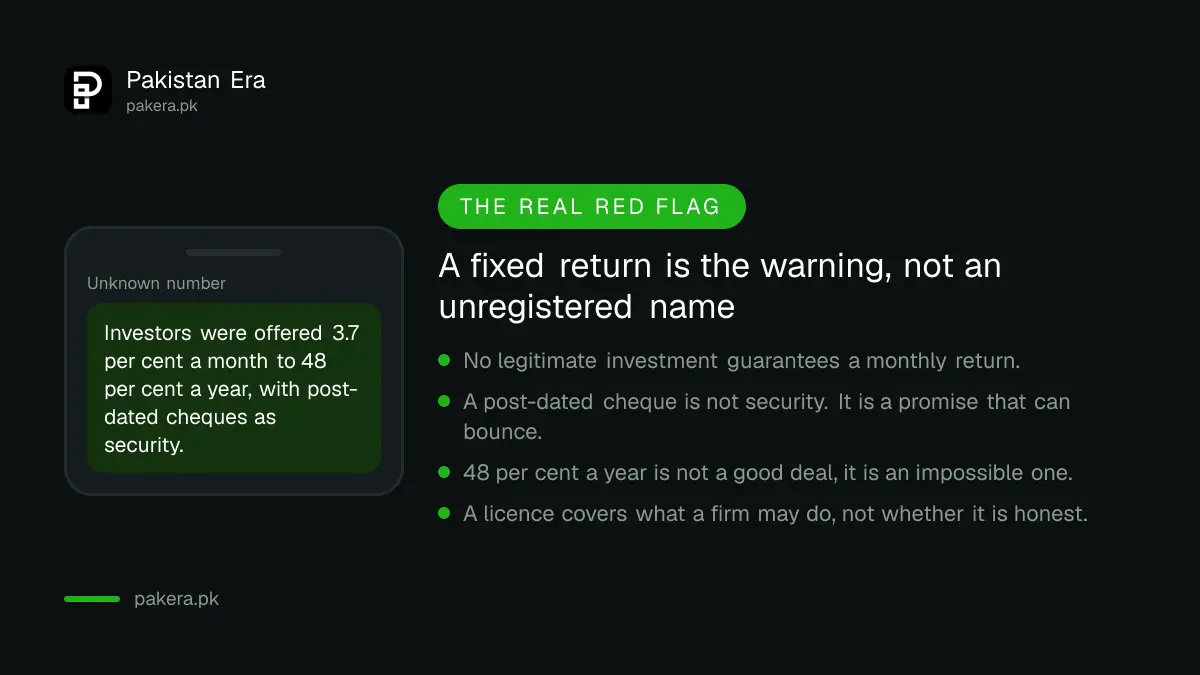
Both halves of that are red flags, and they are worth separating.
A fixed monthly return is not a feature, it is a warning. Real investments fluctuate. A business that promises the same percentage every month regardless of what markets do is either taking the risk itself, which is unusual and expensive, or paying early investors with later investors' money, which is what a Ponzi scheme is.
48 per cent a year is not an attractive rate. It is an impossible one, sustained over any period, and the correct reaction to seeing it is suspicion rather than excitement.
A post-dated cheque is not security. This is the detail worth carrying away, because it is used constantly in Pakistani investment fraud. A cheque dated for the future is a promise. It bounces exactly as easily as any other cheque, and by the time it does, the money is gone. Security means something you can recover value from, not a piece of paper written by the person holding your money.
Why the licence did not help
A licence tells you what a firm is permitted to do. It does not tell you what it is doing.
Blink was licensed as a futures broker and market maker. Accepting deposits from the public with a promised return is not that activity, which is why the allegation includes illegal deposit-taking. The licence and the conduct were different things.
So the check is still worth doing, but understand what it buys you. Being registered means a regulator can act, and SECP did. It does not mean the money is safe while you have it in there.
| What you are told | What it should tell you |
|---|---|
| "We are SECP registered" or "we are licensed" | Only that a regulator exists. Ask licensed for what |
| "Guaranteed 3 to 5 per cent a month" | The single strongest warning sign there is |
| "We will give you post-dated cheques" | Not security. A promise that can bounce |
| "Your friend has been getting paid for months" | Early investors being paid is how a Ponzi works |
| "The strategy is proprietary" | You cannot check what you are not told |
| "Put more in and the rate improves" | Pressure to increase exposure before collapse |
The fourth line is the cruel one. Seeing somebody you trust actually receive their monthly payment is the most persuasive evidence available, and in a Ponzi scheme it is also completely meaningless, because those payments are coming from the money you are about to hand over.
What to check instead
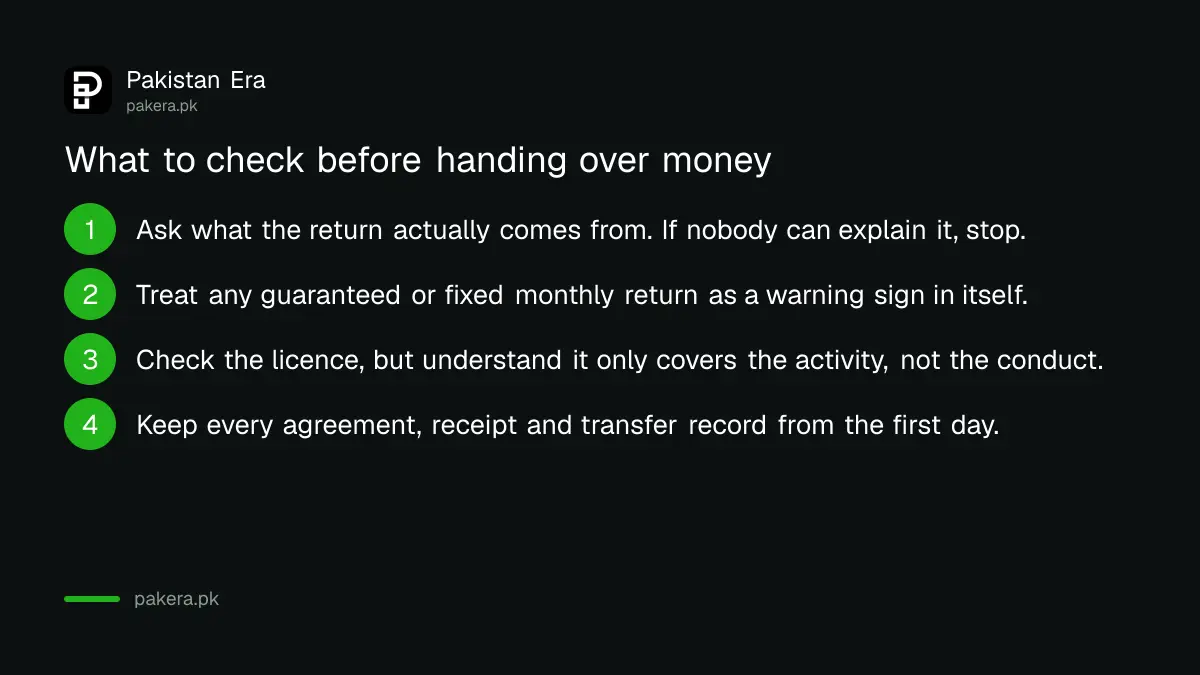
- Ask where the return comes from. Not the rate, the source. If the answer is vague, circular, or about the founder's brilliance rather than a business, stop.
- Treat any guaranteed or fixed monthly return as the red flag itself, regardless of who is offering it.
- Check the licence, and check what it is for. A licence to do one thing is not permission to do another.
- Refuse post-dated cheques as security. If that is the only comfort on offer, there is no comfort on offer.
- Keep everything. Agreements, receipts, transfer records, messages, from the first day. The 29 complainants with a documented trail are in a far stronger position than anyone without one.
- Be wary when the pitch comes through people you trust. Schemes spread through families, mosques and workplaces precisely because the recommendation does the work the numbers cannot.
If you have money in something like this
Speed matters more than certainty. If you are reading this recognising the pattern, the useful steps are to stop putting further money in, gather every document you have, and complain in writing to SECP, which runs a complaint portal.
Waiting to be sure is how people end up in the group with no paperwork. Complaining early costs nothing and it is what builds the case that eventually reaches the FIA.
The same instincts apply to smaller frauds that reach far more people. We covered the lending app cases in the piece on the Barwaqt loan app and the wider pattern in the guide to whether online loan apps are safe.
If money has already left a bank account and the bank will not help, the Banking Mohtasib is free and has its own procedure, which we set out in the guide to complaining about your bank.
Questions readers are asking
What happened with Blink Capital?
SECP referred the company to the FIA over an alleged Ponzi-type scheme involving illegal deposit-taking. 35 complainants claimed Rs 446.664 million. Nothing has been proved in court.
Was Blink Capital registered?
Yes. It was a licensed futures broker and market maker of the Pakistan Mercantile Exchange, which is why checking registration alone would not have protected anyone.
What returns were offered?
Predetermined returns from 3.7 per cent a month up to 48 per cent a year, with post-dated cheques issued as security.
Is a post-dated cheque good security?
No. It is a promise that can bounce like any other cheque. It is not a claim on an asset.
How do I spot an investment scam in Pakistan?
Start with the return. Fixed or guaranteed monthly returns, rates far above what banks pay, and an explanation you cannot follow are the warnings. Registration status matters less than people think.
Where do I complain about an investment company?
SECP is the regulator for companies and runs a complaint portal. Keep your agreements and transfer records, and complain in writing rather than waiting.
About the author

Tax, Bills and Technology Writer
Ali Akhtar is a young and curious voice here at Pakistan Era. He is currently pursuing his A-Levels and has a growing interest in Pakistan’s changing industrial landscape and educational trends. Ali likes to write in a way that helps him explain and explore the world around him. His writing reflects the perspective of the new generation navigating the evolving trends of Pakistan where technology, youth innovation, and shifting opportunities are reshaping the country’s future.