How to Complain About Your Bank to the Banking Mohtasib
The office gives two different waiting periods, 30 days and 45. What it can order, what it cannot touch, and how to appeal a decision.
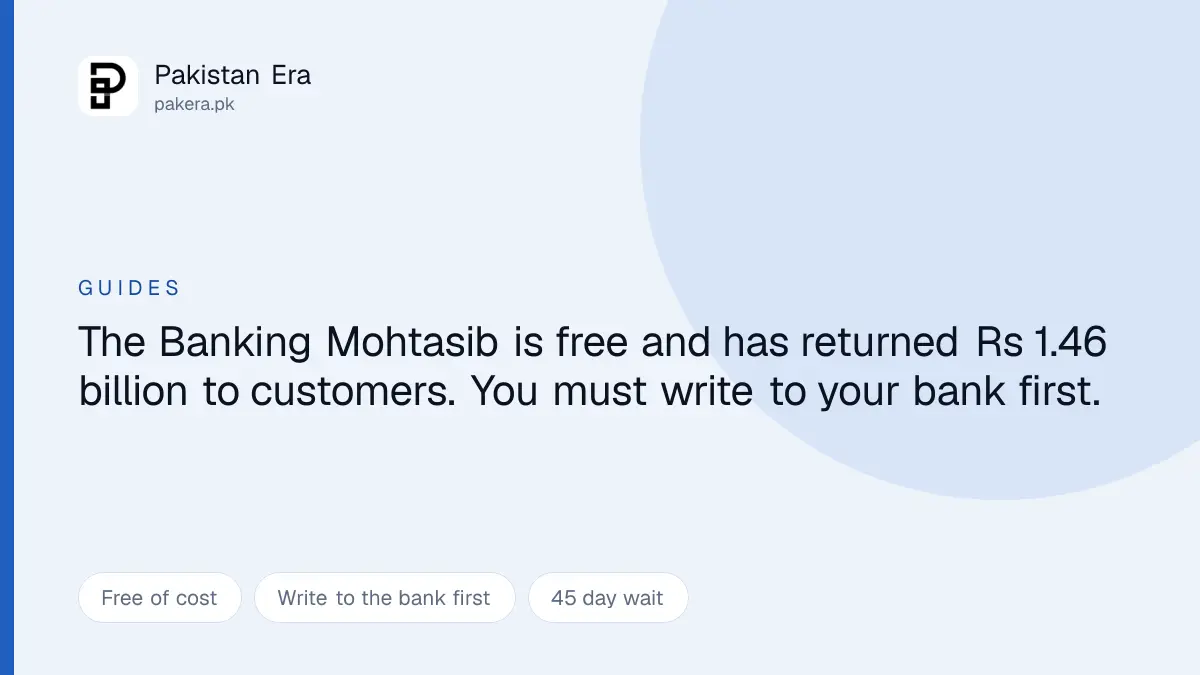
If your bank has taken money it should not have, refused a refund, mishandled a fraud, or simply stopped replying, there is a free office that can order it to put things right.
The Banking Mohtasib says it provided relief of Rs 762.76 million to banking customers in the first half of 2026, and its own counter shows 21,392 complaints received in 2026 with 18,482 disposed of as at 30 June 2026. It costs nothing to use and you do not need a lawyer.
But there is one sentence you have to write first, and getting it wrong sends you back to the beginning.
The sentence that starts your clock
You cannot go to the Banking Mohtasib first. You have to complain to your bank in writing, and that letter must say something specific:
that you intend to refer the grievance to the Banking Mohtasib if the matter is not resolved to your satisfaction.
That line does two things. It puts the bank on formal notice, and it starts the waiting period the bank has to answer you.
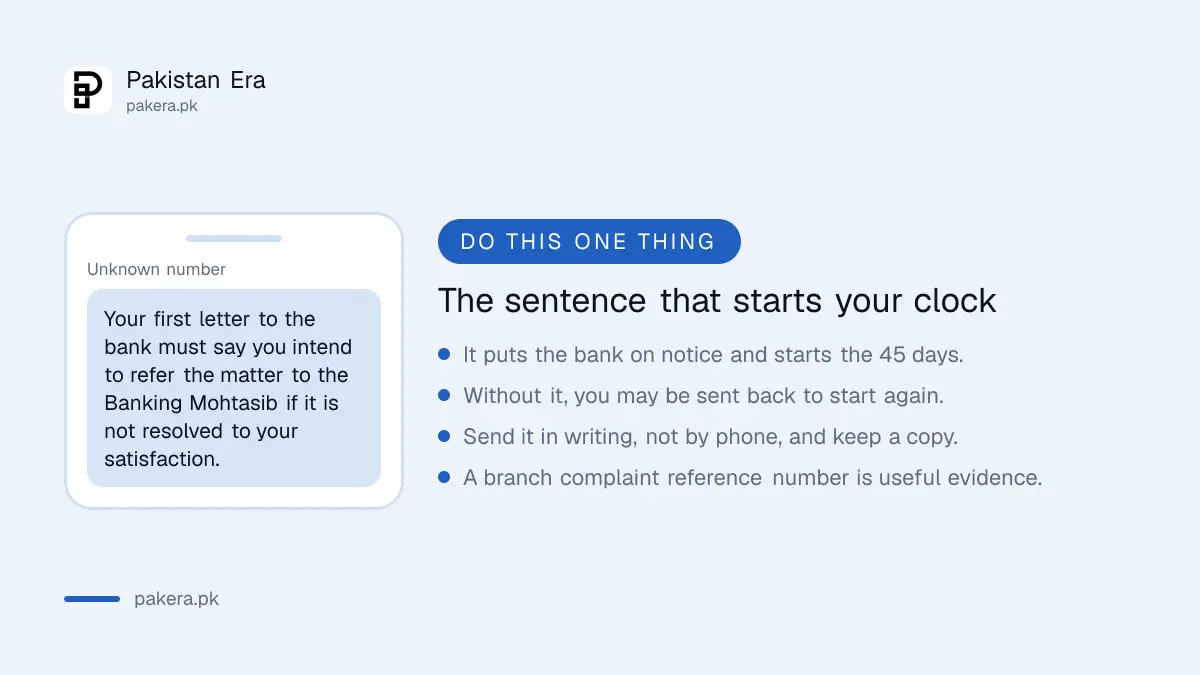
Complain by phone and you have no proof and no clock. Write, keep a copy, and get a complaint reference number from the branch if you can.
The waiting period, and why we quote two numbers
We checked this on 29 August 2026 and found that the Banking Mohtasib's own website gives two different answers, on two different pages.
| Page | What it says |
|---|---|
| Procedure of Lodging Complaint | The bank is allowed a maximum of 30 days to resolve your complaint |
| Frequently Asked Questions, Q9 | If there is no satisfactory response within 45 days you may lodge a complaint within the next 45 days |
Both are quoted from the office's own site, and we are not in a position to say which one the secretariat applies in practice. The safe course is the longer one. Wait 45 days from your letter before filing, and note that the FAQ also sets an outer limit, saying the complaint should follow within the next 45 days after that.
There is one situation where you do not wait at all. If the bank sends you a decline letter, both pages agree that you can file immediately, with no notice period. A rejection in writing is therefore worth more to you than silence, so ask for one.
The step that surprises people
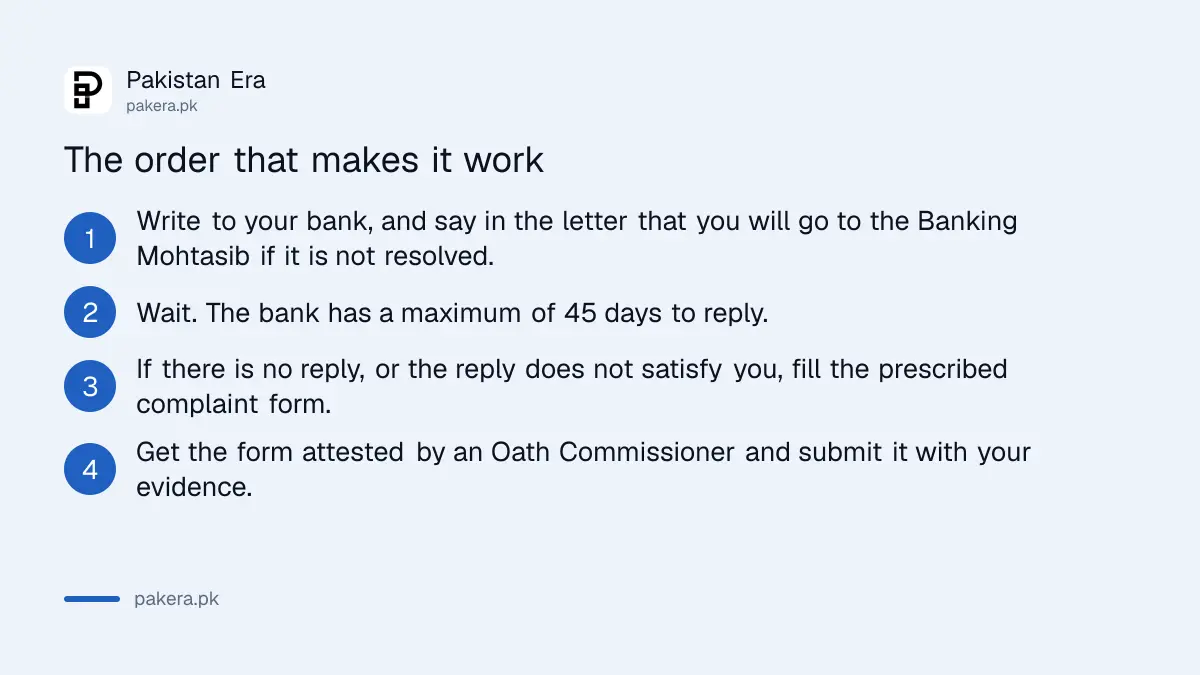
The complaint form has to be completely filled in, signed by you, and attested by an Oath Commissioner.
That is not something you can do at home or online. An Oath Commissioner is found at district courts and through many lawyers' offices, and the attestation is inexpensive. Budget an hour for it rather than discovering it on the day you planned to submit.
Send copies and not originals. The instructions say so directly, and there is no reason to part with a document you may need again.
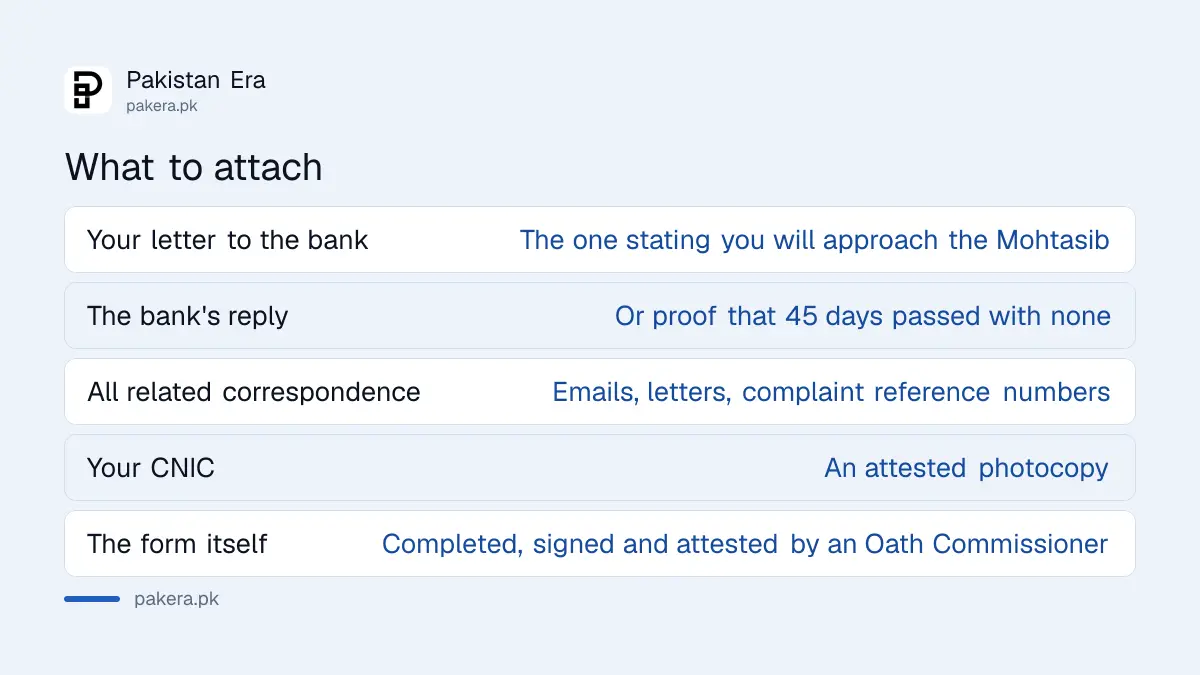
What to attach
| Document | Why it matters |
|---|---|
| Your letter to the bank | The one containing the notice sentence |
| The bank's reply | Or evidence that the waiting period passed with no reply |
| All related correspondence | Emails, letters, reference numbers, app screenshots |
| Copy of your CNIC | Identity |
| The completed form | Signed and attested by an Oath Commissioner |
Complaints can also be lodged online through the Banking Mohtasib's own portal. The secretariat is on the 5th floor of Shaheen Complex, M R Kiyani Road, Karachi, and complaint handling is centralised there even if you lodge the form at another office.
You will not have to travel to Karachi. The office says that where a meeting or a hearing is needed, it will be arranged at the office nearest to you.
What it is good for
The typical cases are the ones people assume they simply have to absorb:
- Unauthorised deductions and charges you never agreed to
- Fraudulent transactions where the bank has refused to make you whole
- ATM disputes, where cash was debited but not dispensed
- Loan and mark-up disputes, including charges applied after settlement
- Delays in releasing funds, closing accounts or issuing documents
- Service failures where the bank has stopped responding
- Harassment during loan recovery, which the office names directly
For public sector banks the office adds corruption, nepotism and maladministration to that list. A locker claim the bank has refused belongs here too, and our guide to what a bank locker actually covers explains what the contract usually says before you get that far.
If your money has already gone to a scam rather than a bank error, the route is different and speed matters more. Blocking the card first is the immediate step, and we set that out in the guide to blocking an ATM card.
What it cannot do for you
Knowing the limits saves a wasted complaint. The office states that it cannot direct a bank to give a loan, an advance or a credit card, and it cannot touch a bank's policy on pricing, which includes the published schedule of charges, or its mark-up, waiver, write-off and risk policies.
It also cannot take a complaint that somebody other than the aggrieved party has filed, a service matter of a bank's own employees, a contractual obligation unrelated to banking products and services, a matter already decided by the State Bank of Pakistan, or anything pending or already decided in a court of law. It has no power to grant a stay order.
On the amount, there is no ceiling. The office says there is no limit on the sum that can be claimed, but it will award compensation for the loss actually sustained, not damages for mental agony or loss of reputation. Claim the money, and leave the distress out of the figure.
Do this immediately, before anything else
If money has left your account without your authorisation, the complaint process is the second thing you do, not the first.
Report it to the bank the same day and get it in writing. Call the helpline, then follow up in writing so there is a dated record. Ask for the transaction to be marked disputed. Banks generally treat a same-day report very differently from one made a fortnight later, and the delay is the first thing raised against you if the matter is contested.
Take screenshots of the transaction, the balance before and after, and any SMS alerts. Do not delete the messages. If a card is involved, block it, then ask for a replacement rather than reactivating the same number.
Only once that is done does the waiting period and the formal complaint become relevant. The Mohtasib route is for when the bank has had its chance and failed to put things right, and your evidence from day one is what carries the case.
Write the first letter properly
- Name the account and the transaction. Account number, date, amount, reference.
- State what went wrong in one paragraph. Facts and dates, not frustration.
- Say what you want. The refund, the reversal, the charge removed.
- Include the notice sentence, that you will approach the Banking Mohtasib if it is not resolved to your satisfaction.
- Date it and keep a copy. Get an acknowledgement or a reference number.
That letter is doing double duty. It is your complaint, and later it is your evidence.
What happens after you file
The office says it aims to resolve complaints within two months, and that complex cases can take longer. It may call for more information from either side, and it can visit a bank to examine books and procedures relating to a complaint.
If the complaint is found to be unjustified you are told and the case is closed. If it is found to be genuine, the office first tries mediation, and where that fails it holds a formal hearing and passes an order requiring the bank to rectify the position or make good your loss. It says it tries to hold any such hearing at the office nearest to you.
An order is binding on the bank. The bank must implement it within 40 days of the date of the order, unless it has appealed to the President of Pakistan within 30 days.
If you disagree with the decision
There are two routes, and both run on 30 day clocks from the date of the order.
The first is a review by the Mohtasib. Either party may file a review petition within thirty days, the Mohtasib is to decide it within forty five days, and on review the order may be altered, modified, amended or recalled.
The second is a representation to the President of Pakistan, again within thirty days. The site is specific that it must be addressed directly to the President and not routed through any ministry, division or department, and that where a representation is made, the order under challenge stays suspended for sixty days.
You also keep your right to go to court. The office says using it does not take that away. But the sequence matters: if you go to a court of law before the Mohtasib has decided your case, it ceases to have jurisdiction, so do one at a time and tell the office if you switch.
If it is not a bank
The Banking Mohtasib covers banks. If your problem is with a federal government department instead, that is the Wafaqi Mohtasib, which is also free and has a 60 day statutory limit. We covered it in the guide to complaining to the Wafaqi Mohtasib.
For anything else, including provincial bodies, the Prime Minister's portal takes complaints against government organisations at all levels, and we set out how in the guide to the Pakistan Citizen's Portal.
Questions readers are asking
Does the Banking Mohtasib charge a fee?
No. The office states its services are free of cost, and that you do not need to engage a lawyer.
Can I go straight to the Banking Mohtasib?
No, unless the bank has sent you a decline letter, in which case you may file at once. Otherwise you must first complain to your bank in writing, stating that you will refer the matter to the Banking Mohtasib if it is not resolved.
Is the waiting period 30 days or 45?
The office's procedure page says 30 and its FAQ says 45. We quote both above. Waiting 45 days is the safer reading.
Is there a limit on how much I can claim?
No ceiling on the amount, but compensation is for the loss actually sustained, not for mental agony or loss of reputation.
Does the form really need an Oath Commissioner?
Yes. The complaint form must be completed, signed and attested by an Oath Commissioner before submission.
How long does a complaint take?
The office aims for two months, and says complex complaints can run longer.
Can I appeal a decision?
Yes. A review petition to the Mohtasib within 30 days, or a representation to the President of Pakistan within 30 days.
Can I file online?
Yes, through the Banking Mohtasib's own portal, alongside the postal route to the Karachi secretariat.
How we verified this
What we checked, where we read it, and what we could not confirm.
Last checked 29 August 2026. We read the Banking Mohtasib Pakistan website at bankingmohtasib.gov.pk on that date, across its procedure of lodging complaint page, its frequently asked questions, its review and representation page and its homepage. The relief figure of Rs 762.76 million for the first half of 2026, the 2026 complaint counter of 21,392 received and 18,482 disposed of as at 30 June 2026, the Oath Commissioner attestation, the instruction to send copies rather than originals, the list of matters outside its jurisdiction, the absence of a ceiling on claims alongside the restriction to loss actually sustained, the two month target, the 40 day implementation deadline, the 30 day review and representation periods, the 45 day decision period on review and the 60 day suspension on a representation to the President are all taken from those pages. The two different waiting periods, 30 days on the procedure page and 45 days in the FAQ, both appear on the site as we read it, and we have quoted both rather than choosing between them. The earlier figure of Rs 1.46 billion up to 30 October 2025 that this guide previously carried covered a different period and has been replaced with the current one.
About the author

Public Services and Education Journalist
Fajr Riaz is a journalist and content writer at Pakistan Era, based in Lahore. She covers the questions people meet in everyday life in Pakistan: how a public service works, what a change in the rules means, and where to find a reliable answer.