How to Reschedule a Microfinance Bank Loan in Pakistan: SBP's 10% Cash and One Year Rule
SBP lets a microfinance bank reschedule an overdue loan. Pay 10% in cash and meet the new terms for one year, or pay 35% to skip the wait. See the steps.
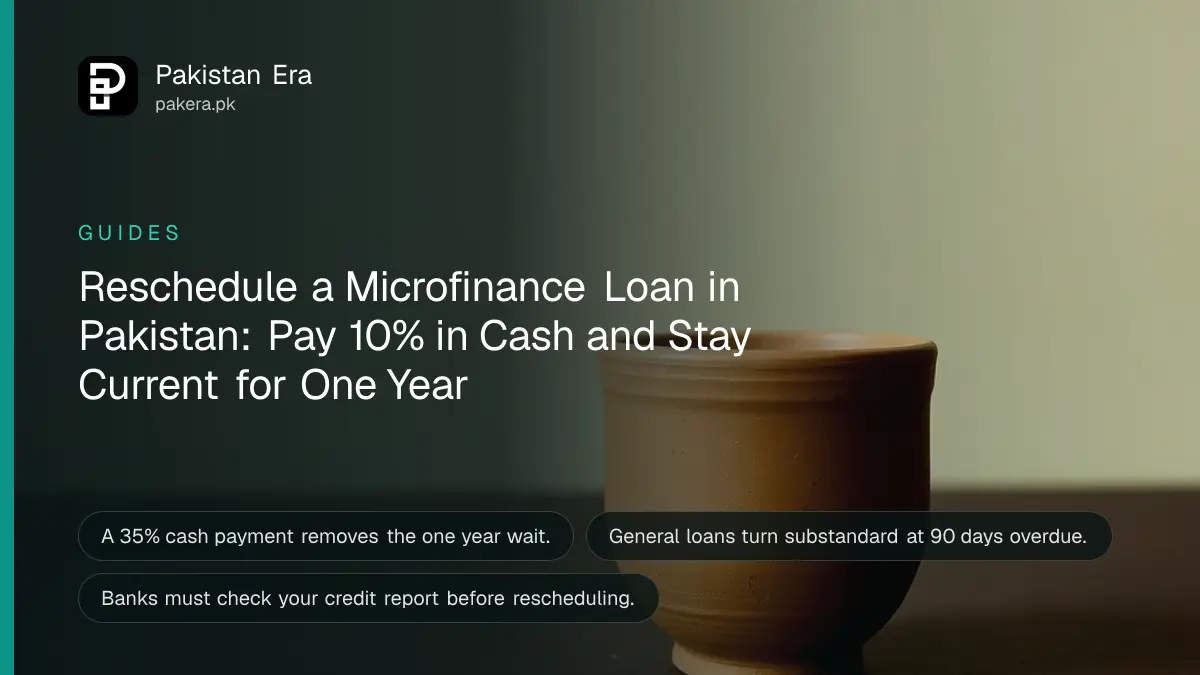
A microfinance bank in Pakistan may reschedule or restructure an overdue loan, but SBP's rule keeps a classified loan classified until you pay 10% of the outstanding amount in cash and meet the new terms for one year. Paying 35% in cash removes the one year wait. The bank may then report the loan to the credit bureau as "rescheduled" instead of "default".
Many borrowers of microfinance banks run a shop, a cart or a few animals, and one bad season can put an instalment behind. We read the State Bank of Pakistan's Prudential Regulations for Microfinance Banks, updated on 16 May 2025, on 21 October 2026. Regulation R-9 sets the rescheduling rules, and R-8 and Annexures I-3 and I-5 set the overdue timelines. Everything below comes from that document unless we say otherwise.
Rescheduling and restructuring are different concessions
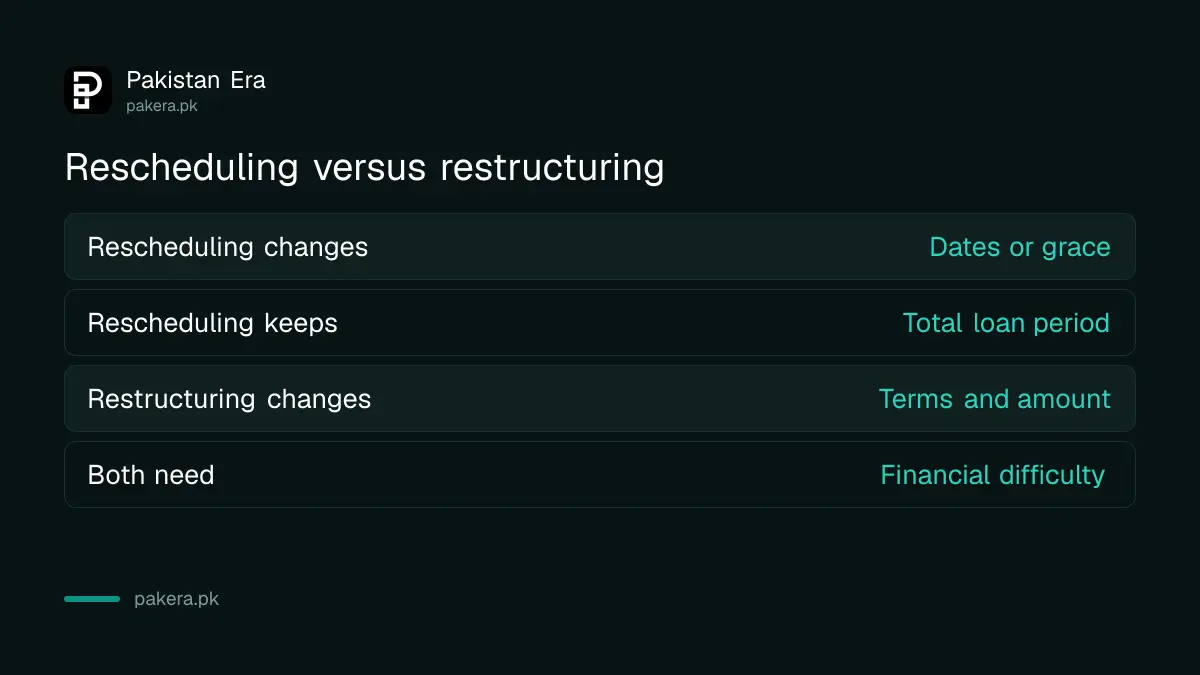
SBP says rescheduling means a change in the grace period or the repayment dates without changing the total loan period. Restructuring means wider changes, such as the repayment period, the instalment, the amount or the mark-up rate. Both are given because the borrower is in financial difficulty.
Ask your bank which one it offers. A new date only may leave your monthly instalment too high. A restructure may lower the instalment but add months. Each microfinance bank must define "financial difficulty" in its own board-approved policy, so the bank cannot invent a test as it goes along. Ask for a copy of that policy.
| Concession | What changes | What stays |
|---|---|---|
| Rescheduling | Grace period or repayment dates | Total loan period |
| Restructuring | Period, instalment, amount or mark-up rate | The loan itself |
A loan becomes non-performing after 90 to 180 days overdue, depending on its type
For a general loan, SBP's table treats a loan as substandard at 90 days overdue and as loss at 180 days. A microenterprise loan is substandard at 180 days, doubtful at one year and loss at 18 months. Overdue accounts first go on a bank watch list.
The watch list is the quiet window. SBP says overdue accounts are kept there before they are classified, and they are not yet counted as non-performing for provisioning. That is the best time to ask for a new schedule. We read the classification tables for general and microenterprise loans only. Agriculture and housing loans use other annexures that we did not read in detail.
Ten percent cash and one year of on-time payments can restore the loan
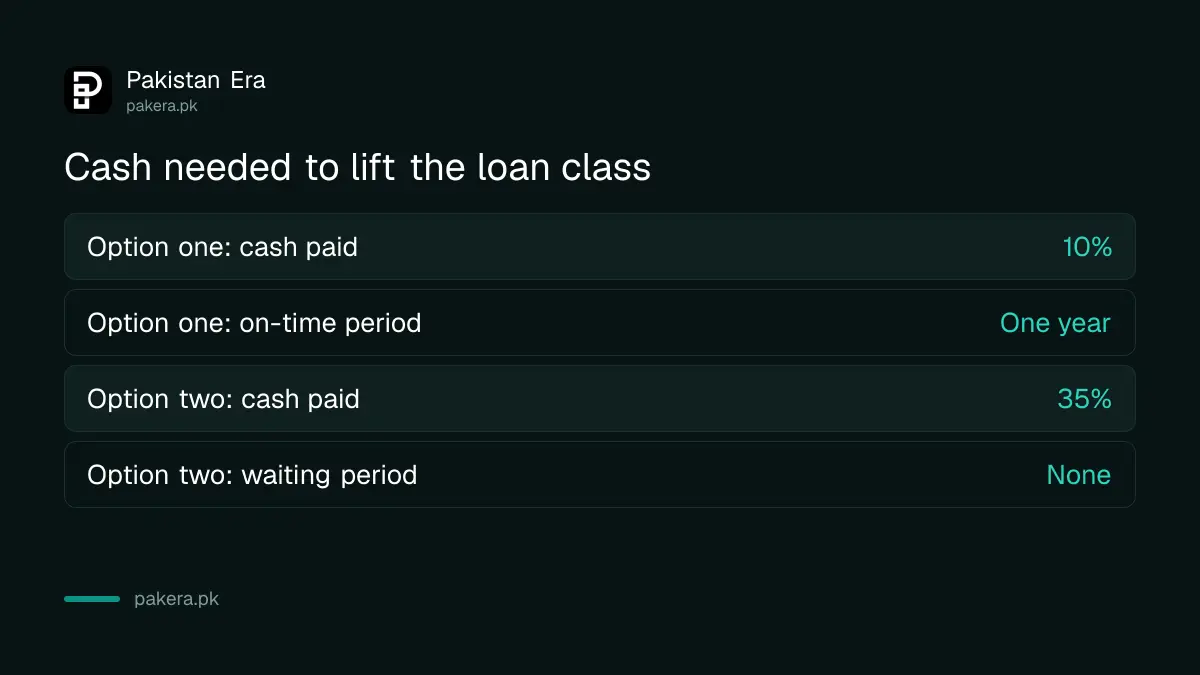
R-9 says a rescheduled non-performing loan stays classified unless at least 10% of the outstanding amount, principal plus mark-up, is paid in cash and the new terms are met for at least one year, not counting grace. If you repay 35% in cash, the one year condition does not apply.
Here is a round example. On Rs 300,000 outstanding, 10% is Rs 30,000 and 35% is Rs 105,000. These numbers are our arithmetic from SBP's percentages and are not an offer from any bank. The 35% payment can be made when the agreement is signed or later during the grace period.
- Write to the bank before the account reaches the classified stage.
- Ask which concession it will give and for how long.
- Ask for the exact cash payment in rupees and get it in writing.
- Keep every receipt and the new repayment schedule.
- Pay each new instalment on its date for a full year.
The credit report can say rescheduled and the bank must check it first
SBP says microfinance banks may show rescheduled or restructured loans to the credit bureau as "rescheduled/restructured" instead of "overdue/default". The bank must also obtain a credit report before rescheduling any loan, and it may not turn down a loan application only because of an overdue amount in the report.
The credit report check is not needed for loans below Rs 25,000. For larger loans the report must be no older than one month when the bank sanctions the limit. To read your own record first, follow the steps in the Tasdeeq and eCIB credit report check.
A new loan cannot be used to hide an old one
SBP bans "adjustment lending", which means giving a fresh loan to pay off the old one so that it never becomes overdue. Banks must also apply a cooling-off period, preferably two to three days, before disbursing a new loan to the same borrower.
That affects the pitch you may hear at the branch: "We will give you a bigger loan and close the old one". The rule exists to stop over-indebtedness. A rescheduling agreement is the lawful route. If the bank pushes an enhanced loan instead, ask for the rescheduling option in writing and see the microfinance loan limits to check your total exposure.
A second default puts the loan back in its old class
If you fall behind again after the loan was declassified, SBP says it returns to the same category it held at rescheduling, counted from the date of default. The bank may also downgrade it further, and any mark-up it had already booked as income is reversed.
Before you sign, test the new instalment against your worst month, not your best. If you cannot meet it, ask for a longer schedule now. For harassing calls or visits, the recovery agent rules apply, and complaints go through SBP rather than the Banking Mohtasib for microfinance banks.
Common questions
Can a microfinance bank refuse to reschedule?
Yes. SBP says banks "may" reschedule under their own policy. It does not give a borrower a right to force it, so ask in writing and keep the reply.
Does the 10% include mark-up?
Yes. SBP's text says 10% of the outstanding loan amount, principal plus mark-up, recovered in cash.
What if I pay 35% at once?
Then the one year on-time condition does not apply, according to R-9. Ask the bank to confirm in writing that your loan is declassified.
Does rescheduling stop the mark-up?
No rule in the document says so. The bank may not book unpaid mark-up as income until 50% of it is realised in cash, but you still owe it.
Do small loans need a credit check before rescheduling?
The one month credit report rule has an exception for loans below Rs 25,000. Ask the bank how it treats your loan.
How we verified this
What we checked, where we read it, and what we could not confirm.
We read SBP's Prudential Regulations for Microfinance Banks (updated 16 May 2025) on sbp.org.pk on 21 October 2026, including R-7, R-8, R-9 and Annexures I-3 and I-5. We did not read any microfinance bank's own rescheduling policy, so cash amounts and approval times at your bank may differ. SBP may have issued later circulars that we did not find on the page.
About the author

Public Services and Education Journalist
Fajr Riaz is a journalist and content writer at Pakistan Era, based in Lahore. She covers the questions people meet in everyday life in Pakistan: how a public service works, what a change in the rules means, and where to find a reliable answer.