Microfinance Bank Loan Limits in Pakistan: Rs 500,000 General, Rs 5 Million for Homes and Business
SBP rules let microfinance banks lend up to Rs 5 million for farms, homes and small firms, and Rs 500,000 for general loans. See the income test and 50% rule.
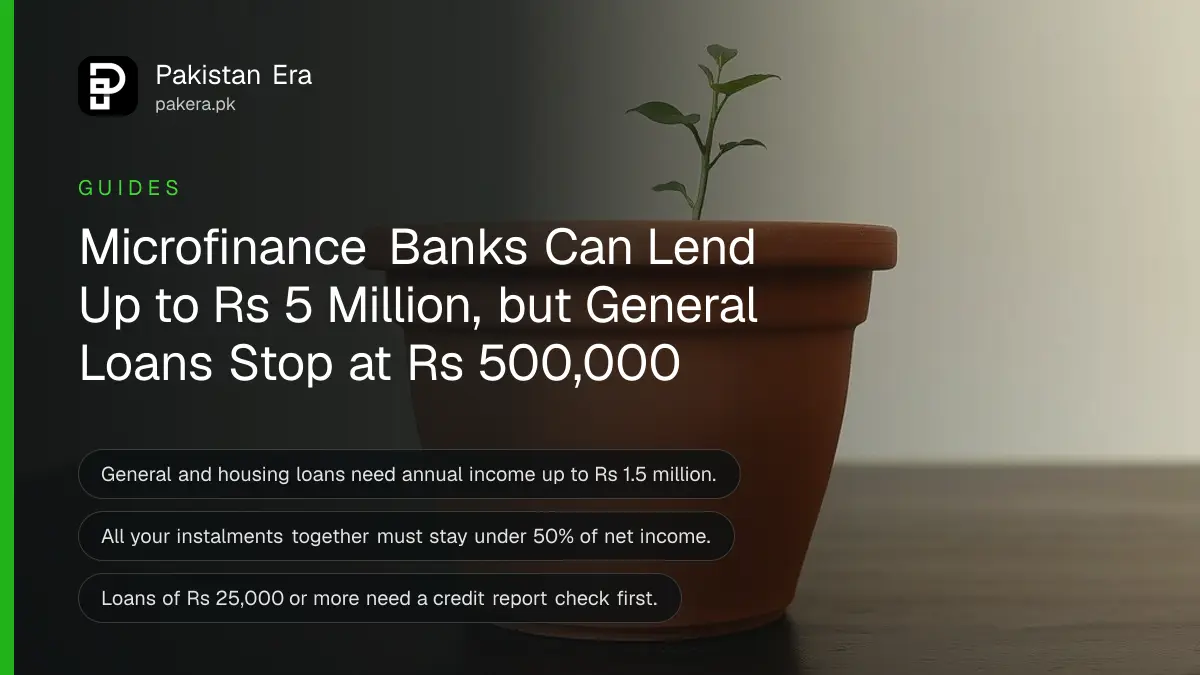
Short answer: a microfinance bank in Pakistan can lend you up to Rs 5 million for a farm, a house or a small business, and up to Rs 500,000 for a general loan such as solar panels, a laptop or a motorbike. All your loan instalments together must stay under half your net monthly income.
These limits come from the State Bank of Pakistan's Prudential Regulations for Microfinance Banks, updated on 16 May 2025. We read the regulations on the SBP website on 20 October 2026. They bind every licensed microfinance bank, including the banks behind the Easypaisa and JazzCash apps.
A microfinance bank, or MFB, is a bank licensed to serve low-income people and very small businesses. Easypaisa's app is run by easypaisa Bank Ltd, and JazzCash by Mobilink Microfinance Bank. The rules below decide how much any of them can offer you.
A microfinance bank can lend up to Rs 5 million, or Rs 500,000 for general loans
The SBP sets four loan types for microfinance banks. Agriculture and livestock, housing and microenterprise loans can each go up to Rs 5 million. General loans, which cover everything else, are capped at Rs 500,000 per borrower.
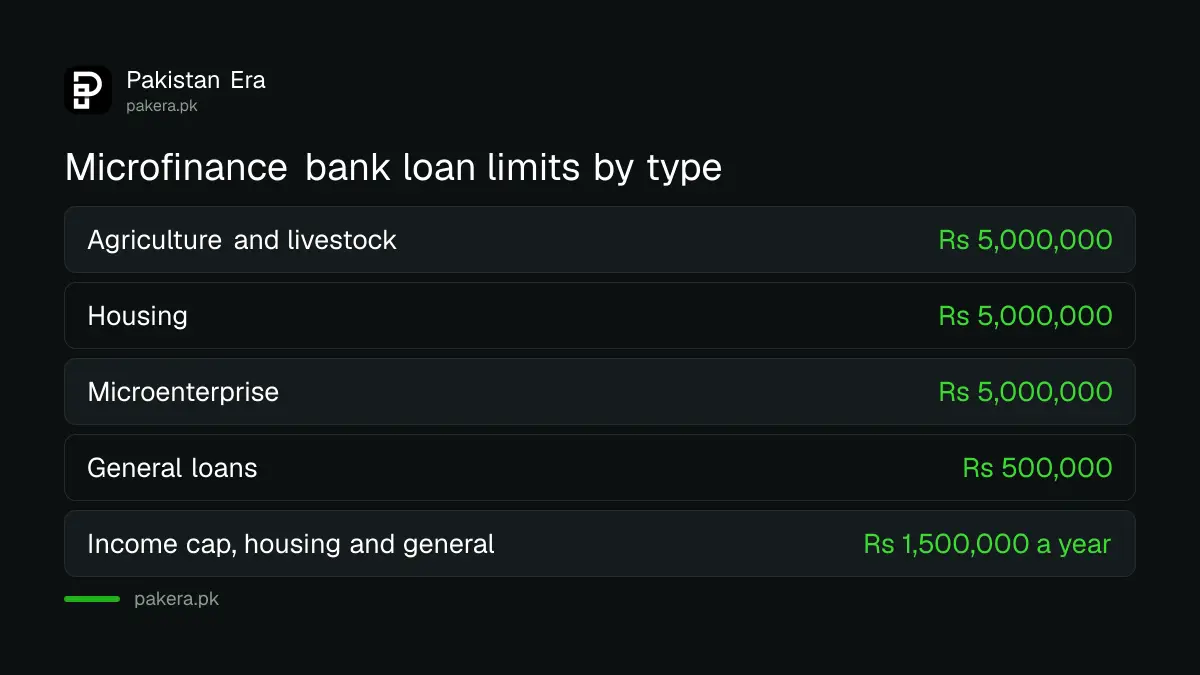
| Loan type | Maximum | Income condition |
|---|---|---|
| Agriculture and livestock | Rs 5,000,000 per borrower | Based on repayment capacity |
| Housing | Rs 5,000,000 per borrower | Annual income up to Rs 1,500,000 |
| Microenterprise | Rs 5,000,000 per project or business | Business with up to 25 workers |
| General loans | Rs 500,000 per borrower | Annual income up to Rs 1,500,000 |
The regulations give examples of general loans: solar panel installation, "laptop loans for students and freelancers" and vehicle or motorbike loans for livelihood. They also allow local credit cards or running finance for livelihood only, such as fuel cards for delivery riders.
A microenterprise is a small business run by a self-employed person employing no more than 25 people, not counting seasonal labour. The SBP lists small software houses, carpentry, electrical work, food stalls and lathe workshops as examples. These loans must be in the entrepreneur's own name.
Your income must be up to Rs 1.5 million a year for general and housing loans
General loans and housing loans are only for borrowers whose annual income, after business expenses, is up to Rs 1,500,000. That works out to Rs 125,000 a month. Above that, a microfinance bank should not class you as an eligible borrower for these loans.
The regulations call such a borrower a "poor person", meaning someone with modest means who is involved in a livelihood activity and can repay from that income. The term is a legal definition, not a judgement. Agriculture and microenterprise loans do not carry the same income line in the regulations.
All your instalments together cannot pass half your income
A microfinance bank must make sure your total monthly instalments, across every lender, do not exceed 50% of your net disposable income. On Rs 60,000 a month, that caps all repayments together at Rs 30,000.
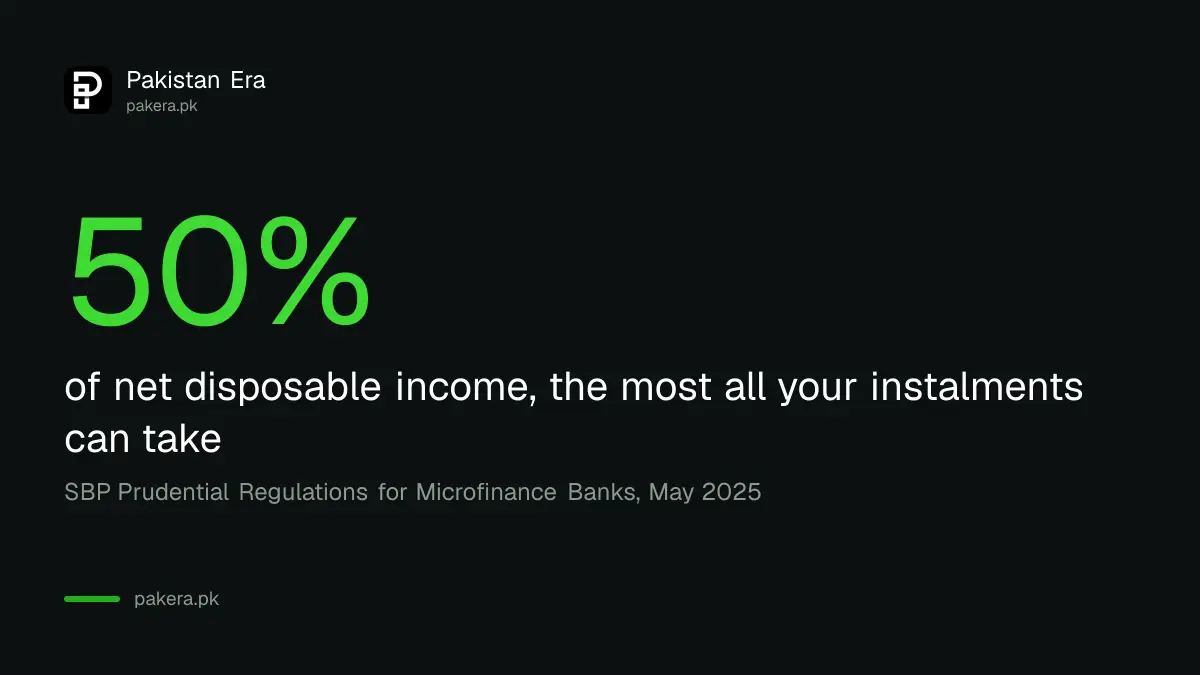
This applies to salaried people too. So a lender that ignores your existing car or phone instalments is not following the rule. If a loan offer looks larger than your income can carry, that is a reason to ask questions, not to sign.
The limits count loans from every lender together
The caps apply to your total borrowing, not to each bank separately. Your combined microfinance-type loans across all institutions cannot pass Rs 5 million, and general loans across all lenders cannot pass Rs 500,000.
That is why a microfinance bank must pull your credit report before lending. The regulations require a report from a licensed credit bureau or the SBP's eCIB, no older than one month, for every loan of Rs 25,000 or more. You can see the same report yourself, as explained in checking your credit report.
One fair point in your favour: the SBP says an application "may not be turned down solely on the basis of overdue amount reported" in the credit report. An old late payment should be weighed, not used as an automatic no.
Housing loans have extra rules on plots and property value
A microfinance housing loan cannot be used only to buy a plot. Money for land is capped at 90% of the plot's value and 50% of the total loan. The rest must go to construction, released in stages as building progresses.
The loan to value ratio, the loan compared with the property's worth, cannot pass 90%. The property is mortgaged to the bank. A property worth more than Rs 5 million must be valued by a valuer on the Pakistan Banks' Association panel. Building permissions must be in place before money is released. Larger home loans from commercial banks follow different rules, set out in home loan eligibility rules.
Check a microfinance loan offer in five steps
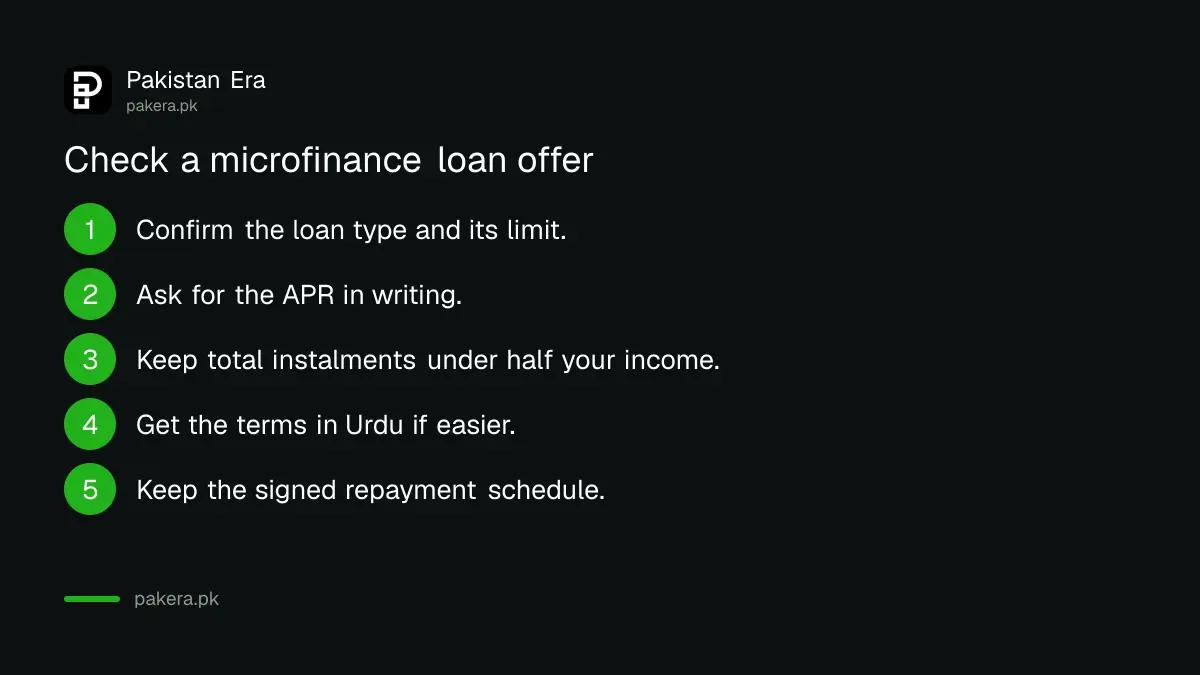
Before signing, confirm the loan type and limit, ask for the annual percentage rate in writing, check your total instalments against half your income, and keep a signed copy of the terms. The SBP requires each of these.
- Ask which of the four loan types you are being offered, and check the amount against its limit.
- Ask for the annualised percentage rate (APR), the yearly cost of the loan. The regulations require it to be disclosed with all fees and penalties.
- Add up every instalment you already pay and the new one. Keep the total under half your net monthly income.
- Ask for the terms in Urdu or your regional language if that is easier. The SBP says terms must be read out, copied and given to you after signing.
- Keep the repayment schedule. It must show the period, principal, mark-up and fees.
If recovery staff later call or visit, a microfinance bank must give at least 14 days' notice before a visit and must not harass your family. Those protections match the commercial bank rules in stopping recovery agent harassment. Complaints about a microfinance bank go to the bank first and then to the SBP.
Common questions
What is the maximum microfinance loan in Pakistan?
Rs 5 million for agriculture, housing or microenterprise loans, and Rs 500,000 for general loans, under SBP rules for microfinance banks.
Who can get a microfinance general loan?
A borrower with annual income, after business expenses, of up to Rs 1,500,000, for purposes like solar panels, laptops or a work motorbike.
Can a microfinance bank lend to a salaried person?
Yes. The income test applies to salaried people too, and total instalments must stay under 50% of net income.
Does a microfinance bank check my credit history?
Yes, for every loan of Rs 25,000 or more, using a credit report no older than one month.
Can a microfinance housing loan pay for just a plot?
No. It must also fund construction or renovation, and the plot share is capped at 50% of the loan.
How we verified this
What we checked, where we read it, and what we could not confirm.
We read the State Bank of Pakistan's Prudential Regulations for Microfinance Banks, updated on 16 May 2025 and listed on the SBP laws and regulations page, on 20 October 2026. We used Regulations R-5, R-6 and R-7, the definitions and the consumer protection section. We also read the easypaisa Bank and Mobilink Microfinance Bank documents that name each bank as the operator of its app. We did not apply for a loan, so actual approval amounts and rates at any bank are not verified, and individual banks may set lower limits in their own policies.
About the author

Public Services and Education Journalist
Fajr Riaz is a journalist and content writer at Pakistan Era, based in Lahore. She covers the questions people meet in everyday life in Pakistan: how a public service works, what a change in the rules means, and where to find a reliable answer.