How Banks Decide Your Home Loan in Pakistan
The bank can lend 90 per cent, and total repayments cannot pass 65 per cent of income. Existing loans count. What proof is accepted.
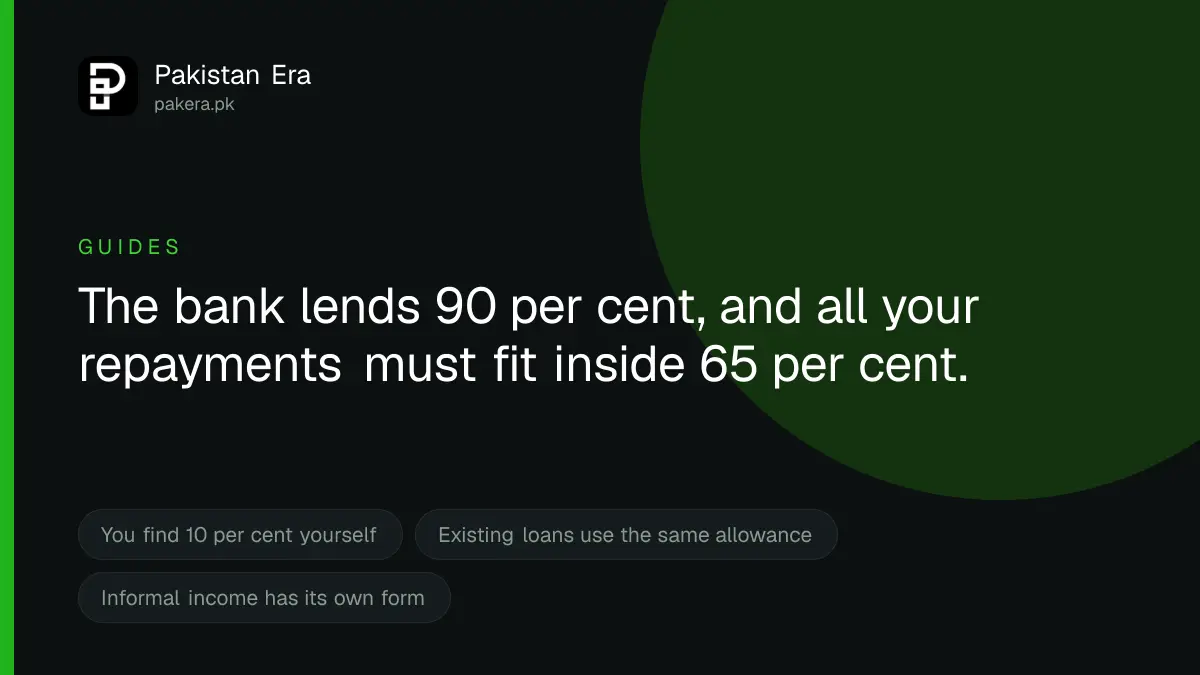
Two numbers decide most home loan applications before a bank reads your file. The bank can lend you 90 per cent of the property price, and your total loan repayments cannot exceed 65 per cent of your income.
Update, 10 October 2026: The State Bank changed its home loan document rule on 9 October 2026. Banks may now ask only for the property papers on its list. Read the update.
The second one is where applications die, because it counts the loans you already have. Your car instalment and your credit card come out of the same 65 per cent.
These are the State Bank's own rules. We read the Housing Finance Prudential Regulations 2026 on its site on 1 September 2026.
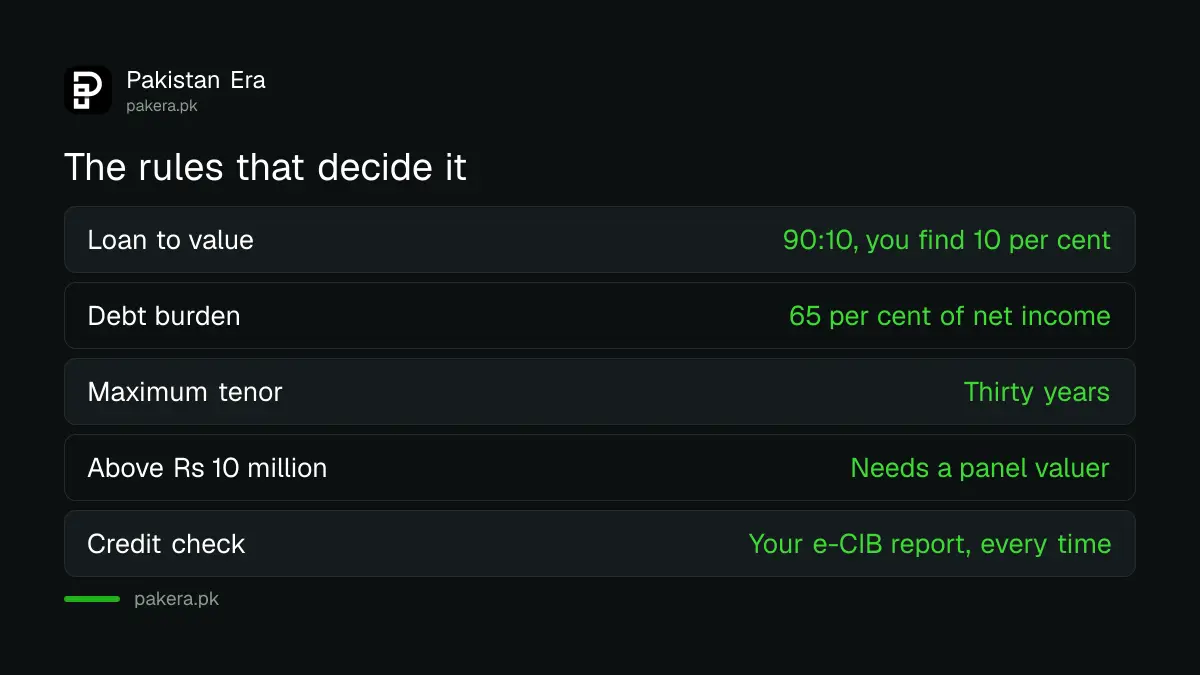
The numbers that decide it
| Regulation | What it says |
|---|---|
| HF-5, loan to value | Maximum ratio is 90:10, so you find 10 per cent |
| HF-6, debt burden | Not more than 65 per cent of net disposable income |
| HF-4, tenor | Maximum 30 years, or 10 years for renewable energy |
| HF-8, valuation | Above PKR 10 million needs a panel valuer |
| HF-3, credit check | Your e-CIB report is obtained every time |
Work out both sums on your own numbers before you apply. If the deposit is not there, or your existing instalments already fill most of the 65 per cent, no amount of paperwork will fix it.
Existing loans come out of the same allowance
Regulation HF-6 is precise about this. The limit covers the housing finance being applied for together with repayment obligations against all other outstanding consumer financing.
So a car loan, a personal loan and a credit card balance all reduce what you can borrow for a house. If you are planning to buy in the next year, clearing a small loan first may do more for your application than raising your income.
Regulation HF-3 also means your history is always checked. Banks must obtain your latest credit information report from the State Bank's e-CIB, or a licensed private bureau. Check yours before they do, and our guide to reading your ECIB credit report explains how.
If you have no salary slip, there is an official route
This is the part almost nobody knows, and it matters in a country where most people earn without documenting it.
The regulations attach three application forms: one for a formal salaried person, one for a formal business, and one for an informal income person. That third form exists precisely for shopkeepers, tradesmen, drivers and small contractors.
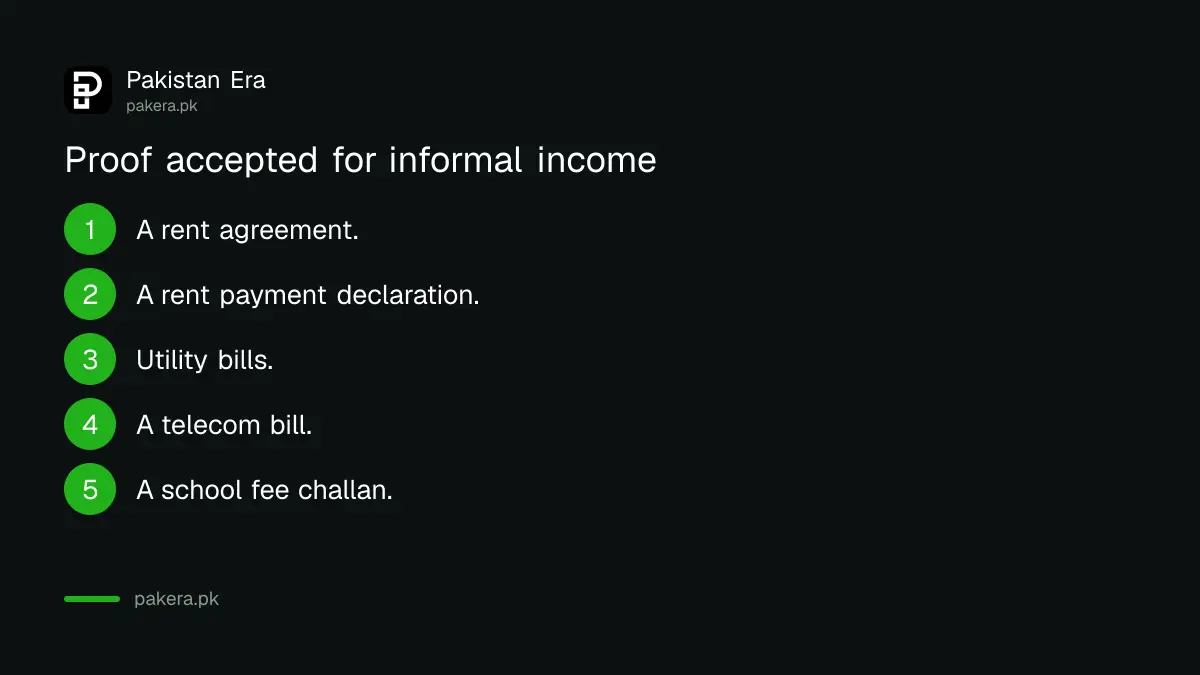
Where income is informal, the regulations say one of a list of documents is required to assess the customer on proxy income or repayment surrogates. The examples given include:
- A rent agreement.
- A rent payment declaration.
- Utility bills.
- A telecom bill.
- A school fee challan.
A school fee challan as proof of income sounds strange until you see the logic. It shows a regular payment you have been meeting, which is exactly what a lender wants to know. If a bank has turned you away before for having no payslip, that is a reason to ask again and to ask for the informal income form by name.
Your documents can be two months old
A small detail that saves a wasted trip. The application forms state that a salary slip and bank statement up to 60 days old may be accepted.
So you do not need documents printed this week. Gather what you have, check the dates, and only chase fresh copies if something is older than two months.
The bank must tell you what it needs, and what it charges
Two regulations here are worth quoting back to a bank if the process starts drifting.
Regulation HF-2 requires banks to adopt simplified application forms and to explicitly prescribe the list of documents required for processing, available in both physical and digital form. A list that grows every visit is not how this is meant to work.
Regulation HF-11 requires all charges to be explicitly disclosed to the borrower, and states there shall be no hidden charges. Ask for that disclosure in writing before you sign anything.
Valuation and the ten million line
Regulation HF-8 splits property assessment at PKR 10 million. Above that, the property must be assessed by at least one valuer from the PBA approved panel. Up to that figure, a bank may assess through its own internal resources.
There is also a sensible shortcut in the rules. For housing units of the same category, layout and size within the same society or colony, a bank may rely on the valuation of a single unit rather than valuing each one separately.
If you fall behind later
The regulations set out what happens on default, and it is better to know now than to discover it.
Default notices are issued at 90 days or more past due, with a further classification stage at 180 days. Regulation HF-13 allows rescheduling or restructuring, extending the financing by a maximum of five years beyond the original tenure, subject always to the overall 30 year limit.
There is a catch worth noting. If a borrower again reaches 180 days past due within two years after being declassified, the financing is put back into the category it was in before.
Talk to the bank early if trouble is coming. Restructuring exists in the rules, and it is easier to ask for before the notices start.
Where the government scheme fits
These regulations govern housing finance generally, including loans under the federal scheme. Our guide to applying for the Apna Ghar housing loan covers that programme and what its own figures show about how far applications get.
Before you commit to any property, establish that the title is clean, and remember that unpaid provincial property tax attaches to the property rather than the previous owner. Our guides to getting a fard online and the tax collected at transfer cover those checks.
Try it on your own numbers: use our Home Loan Calculator to compare banks and the Apna Ghar scheme on your own property price and income.
Common questions
How much deposit do I need?
The maximum loan to value ratio is 90:10, so plan for 10 per cent of the price.
What is the debt burden ratio?
Total repayments, including the new housing finance and all other consumer financing, cannot exceed 65 per cent of net disposable income.
Can I get a loan without a salary slip?
There is an application form for informal income, assessed on proxy income using documents such as a rent agreement, utility bill, telecom bill or school fee challan.
How old can my bank statement be?
The forms state that a salary slip and bank statement up to 60 days old may be accepted.
How long can the loan run?
Maximum tenor is 30 years, and 10 years for renewable energy financing.
Will they check my credit history?
Yes. Banks must obtain your latest e-CIB report or one from a licensed private bureau.
How we verified this
What we checked, where we read it, and what we could not confirm.
Last checked 1 September 2026. We downloaded the State Bank of Pakistan's Housing Finance Prudential Regulations 2026 from sbp.org.pk on that date and read them. Regulation HF-2 on simplified application forms and the explicit list of required documents, HF-3 requiring the latest e-CIB or licensed bureau credit report, HF-4 setting a maximum tenor of thirty years and ten years for renewable energy financing, HF-5 setting the maximum loan to value ratio at 90:10, HF-6 capping total repayments including other outstanding consumer financing at sixty-five per cent of net disposable income, HF-8 on property assessment with the PKR 10 million threshold and the PBA approved panel and the single unit valuation allowance, HF-11 requiring explicit disclosure of charges with no hidden charges, the classification stages at 90 and 180 days past due, HF-13 on rescheduling with the five year extension and the two year re-default rule, the three annexed application forms for formal salaried, formal business and informal income persons, the proxy income documents including rent agreement, rent payment declaration, utility bills, telecom bill and school fee challan, and the acceptance of a salary slip and bank statement up to sixty days old, are all taken from that document. Individual banks apply their own additional criteria within these rules, including minimum income requirements, so confirm with the bank you approach. Nothing here is financial advice.
Work out your own figure
Compare banks and the Apna Ghar scheme on your own property price and income.
Home Loan Calculator →About the author

Tax, Bills and Technology Writer
Ali Akhtar is a young and curious voice here at Pakistan Era. He is currently pursuing his A-Levels and has a growing interest in Pakistan’s changing industrial landscape and educational trends. Ali likes to write in a way that helps him explain and explore the world around him. His writing reflects the perspective of the new generation navigating the evolving trends of Pakistan where technology, youth innovation, and shifting opportunities are reshaping the country’s future.