What Tax You Pay When You Buy or Sell Property
Sellers pay under 236C and buyers under 236K. Both are advance tax you can set against your annual bill, not a charge that vanishes.
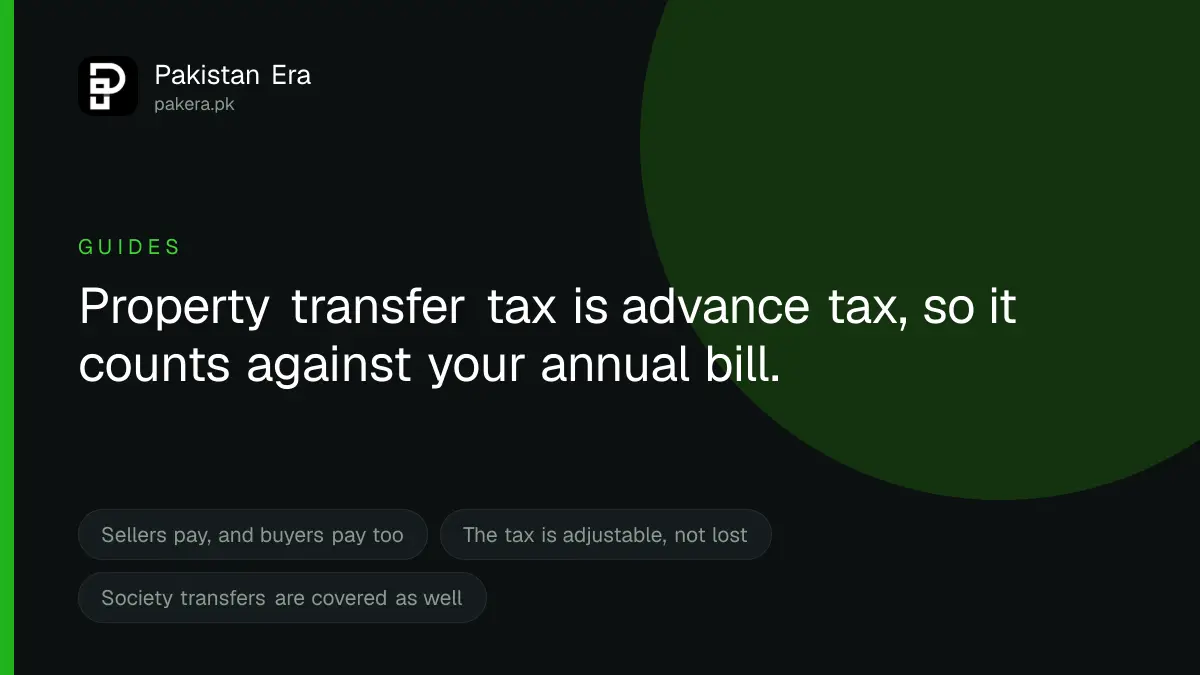
The tax collected when you buy or sell property is advance tax, which means it counts against your annual tax bill rather than disappearing. Most people treat it as a fee they paid and forgot, and never claim the credit.
We read sections 236C and 236K in the consolidated Income Tax Ordinance, 2001 published by FBR on its own download site on 29 August 2026. There is an important limit on that copy, and we set it out before the end.
Both sides of the deal are taxed, under different sections
People often think one party bears this. The Ordinance taxes each of them separately.
| Section | Who pays | When |
|---|---|---|
| 236C | The seller or transferor | At the time of registering, recording or attesting the transfer |
| 236K | The purchaser or transferee | At the time of registering, recording or attesting the transfer |
In both cases the tax is not paid by you to FBR directly. It is collected by the person responsible for registering, recording or attesting the transfer, at the moment the transfer is done.
A society file does not sit outside this
A common belief is that a transfer inside a housing society, where nothing goes to the registrar, is outside the net. Both sections carry an explanation that says otherwise.
The person responsible for registering, recording or attesting a transfer is stated to include a local authority, a housing authority, a housing society, a co-operative society, public and private real estate projects registered or governed under any law, joint ventures, private commercial concerns, and the registrar of properties.
That list was widened over time by successive Finance Acts, and it is drawn to cover the way most property in Pakistan actually changes hands. If somebody is recording your transfer, they are the collector.
The word that matters is adjustable
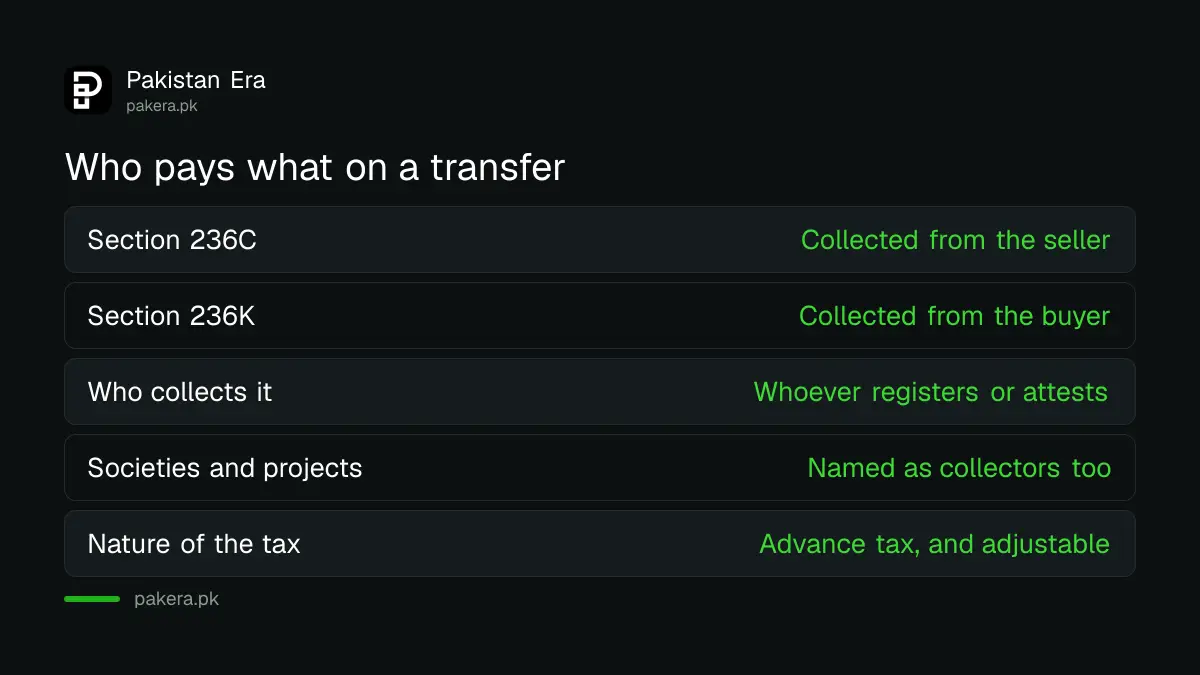
Section 236C states that the advance tax collected under it is adjustable. That single word changes what this money is.
Adjustable means it is a payment on account of your income tax for the year, not a separate transaction charge. When you file your return, it is set against what you owe, and if you have overpaid it forms part of a refund claim.
- Get the challan or deposit slip showing the tax collected, in your name.
- Check the amount appears against your own CNIC or NTN.
- Keep it with your records for the tax year of the transfer.
- Enter it as tax already paid when the return is filed.
- Follow up if it does not appear, because the credit is yours.
The practical failure is documentary rather than legal. If the collector deposits the tax without your correct identifier, the credit does not attach to you, and nobody will chase it on your behalf. Ask for the evidence at the counter rather than afterwards.
Filing is what turns the credit into money, so if you are not on the Active Taxpayer List that is worth fixing, and our guide to the ATL surcharge and the 30 September deadline covers the cost of being off it.
Shaheed families and ex-servicemen have an exemption
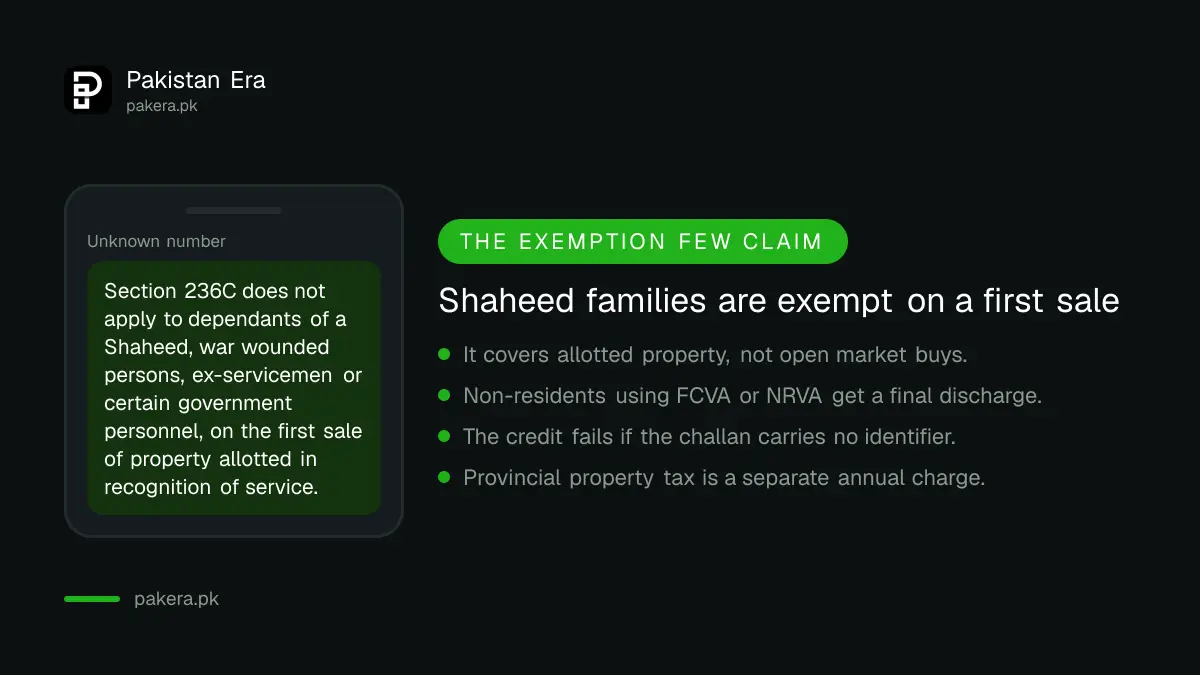
Section 236C carries a proviso that is specific and rarely claimed. It does not apply to a seller who is a dependant of a Shaheed belonging to the Pakistan Armed Forces, or of a person who died while in the service of the Armed Forces or of the Federal or Provincial Government.
Later amendments extended it to a war wounded person while in service of the Armed Forces or the Federal or Provincial Government, to an ex-serviceman and serving personnel of the armed forces, and to ex-employees and serving personnel of Federal and Provincial Government.
The exemption is narrow in one respect and worth reading carefully. It applies in respect of the first sale of immovable property acquired from or allotted by the Federal or Provincial Government, or an authority duly certified by the official allotment authority, where the property was acquired or allotted in recognition of or for services rendered. So it covers the allotted property, on its first sale, and not property bought on the open market.
Overseas Pakistanis who used an FCVA or NRVA account
There is a separate proviso for non-residents, and it is a genuine planning point rather than a technicality.
Where the seller is a non-resident individual holding a Pakistan Origin Card, a National ID Card for Overseas Pakistanis or a CNIC, and acquired the property through a Foreign Currency Value Account or an NRP Rupee Value Account maintained with authorised banks in Pakistan under State Bank foreign exchange regulations, the tax collected under section 236C is the final discharge of tax liability in lieu of capital gains taxable under section 37.
In plain terms, buying through those accounts changes the tax outcome on a later sale. If you hold a NICOP or POC and are considering property in Pakistan, that is a decision to take before the purchase rather than after it, and our guide to NICOP and POC for overseas Pakistanis covers the cards themselves.
Provincial property tax is a different thing entirely
These sections are federal income tax collected once, at transfer. The annual property tax charged on a building is provincial, assessed separately, and paid to a different department.
Our guides to paying Punjab property tax and to what Sindh property tax actually costs cover that side. Before any transfer, establish that the title is clean and the arrears position is known, since unpaid provincial tax attaches to the property rather than to the previous owner. For land in Punjab, our guide to getting a fard online sets out the record check.
Why no rate appears on this page
Both sections set the amount by reference to the First Schedule rather than in the section itself. Section 236C points to Division X of Part IV, and section 236K to Division XVIII of Part IV.
The consolidated Ordinance that FBR publishes is the version amended up to 20 February 2026, which predates the Finance Act, 2026 and its changes effective 1 July 2026. We are therefore not quoting a percentage, because the copy we could read at source is not current on rates and we will not repeat one we have not verified.
Confirm the current rate for your transaction with a tax adviser or through FBR, and expect it to differ depending on whether you are on the Active Taxpayer List.
Common questions about property transfer tax
Who pays this, the buyer or the seller?
Both. The seller is taxed under section 236C and the buyer under section 236K, as separate collections.
Is this money gone?
No. Section 236C says the advance tax collected is adjustable, so it counts against your income tax for the year when you file.
Does a housing society transfer avoid it?
No. The sections name housing societies, co-operative societies and private real estate projects among those responsible for collecting.
Is anyone exempt?
Section 236C exempts dependants of Shaheeds, war wounded persons, ex-servicemen and certain government personnel, on the first sale of property allotted for services rendered.
What is the rate?
We are not quoting one. The rates sit in the First Schedule and the published consolidated Ordinance predates the Finance Act, 2026.
How we verified this
What we checked, where we read it, and what we could not confirm.
Last checked 29 August 2026. We downloaded the consolidated Income Tax Ordinance, 2001 from FBR's own download site on that date, the version amended up to 20 February 2026, and read sections 236C and 236K in it. The collection from the seller under 236C and from the purchaser under 236K, the timing at registering, recording or attesting, the explanation extending the collector to local authorities, housing authorities, housing societies, co-operative societies, public and private real estate projects, joint ventures, private commercial concerns and the registrar of properties, the statement that the advance tax collected is adjustable, the proviso exempting dependants of Shaheeds, war wounded persons, ex-servicemen and serving and former Federal and Provincial Government personnel on first sale of allotted property, and the proviso making the tax a final discharge in lieu of capital gains under section 37 for non-residents who bought through an FCVA or NRVA account, are all taken from that text. That published version predates the Finance Act, 2026, whose changes took effect on 1 July 2026, so no rate or percentage is quoted anywhere on this page. Nothing here is tax advice, and the amounts for your own transaction should be confirmed with a tax adviser or through FBR.
About the author

Tax, Bills and Technology Writer
Ali Akhtar is a young and curious voice here at Pakistan Era. He is currently pursuing his A-Levels and has a growing interest in Pakistan’s changing industrial landscape and educational trends. Ali likes to write in a way that helps him explain and explore the world around him. His writing reflects the perspective of the new generation navigating the evolving trends of Pakistan where technology, youth innovation, and shifting opportunities are reshaping the country’s future.