How to Pay Punjab Property Tax Online on ePay Punjab
Pay Punjab property tax on ePay Punjab with your property number or CNIC, check the challan and PSID, and pay by 30 September for a 5% rebate.
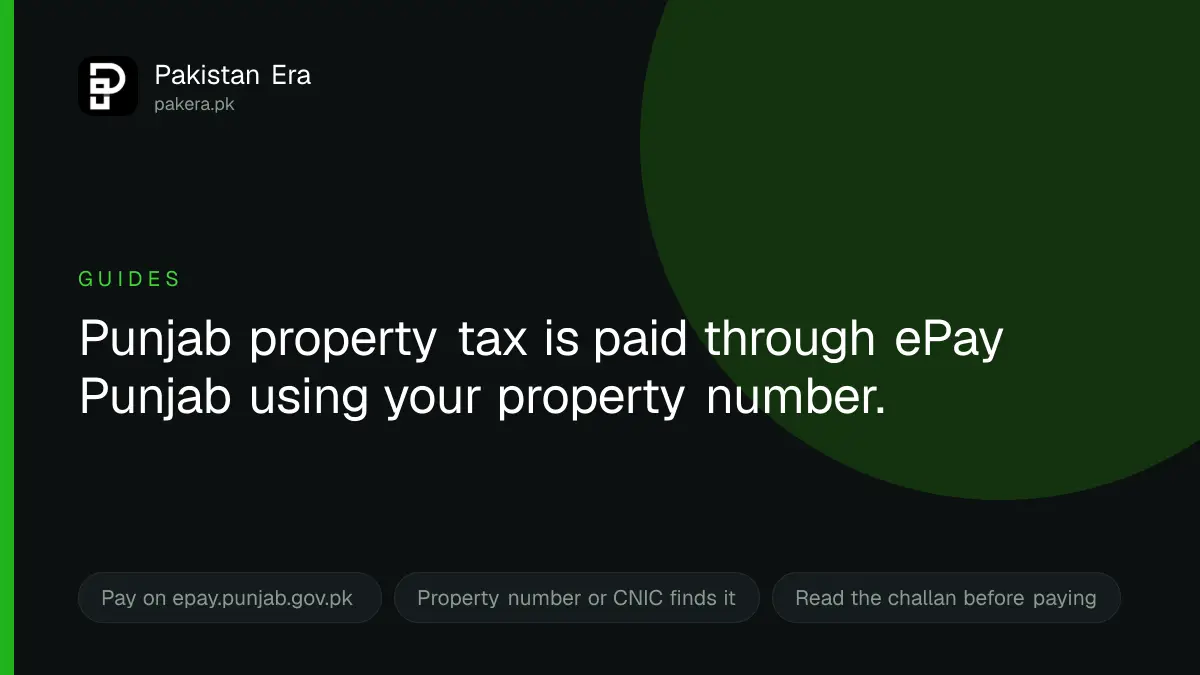
To pay Punjab property tax online, open epay.punjab.gov.pk or the ePay Punjab app, choose Excise and Taxation, then Property Tax, enter your property number or CNIC, check the challan and pay its PSID by internet banking, ATM, mobile wallet or at a bank. Pay the full year by 30 September to get 5 per cent off.
The tax itself is now worked out on capital value: the Excise department's calculator page exempts homes valued up to Rs 5 million and charges 0.07 to 0.09 per cent above that.
The one thing to sort out first is how your property is identified, because that is where most people stall before they have paid anything.
Find the property first, then pay
The system needs to know which property you are paying for. There are two usual ways in.
| Identifier | Where it comes from | Note |
|---|---|---|
| Property number, the PTN | A previous tax challan or notice | The most reliable route |
| CNIC | Your own identity card | Works where the property is recorded against you |
| Challan verification | The Excise and Taxation Punjab services page | Lets you view and download the challan |
If you have never had a challan and the CNIC search finds nothing, the property may not be recorded against you, which is a different problem from a payment problem. That happens after a purchase where the record was never transferred, and it is dealt with at the Excise and Taxation office rather than in the app.
Paying it, step by step
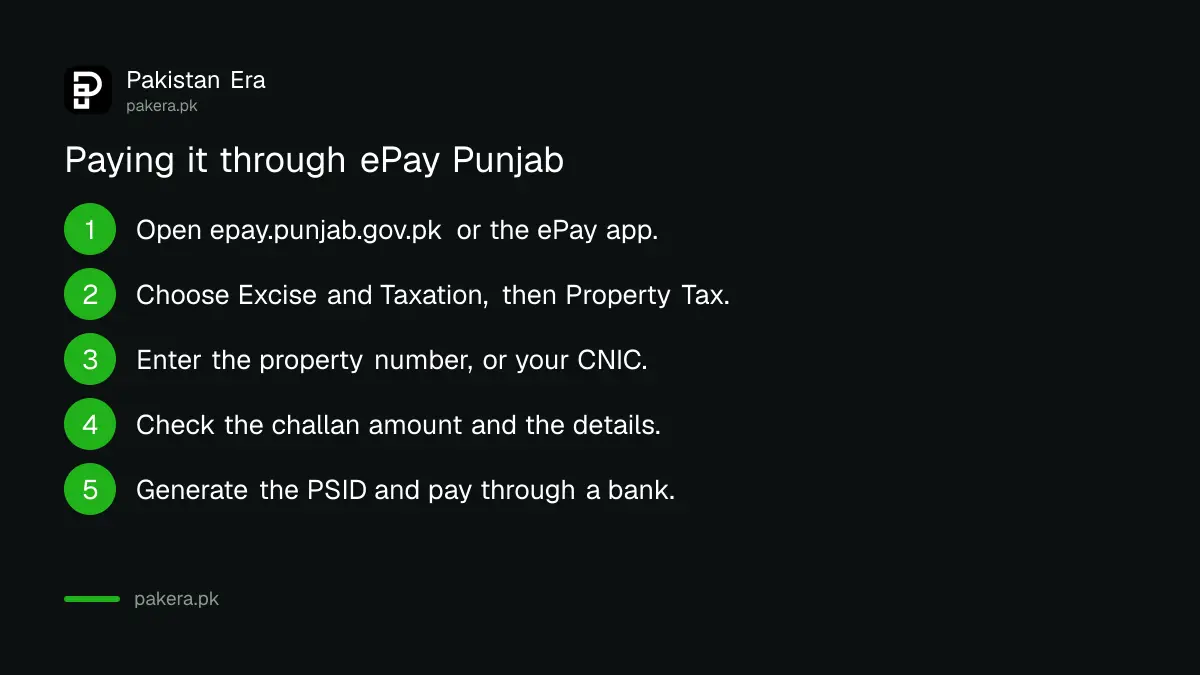
- Open epay.punjab.gov.pk or the ePay Punjab app.
- Choose Excise and Taxation, then Property Tax.
- Enter your property number, or your CNIC if that is what you have.
- Read the challan that appears and check the amount and the property details.
- Generate the PSID and pay it through internet banking, an ATM, a mobile wallet, or over the counter at a partner bank.
The PSID is the payment identifier that connects your money to the right challan. Keep it, and keep the receipt, because a payment you cannot evidence is a payment you may have to make again.
Check the challan before you pay it
Read what is on the screen rather than paying the number at the bottom. Check the property details, the tax year the challan covers, and whether any arrears or surcharge have been added to it.
If the amount looks wrong, do not simply pay and argue afterwards. Getting money back is far harder than questioning a figure before it leaves your account. Take the challan to the Excise and Taxation office and ask what the assessment is based on, and note the time limits in our guide to objecting to a Punjab property tax assessment.
You can also check a PT-5 challan online with your CNIC and the PIN printed on it. Our guide to the Punjab property tax calculator and PT-5 check explains both tools and the capital value rate table.
The date that changes the amount
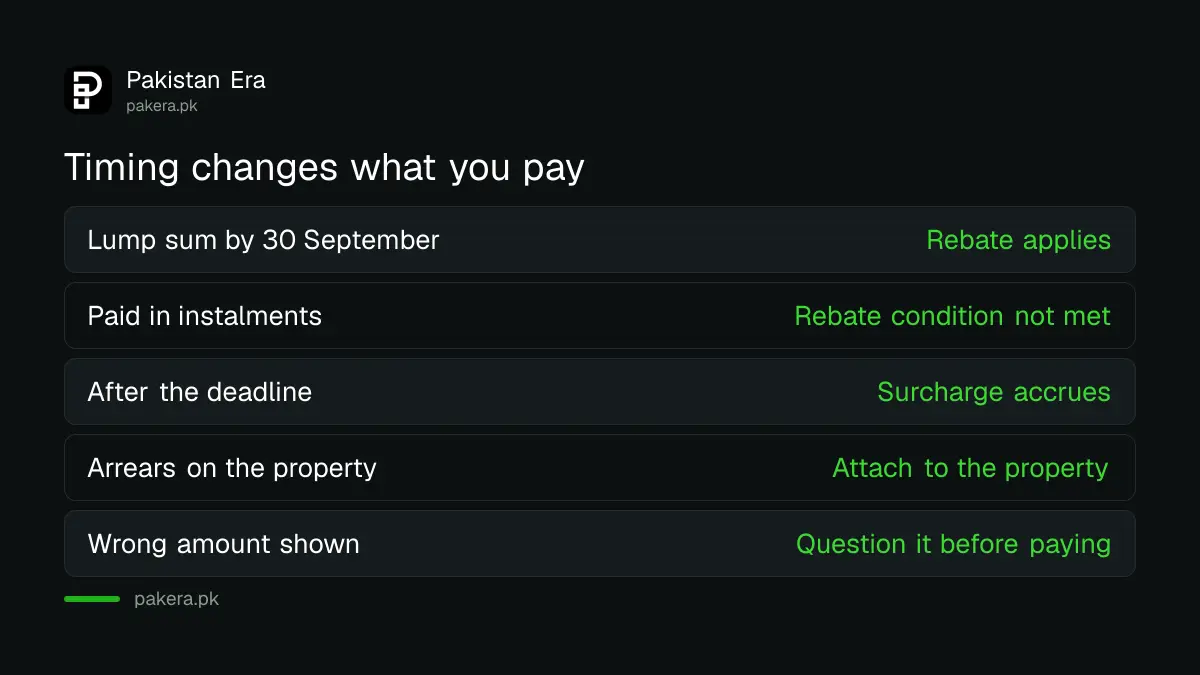
Timing changes what you pay. Pay the year's tax in a single lump sum by 30 September and 5 per cent comes off. Miss it and 1 per cent of the gross tax is added on 1 October, then again on 1 January, 1 April and 1 July, under the Act as amended in 2026.
We set out the rebate, the lump sum condition and the surcharge in our piece on the 30 September property tax deadline. Read that before deciding whether to pay in one go or in instalments, because the rebate is conditional on the lump sum.
Keep the record straight after a purchase
Buying a property does not automatically move the tax record into your name, and an unpaid amount from a previous owner attaches to the property rather than following the person. Check the position before you complete rather than after.
A sale also brings federal taxes: advance tax at transfer, and capital gains tax on the profit, set out in our guide to capital gains tax on property in Pakistan. Pull the record of the land itself as well, since the tax record and the ownership record are separate things maintained by different bodies. Our guide to getting a fard in Punjab covers the ownership side, and the sale documentation should be on proper e-stamp paper.
ePay handles more than property tax
The same app and website carry other provincial payments, which is worth knowing once you have set it up. Vehicle token tax is the one most people use next, and we cover it in our guide to paying token tax online.
Using the official channel matters more than convenience. Pay through ePay, a bank, an ATM or a recognised wallet, and never into a personal account offered by someone promising to settle it for you.
Common questions about Punjab property tax
Can I pay without a property number?
You can try the CNIC route, which works where the property is recorded against you. If nothing is found, the record itself may need attention at the Excise and Taxation office.
What is a PSID?
It is the payment identifier generated from your challan. You quote it at the bank, ATM or wallet so the payment reaches the right account.
Is there a discount for paying early?
Punjab offers a rebate for a lump sum payment by 30 September. The lump sum condition is the part people miss, and we cover it in the linked piece.
What happens if I pay late?
You lose the 5 per cent rebate, and 1 per cent of the gross tax is added on 1 October, 1 January, 1 April and 1 July. If you disagree with the assessment, object at the Excise and Taxation office before paying, within the time limit on your notice.
Does this cover Sindh or Khyber Pakhtunkhwa?
No. Property tax is provincial. ePay Punjab and Excise and Taxation Punjab cover Punjab only. For Karachi and the rest of Sindh, see our guide to Sindh property tax, and for a cantonment area, cantonment board property tax.
How we verified this
What we checked and where we read it.
Last checked 8 November 2026. Sources: ePay Punjab (titled Online Payment of Govt. Receipts) and the capital value rate table on the Excise, Taxation and Narcotics Control Department's property tax calculator page. The rebate and quarterly surcharge follow section 12(3) of the Punjab Urban Immovable Property Tax Act, 1958 as amended by the Punjab Finance Act 2026, covered with its sources in our Punjab property tax rebate guide.
About the author

Tax, Bills and Technology Writer
Ali Akhtar is a young and curious voice here at Pakistan Era. He is currently pursuing his A-Levels and has a growing interest in Pakistan’s changing industrial landscape and educational trends. Ali likes to write in a way that helps him explain and explore the world around him. His writing reflects the perspective of the new generation navigating the evolving trends of Pakistan where technology, youth innovation, and shifting opportunities are reshaping the country’s future.