What Sindh Property Tax Actually Costs
The 25 per cent applies to annual rental value from a table, not to what the house is worth. How the figure is built and what to check first.
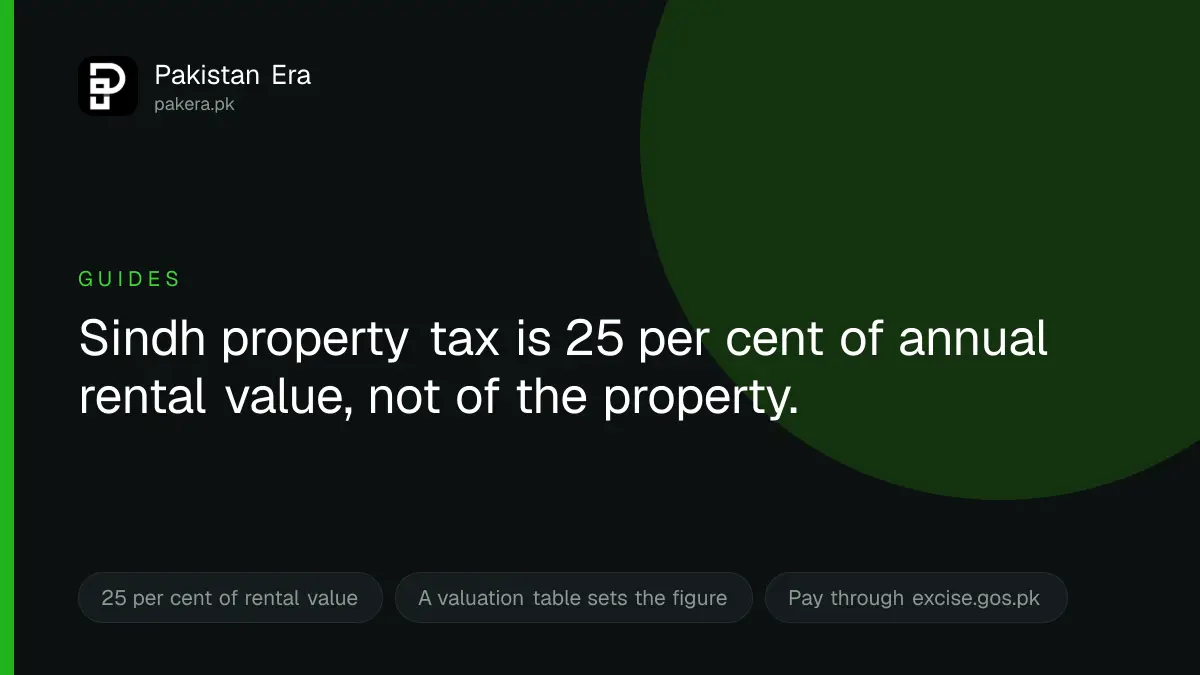
Sindh charges 25 per cent, but not of what your property is worth. The rate applies to the annual rental value, which is a notional figure worked out from a valuation table, not to the market price of the house.
We read that on the Excise, Taxation and Narcotics Control Department's own page on 29 August 2026, where it says a uniform rate is levied on all categories of properties at 25 per cent of annual rental value under the Sindh Urban Immovable Property Tax Act, 1958.
Why 25 per cent is not as alarming as it sounds
People hear the figure and assume a quarter of their property's value is due every year. It is not. The tax is a quarter of the annual value, and the annual value is an estimate of what the property could earn in rent over a year, set by a table rather than by the market.
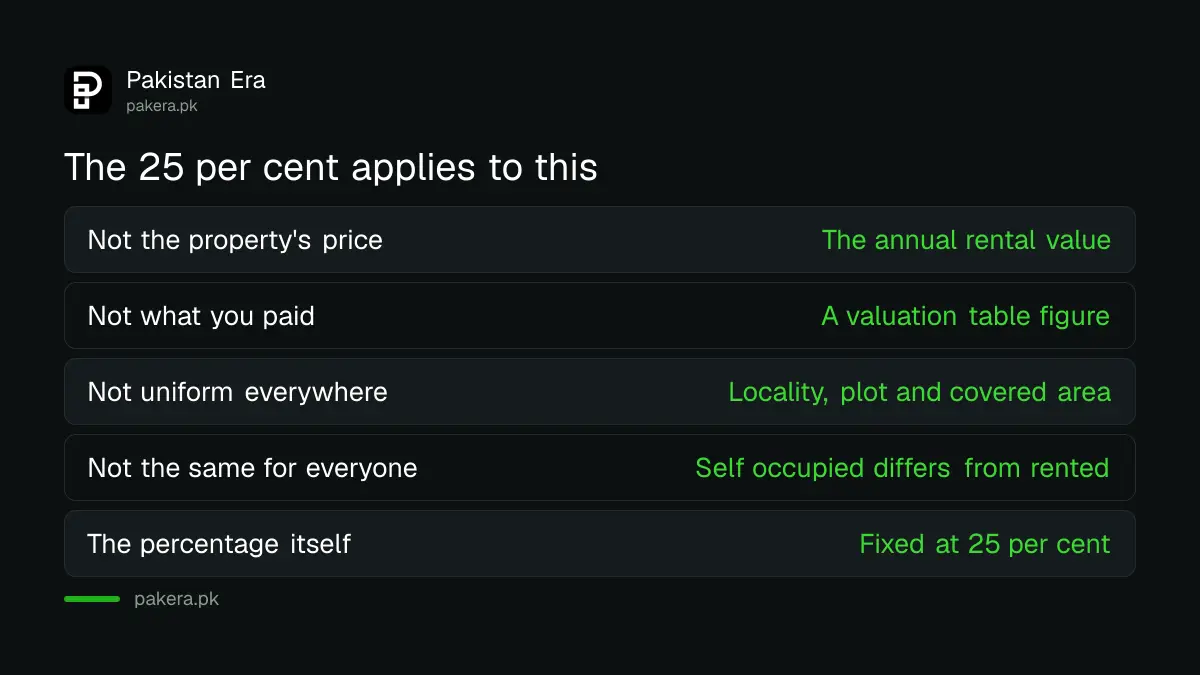
| What it is not | What it is |
|---|---|
| 25 per cent of the property's price | 25 per cent of the annual rental value |
| Based on what you paid | Based on a valuation table |
| The same everywhere | Set by locality, plot size and covered area |
| The same whoever lives there | Self occupied and rented are treated differently |
The department's page describes the annual value as determined from the size of the plot and a rate, with cities across Sindh divided into notified rating areas and localities categorised for the purpose. So two identical houses in different areas can carry different bills.
How the figure is built
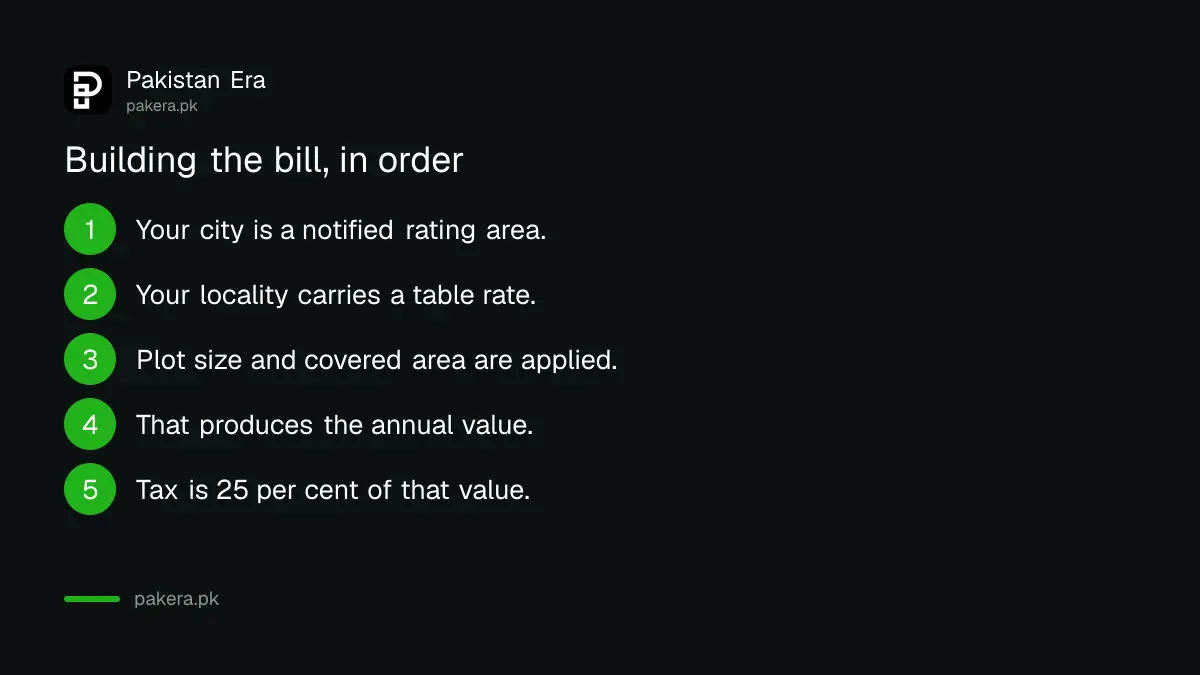
The chain runs from the property to the bill in a fixed order, and knowing it tells you which part to question if the amount looks wrong.
- Your city is a notified rating area, divided into categorised localities.
- Your locality carries a rate under the valuation table.
- Plot size and covered area are applied to that rate.
- That produces the annual value for your property unit.
- The tax is 25 per cent of that annual value.
An amount that looks too high is usually a problem with one of the first three steps rather than with the percentage, which is fixed. Wrong covered area and wrong locality category are the common ones.
Paying it
Payment runs through the department's own online channel and through the provincial e-pay system. Open the Excise and Taxation Sindh site, choose online tax payment and then property tax, and identify the property by its property number or by CNIC.
Read the challan that appears before paying it. Check the property details and the period covered, and check whether arrears have been added. Payment is reported to be possible through Sindh Bank, through 1Link and through supported mobile wallets, and there is an ePay Sindh mobile application as well.
Punjab works differently, so do not carry assumptions across
Property tax is provincial. Sindh and Punjab have separate statutes, separate valuation tables, separate portals and separate rebate arrangements, so a rule you heard about one does not transfer to the other.
If your property is in Punjab, our guide to paying Punjab property tax online covers that system, including the rebate deadline that Sindh does not share. Owning in both provinces means dealing with both, separately.
Check the record before you check the bill
If a search by CNIC returns nothing, the likely explanation is that the property is not recorded against you rather than that no tax is due. That happens after a purchase where the record was never transferred, and it is a record problem to fix at the office rather than a payment problem.
Arrears attach to the property rather than to the person who lived there, so an unpaid balance from a previous owner becomes the current owner's obstacle. Establish the position before you buy, not after. For land records in Punjab we cover getting a fard, and Sindh maintains its own separate system.
Common questions about Sindh property tax
Is it really 25 per cent?
Yes, but of the annual rental value rather than of the property's price. The department's own page states a uniform 25 per cent of annual rental value.
How is the annual value decided?
From a valuation table, using the locality category, plot size and covered area, with cities divided into notified rating areas.
Does it matter whether I live in it or rent it out?
Self occupied and rented properties are treated differently in the valuation. Check which basis your assessment used.
Where do I pay?
Through the Excise and Taxation Sindh online payment section or the ePay Sindh application, identifying the property by number or CNIC.
My bill looks too high. What do I check?
The covered area and the locality category first, since the 25 per cent itself is fixed. Take the challan to the office rather than paying and arguing later.
How we verified this
What we checked, where we read it, and what we could not confirm.
Last checked 29 August 2026. We read on the Excise, Taxation and Narcotics Control Department's own property tax page at excise.gos.pk that property tax is levied under the Sindh Urban Immovable Property Tax Act, 1958, that a uniform rate of 25 per cent of annual rental value applies to all categories of property, and that the annual value is determined from plot size and a rate with cities divided into notified rating areas. The payment channels, including Sindh Bank, 1Link, mobile wallets and the ePay Sindh application, are reported rather than read at source. No rupee figure or valuation table rate is quoted here, because those vary by locality and only your own challan is authoritative for your property.
About the author

Tax, Bills and Technology Writer
Ali Akhtar is a young and curious voice here at Pakistan Era. He is currently pursuing his A-Levels and has a growing interest in Pakistan’s changing industrial landscape and educational trends. Ali likes to write in a way that helps him explain and explore the world around him. His writing reflects the perspective of the new generation navigating the evolving trends of Pakistan where technology, youth innovation, and shifting opportunities are reshaping the country’s future.