How to Get a Fard of Your Land in Punjab
A Punjab fard comes from the Arazi Record Centre or punjab-zameen.gov.pk. What you need, the two types, and how to read it before you buy.
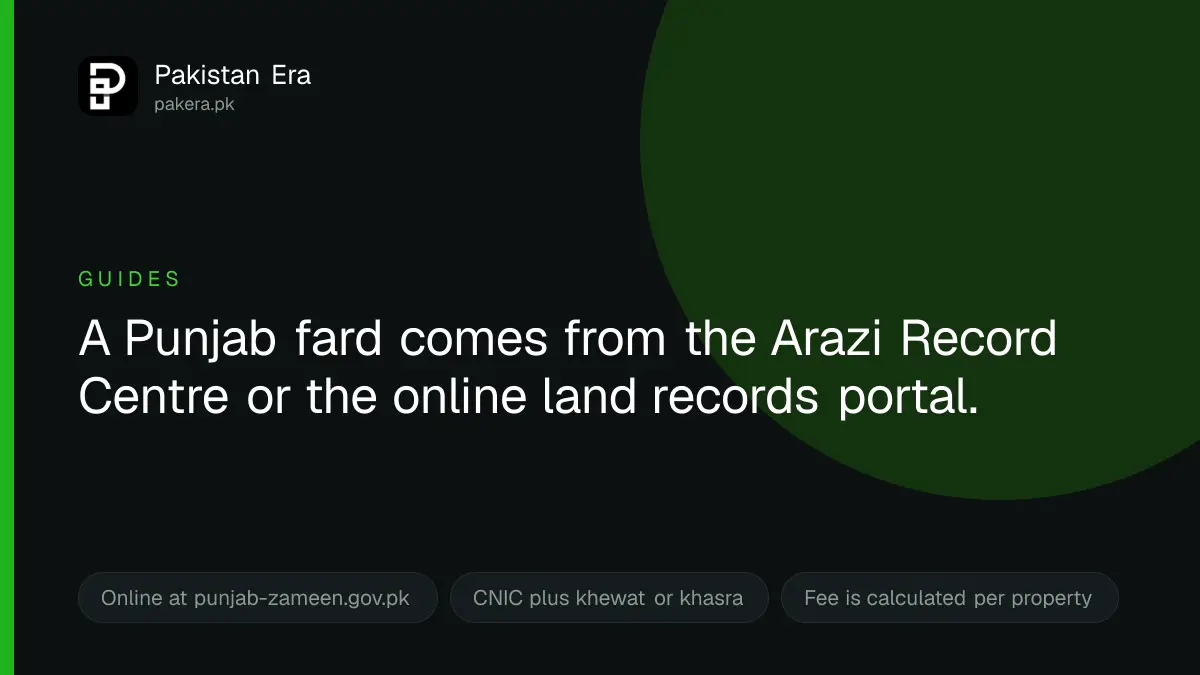
You do not need a patwari to get a fard in Punjab. The land record was computerised, and a fard now comes from an Arazi Record Centre or from the Punjab Land Records Authority portal at punjab-zameen.gov.pk. We opened that portal on 26 August 2026 and it responded.
Update, 11 October 2026: PLRA also issues a Green Property Certificate for a Rs 900 initial fee.
A fard is the record of rights for a piece of land. It names who owns it, how much of it they own, and what is registered against it. You need one to sell land, to buy it safely, to raise a loan against it, to transfer it after a death, and in most property disputes.
The two kinds of fard, and why the difference matters
Asking for the wrong one wastes a trip, because they are issued for different purposes and priced differently.
| Type | What it is for | Practical note |
|---|---|---|
| Fard for information | Checking a record, personal use | Cheaper, not for registering a sale |
| Fard for sale, also called fard bai | Registering a transfer or mutation | Required when money changes hands |
| Fard for a loan | Offering land as security | The bank will tell you what it needs |
If you are buying, the fard the seller shows you should be recent. An old fard proves what was true on the day it was issued and nothing about today, which is precisely how buyers get caught.
What you need before you start
The record is indexed by land, not by name, so a name alone is usually not enough.
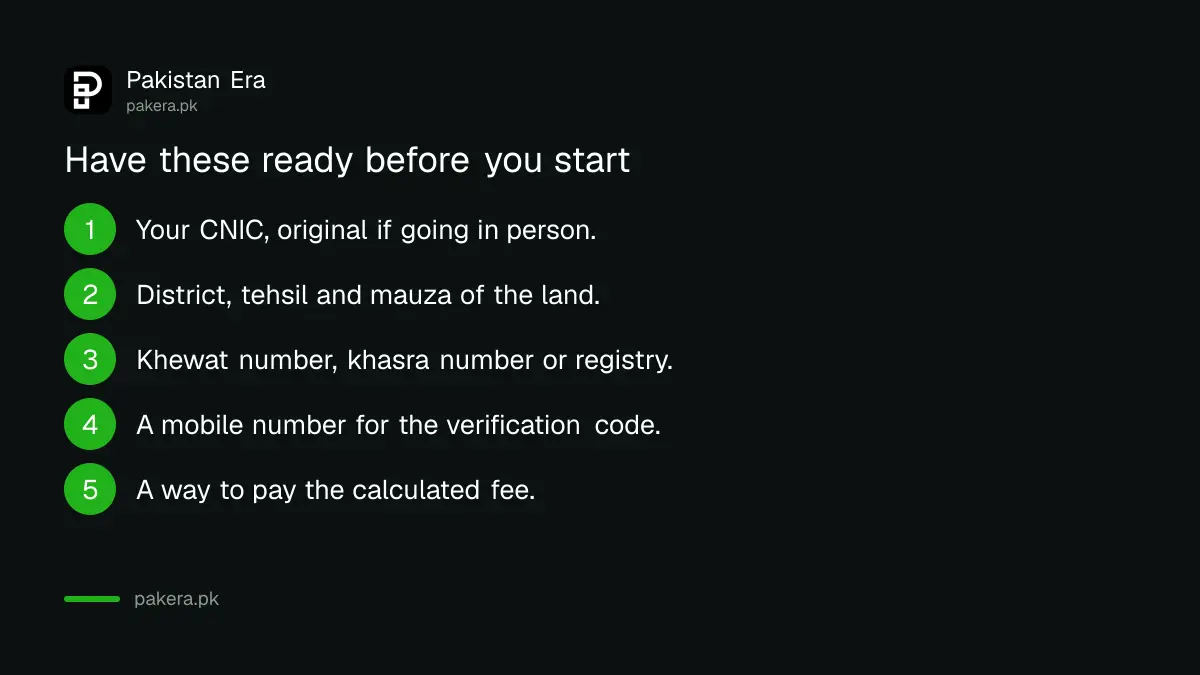
- Your CNIC, and the original if you are going in person.
- The district, tehsil and mauza, which is the revenue estate or village.
- The khewat number, the khasra number, or the registry, whichever you have.
- A mobile number that can receive a verification code.
- A way to pay the fee, since the amount is calculated by the system.
If you have none of the land numbers, take whatever document you do have to the Arazi Record Centre for the tehsil where the land sits. Staff there can search on the owner name within that estate, which is far harder to do from home.
Getting it from the portal
Register or log in on punjab-zameen.gov.pk using your CNIC and mobile number, then choose the fard service. Select the district, tehsil and mauza, enter the khewat or khasra number, and the system pulls the record for you to confirm before it charges anything.
The fee is generated by the system rather than fixed, because it depends on the property, the khewat and khatooni entries and the area involved. We could not read a single flat figure on a PLRA page, so we are not quoting one. Whatever the portal shows you at the payment step is the amount, and you should not pay a different figure to anybody else.
Once paid and approved, you either download the fard or collect it from the Arazi Record Centre, depending on the type you asked for.
Getting it in person, which is still the surer route
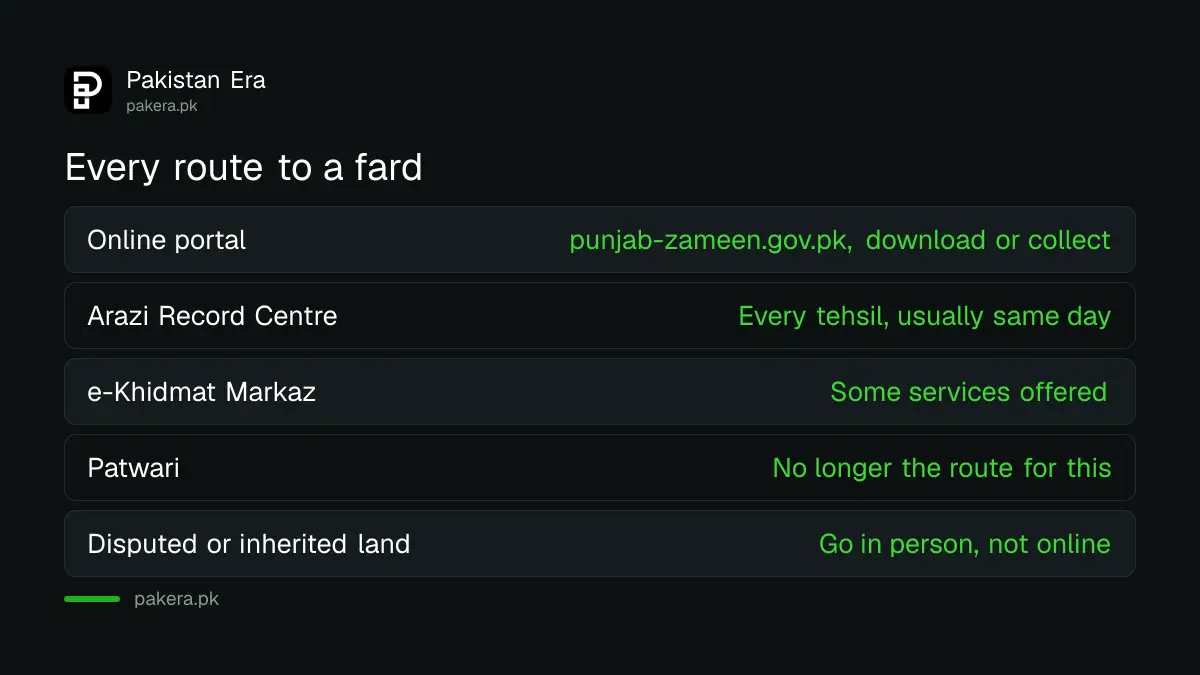
Arazi Record Centres exist in every tehsil and are the offices that replaced the patwari for this purpose. Take your CNIC and the land details, take a token, and the fard is issued the same day in ordinary cases.
Some services are also offered through e-Khidmat Markaz centres. Go in person if the record is disputed, if the land has been through an inheritance, if the names on the record are spelled differently from your CNIC, or if the online search returns nothing. Those cases need a human to look at the entry.
Read the fard before you rely on it
People collect a fard and file it without reading it, which defeats the point. Check the owner name against the CNIC of the person you are dealing with, letter by letter. Check the share, because land is often held in fractions and the seller may own less than they say. Check the total area against what you were shown on the ground.
Look for anything recorded against the land, such as a mortgage, an inheritance not yet divided, or a pending mutation. If the fard shows the land still in the name of somebody who has died, the transfer has not happened, and the person selling it may not yet be legally able to. That is a matter for a succession certificate before any money moves.
Nobody needs to be paid to fetch this for you
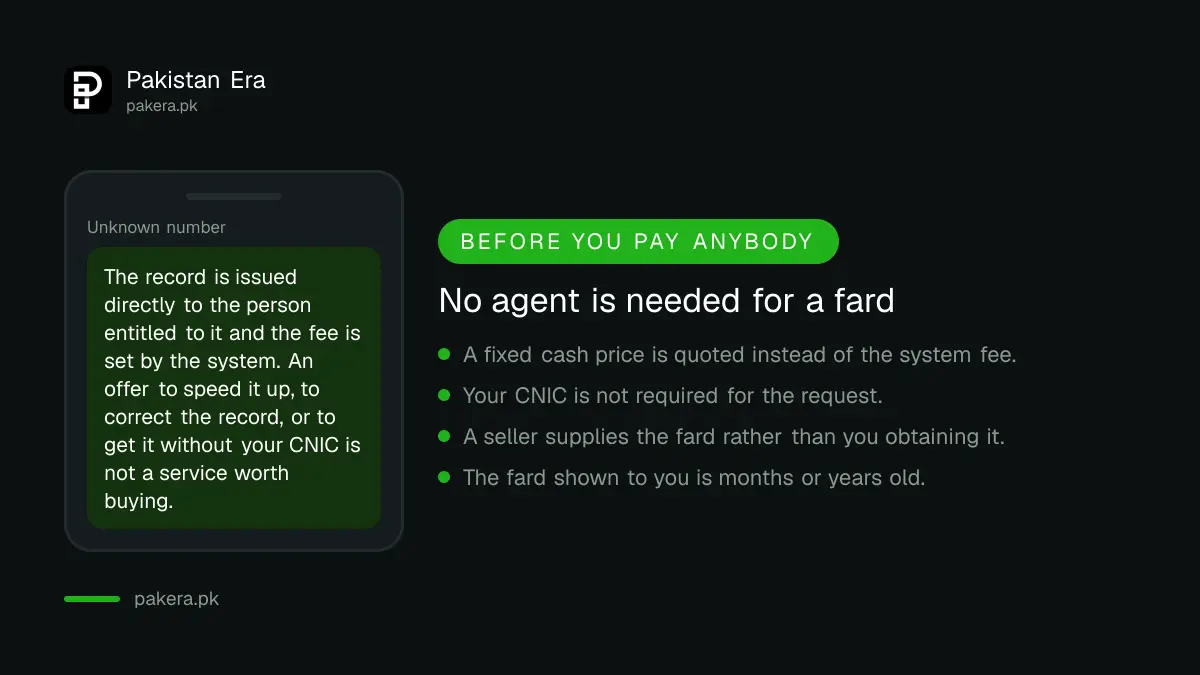
The record is public to the person entitled to it, the fee is set by the system, and the centre issues it directly. An offer to speed it up, to fix the record, or to obtain it without your CNIC is not a service you want to buy.
Be equally careful with a fard handed to you by a seller rather than obtained by you. Verify it yourself against the portal or the centre before any payment, and keep the transaction on a documented footing, with the sale agreement on proper e-stamp paper rather than a plain sheet. The same applies if you are renting the land out afterwards, where a stamped rent agreement is what makes the arrangement enforceable.
Common questions about getting a fard
Can I get a fard with only my CNIC?
Sometimes, if the record can be matched to you, but the search is built around the land. Bring the district, tehsil, mauza and a khewat or khasra number if you possibly can.
How much does a fard cost?
There is no single figure. The portal calculates it from the property details, and the amount shown at the payment step is the amount. We could not find a flat rate published, so we do not quote one.
Is an online fard accepted for a sale?
A fard for information is not the one used to register a transfer. Ask for the sale type, and expect to deal with the Arazi Record Centre for the mutation itself.
What if the land is not in the computerised record?
Some entries, particularly older or disputed ones, are not fully mapped. Go to the Arazi Record Centre for the tehsil with whatever paperwork exists, since that cannot be resolved online.
Does this work for property outside Punjab?
No. Land record is a provincial subject and this portal covers Punjab only. Sindh, Khyber Pakhtunkhwa and Balochistan run their own systems.
How we verified this
What we checked, where we read it, and what we could not confirm.
Last checked 26 August 2026. We opened punjab-zameen.gov.pk on that date and it responded, but the site is a JavaScript application whose text we could not read directly, so the service names and the process described here come from the portal's own published service listing and from reporting of it rather than from a page we could read end to end. We have not quoted a fee because we could not find one published as a flat figure, and the fee is in any case calculated per property. We hold no land record and did not order a fard, so nothing here describes a transaction we completed.
About the author

Senior Writer, Public Services and Technology
Shahid joined us in 2024 as an author. He is a senior contributor to Pakistan's leading technology websites. He writes detailed articles, mostly covering his expertise in the latest tech, mobiles, apps, gadgets, and step-by-step guides. His ideology is to help people understand the latest trends and explain complex methods through very easy-to-understand guides.