Punjab Land Record Fees 2026-27: Fard Rs 900, Mutation Rs 1,200, Registration 0.1%
Check the reported 2026-27 PLRA service charges for a Fard, mutation, bank verification and e-registration in Punjab, and the one fee where sources disagree.
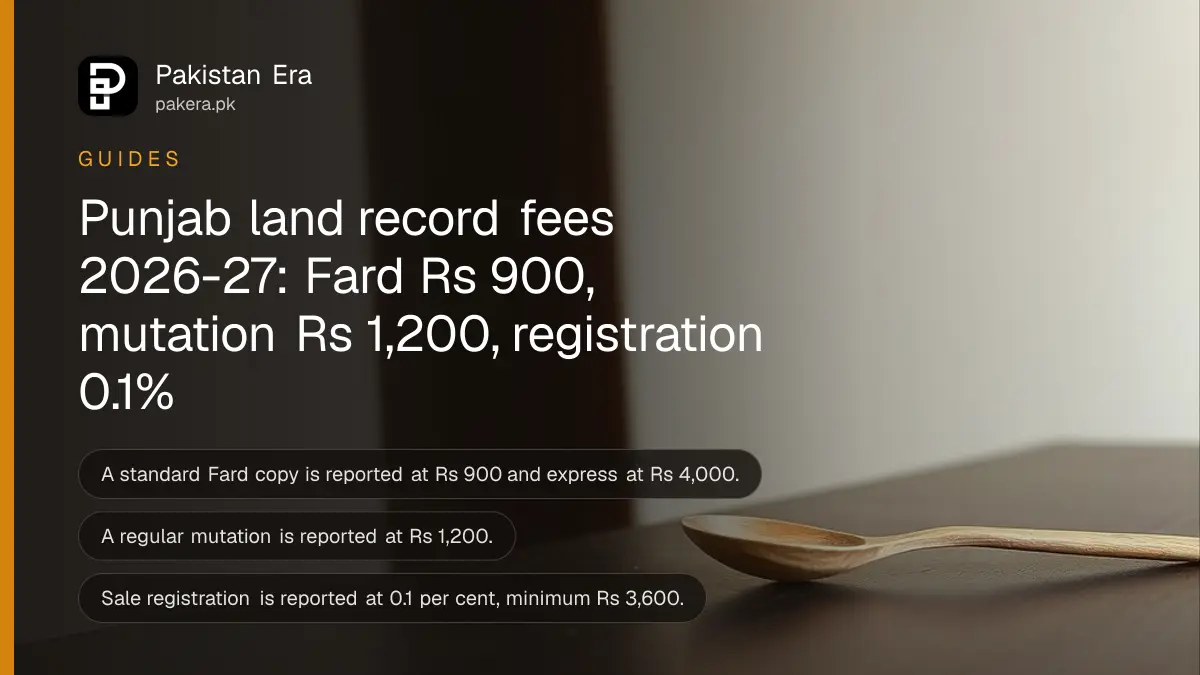
Short answer: The Punjab Land Records Authority (PLRA) revised its service charges for 2026-27 in a notification dated 9 July 2026, as reported. A standard Fard copy is Rs 900, a regular mutation is Rs 1,200 and a sale registration is 0.1 per cent of land value, with a minimum of Rs 3,600.
Land fees in Punjab changed at the start of the 2026-27 year. Many pages still quote old amounts, and some agents quote their own. Use this list to know what the office should charge before you pay.
Every fee below is reported from a July 2026 account of the notification. Check the amount on your PSID or challan before you pay.
As an example from the reported schedule, a standard Fard copy at Rs 900 plus a regular mutation at Rs 1,200 comes to Rs 2,100 in service charges. An express copy at Rs 4,000 costs Rs 3,100 more than a standard one. The figures are reported, so the amount on your challan is the one to pay.
The fees reported for 2026-27
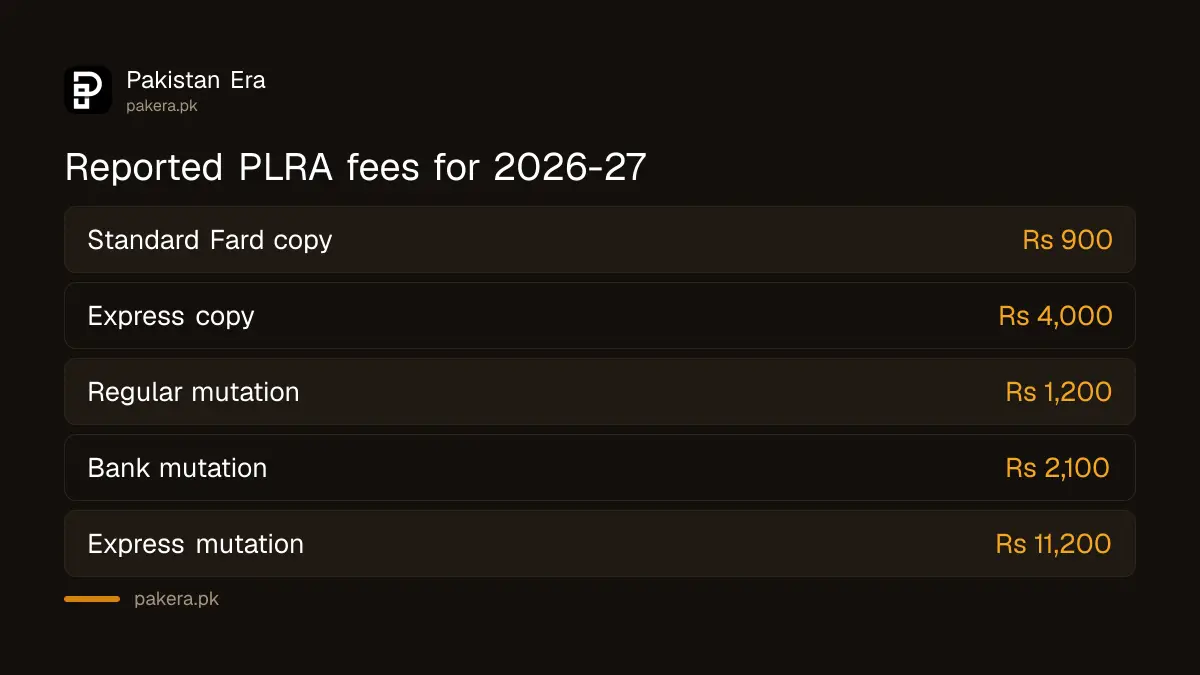
The reported schedule has one standard Fard fee of Rs 900, an express copy of Rs 4,000, a regular mutation of Rs 1,200, a bank mutation of Rs 2,100, an express mutation of Rs 11,200, and a sale registration charge of 0.1 per cent of value with a Rs 3,600 minimum.
| Service | Reported fee 2026-27 |
|---|---|
| Standard copy of Fard, mutation or Girdawari | Rs 900 |
| Express copy of the same records | Rs 4,000 |
| Regular mutation | Rs 1,200 |
| Bank mutation | Rs 2,100 |
| Express mutation | Rs 11,200 |
| Registered deed copy | Rs 1,400 per transaction |
| Bank verification, successful | Rs 1,000 |
| Bank verification, unsuccessful | Rs 700 |
E-registration and transfer system charges
For e-registration, the reported charge is 0.1 per cent of land value on a sale or purchase, with a minimum of Rs 3,600. Other e-registration transactions are Rs 3,600. A transfer through the Property Transfer System for housing societies and authorities is Rs 3,000.
These are service charges, not stamp duty or tax. Stamp duty, registration fee, capital value tax and advance tax are separate and follow other rules. Our guide on registering property online in Punjab shows how the whole bill fits together.
| Service | Reported charge |
|---|---|
| E-registration of a sale or purchase | 0.1 per cent of value, minimum Rs 3,600 |
| Other e-registration transactions | Rs 3,600 |
| Appointing a commission through e-registration | Rs 6,700 |
| Property Transfer System for societies and authorities | Rs 3,000 |
| Filing a case in the Revenue Courts Management System | Rs 3,500 |
For the housing society route, read transferring a plot through PLRA's Property Transfer System.
Overseas Pakistanis pay in dollars
The same report says service through foreign missions carries an extra USD 50 charge per transaction, and appointing a foreign mission as commission under e-registration costs USD 100. These apply to overseas applicants only.
If you live abroad, add these to the local fees above and ask the mission which amount it will collect. Our guide on making a power of attorney from abroad covers the document side.
One conflict: the Green Property Certificate fee
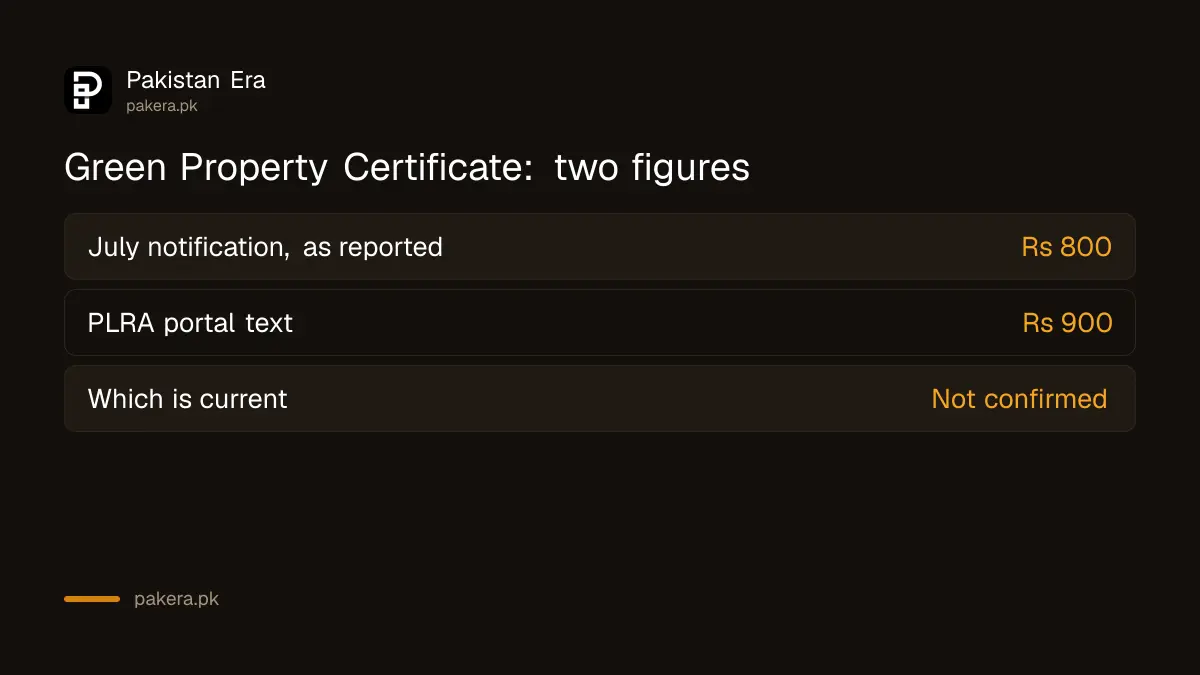
The report of the July notification lists the Green Property Certificate at Rs 800. PLRA's own portal text, as read for our Green Property Certificate guide, gives an initial processing fee of Rs 900. Check your challan to see which applies.
The difference may be timing or what each figure includes. Pay what your challan shows, keep the receipt, and compare it with the amount PLRA shows on its own page.
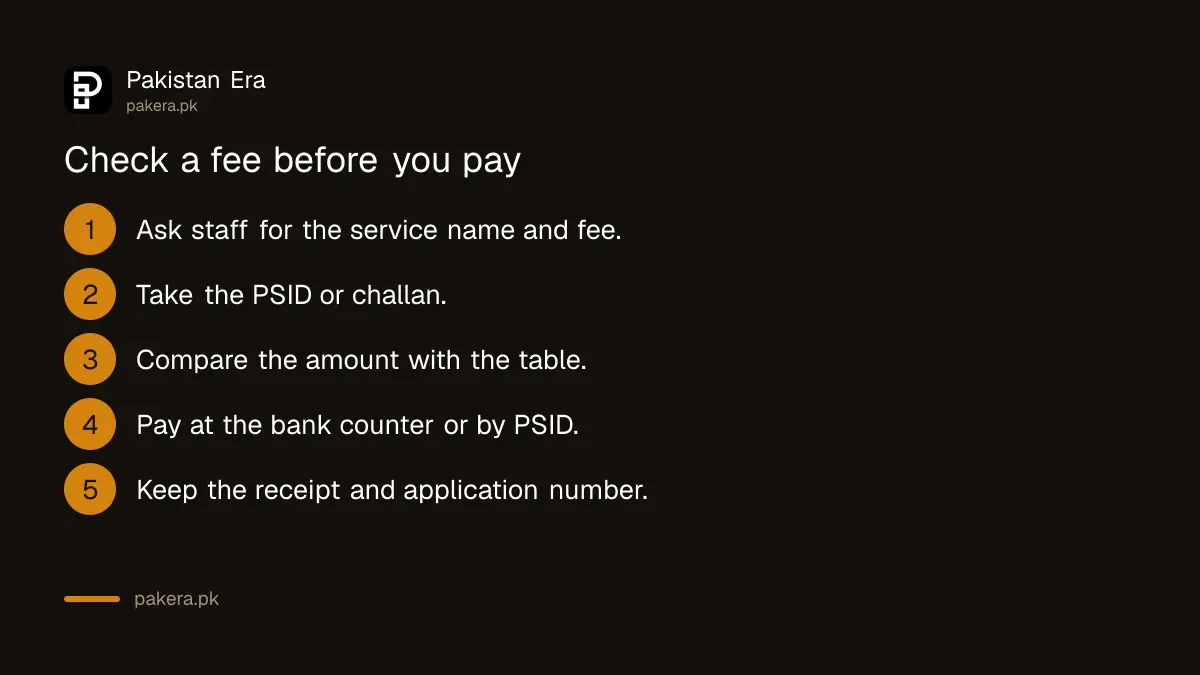
How to check a fee before you pay
Ask for the PSID or challan, read the amount, and compare it with the table. Pay only at a Bank of Punjab counter, branch or through the PSID. Do not pay cash to an agent, and keep the receipt for the transaction.
- Ask the centre staff for the service name and the exact fee.
- Take the PSID or challan, and read the amount and service name on it.
- Compare with the table. If it is higher, ask which line makes up the difference.
- Pay through the bank counter or the PSID, never to a person.
- Keep the receipt and the application number until the record shows the change.
To find a centre, read how to find the nearest PLRA land record centre. To record a sale at one, see recording a land sale mutation at an Arazi Record Centre.
Common questions
How much is a Fard in Punjab in 2026-27?
A standard copy is reported at Rs 900, and an express copy at Rs 4,000. Check your challan.
How much is a mutation in Punjab?
A regular mutation is reported at Rs 1,200. A bank mutation is Rs 2,100, and an express mutation is Rs 11,200.
Is the 0.1 per cent charge the same as stamp duty?
No. It is PLRA's e-registration service charge. Stamp duty, registration fee and taxes are separate.
Do these fees apply outside Punjab?
No. They are Punjab Land Records Authority charges. Sindh, Khyber Pakhtunkhwa, Balochistan and Islamabad have their own fees.
Why does another page show a different fee?
Fees were revised in July 2026, and older pages keep old amounts. The Green Property Certificate fee also differs between the report and PLRA's portal, as noted above.
How we verified this
What we checked and where we read it.
Last checked 12 October 2026. The fee figures come from a report on the PLRA notification dated 9 July 2026 for fiscal year 2026-27, so they are marked as reported. PLRA's portal is the place to confirm them. Fees can change in a later notification.
About the author

Public Services and Education Journalist
Fajr Riaz is a journalist and content writer at Pakistan Era, based in Lahore. She covers the questions people meet in everyday life in Pakistan: how a public service works, what a change in the rules means, and where to find a reliable answer.