How to Make a Power of Attorney From Abroad
A power of attorney signed abroad needs consular attestation to work in Pakistan. The chain, the wording that protects you, and how to revoke it.
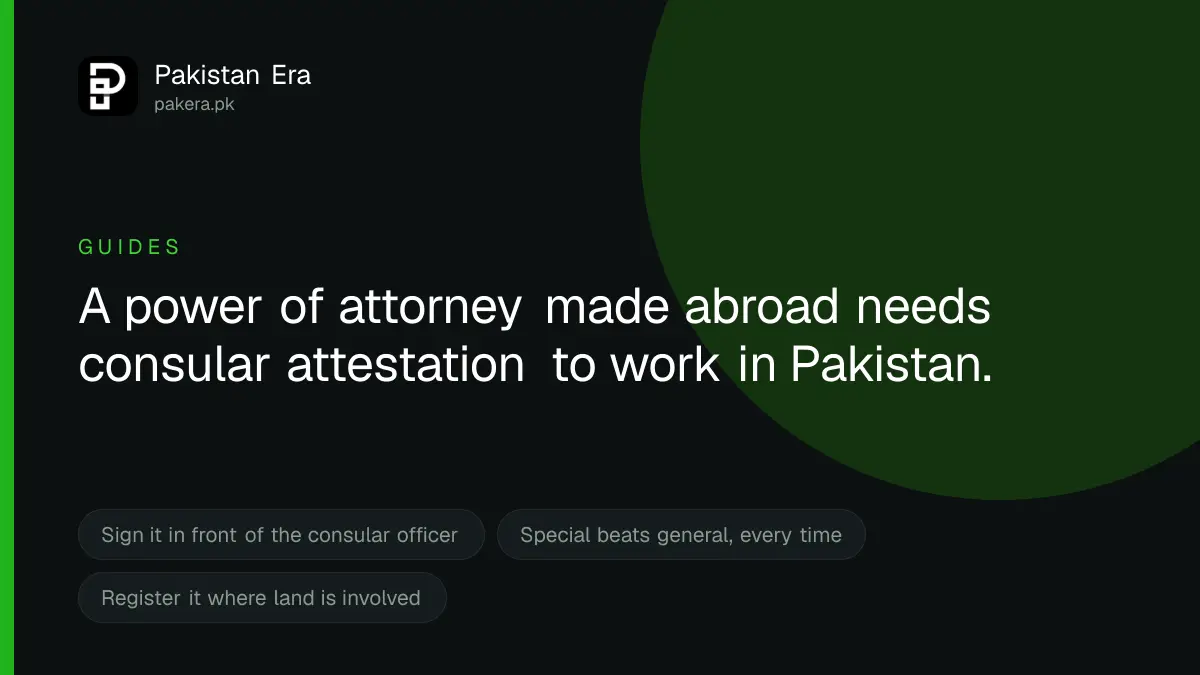
Give a special power of attorney, not a general one. If you take one thing from this page, take that. A general power of attorney hands somebody broad authority over your affairs, and it is the instrument behind a large share of property disputes involving overseas Pakistanis. A special power of attorney authorises one named act and nothing else.
A power of attorney signed abroad does not work in Pakistan by itself. It has to be attested through the consular chain first, and where it concerns land it normally has to be registered as well.
Special against general, and why it matters
| Type | What it gives away | When it fits |
|---|---|---|
| Special power of attorney | Authority for one named act on one named property | Almost always the right choice |
| General power of attorney | Broad authority across your affairs | Rarely, and never casually |
Name the act, name the property, and put an end date on it. A document that says your brother may sell plot number such and such in a named scheme, and expires in six months, is a very different exposure from one that says he may act generally on your behalf.
Be equally careful about who holds it. Most of these disputes are not strangers defrauding somebody. They are family arrangements that went wrong years later, and the paperwork decided the outcome.
The attestation chain
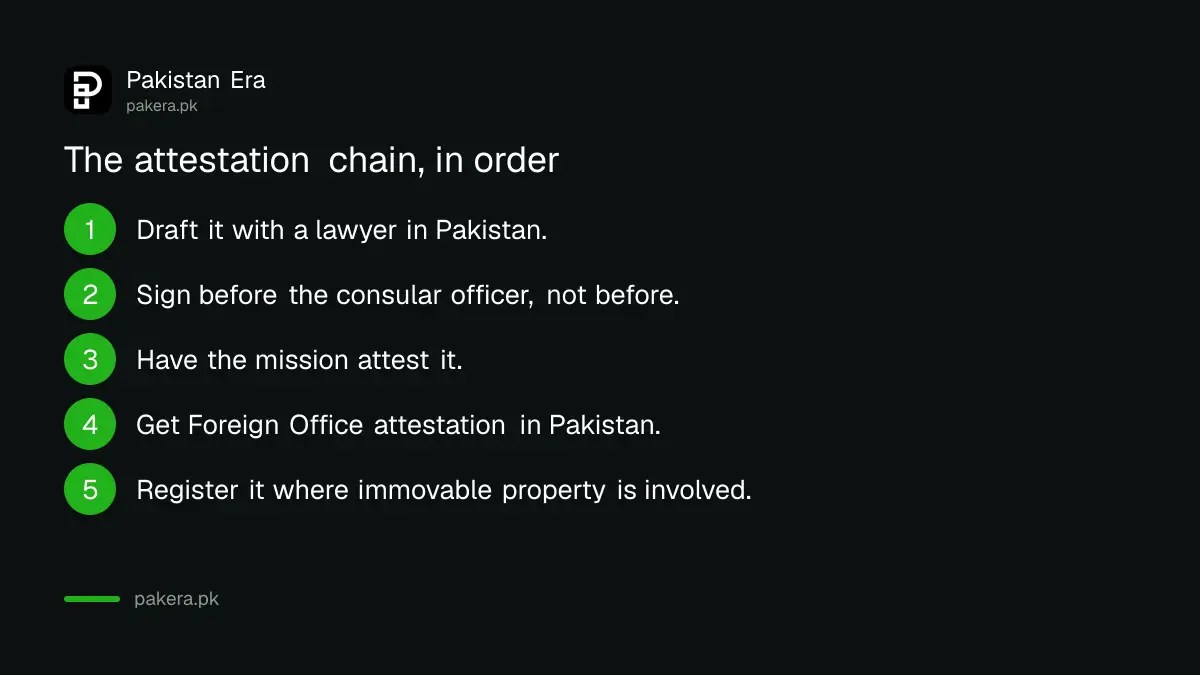
- Draft the document with a lawyer in Pakistan, so the wording matches what the office there will accept.
- Sign it before the consular officer at the Pakistani embassy or consulate, not before you go.
- Have the mission attest it.
- Get it attested in Pakistan by the Ministry of Foreign Affairs.
- Register it with the relevant sub registrar where it concerns immovable property.
The order is the point. Signing at home and taking it to the mission afterwards is the common mistake, because the officer is attesting that you signed in front of them. Expect to bring your NICOP or passport, photographs, and the identity details of the person you are appointing.
What the document should actually say
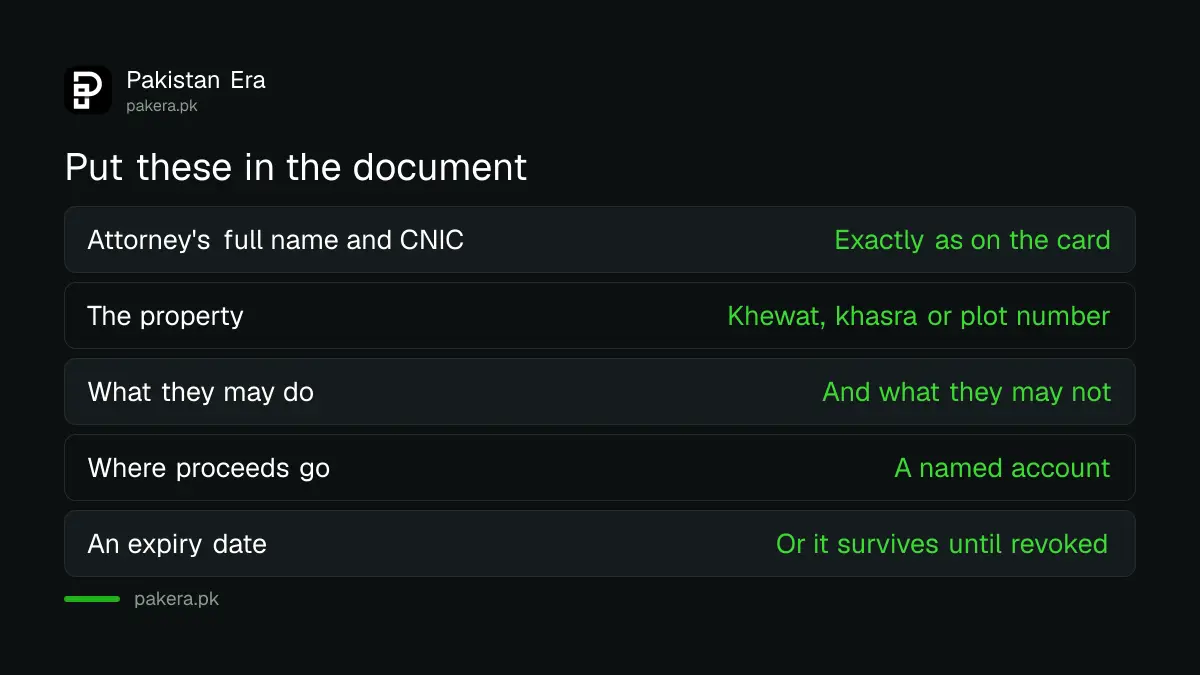
Vague drafting is what gets exploited. Name the attorney with their full name and CNIC number, exactly as those appear on the card. Describe the property precisely, using the khewat, khasra or plot number rather than a description of where it is.
State what the attorney may do and, just as importantly, what they may not. If they may sell but not mortgage, say so. If the sale proceeds must go to a named account, say so. If you want a floor price, put it in.
Put an expiry date on it, and keep a copy yourself. A power of attorney with no end date survives until it is revoked, and revoking one from abroad is harder than granting it.
Check the property before you authorise anything
Know what you actually own before you give anyone authority over it. Pull the record rather than relying on what you were told, and our guide to getting a fard in Punjab covers that for Punjab land.
If the property is still recorded in the name of a parent who has died, a power of attorney does not fix that. The inheritance has to be dealt with first, and our guide to succession certificates covers the route.
Revoking it is your right, and it takes effort
You can revoke a power of attorney. Doing it properly means executing a revocation through the same chain, notifying the attorney, and notifying anyone likely to rely on the original, including the registrar where it was registered.
Telling your cousin on the phone that the arrangement is over is not revocation. Until the paperwork catches up, a third party dealing in good faith on the original document is in a much stronger position than you would like.
Costs you should expect
There are fees at several points: the mission's attestation, the Foreign Office attestation, stamp duty and the registration fee. We are not quoting figures because they vary by country, by mission and by province, and a stale number here would be worse than none.
Ask the mission what it charges before you travel to it, and expect the Pakistan side to want the transaction documented properly, including on proper e-stamp paper where that applies.
Common questions about a power of attorney from abroad
Can I sign it in front of a local notary instead?
For use in Pakistan the consular route through the Pakistani mission is the one normally expected. Ask your lawyer in Pakistan before relying on a local notary alone.
Does it have to be registered?
Where it concerns immovable property, registration is normally required. For a limited act unrelated to land, requirements differ, so take advice on your specific case.
How long does the chain take?
It depends on the mission and on the Foreign Office. Start earlier than you think you need to, particularly if a transaction has a deadline.
Can I give it to more than one person?
Yes, and you can require them to act jointly rather than separately. Requiring both signatures is a simple protection worth considering.
What if my attorney refuses to hand back control?
That is a legal dispute and a lawyer in Pakistan is the answer, not a phone call. It is also the reason to prefer a narrow, dated document at the start.
How we verified this
What we checked, where we read it, and what we could not confirm.
Last checked 27 August 2026. The attestation chain described here, being consular attestation at the Pakistani mission followed by Ministry of Foreign Affairs attestation and then registration for immovable property, is reported from how the process is documented rather than read by us on a mission or Foreign Office page on that date. Requirements differ between missions and between provinces, and no fee is quoted anywhere on this page for that reason. This is general information and not legal advice. A power of attorney is a document that transfers real control over real assets, and it is worth a lawyer rather than a template.
About the author
Public Services and Education Journalist
Fajr Riaz is a journalist and content writer at Pakistan Era, based in Lahore. She covers the questions people meet in everyday life in Pakistan: how a public service works, what a change in the rules means, and where to find a reliable answer.