Register an Agreement to Sell or Power of Attorney for Property in Punjab: Section 17 and the 4 Month Rule
In Punjab an agreement to sell property and a power of attorney to sell it must be registered within 4 months, or section 49 says they give you no right.
Short answer: In Punjab, an agreement to sell immovable property worth Rs 100 or more, and a power of attorney that lets someone sell it, must both be registered. Section 17(1)(bb) of the Registration Act 1908 says so. Present the document within four months of signing. If you are late by up to four months, the Registrar can accept it for a fine of up to ten times the registration fee.
A buyer in Lahore pays a Rs 5 million "bayana" (advance) on a plain stamp-paper agreement and a sworn statement. The seller keeps the original and later sells to a second buyer, who registers first. The first buyer holds paper that never went near a Sub-Registrar. That is the gap this rule closes.
We read the Registration Act 1908, in the Punjab version with its amendment footnotes, on the Punjab Code, the provincial law database, on 12 October 2026. Section numbers below come from that text.
Section 17 lists the documents that must be registered
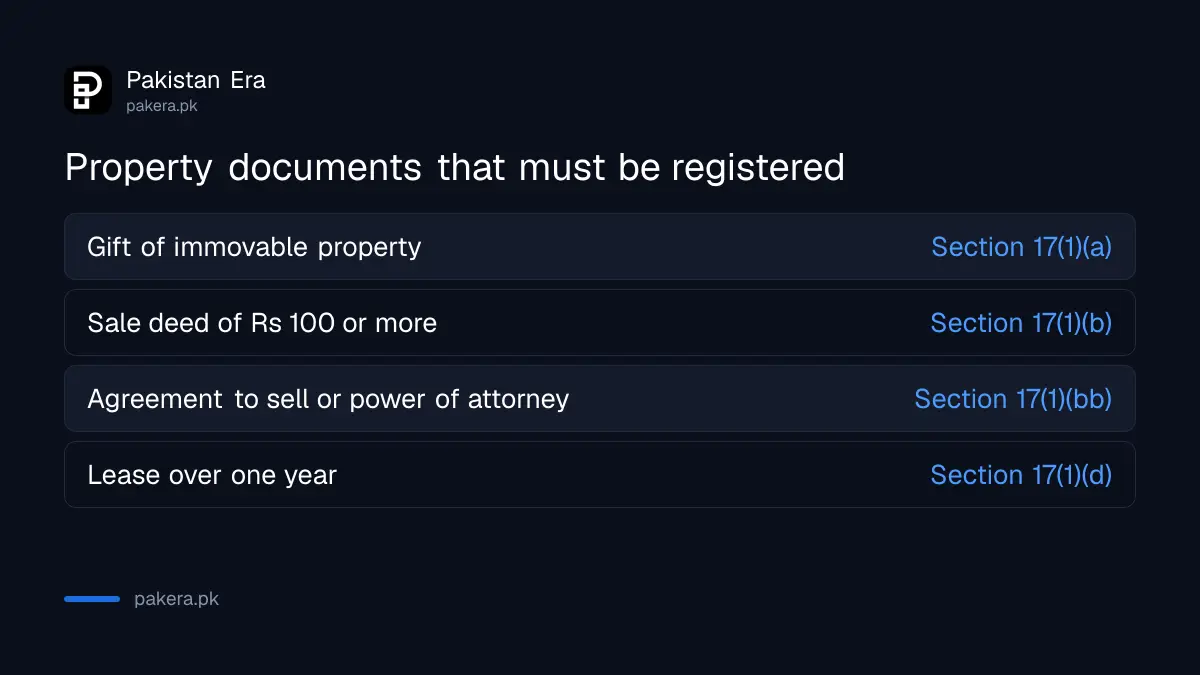
Section 17(1) names documents of which registration is compulsory when the property they concern is in a district where the Act is in force. The ones that matter to most buyers and sellers are in the table.
| Clause | Document |
|---|---|
| 17(1)(a) | An instrument of gift of immovable property |
| 17(1)(b) | A document that creates, declares, assigns, limits or ends a right in immovable property of Rs 100 or more, such as a sale deed |
| 17(1)(bb) | An instrument that grants power to an attorney, or an agreement to create or assign a right by way of sale, of Rs 100 or more, in immovable property |
| 17(1)(d) | A lease from year to year, for more than one year, or reserving a yearly rent |
Clause (bb) is the one many people miss. The Punjab Code footnote shows that the Registration (Amendment) Act 2018 inserted it. A long-running idea that an agreement to sell on stamp paper is enough does not match this text.
Section 17(2)(v) exempts a document that only creates a right to obtain another document. But the same clause carves out a document that grants power to an attorney or is an agreement to sell. Those two still need registration.
An unregistered document gives you no right in the property
Section 49 says a document that is required to be registered shall not operate to create, declare, assign, limit or extinguish any right, title or interest in immovable property unless it has been registered. That is the main risk.
Section 50 adds that a registered document of these kinds takes effect against every unregistered document about the same property. So the second buyer in our example wins on the paper, whatever the first buyer paid. There is a proviso that protects a person in possession under an earlier unregistered document if the conditions of section 53A of the Transfer of Property Act are met, and it needs a lawyer's reading.
Four months to present, and a fine if you are late
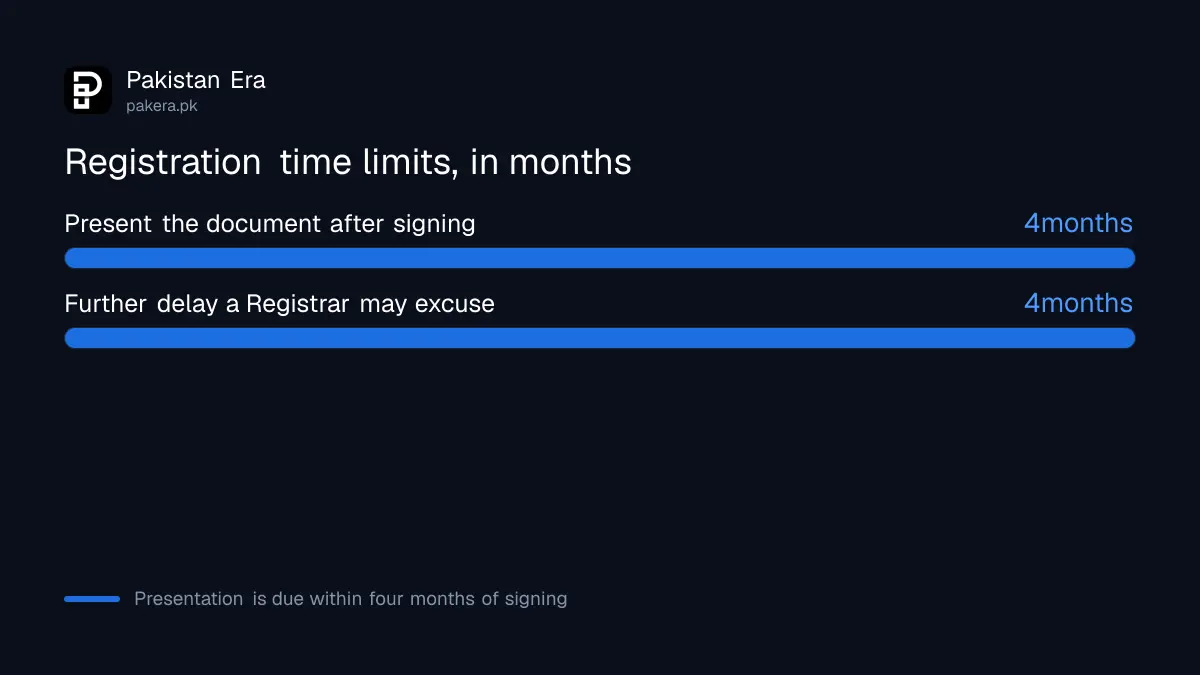
Section 23 says no document, other than a will, may be accepted for registration unless presented to the proper officer within four months from the date of its execution. For several signatories on different days, section 24 gives four months from each execution.
Section 25 helps when the delay is unavoidable. If the delay does not exceed four months, the Registrar may direct acceptance on payment of a fine not exceeding ten times the proper registration fee. The application for this can be lodged with a Sub-Registrar, who forwards it. Beyond that, the document cannot be accepted, and you would need a fresh document.
A document executed outside Pakistan gets four months after it arrives in Pakistan, under section 26, on payment of the proper fee.
Presentation is now electronic and needs title proof
The Registration (Amendment) Act 2026 was published in the Punjab Gazette on 14 May 2026. In the Punjab Code text, its footnotes mark several changes, and three matter here.
- Documents are presented electronically for registration (sections 28, 29 and 32). Section 32 says through the electronic record registration system.
- A document about immovable property must carry a description sufficient to identify it, and valid documentary proof of title, including an electronic record (section 21).
- Section 4 has the Punjab Land Records Authority run an electronic record system, with identity checked by biometric verification or electronic signature.
The practical sequence of an e-registration is in the note on registering property online in Punjab through PLRA e-registration. The fees charged on the portal are in the note on Punjab land record fees for 2026-27.
Who may present, and how a power of attorney is made
Section 32 says the document must be presented by someone who executed it or claims under it, by his representative or assign, or by an agent holding a power of attorney executed and authenticated as the Act requires.
Section 33 sets the rule for that power of attorney. If the principal lives in Punjab, it must be executed before, and authenticated by, the Registrar or Sub-Registrar of his district. If he lives elsewhere in Pakistan, a Magistrate does it. If he lives abroad, a Notary Public, a Court, a Judge, a Magistrate, or a Pakistan Consul or Vice-Consul does it. The steps for a person abroad are in the note on making a power of attorney from abroad.
A buyer should check a seller's power of attorney the same way as a title. The guide to verifying a property's title before you buy lists the record checks.
How to register an agreement to sell, in order
These steps follow the Act's text. Fees and portal screens change, so check them on the official portal before you pay.
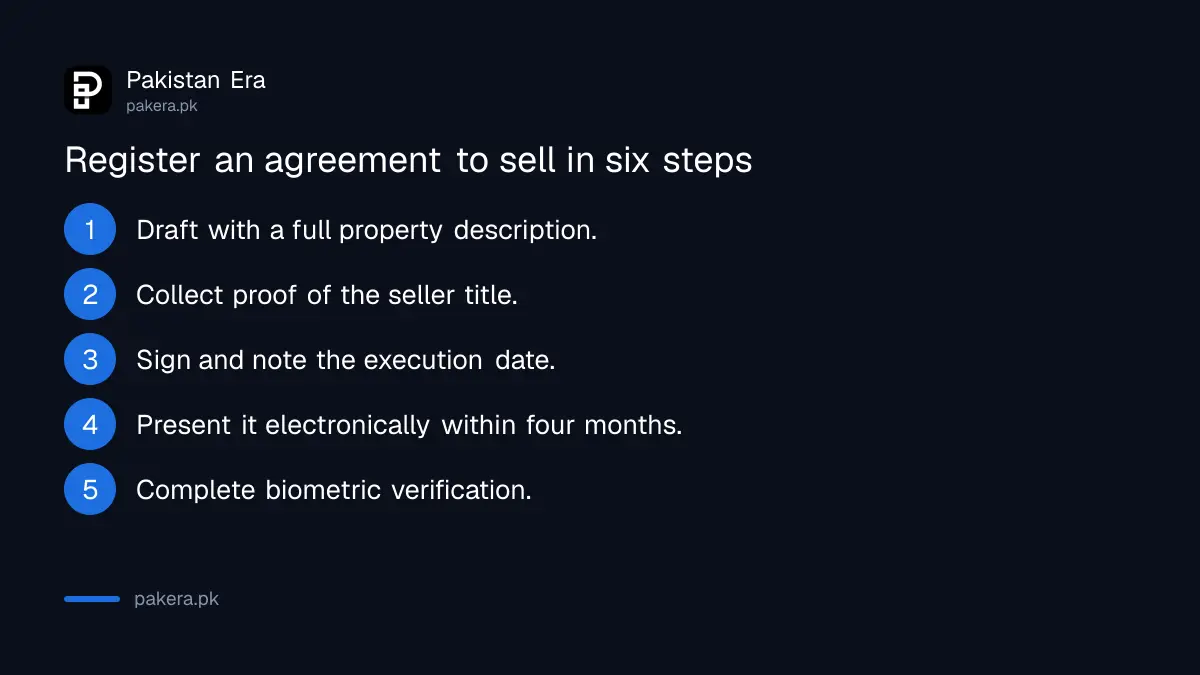
- Draft the agreement with a full description of the property, the price, the advance and the date for the sale deed.
- Collect proof of the seller's title, including the electronic record where the portal needs it.
- Sign the agreement with both parties, and note the date of execution.
- Present it electronically for registration, within four months of that date.
- Complete biometric verification of the parties, as the electronic system requires.
- Keep the registered copy and the certificate of registration.
Common questions
Is an agreement to sell on stamp paper enough in Punjab?
No. Section 17(1)(bb) makes registration compulsory for an agreement to sell immovable property of Rs 100 or more. Without it, section 49 says it creates no right in the property.
Does a power of attorney to sell my land have to be registered?
Yes. Clause (bb) covers an instrument that grants power to an attorney in respect of such property.
What if I miss the four months?
You may still apply under section 25 if the delay is unavoidable and does not exceed four months. The fine can be up to ten times the registration fee.
Does a will have to be registered?
No. Section 23 excepts a will from the four month rule, and wills are outside the compulsory list.
Does this apply in Sindh, KP or Islamabad?
The text we read is the Punjab version. Other provinces have their own amendments to this old Act, so check your province's text.
How we verified this
What we checked, where we read it, and what we could not confirm.
We read the Registration Act 1908 on the Punjab Code on 12 October 2026, including its footnotes on the 2018 and 2026 amendments. We did not read the 2026 amending Act itself or the registration rules, so we state no fee and no date by which manual documents must move online. This is general information, not legal advice.
About the author

Senior Writer, Public Services and Technology
Shahid joined us in 2024 as an author. He is a senior contributor to Pakistan's leading technology websites. He writes detailed articles, mostly covering his expertise in the latest tech, mobiles, apps, gadgets, and step-by-step guides. His ideology is to help people understand the latest trends and explain complex methods through very easy-to-understand guides.