How to Verify a Property's Title Before You Buy in Pakistan
Before you pay for a plot or house in Pakistan, check the fard, the registered sale deed and the encumbrance record. Here is what each one proves and why.
Before you hand over a single rupee for a plot or a house in Pakistan, pull a fresh fard in the seller's name and check it against the mutation record. We have seen buyers lose their deposit to a seller who was not the registered owner at all, just someone with an old photocopy and a confident manner. The registry, not the plot, is what you are actually buying into.
Update, 11 October 2026: A court or stay order can be recorded in the Punjab land record.
This is different from checking whether a housing scheme itself is approved. That question, whether the society has a CDA or LDA no objection certificate, is settled before anyone talks about a specific plot. What we cover here is the plot's own paper trail: who legally owns it right now, whether that ownership is clean, and how to prove both before you sign.
The fard is your starting point, and it has to be fresh
A fard is a certified extract of the land record naming the current owner. Get today's version from the land records office or its online portal, not a copy the seller already has in hand.
The Punjab Land Records Authority's own portal explains why this matters: a fard changes whenever a mutation is entered, so a version from six months ago may already be out of date. In Punjab, that means going to plra.punjab.gov.pk and pulling the Fard yourself using the khasra or khewat number, the tehsil and the district, rather than trusting whatever the seller prints out.
Sindh runs its own version through the Board of Revenue's property register portal, searchable by the owner's name, CNIC, district, tehsil and deh. It was built specifically to stop forged papers moving land out from under the wrong owner, and checking a property there before a deal is reported to carry a small per-search charge, though we could not confirm one fixed figure on an official notice.
Match the seller's CNIC to the name on the fard, not the other way round
A seller's name on a sale agreement means nothing if it does not match the name the land record actually carries. This is the single check that stops most impersonation attempts.
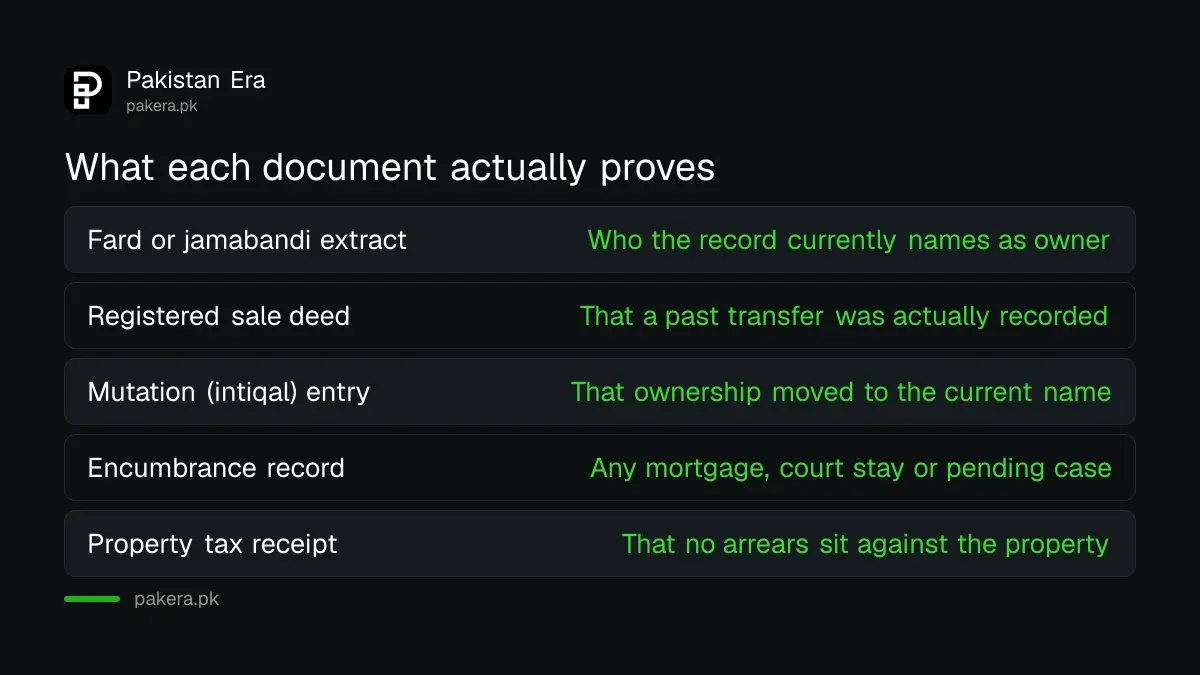
| Document | What it actually proves |
|---|---|
| Fard or jamabandi extract | Who the record currently names as owner |
| Registered sale deed | That a past transfer was actually recorded, not just agreed verbally |
| Mutation (intiqal) entry | That ownership moved into the current name through a recorded step |
| Encumbrance record | Any mortgage, court stay or pending case against the property |
| Property tax receipt | That no arrears sit against the property before you take it on |
If the seller inherited the property, ask for the full mutation chain from the original owner down to them, not just the latest entry. A missing link in that chain is exactly where disputes between siblings and cousins tend to surface years later, usually once you have already paid.
Checking for a mortgage, a court case or a hidden claim
A clean fard tells you who owns the property. It does not, on its own, tell you whether a bank holds a mortgage against it or a court has frozen it in a pending case.
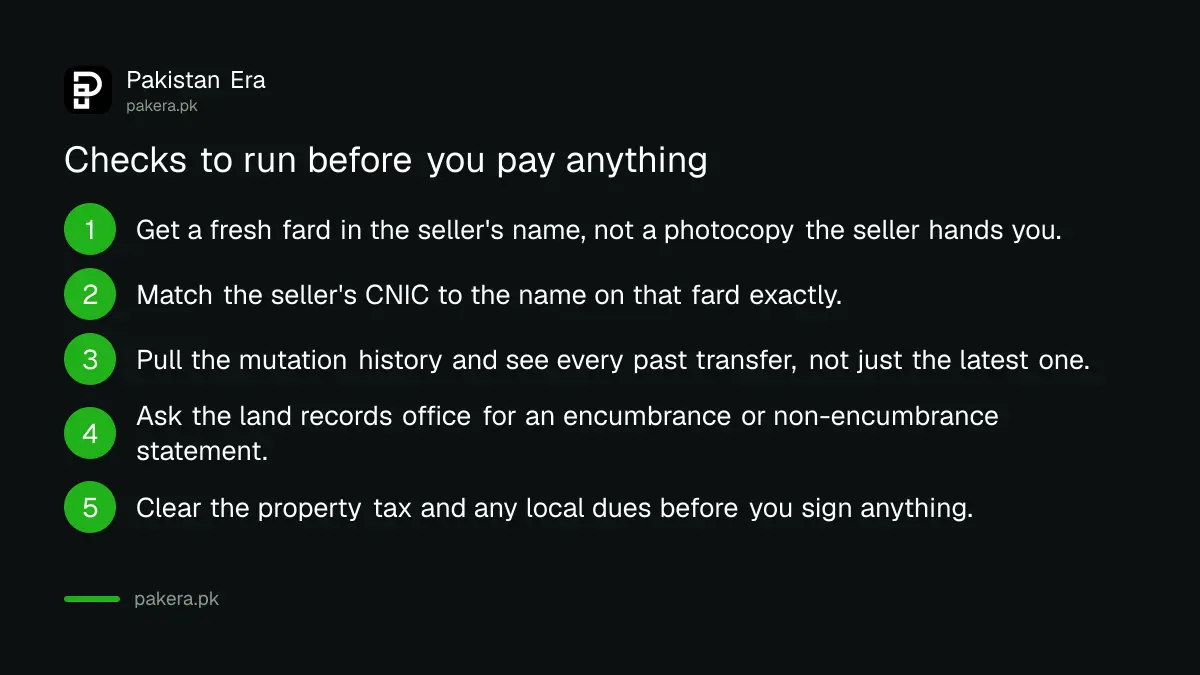
- Get a fresh fard in the seller's name, not a photocopy the seller hands you.
- Match the seller's CNIC to the name on that fard exactly, letter for letter.
- Pull the full mutation history, not just the most recent entry.
- Ask the land records office for an encumbrance or non-encumbrance statement on the property.
- Clear any property tax arrears question before you sign, and get the receipt showing it.
Ask the land records office directly whether anything is attached against the property: a bank mortgage from a loan that was never cleared, a stay order from an ongoing family dispute, or a government acquisition notice for road widening or a public project. None of these show up on a basic fard print, and a seller is not obliged to volunteer them.
Registering the sale is a separate, later step
Verifying title and registering a purchase are two different jobs, and mixing them up is where buyers get hurt. Verification happens before you agree a price. Registration happens after, once you are satisfied the title is clean.
In Punjab, that later step runs through PLRA's own e-Registration system for property transfers, which records the new owner once the deal is final. In Islamabad, the registration itself happens at the sub-registrar's office, where both parties and two witnesses appear in person and the deed is registered the same day. That office executes the registration, it does not independently investigate the seller's title for you, so the verification step above is entirely on the buyer, not something the registry does automatically on your behalf.
Common mistakes that cost buyers their deposit
Most property fraud in Pakistan does not involve a forged stamp or a fake government seal. It involves ordinary pressure tactics working on a buyer who skipped one of the checks above.
- Accepting a photocopy as proof of ownership. A photocopy cannot show you whether a mutation happened last week.
- Trusting a power of attorney without verifying it. If someone is selling on another person's behalf, verify that document at its source, not just by looking at it.
- Rushing because of a "limited time" price. Genuine owners rarely need you to skip the fard check to close a deal today.
- Confusing scheme approval with title verification. A plot inside an approved housing scheme can still have a title problem of its own; the two checks are not substitutes for each other.
Common questions about verifying a property's title
What is the fastest way to check who owns a property in Pakistan?
Pull a current fard from the provincial land records portal using the khasra or khewat number. It names the current registered owner as of today.
Is an old fard good enough to verify ownership?
No. A fard changes whenever a new mutation is entered, so a copy from several months ago may already be out of date. Always pull a fresh one.
How do I check if a property has a mortgage or a pending court case against it?
Ask the land records office for an encumbrance statement. It records mortgages, court stays and other claims that a basic fard print does not show.
Does checking a housing scheme's approval also verify the plot's title?
No. Scheme approval and a specific plot's title are separate questions. An approved scheme can still contain a plot with its own ownership dispute.
Who is responsible for checking a seller's title before a sale is registered?
The buyer. The registration office records a transfer once it happens; it does not investigate the seller's ownership chain on the buyer's behalf.
How we verified this
What we checked, where we read it, and what we could not confirm.
Last checked on 5 October 2026. We read the Punjab Land Records Authority's own description of the Fard and its Fard generation process on its portal, the Sindh Board of Revenue's own description of its property register search tool, and the ICT Administration's own page on registering a deed in Islamabad, including that it does not independently verify a seller's title. The exact Sindh per-search fee and the turnaround time for an encumbrance statement in each province are reported rather than read on a current fee notification, and the body says so. This is general guidance, not legal advice, and a property lawyer should still review the specific documents before you pay.
About the author

Senior Writer, Public Services and Technology
Shahid joined us in 2024 as an author. He is a senior contributor to Pakistan's leading technology websites. He writes detailed articles, mostly covering his expertise in the latest tech, mobiles, apps, gadgets, and step-by-step guides. His ideology is to help people understand the latest trends and explain complex methods through very easy-to-understand guides.