How to Register Property Online in Punjab Through PLRA e-Registration
Register a property sale in Punjab on PLRA's e-Registration portal: steps, 2% urban and 1% rural stamp duty, FBR challans, documents and Sub-Registrar visit.
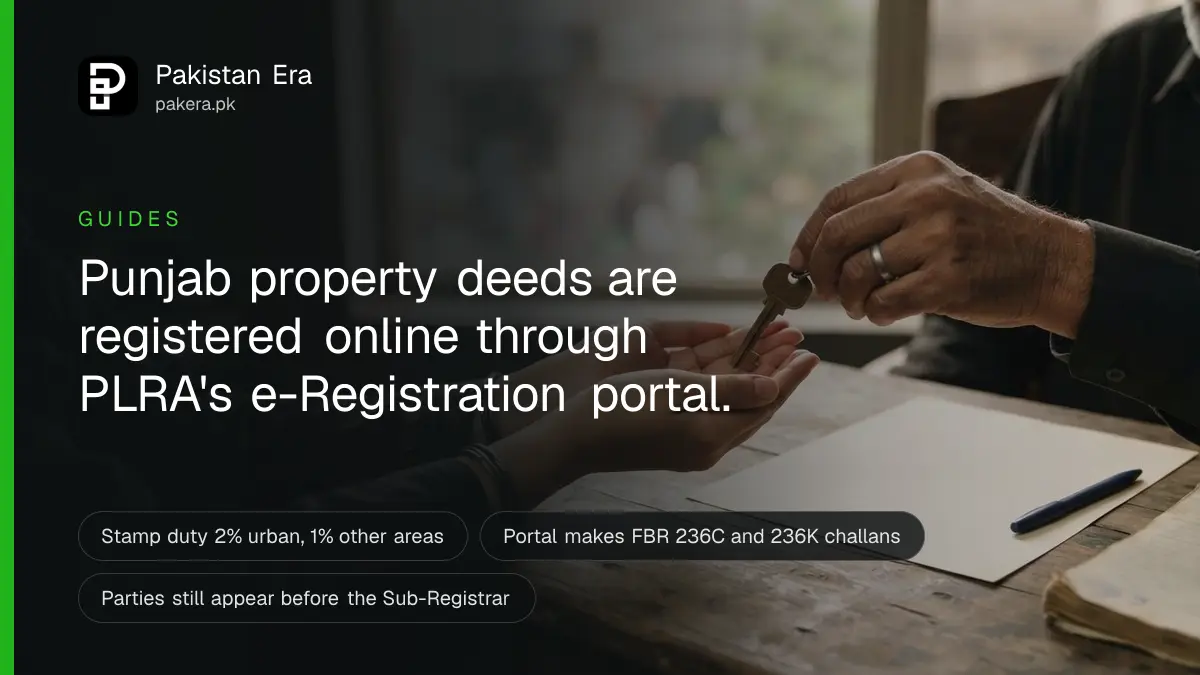
In Punjab, a property sale deed is now registered through PLRA's e-Registration portal at eregistration.punjab-zameen.gov.pk. You pay stamp duty and FBR taxes online first, the request goes to the Sub-Registrar, and buyer, seller and witnesses still appear in person once. Stamp duty is 2 per cent in urban areas and 1 per cent elsewhere.
Update, 11 October 2026: An old deed can be downloaded from the RoD portal.
Since 26 August 2026, the portal also creates the FBR tax challans itself. For every registry made after 25 August, the FBR challan must come from the e-registry portal, not from FBR's own website. That is the Punjab Land Records Authority (PLRA) and Board of Revenue notice shown on the portal's login page.
One warning before you start. A similar address, e-registration.punjab.gov.pk, is not a property site. We opened it on 27 September 2026 and it is the Higher Education Department's private college registration system.
Punjab property e-registration in five stages
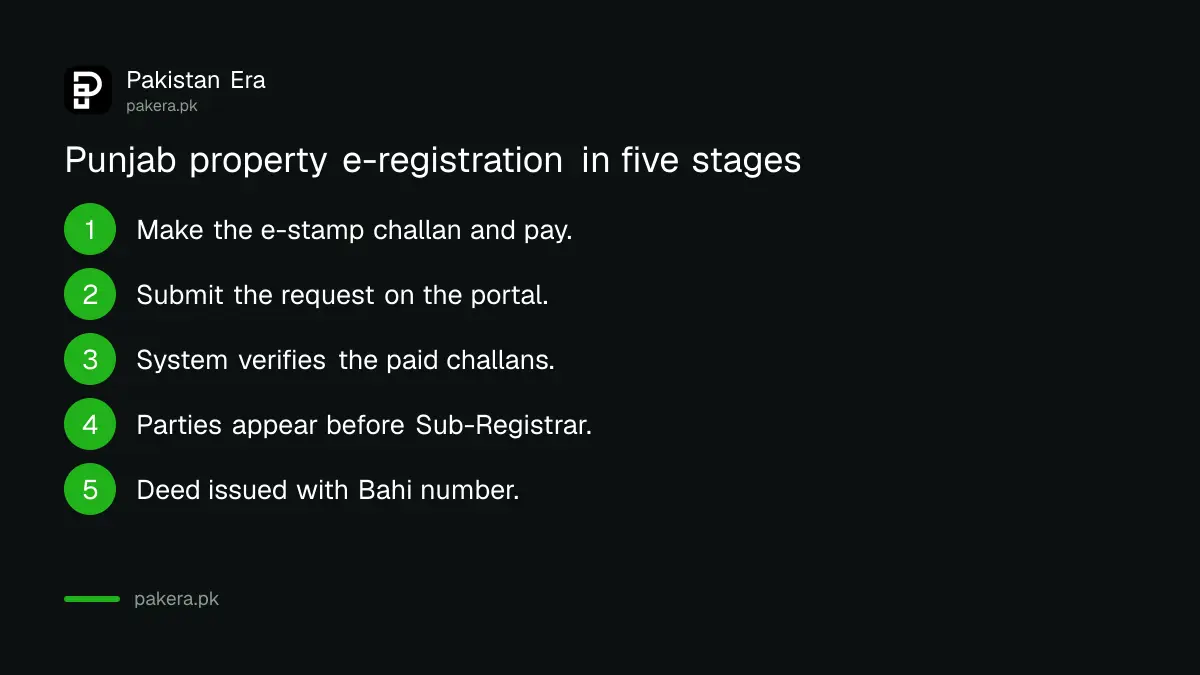
PLRA's own process flow has five stages: create the e-stamp challan and pay the fees, submit the registration request on the portal, let the system verify the payments, appear before the Sub-Registrar, and collect the registered deed with its Bahi number and document number.
- Challan and fees. Generate the e-stamp challan online and pay stamp duty, FBR taxes, registration fee and mutation fee. Obtain the security paper for the deed.
- Portal request. Log in to the e-Registration portal, start the deed registration request, and enter the buyer, seller, witnesses and property details.
- Verification. The system checks the paid challans and taxes, then forwards the request to the Sub-Registrar.
- Appearance. Buyer, seller and witnesses go to the Sub-Registrar's office. The Sub-Registrar records their statements.
- Deed issued. The system gives the deed a Bahi number and a document number, and the registered deed is printed and handed over.
The login page is titled "Registry of Deeds Public Portal" and asks for your CNIC number and a captcha. We did not file a deed, because that needs a real sale.
Stamp duty and taxes on a property sale in Punjab
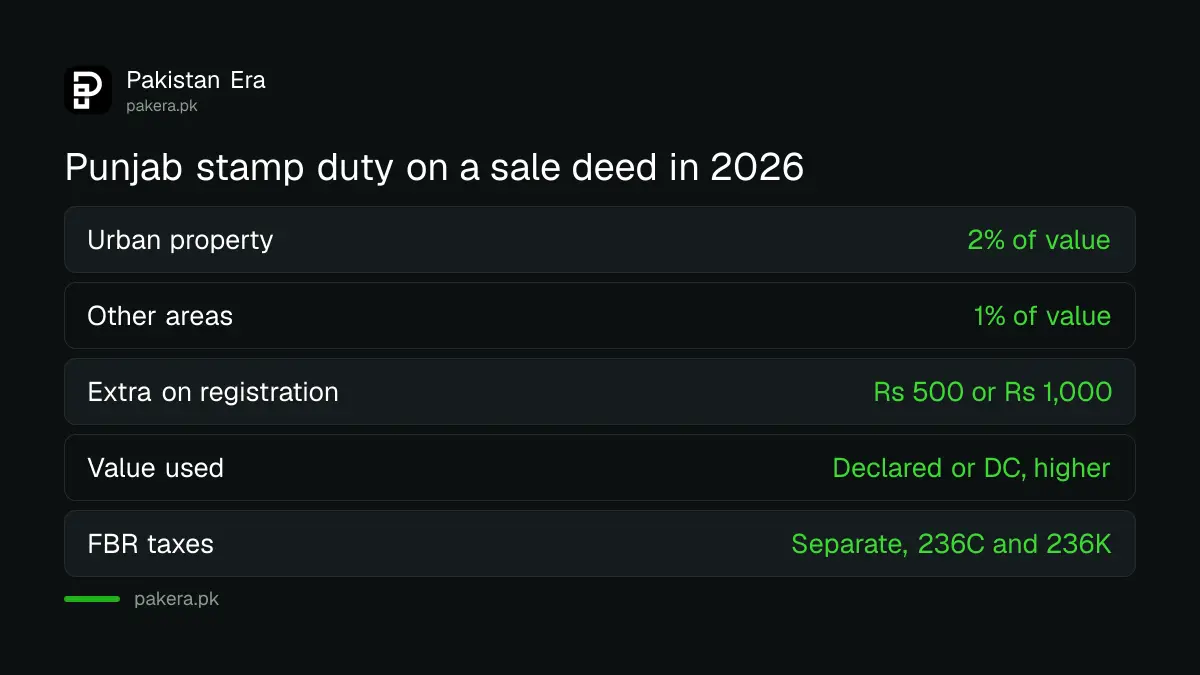
Under Article 23 of the Stamp Act as it applies in Punjab, stamp duty on a sale deed is 2 per cent of the property value in an urban area and 1 per cent anywhere else. Registration adds Rs 500 or Rs 1,000 of extra stamp duty. FBR's advance taxes are separate.
The rural rate fell from 3 per cent to 1 per cent through the Stamp (Amendment) Act 2026, published in the Punjab Gazette on 6 May 2026. Some reports described the change as 1 per cent everywhere. The consolidated Stamp Act on the Punjab Code still shows 2 per cent for urban property, and the Punjab Finance Act 2026 did not change it.
| Charge | Who pays | Rate or amount | Paid through |
|---|---|---|---|
| Stamp duty, urban property | Payer chosen on the challan | 2% of value | E-stamp challan 32-A |
| Stamp duty, other areas | Payer chosen on the challan | 1% of value | E-stamp challan 32-A |
| Extra stamp duty on registration | With the deed | Rs 500 up to Rs 500,000; Rs 1,000 above | E-stamp challan 32-A |
| Registration fee and mutation fee | With the deed | Worked out by the system | Same challan |
| Advance tax, section 236K | Buyer | 1.25% on the Active Taxpayers List; 10.5% to 18.5% if not | FBR challan made by the portal |
| Advance tax, section 236C | Seller | 2.75% on the Active Taxpayers List; 11.5% if not | FBR challan made by the portal |
"Urban area" has a legal meaning. It includes any scheme built by a development authority, housing authority or housing society, so a society plot pays the urban rate even if it looks rural.
Punjab's separate capital value tax (CVT) on property was removed by the Punjab Finance Act 2017 and folded into stamp duty. The challan form still has a CVT line, which the system fills only where it applies.
For the FBR side, FBR's withholding tax rate card for 2026-27, updated for the Finance Act 2026, sets the buyer's rate under 236K at 1.25 per cent for a person on the Active Taxpayers List. For anyone else it is 10.5 per cent up to Rs 50 million, 14.5 per cent up to Rs 100 million and 18.5 per cent above that. The seller's rate under 236C is 2.75 per cent on the list and 11.5 per cent off it. PLRA's help pages still show older figures, so go by FBR's card and the challan the portal gives you. The tax is worked out on FBR's own property valuation rates where they are higher than the price. Both are advance taxes on buying and selling property, which you can adjust in your tax return.
DC valuation sets the minimum value you pay on
Stamp duty is charged on the declared price or the District Collector's rate, whichever is higher. The e-stamp system does this sum automatically. If you write a lower price in the deed, you still pay on the DC value, so a low price on paper saves nothing.
You can check the rate yourself before you agree a price. The e-stamp portal has a "Calculate DC Value" tool: pick the district, tehsil, revenue circle, area and land class, and it shows the rate per marla or per acre. If you think a new DC valuation table is wrong, the Stamp Act allows an appeal to the Commissioner within 30 days of its notification.
Take a made-up example. A house in a Lahore scheme with a DC value of Rs 1 crore attracts Rs 2 lakh in stamp duty, plus Rs 1,000 on registration, before FBR taxes.
How to create the e-stamp challan and pay
Open the Punjab e-stamping portal, choose "Generate Challan 32-A", enter the district, tehsil, deed type, parties and property value, then print the challan. Pay at any Bank of Punjab branch or through a banking app using the PSID number. No account is needed.
- The system gives each challan a 16-digit number and a QR code.
- You can edit a challan before payment but not after.
- A challan is valid until the date printed on it, usually 90 days, and covers one transaction only.
- A property dealer or lawyer acting for you goes in the agent section, with name and CNIC.
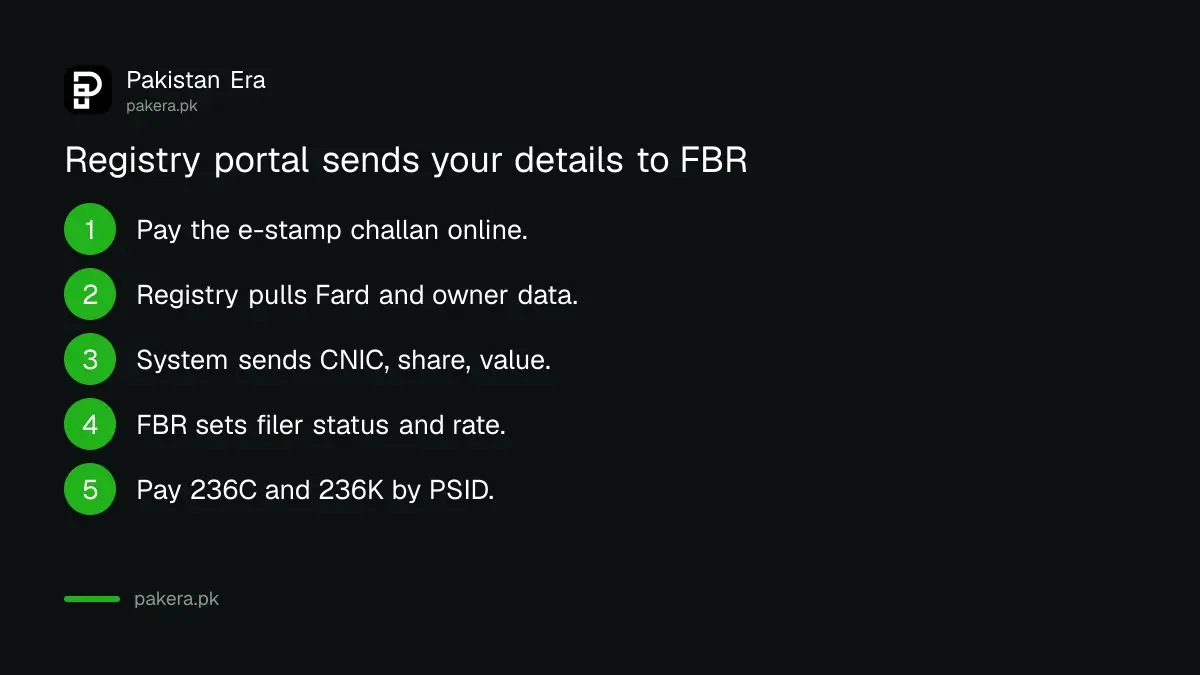
The screens are the same ones used for issuing an e-stamp paper for any deed. For the FBR taxes, you no longer go to FBR's website. The registry system sends the parties' CNICs, shares and the total value to FBR, FBR works out filer status and the rate, and two challans come back: 236C for the seller and 236K for the buyer.
Documents and the Sub-Registrar appearance
Bring the original CNICs of the buyer, seller and witnesses, the paid challans, and the property's land record details. The portal pulls ownership, area and party details from the Fard and the Green Property Certificate. Everyone then appears before the Sub-Registrar, who records their statements.
- Original CNICs for the buyer, the seller and the witnesses.
- Paid e-stamp challan and both FBR challans.
- A sale Fard or the land record details, from an Arazi Record Center or online through Punjab Zameen.
- A power of attorney verified by the Sub-Registrar, if someone is acting for an owner.
PLRA says biometric checks are not needed at the online filing stage, but may be needed later at an ARC to update the record. For overseas Pakistanis, the Sub-Registrar can appoint the Community Welfare Attaché at a Pakistani mission to record their statement abroad, with thumb impressions, photos and video.
The mutation and your registered deed
A registry and a mutation are different things. In "online mouzas", PLRA says the mutation of an e-registry is approved at the same time as the registry. Elsewhere, you must still get the mutation entered. Keep the deed, which carries its Bahi number and document number.
The Punjab Overseas Pakistanis Commission's own advice to property buyers puts it bluntly: a sale deed alone does not put your name in the land record. Check the mutation after registration, and follow the steps for mutation at an Arazi Record Center if it has not happened automatically.
For an older registry, PLRA points to the Registration of Deeds portal at rod.pulse.gop.pk to download a verified copy.
Common questions
What is the official website for property e-registration in Punjab?
eregistration.punjab-zameen.gov.pk, run by the Punjab Land Records Authority. The similar-looking e-registration.punjab.gov.pk is for private college registration and has nothing to do with property.
What is the stamp duty on property in Punjab in 2026?
2 per cent of the value for urban property and 1 per cent elsewhere, under Article 23 of the Stamp Act as amended to 6 May 2026. Registration adds Rs 500 or Rs 1,000.
Do I still make the FBR challan on the FBR website?
No, not for registries after 25 August 2026. The e-registry portal now creates the 236C and 236K challans. Challans made on FBR's portal before 25 August are still accepted.
Do buyer and seller have to go to the Sub-Registrar office?
Yes. The filing is online, but the parties and witnesses appear in person so the Sub-Registrar can record their statements. Overseas parties can record theirs through the Community Welfare Attaché.
How do I pay the e-registration fees?
At any Bank of Punjab branch, or online through a banking app using the PSID number on the challan.
How we verified this
What we checked, where we read it, and what we could not confirm.
Last checked on 27 September 2026. The five-stage process, the challan rules, the DC value tool, the higher-of-declared-or-DC rule, the biometric answer, the overseas procedure, automatic mutation in online mouzas and the Registration of Deeds portal are read on PLRA's website at punjab-zameen.gov.pk. The 26 August 2026 PLRA and FBR linked system and the 25 August challan cut-off are read in the PLRA and Board of Revenue notice on the e-Registration login page. Stamp duty rates, the extra registration duty, the meaning of "urban area" and the valuation appeal are read in the Stamp Act 1899 as consolidated on the Punjab Code, with the Punjab Finance Acts 2017, 2022 and 2026. The FBR tax percentages are as listed by PLRA and are set by FBR. We did not register a deed ourselves.
About the author

Senior Writer, Public Services and Technology
Shahid joined us in 2024 as an author. He is a senior contributor to Pakistan's leading technology websites. He writes detailed articles, mostly covering his expertise in the latest tech, mobiles, apps, gadgets, and step-by-step guides. His ideology is to help people understand the latest trends and explain complex methods through very easy-to-understand guides.