Check FBR Property Valuation Rates for Your Area in Pakistan
Check the FBR property valuation rate for your area in Pakistan. Which 2024 and 2026 SROs apply city by city, how to read the table, and the tax it sets.
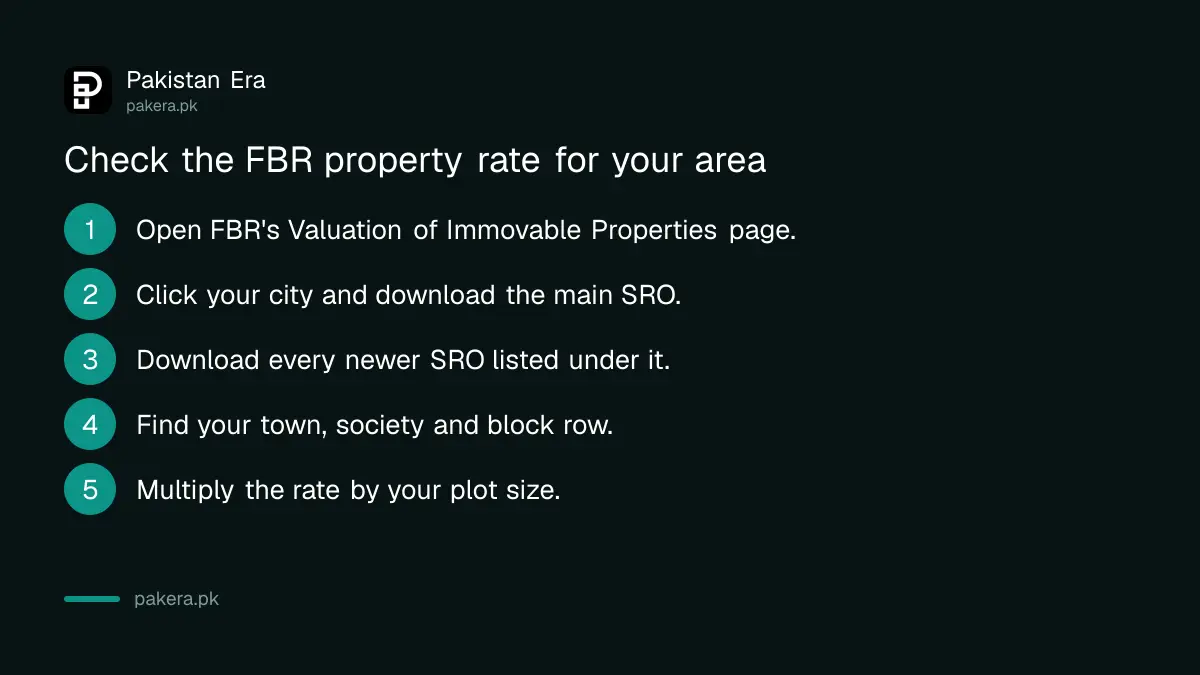
To check the FBR property valuation for your area, open FBR's "Valuation of Immovable Properties" page, pick your city, and download the base notification plus every amendment listed under it. Find your town and society, read the rate for your property type, and multiply by the size.
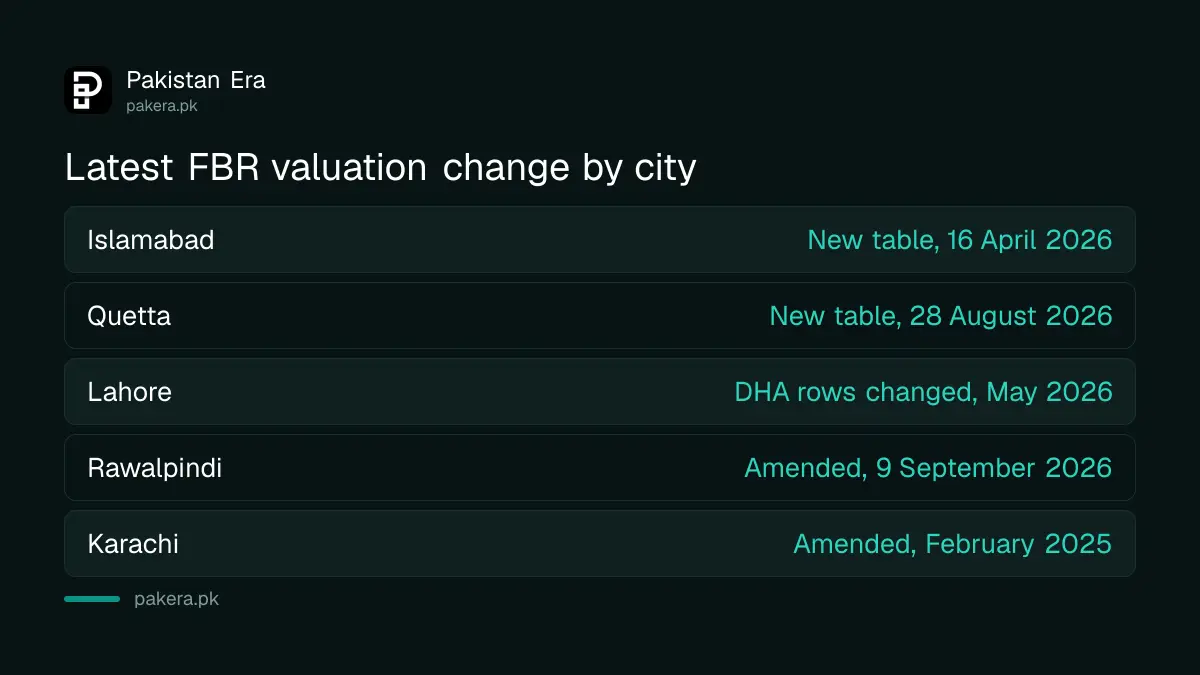
We opened the page on 2 October 2026. It lists more than 50 cities and towns, from Abbottabad to Wazirabad. Most tables date from 29 October 2024, but several cities have newer ones. Islamabad got a full new table on 16 April 2026, and Quetta on 28 August 2026. Lahore, Rawalpindi, Faisalabad and Multan have 2026 amendments that change rows in the 2024 tables.
That last point catches buyers out. If you read only the first PDF, you may use a rate FBR has already replaced.
FBR valuation is the value FBR taxes a property sale on
The FBR valuation is a fair market value per marla, square yard or square foot that FBR notifies under section 68 of the Income Tax Ordinance 2001. Advance taxes on buying and selling property are worked out on it when your declared price is lower.
FBR sets these tables for federal taxes only. Its own FAQ on valuation says so plainly: stamp duty and other provincial charges use the District Collector rate instead. So one plot can have two official values. The DC valuation drives stamp duty. The FBR value drives section 236K tax on the buyer and section 236C tax on the seller.
The FBR rate is usually the higher of the two in big city schemes. That is why it matters more to your total bill.
How to check the FBR rate for your area, step by step
Go to fbr.gov.pk, open Income Tax, then Valuation of Immovable Properties. Click your city. Download the main SRO and every newer SRO listed under "Other Related Sros". Then find your town and society row.
- Open the FBR page. The address is fbr.gov.pk, Valuation of Immovable Properties. It works on a phone, but the PDFs are easier to read on a computer.
- Click your city. Each city page shows one main notification, called an SRO, with its number and date.
- Check "Other Related Sros" on the same page. These are amendments. A newer SRO replaces the rows it names in the older table.
- Find your row. Tables go by town, then area or society, then block or sector. Lahore's table lists, for example, "Nishtar Town, Defence Phase VI Excluding C, M & N Blocks".
- Pick the right column. There are separate columns for a residential open plot, a residential building, a commercial open plot and a commercial building.
Most of these PDFs are scanned pages, not text. Your phone's search box will not find a society name inside them. Scroll and read.
Recent FBR valuation tables by city
Most cities still use the October 2024 tables. Islamabad and Quetta have new full tables from 2026. Lahore, Rawalpindi, Faisalabad and Multan have 2026 amendments on top of their 2024 tables, so check both.
| City | Main table | Later changes we found |
|---|---|---|
| Islamabad | SRO 644(I)/2026, 16 April 2026 | SRO 1335(I)/2026, 7 August 2026 (E-8 shops added) |
| Lahore | SRO 1722(I)/2024, 29 October 2024 | SRO 876(I)/2026, 19 May 2026 (DHA rows) |
| Rawalpindi | SRO 1728(I)/2024, 29 October 2024 | Four amendments, the latest SRO 1513(I)/2026 of 9 September 2026 |
| Karachi | SRO 1724(I)/2024, 29 October 2024 | SRO 144(I)/2025, February 2025 |
| Faisalabad | SRO 1688(I)/2024, 29 October 2024 | SRO 651(I)/2026, 21 April 2026 |
| Multan | SRO 1729(I)/2024, 29 October 2024 | SRO 650(I)/2026, 21 April 2026 |
| Peshawar | SRO 1710(I)/2024, 29 October 2024 | None listed |
| Quetta | SRO 1444(I)/2026, 28 August 2026 | None listed |
FBR adds amendments without notice on the city page. Recheck it on the day you sign. A table we read in October can have a new SRO by the time you pay.
Work out the FBR value of a plot or house
For an open plot, multiply the rate by the size in the unit the table uses. For a house or flat, add the land value to the covered area times the building rate. Then compare it with your agreed price.
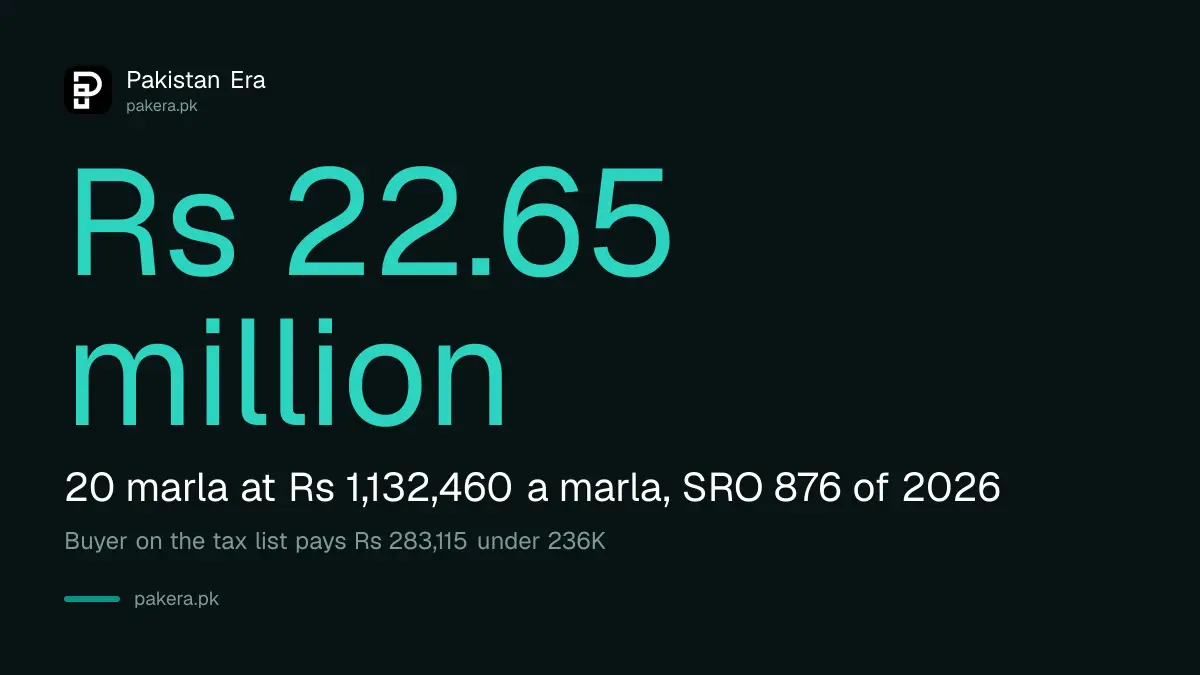
Take a 1 kanal plot, which is 20 marla, in Lahore's DHA Phase VI outside blocks C, M and N. SRO 876(I)/2026 puts the residential open plot rate at Rs 1,132,460 a marla. So the FBR value is Rs 22,649,200.
Now say the seller writes Rs 18 million in the deed. The advance taxes are still worked out on Rs 22.65 million, because the FBR value is higher.
Units change from city to city. Lahore's table is per marla for land and per square foot for buildings. Islamabad's is per square yard for land and per square foot for flats and shops. In Islamabad, a D-12 open plot is Rs 91,000 a square yard.
Buildings have their own rule in each table. Islamabad's 2026 SRO sets a house structure at Rs 2,500 a square foot if it is up to five years old, and Rs 1,200 if it is older. Lahore's DHA rows use Rs 1,750 a square foot for a residential structure.
What the FBR value means for your tax bill
The buyer pays advance tax under section 236K and the seller under section 236C. Both are a percentage of the FBR value or the price, whichever is higher. Being on the Active Taxpayers List cuts the rate sharply.
FBR's withholding tax rate card, updated for the Finance Act 2026, gives these rates. We list them with the caveat that the law, not the card, has the final word.
| Tax | Who pays | On the Active Taxpayers List | Not on the list |
|---|---|---|---|
| Section 236K | Buyer | 1.25% | 10.5% up to Rs 50 million, 14.5% to Rs 100 million, 18.5% above |
| Section 236C | Seller | 2.75% | 11.5% |
On our Rs 22,649,200 example, a buyer on the list pays Rs 283,115. A buyer who is not on it pays Rs 2,378,166. That gap is the strongest reason to check your filer status before you book a registry date.
These are advance taxes. You can adjust them in your return. Capital gains tax on property is a separate sum you work out when you file.
If your area is not in the FBR table
If your society or village is not listed, the FBR table does not apply to it. FBR's FAQ says unlisted areas use the value fixed for stamp duty, usually the DC rate. Ask the registrar for that rate in writing.
Two other rules are worth knowing. If one area appears twice with two different rates, Islamabad's SRO says the higher value applies. And a society that attests a transfer collects the same two taxes, as FBR's FAQ explains, so you cannot avoid them by skipping the registry office.
Sellers sometimes say "the FBR rate does not apply to this block". Check it yourself. It takes ten minutes.
Common questions
Where do I find the FBR property valuation table?
On fbr.gov.pk, under Income Tax, then Valuation of Immovable Properties. Click your city and download the SRO PDFs.
Is there a new FBR valuation table for 2026-27?
Not for every city. Islamabad and Quetta have new tables from 2026. Most others still use October 2024 tables, some with 2026 amendments.
Is stamp duty paid on the FBR value?
No. FBR says its rates are for federal taxes only. Stamp duty uses the provincial DC rate.
What if my agreed price is higher than the FBR value?
Then the taxes are worked out on your price. The FBR value is a floor, not a cap.
Why can I not search the PDF for my society?
Most FBR valuation PDFs are scanned images with no text layer. You have to scroll and read the rows.
Does the FBR value apply to a society file transfer?
Yes. FBR's FAQ says a society that attests a transfer collects advance tax from both seller and buyer.
How we verified this
What we checked, where we read it, and what we could not confirm.
Last checked on 2 October 2026. We opened FBR's Valuation of Immovable Properties page and the city pages for Islamabad, Lahore, Rawalpindi, Karachi, Faisalabad, Multan, Peshawar and Quetta, and noted each SRO number and date. We read SRO 876(I)/2026 for Lahore and the first and last pages of SRO 644(I)/2026 for Islamabad, both scanned PDFs. We read FBR's FAQs on valuation of immovable property, written for the 2016 rules, for the principles only, not its rates, and the FBR withholding tax rate card for sections 236C and 236K. We did not read every row of every city's table.
About the author

Tax, Bills and Technology Writer
Ali Akhtar is a young and curious voice here at Pakistan Era. He is currently pursuing his A-Levels and has a growing interest in Pakistan’s changing industrial landscape and educational trends. Ali likes to write in a way that helps him explain and explore the world around him. His writing reflects the perspective of the new generation navigating the evolving trends of Pakistan where technology, youth innovation, and shifting opportunities are reshaping the country’s future.