PM Electric Bike Scheme 2026 in Pakistan: Rs 80,000 or Rs 50,000 Subsidy
PM electric bike scheme 2026 pays Rs 80,000 on cash buys and Rs 50,000 on the bank loan. We read pave.gov.pk: both routes, rickshaw subsidy and approved models.
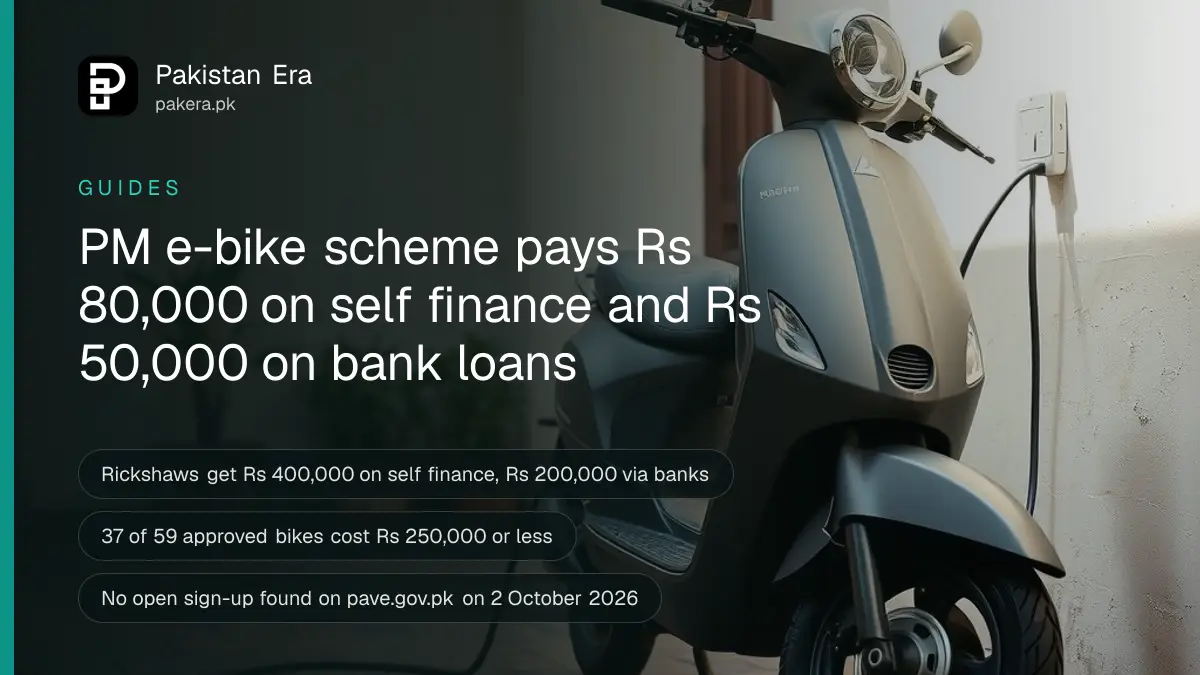
The PM Electric Bike and Rickshaw Scheme pays two different subsidies. If you pay for the bike yourself, the government refunds Rs 80,000 to your bank account. If you take the interest free bank loan, the subsidy is Rs 50,000. For a rickshaw or loader it is Rs 400,000 on the self finance route and Rs 200,000 on the bank route.
Both figures are on the official portal, pave.gov.pk, which we read on 2 October 2026. The bigger number is why people keep quoting Rs 80,000. The smaller one is what most buyers actually get. Which route suits you depends on one question: can you pay the full price up front and wait for the refund?
The scheme is PAVE, run by the Ministry of Industries
The PM Electric Bike and Rickshaw Scheme 2026 is the Pakistan Accelerated Vehicle Electrification Programme, or PAVE. The Ministry of Industries and Production runs it under the New Energy Vehicles Policy 2025 to 2030. The portal is pave.gov.pk, and its helpline is 1048.
The portal lists 116,000 e-bikes and scooters and 3,170 rickshaws and loaders. It is open across Pakistan, including AJK and Gilgit Baltistan. Applicants are chosen by e-balloting, a computer draw. The basic terms and the women's quota are in our August report on the PAVE electric bike scheme.
Self finance pays Rs 80,000, the bank route pays Rs 50,000
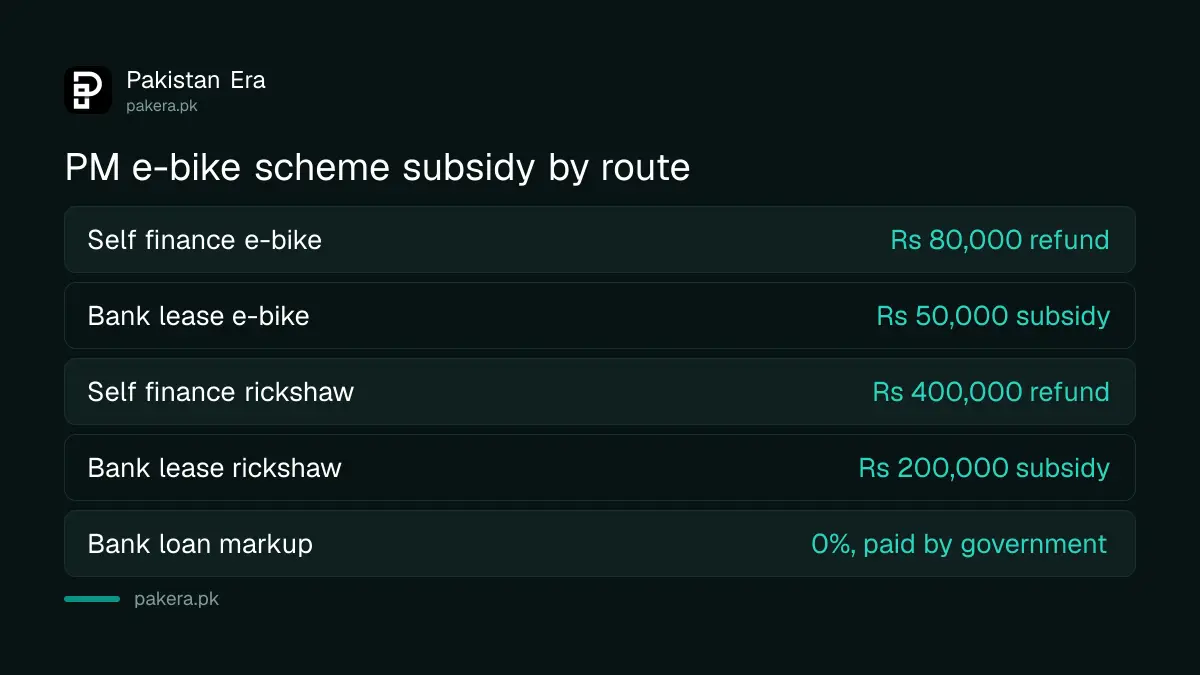
The portal sets two financing paths. Self finance means you pay the manufacturer the full price yourself, then the government refunds Rs 80,000 for a bike or Rs 400,000 for a rickshaw or loader. Bank lease means a partner bank pays, and the subsidy is Rs 50,000 or Rs 200,000.
| Item | Self finance | Bank lease |
|---|---|---|
| Subsidy on an e-bike | Rs 80,000 | Rs 50,000 |
| Subsidy on a rickshaw or loader | Rs 400,000 | Rs 200,000 |
| Who pays the manufacturer | You, by bank draft or pay order | The bank |
| When the subsidy reaches you | Refunded to your account after delivery and checks | Taken off the loan at the start |
| Monthly installments | None | Up to 2 years for bikes, 3 for rickshaws, 0% markup |
| Delivery | Within 60 days of payment | Within 60 days of the bank's payment |
That is the catch. On self finance you pay the full price, including the part the government later returns. The Rs 80,000 is not a discount at the counter. On the bank route you still pay bank documentation charges and the first year's insurance.
A Rs 250,000 bike costs about Rs 30,000 less on self finance
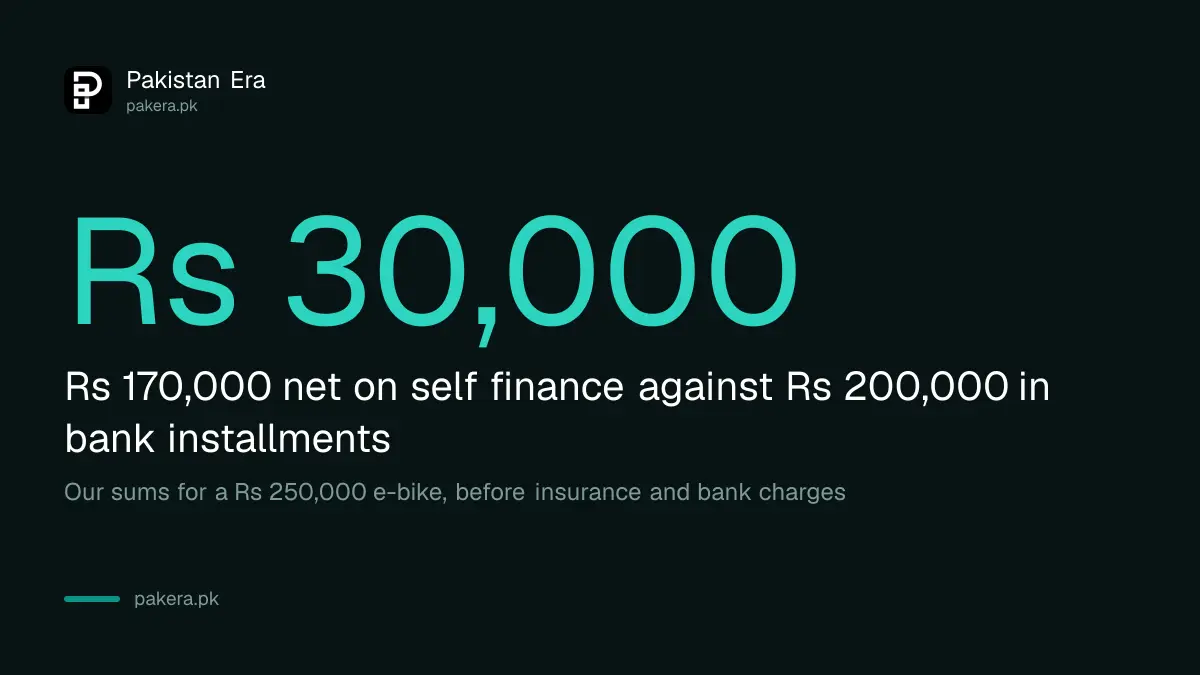
On a Rs 250,000 e-bike, self finance leaves you about Rs 170,000 out of pocket once the Rs 80,000 refund arrives. The bank route costs about Rs 200,000 spread over two years, plus insurance and documentation charges. The gap is roughly Rs 30,000.
These are our sums from the portal's figures, not a bank quote.
- Self finance. You pay Rs 250,000 to the manufacturer. After delivery and checks, Rs 80,000 comes back. Your net cost is Rs 170,000.
- Bank lease. The Rs 50,000 subsidy comes off first. The bank lends Rs 200,000 at 0% markup over up to 24 months. That is about Rs 8,333 a month before insurance.
- The difference. Rs 200,000 against Rs 170,000, so about Rs 30,000 in favour of paying cash, before bank charges.
So why pick the bank? Most buyers do not have Rs 250,000 in an account. The portal carries a notice that many self finance applicants asked to move to the bank route. It allowed the switch for seven days only, and the notice has no date.
For a rickshaw the gap is far bigger: Rs 400,000 against Rs 200,000. One caution. The portal gives two loan figures for three wheelers, up to Rs 1,100,000 in one place and Rs 880,000 in another. Ask your bank which applies before you sign.
59 bike models and 10 rickshaws are on the approved list
Only models approved by the Engineering Development Board qualify. On 2 October 2026 the portal listed 59 two wheeler models from Rs 201,000 to Rs 577,000, and 10 rickshaws and loaders from Rs 800,000 to Rs 1,330,000.
Of the 59 bikes, 37 cost Rs 250,000 or less. That matters on the bank route. Pick a model above Rs 250,000 and you pay the difference up front. The portal's own example: a Rs 300,000 bike means Rs 50,000 extra in cash, on top of the first installment, insurance and bank charges.
Seventeen partner banks are listed, including National Bank, Bank of Punjab, Sindh Bank, Bank of Khyber and Meezan, with Islamic and conventional options. Check each model's brochure for range before price.
The Rs 80,000 and 116,000 figures trace back to the 2025 policy
The New Energy Vehicles Policy 2025 to 2030 set a reference subsidy of Rs 65,000 per two wheeler and Rs 400,000 per three wheeler. It set a target of 116,053 electric two wheelers for 2025 to 2026, and said the subsidy would be cut gradually in later years.
The policy on the Ministry's website lets a steering committee set the exact amount. That is why the portal shows Rs 80,000 and Rs 50,000, not Rs 65,000.
One claim going around needs care. Reports say 116,000 bikes are being subsidised "this fiscal year". In the policy, 116,053 is the target for 2025 to 2026, the year that ended in June. The target for 2026 to 2027 is 246,728. We found no official notice of a new round or a new subsidy amount for this year.
The policy also says no registration fee or annual token tax will be charged on electric vehicles registered in Islamabad. Provinces are only "encouraged" to do the same, so check with your provincial Excise office.
Applications run online only, and we found no open sign-up
The portal says applications are accepted only online, with no paper forms. On 2 October 2026 its front page still showed the old banner about registrations opening on 1 September 2025. The register address sent us back to the login page. We found no open sign-up for new applicants.
If you already applied, log in to track your application. The ballot result page asks for your CNIC and a simple sum. The portal calls that list provisional, so names can still be removed after screening. For the next round, keep these ready:
- A valid CNIC. If it has lapsed, renew your expired CNIC first.
- A recent photograph.
- Proof of income or a bank account.
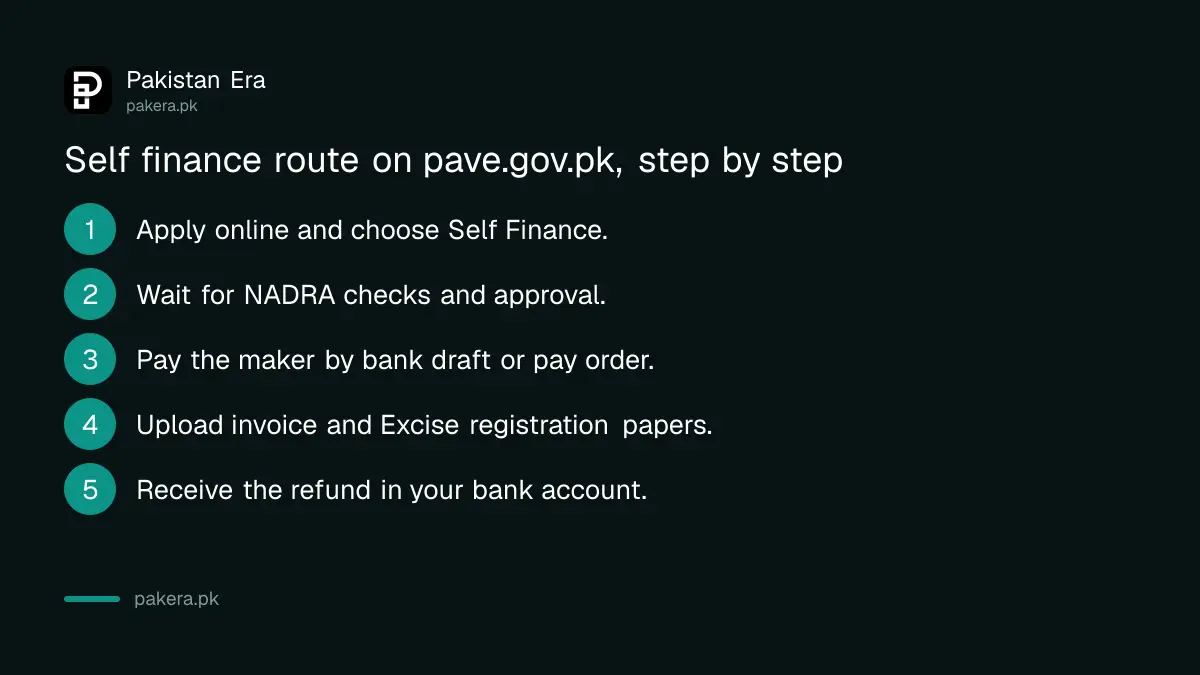
- For self finance, money for a bank draft, and later the invoice and Excise registration papers to upload.
Type the address yourself. The real site ends in .gov.pk.
Rules that catch people after approval
The portal's FAQ sets four rules buyers miss. You can apply for one vehicle only. You cannot change the model after you submit. You cannot sell the vehicle before the loan is paid. And anyone who already got an electric vehicle from a government scheme is not eligible again.
The last rule matters with provincial schemes, such as Punjab's e-bike scheme for students. The FAQ says you may apply to both, but may not get both benefits. The steering committee decides.
You do not need a driving licence to apply, but you need one to ride. The bike must still be registered with Excise, and registering a motorcycle in Punjab works the same way for an e-bike.
Common questions
Is the PM electric bike subsidy Rs 80,000 or Rs 50,000?
Both. Rs 80,000 is refunded if you pay the full price yourself. Rs 50,000 applies if you take the bank loan.
How much is the subsidy on an electric rickshaw?
Rs 400,000 on the self finance route and Rs 200,000 on the bank lease route, according to pave.gov.pk.
Can I apply for the PM e-bike scheme now?
We found no open sign-up on 2 October 2026. Watch pave.gov.pk or call 1048 for a new round.
When does the Rs 80,000 refund arrive?
After delivery and document checks. The portal gives no fixed number of days.
Can I choose a bike above Rs 250,000?
Yes. On the bank route you pay the amount above Rs 250,000 in cash up front.
Who can apply?
Pakistani citizens aged 18 to 65 for e-bikes and 21 to 65 for rickshaws and loaders, including in AJK and Gilgit Baltistan.
How we verified this
What we checked, where we read it, and what we could not confirm.
Last checked 2 October 2026. We read pave.gov.pk in full that day: financing paths, FAQ, notices, vehicle list, banks, ballot and login pages. Every subsidy, loan term and eligibility rule comes from there. Targets, the reference subsidy and the Islamabad waiver come from the New Energy Vehicles Policy on the Ministry of Industries and Production site. The cost comparison is our arithmetic. The "116,000 bikes this fiscal year" claim is reported and does not match the policy. We did not reach the Ministry for comment.
About the author
Tax, Bills and Technology Writer
Ali Akhtar is a young and curious voice here at Pakistan Era. He is currently pursuing his A-Levels and has a growing interest in Pakistan’s changing industrial landscape and educational trends. Ali likes to write in a way that helps him explain and explore the world around him. His writing reflects the perspective of the new generation navigating the evolving trends of Pakistan where technology, youth innovation, and shifting opportunities are reshaping the country’s future.