How to Apply for the CM Punjab E-Bike Scheme for Students
No down payment, Rs 90,000 subsidy and zero interest. Applications close 4 October 2026, and the guarantor must earn Rs 40,000 a month.
Applications for the CM Punjab e-bike scheme for students close on 4 October 2026. There is no down payment, the government pays Rs 90,000 per bike, and the portal does not say how the 100,000 bikes will be allocated.
Update, 2 October 2026: CM Maryam Nawaz says 1,149,058 students have registered and distribution starts in early November. The portal no longer says first come first served, and now sets a Rs 40,000 minimum monthly income for the guarantor. Read the update.
Phase 1 of this programme used electronic balloting. Phase 2 has not announced its method, so a complete and correct application before the deadline is what you control.
We read the official portal at bikes.punjab.gov.pk on 6 September 2026 and again on 2 October 2026. It is run by the Transport and Masstransit Department under the Chief Minister's Youth Initiative, and is powered by the Punjab Information Technology Board.
What the scheme actually offers
| Item | What the portal says |
|---|---|
| Total e-bikes | 100,000 |
| Capital subsidy | Rs 90,000 per bike, by the Government of Punjab |
| Down payment | None |
| Interest rate | Zero per cent for the applicant |
| Financing period | Three years |
| Monthly instalment | About Rs 3,000 |
| Insurance, registration, token tax | Paid by the Government of Punjab |
| Last date to apply | 4 October 2026 |
Helmet and safety rods are listed as free. The instalment figure is described on the portal as approximate.
Who can apply
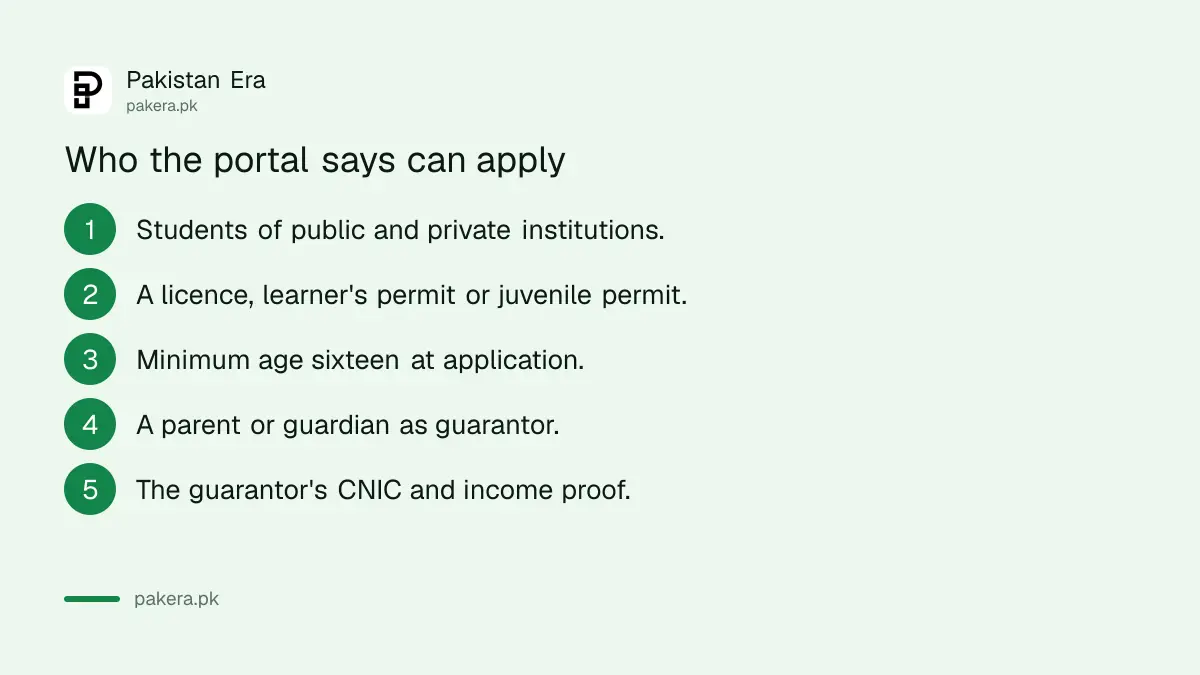
The portal lists six conditions, and two of them are where applications fail.
Students of both public and private educational institutions are eligible. The student must have a valid driving licence, a learner's permit, or a juvenile driving permit. The minimum student age is sixteen years at the time of application submission.
The guarantor conditions are the other three. A parent or legal guardian can be the guarantor, with valid proof of income. The guarantor must have a valid CNIC.
The portal now spells out more. The guarantor must earn at least Rs 40,000 a month and give a recent bank statement. The student needs a student card or institution letter and the latest paid fee slip. Students of federally chartered institutes and their campuses are not eligible.
And the one people miss: the mobile number given on the application must be registered in the name of the guarantor. The portal's own questions add a single exception, that it may be in the applicant's name if the student has a documented source of income.
The age is sixteen, not eighteen
Most coverage of this scheme states eighteen. The portal states sixteen years at the time of application submission, and it pairs that with the juvenile driving permit in the list of acceptable documents.
The portal also answers the obvious follow up. If you are sixteen and want a juvenile licence made, it says to visit your nearest Sahulat Center along with your guardian.
So a sixteen year old without any driving document is not shut out. They have a step to do first, and it is worth starting that step immediately given the closing date.
If you do not have a licence yet
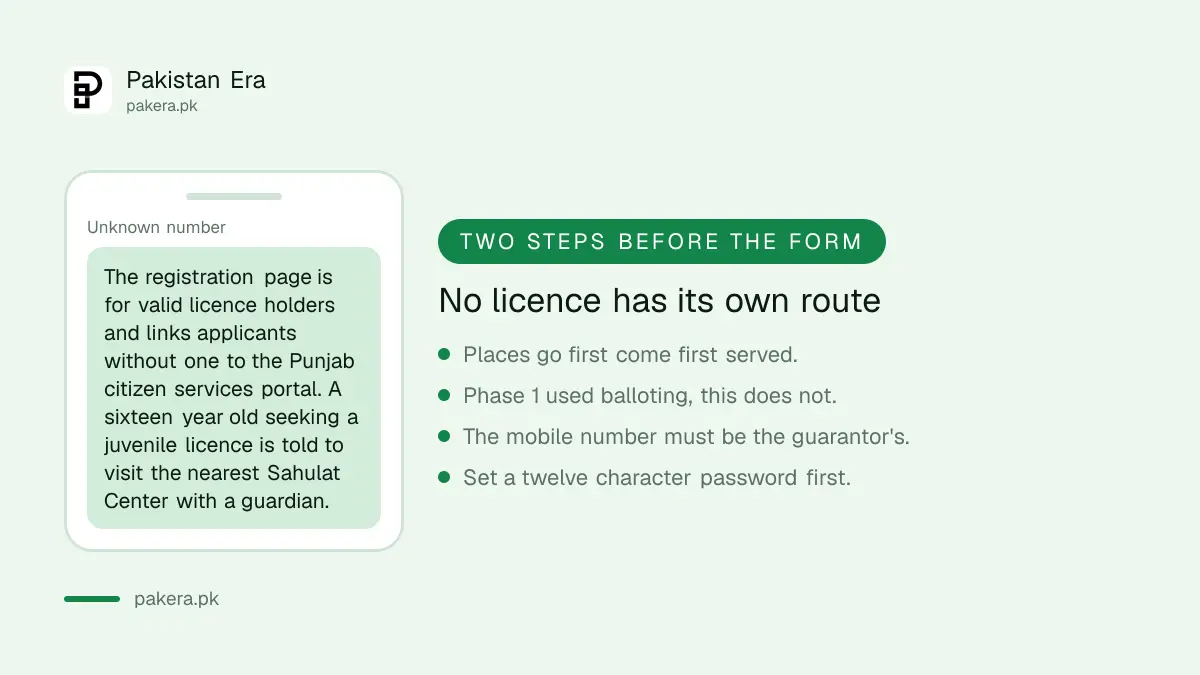
The registration page is titled for valid licence holders, and carries a separate link for people who do not have one. That link goes to the Punjab citizen services portal at dastak.punjab.gov.pk.
Our guide to getting a learner licence in Punjab covers that document and what it needs, and our guide to applying for a driving licence online covers the full licence.
Do not treat this as something to sort out later. The licence, permit or juvenile permit is an eligibility condition, and the scheme is not waiting on it.
How to apply, step by step
- Register an account at bikes.punjab.gov.pk with your name as per CNIC, email, CNIC number, gender as per CNIC and the province shown on your licence.
- Submit the application online through the same portal.
- Complete the documentation.
- Wait while your details and eligibility are verified.
- Complete the approval and financing formalities, then take delivery of the bike.
The account password must be at least twelve characters with an uppercase letter, a lowercase letter, a number and a special character, and there is a CAPTCHA on the form. Set that password before you sit down to apply, because a rejected password at the last step is a common reason people abandon a form.
The province field asks for the province as per your licence, and the list includes Azad Jammu and Kashmir, Balochistan, Sindh, Khyber Pakhtunkhwa, Gilgit Baltistan, the tribal districts and Islamabad alongside Punjab.
The portal no longer says first come first served
When we checked on 6 September, step two on the portal said documentation would proceed on a first come first serve policy. On 2 October that line was gone. Step two now says only "complete documentation and proceed accordingly".
The portal does not say whether bikes will go by ballot, merit or queue. With more than a million registrations for 100,000 bikes, the method matters, and it has not been published.
So the practical advice is to make the application clean. Get the driving document sorted, get the guarantor's CNIC, income proof and bank statement ready, make sure the mobile number is the guarantor's, and apply before 4 October.
What the bike is
The portal publishes the specification, which is useful because the instalment is fixed and the machine is not something you choose.
It is a 2026 electric scooty with a 72V 30Ah lithium iron phosphate battery and a 1000 watt brushless rear wheel hub motor. Maximum speed is listed as 50 to 55 kilometres per hour. It has a digital display, a twelve tube controller, an LED headlamp and hydraulic shock absorption. Two colours are shown, a black and a pink.
Since the government is paying the token tax, our guide to paying token tax online is for the years after that cover ends rather than for the application itself.
This is not the federal PAVE scheme
Two electric bike programmes are running at the same time and they are being confused with each other constantly.
This one is provincial. It is the Punjab Chief Minister's Youth Initiative, for students, administered by the Transport and Masstransit Department, with a Rs 90,000 subsidy and no down payment.
The other is federal, run by the Ministry of Industries and Production, open to all citizens rather than students, with a different subsidy and an e-balloting system. Our guide to the PAVE electric bike scheme covers that one, and you can apply to both since they are separate programmes with separate portals.
Where the published numbers disagree
The portal says 100,000 e-bikes. Reporting in the first week of September 2026 has described the programme as more than 125,000 bikes.
We are quoting the portal, because that is the responsible department's own page and it is the page the application is made on. A larger figure may cover the programme across phases, or may be an announcement not yet reflected on the portal. We could not confirm which, and we are not going to guess.
The same applies to any figure of ten thousand you may have seen. Nothing on the portal supports it.
Common questions
What is the last date to apply for the CM Punjab e-bike scheme?
4 October 2026, according to the portal at bikes.punjab.gov.pk.
How much down payment is needed?
None. The portal states that no down payment is required.
What is the minimum age?
Sixteen years at the time of application submission.
Can private school and college students apply?
Yes. Students of both public and private educational institutions are eligible.
Whose mobile number goes on the application?
The guarantor's, or the applicant's if the student has a documented source of income.
Is it a ballot?
The portal does not say. It no longer mentions first come first served, and no ballot or merit list has been announced as of 2 October 2026.
How we verified this
What we checked, where we read it, and what we could not confirm.
Last checked 2 October 2026, when we re-read the portal: the 4 October deadline, the 100,000 bikes and the terms were unchanged, step two no longer mentions first come first serve, and the eligibility block now lists a PKR 40,000 minimum monthly income and bank statement for the guarantor, a student card or institution letter, the latest paid fee slip, and the exclusion of federally chartered institutes. First checked 6 September 2026. We read the official scheme portal at bikes.punjab.gov.pk on that date, described on the page as the Chief Minister Punjab's Green Initiative, E-Bikes Scheme for Students, Phase 2, under the Chief Minister's Youth Initiative and the Transport and Masstransit Department, powered by the Punjab Information Technology Board. The total of 100,000 e-bikes, the capital subsidy of PKR 90,000 per e-bike by the Government of Punjab, the zero per cent interest rate for applicants, the three year financing period, the absence of a down payment, the approximate monthly instalment of Rs 3,000, free helmet and safety rods, the coverage of interest, insurance, registration and token tax by the Government of Punjab, and the last date to apply of 4 October 2026, are all taken from that page and from its published questions and answers. The eligibility conditions, that students of both public and private educational institutions are eligible, that a valid driving licence, learner's permit or juvenile driving permit is required, that the minimum student age is sixteen years at the time of application submission, that the mobile number on the application must be in the name of the guarantor or of the applicant where the student has a documented source of income, that a parent or legal guardian may act as guarantor with valid proof of income, and that the guarantor must hold a valid CNIC, are from the same page. The five application steps (on 6 September step two said documentation proceeds with the first come first serve policy; that wording was removed by 2 October), and the registration fields and password requirement, were read on the portal and its registration page. The direction that a sixteen year old seeking a juvenile licence should visit the nearest Sahulat Center with a guardian, and the link for applicants without a licence to the Punjab citizen services portal at dastak.punjab.gov.pk, are also from the portal. The bike specification listed as a 2026 model with a 72V 30Ah lithium iron phosphate battery, a 1000 watt brushless rear wheel hub motor, a maximum speed of 50 to 55 kilometres per hour, a digital display, a twelve tube controller, an LED headlamp and hydraulic shock absorption, is as published on the portal. The helpline 042-99212260 and the support address at the bikes.punjab.gov.pk domain are as listed. We did not verify the figure of more than 125,000 bikes that appeared in reporting during the first week of September 2026, and have said so in the body rather than reconciling it silently. Confirm every detail on the portal before applying, because a scheme in an open application window can change.
About the author

Tax, Bills and Technology Writer
Ali Akhtar is a young and curious voice here at Pakistan Era. He is currently pursuing his A-Levels and has a growing interest in Pakistan’s changing industrial landscape and educational trends. Ali likes to write in a way that helps him explain and explore the world around him. His writing reflects the perspective of the new generation navigating the evolving trends of Pakistan where technology, youth innovation, and shifting opportunities are reshaping the country’s future.