Capital Gains Tax on Property in Pakistan
The gain is what you sold it for minus what it cost. The holding period reduction was removed in 2022. What to keep as proof.
Capital gains tax on property is worked out on a simple sum: what you sold it for, minus what it cost you. The law writes it as A minus B.
The rule most people still repeat, that holding a property for a few years reduces the taxable gain, was removed from the law in 2022. If you are planning a sale around that idea, plan again.
We read section 37 of the Income Tax Ordinance, 2001 on 31 August 2026, in the consolidated text FBR publishes on its own download site.
How the gain is calculated
Section 37(2) sets out the formula in the statute itself.
| In the law | What it means |
|---|---|
| A | The consideration received on disposal, meaning what you sold it for |
| B | The cost of the asset |
| A minus B | The gain that is charged to tax |
So the gain is the difference between the two figures. Keeping proof of what you paid is therefore not paperwork for its own sake. It is the number that reduces your tax.
The holding period rule is gone
This is the part still being repeated in conversation and in older articles.
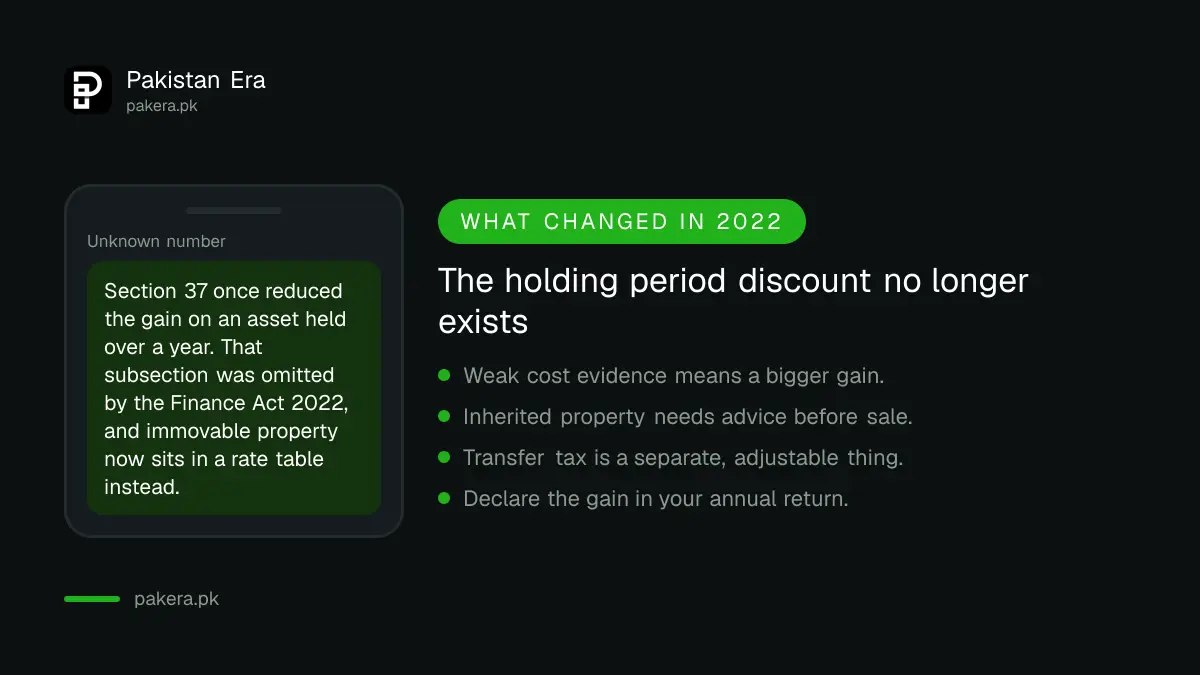
Section 37 used to contain a subsection 3, which said that where a capital asset had been held for more than one year, the gain was reduced by a formula before being taxed. That subsection was omitted by the Finance Act, 2022. The text we read shows it as removed, with the old wording preserved only in a footnote.
Immovable property is now dealt with separately under subsection 1A, which was itself substituted by the Finance Act, 2022. It says that gain on disposal of immovable property situated in Pakistan is chargeable under the head Capital Gains at the rates specified in Division VIII of Part I of the First Schedule.
What that means in practice is that the treatment of property sits in a rate table rather than in a discount formula. Ask your tax adviser what the current table says for your holding period, rather than assuming an old rule survives.
Why we are not printing a rate
The rates are not in section 37. They sit in the First Schedule, which is a separate part of the law that changes with each Finance Act.
The consolidated Ordinance that FBR publishes is amended up to 20 February 2026. That is before the Finance Act, 2026, which took effect on 1 July 2026. So the rate table in the copy we can read is not current, and we are not going to repeat a percentage we could not verify.
Confirm the rate for your own sale with a tax adviser or through FBR. Expect it to depend on how long you held the property.
Keep the purchase evidence
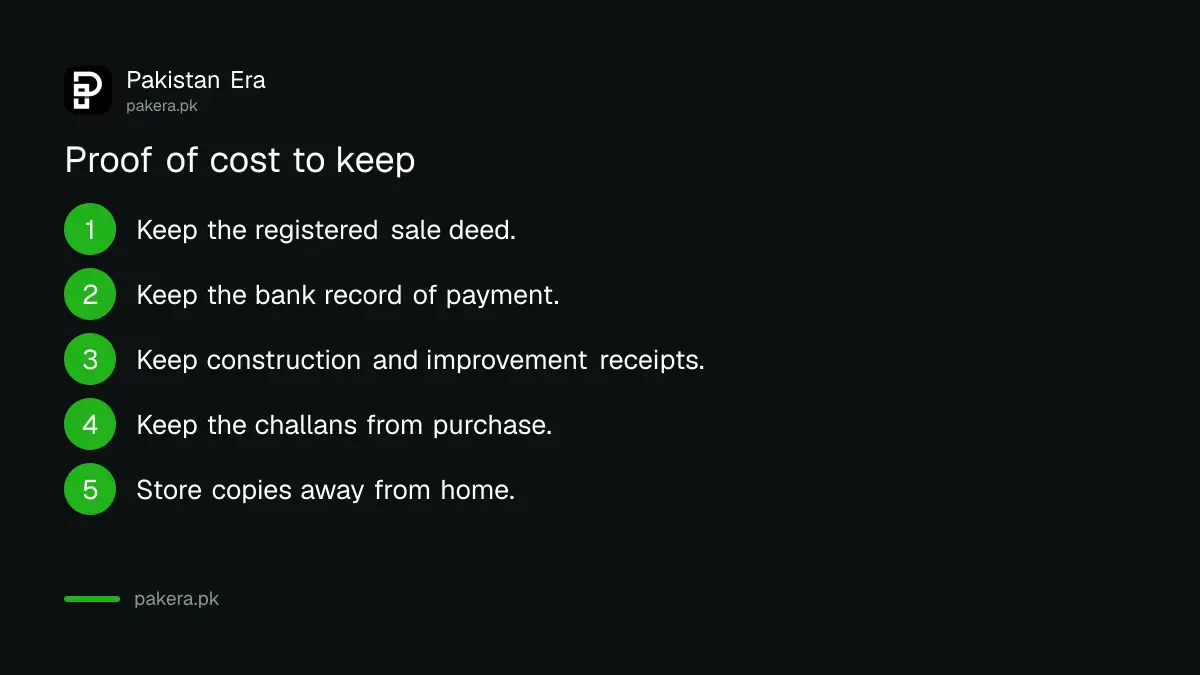
Because the gain is sale price minus cost, weak evidence of cost means a larger taxable gain. This is where families lose money on inherited or long held property.
- Keep the registered sale deed from when you bought it.
- Keep the bank record of what you actually paid.
- Keep receipts for construction and major improvement work.
- Keep the challans for tax collected at the time of purchase.
- Store copies somewhere other than the file at home.
If the property came to you through inheritance rather than purchase, gather whatever establishes the original acquisition and speak to an adviser before selling, because the cost side of the sum is the difficult part.
This is separate from the tax collected at transfer
Two different taxes touch a property sale and people mix them up constantly.
Capital gains tax under section 37 is on the profit. The advance tax collected when the transfer is registered is a different thing, charged under section 236C on the seller and 236K on the buyer, and it is adjustable against your annual bill. Our guide to what tax you pay when you buy or sell property covers that side and explains how to claim the credit.
Provincial property tax is a third thing again, charged annually on the building rather than on a sale. Our guides to Punjab property tax and Sindh property tax deal with that.
Filing matters as much as calculating
A gain has to be declared in your annual return, and being off the Active Taxpayer List makes every part of a property transaction more expensive.
The return deadline for individuals is 30 September, and our guide to the ATL surcharge and that deadline sets out what being late now costs.
Common questions
How is the gain calculated?
Section 37(2) gives the formula as A minus B, where A is what you received on disposal and B is the cost of the asset.
Does holding the property longer reduce my tax?
The old subsection that reduced the gain after one year was omitted by the Finance Act, 2022. Immovable property is now taxed by a rate table instead.
What is the rate?
We are not quoting one. It sits in the First Schedule and the published consolidated Ordinance predates the Finance Act, 2026.
Is this the same as the tax deducted at the registry?
No. That is advance tax under sections 236C and 236K, and it is adjustable against your annual bill.
What if I inherited the property?
The cost side of the calculation is the hard part. Gather the original acquisition records and take advice before selling.
How we verified this
What we checked, where we read it, and what we could not confirm.
Last checked 31 August 2026. We downloaded the consolidated Income Tax Ordinance, 2001 from FBR's own download site, the version amended up to 20 February 2026, and read section 37 in it. The charge on a gain arising on disposal of a capital asset under the head Capital Gains, the formula in subsection 2 of A minus B where A is the consideration received on disposal and B is the cost of the asset, the treatment of immovable property situated in Pakistan under subsection 1A at rates specified in Division VIII of Part I of the First Schedule as substituted by the Finance Act 2022, and the omission of the former subsection 3 holding period reduction by the Finance Act 2022, are all taken from that text. No rate or percentage appears on this page because the rates sit in the First Schedule and the published consolidated text predates the Finance Act, 2026, which took effect on 1 July 2026. Nothing here is tax advice.
About the author

Tax, Bills and Technology Writer
Ali Akhtar is a young and curious voice here at Pakistan Era. He is currently pursuing his A-Levels and has a growing interest in Pakistan’s changing industrial landscape and educational trends. Ali likes to write in a way that helps him explain and explore the world around him. His writing reflects the perspective of the new generation navigating the evolving trends of Pakistan where technology, youth innovation, and shifting opportunities are reshaping the country’s future.