Late Tax Filing Now Costs Rs 25,000, Not Rs 1,000
The ATL surcharge rose from Rs 1,000 to Rs 25,000 for individuals on 1 July. Returns are due 30 September. Check what you are budgeting.
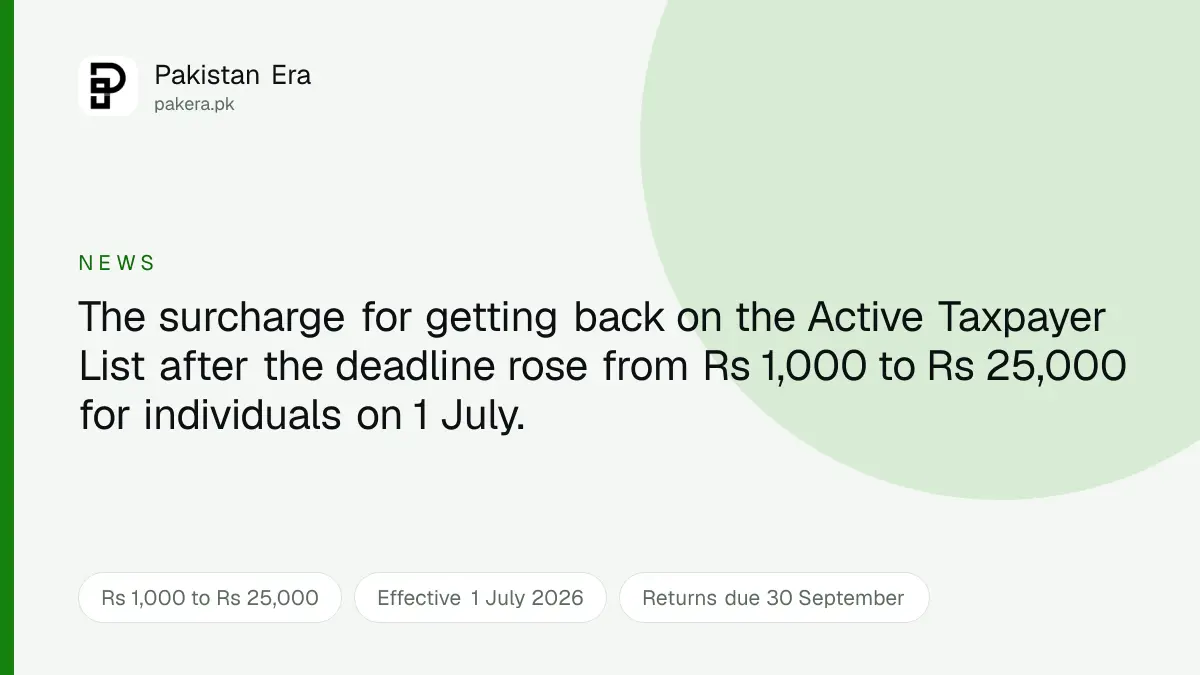
If you miss the tax return deadline and later want back on the Active Taxpayer List, the surcharge is now Rs 25,000.
It used to be Rs 1,000. It changed on 1 July 2026.
Search for the penalty today and you will still find tax advice pages quoting the old figure. Returns are due on 30 September, so this is worth getting right now rather than in October.
What changed, and by how much
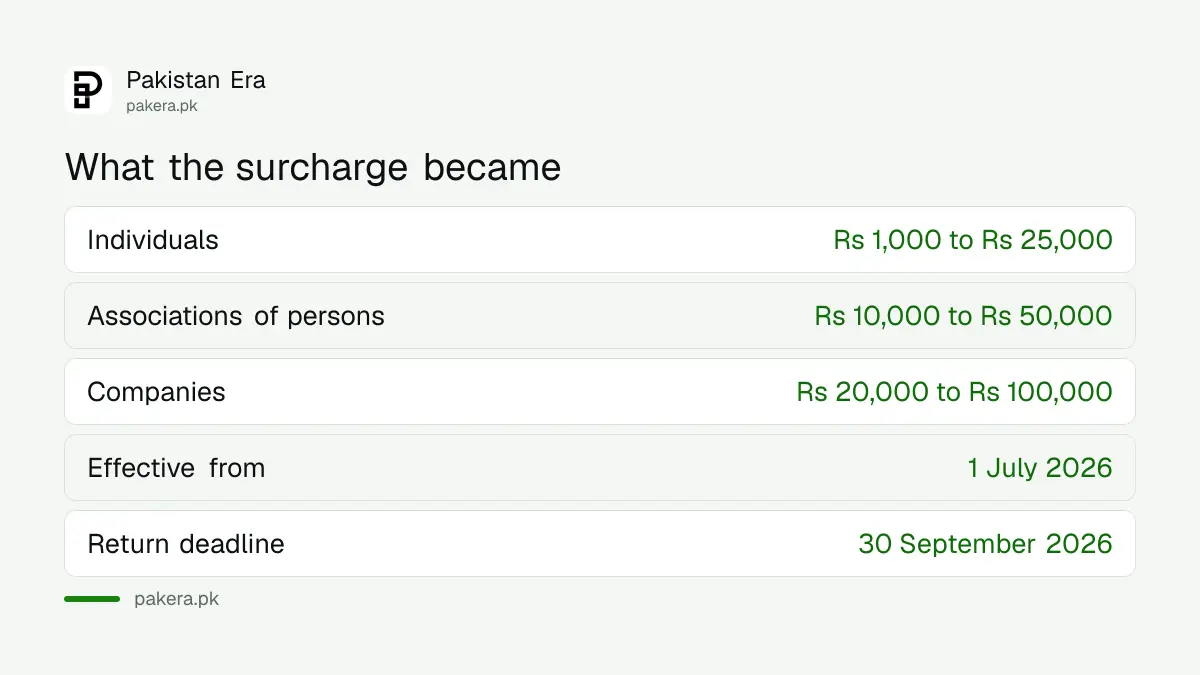
| Who | Was | Now |
|---|---|---|
| Individuals | Rs 1,000 | Rs 25,000 |
| Associations of persons | Rs 10,000 | Rs 50,000 |
| Companies | Rs 20,000 | Rs 100,000 |
For an individual that is a twenty five fold increase, and it took effect on 1 July 2026.
Two different charges people keep confusing
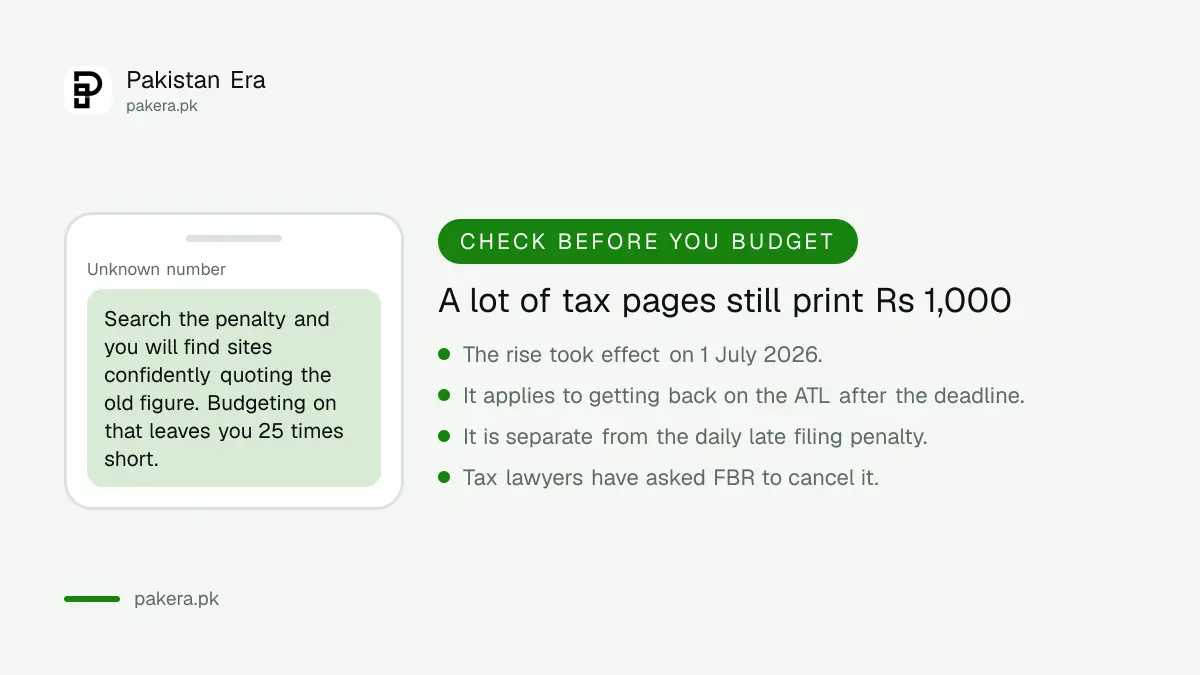
This is where most of the wrong numbers come from, so it is worth separating properly.
The ATL surcharge is what you pay to be restored to the Active Taxpayer List after missing the deadline. That is the Rs 25,000.
The late filing penalty under the Income Tax Ordinance is a separate charge for filing late at all.
They are not alternatives and they are not the same number. We are not printing a figure for the second one, because the amounts circulating for it come from the same advice sites carrying the outdated surcharge, and we did not read them on an FBR page.
Why being off the ATL costs more than the surcharge
The surcharge is the visible price. It is usually not the expensive part.
Being off the Active Taxpayer List means non-filer rates apply when you do ordinary things: banking transactions, registering a vehicle, buying or transferring property. Those differentials are designed to be uncomfortable, and on a property transaction they can dwarf Rs 25,000 comfortably.
So the real cost of missing 30 September is the surcharge plus however many months you spend paying non-filer rates before you fix it.
If you are not sure where you currently stand, that is checkable in a minute and set out in our guide to checking your filer status.
Three more consequences that sit in the same section
We read section 182A on 29 August 2026 in the consolidated Income Tax Ordinance, 2001 published by FBR on its own download site. Alongside removal from the Active Taxpayer List, the section attaches three further consequences to a return filed after the due date.
| Consequence | What the section says |
|---|---|
| Losses | Not allowed to carry forward any loss for that tax year |
| Refunds | No refund is issued while the person is off the list |
| Delayed refund payment | The time spent off the list is not counted towards it |
The refund one bites hardest for salaried people who are owed money back. A refund does not simply wait for you, it is withheld for the whole period you are off the list, and the compensation normally payable for a delayed refund does not accrue over that period either.
There is a route that avoids paying the surcharge
We read this in section 182A(3) of FBR's copy of the Income Tax Ordinance 2001, amended up to 30 June 2026. Under section 182A, an individual can be included in the Active Taxpayer List without paying the surcharge by furnishing an undertaking before the Commissioner.
The undertaking is that you will not purchase, acquire or otherwise obtain ownership or a beneficial interest in any property for six months from the date you furnish it. The law says "any property", not only land or houses. The form of the undertaking is to be prescribed by FBR, and we could not find it published.
- Work out whether you intend to buy property in the next six months.
- If you do not, the undertaking costs you nothing you were going to use.
- If you might, weigh six months of being unable to buy against Rs 25,000.
- Ask your tax adviser to file the undertaking with the Commissioner.
- Do not treat a verbal assurance at a counter as the undertaking being on record.
For most salaried filers with no property plans, that is a straightforward choice. For anyone in the middle of a purchase it is not, and paying the surcharge may simply be cheaper than freezing the transaction.
First-time filers are also reported to be accepted onto the list without the surcharge. If this is your first return, ask before you pay anything.
Why FBR's own published ordinance still shows Rs 1,000
This explains a lot of the confusion, and we checked it directly.
The consolidated Income Tax Ordinance, 2001 that FBR publishes on its own site is the version amended up to 20 February 2026. We downloaded it on 29 August 2026 and read section 182A in it. The proviso there still sets the surcharge at Rs 20,000 for a company, Rs 10,000 for an association of persons and Rs 1,000 for an individual.
Those are the figures before the Finance Act, 2026, which took effect on 1 July 2026. FBR's published consolidated text simply has not caught up with the amendment, so anyone who goes to the primary source to check will read the old number and repeat it in good faith.
We could not therefore read Rs 25,000 on an FBR page, and we are saying so rather than implying otherwise. What is not in doubt is that the higher amount is being applied, because it is being demanded through the IRIS portal.
Tax lawyers have asked for it to be cancelled
Worth knowing, and worth not relying on.
The Pakistan Tax Bar Association wrote to the FBR chairman, Rashid Mahmood Langrial, on the surcharge in early July 2026. The objection reported is not about fairness. It is a legal argument that the higher amount cannot be applied backwards.
The association's position, as reported, is that the enhanced surcharge creates a new financial liability, and that an amendment imposing a new liability applies going forward unless Parliament says otherwise. It asked FBR either to remove the IRIS check demanding the money for tax year 2025 or to hold the higher figure back until tax year 2026 returns.
That request exists. It has not been granted. Filing your return on the assumption that a charge will be withdrawn is not a plan, and we would not encourage anyone to treat it as one.
The charge is already being demanded for tax year 2025
This is the part that catches people out, because most coverage frames the surcharge as a 30 September 2026 problem.
Reporting says FBR updated IRIS from 1 July 2026 so that a late filer of a tax year 2025 return has to pay the Rs 25,000 before appearing on the Active Taxpayer List. Many practitioners had expected the new figure to apply only once tax year 2026 returns were being filed. If you are catching up on a late 2025 return, that is the demand you are meeting, and it is the exact demand the tax bar has questioned.
Two practical points follow. Paying it puts you on the list now, and it is the only route to filer status that currently works. Not paying it leaves you off the list, with the higher withholding rates that come with that, while an unresolved legal question runs in the background. Neither is comfortable, and the choice is yours to make with your own tax adviser rather than ours to make for you.
How to make the whole question irrelevant
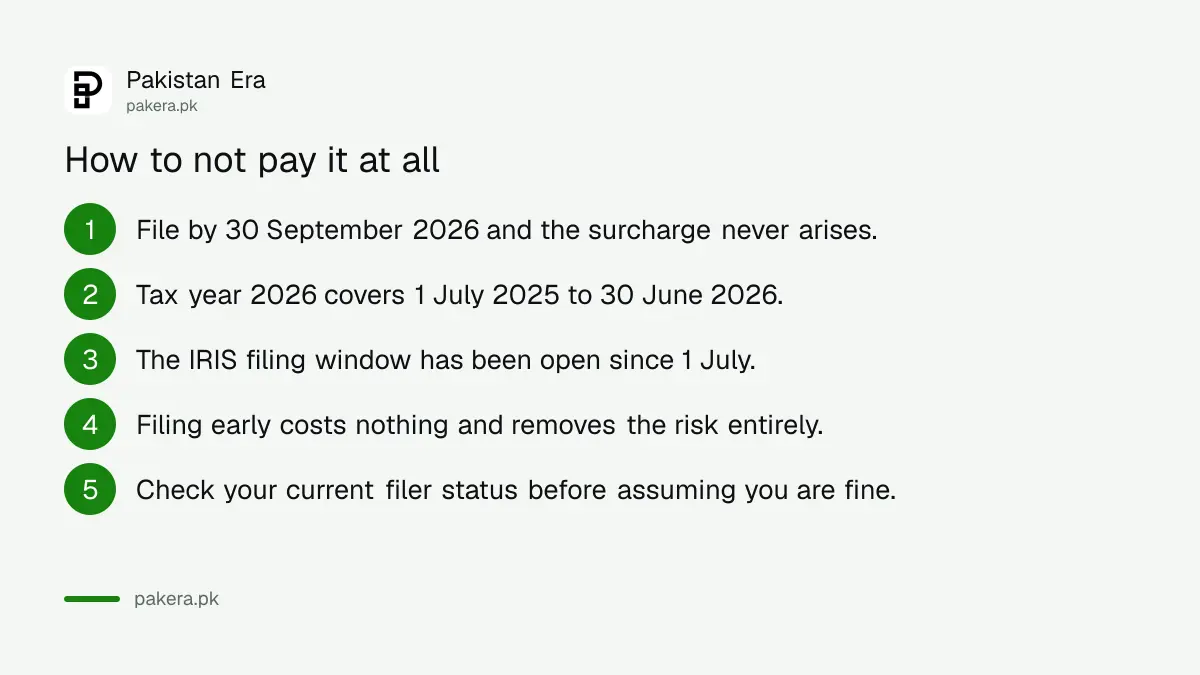
- File by 30 September 2026. If you do, the surcharge never arises at any amount.
- Know which year you are filing. Tax year 2026 covers income from 1 July 2025 to 30 June 2026.
- The window is already open. IRIS has accepted tax year 2026 returns since 1 July, so there is nothing to wait for.
- File early rather than on the day. The portal is busiest at the end and a technical problem on 29 September is your problem, not FBR's.
- Check your status first rather than assuming you are on the list.
The process itself, step by step, is in our guide to filing your income tax return. If you have never filed and are starting from nothing, begin with becoming a tax filer.
Check the date on whatever you are reading
We are not naming any site. The point is not that a particular firm is wrong, it is that a rule changed in July and a lot of pages were written before that.
The habit worth building is simple. On any tax figure, look for when the page was written or last updated. A confident number with no date attached to it is worth very little in a year when the Finance Act moved several of them.
The same goes for this page. It is correct as of 12 August 2026, and if the surcharge changes again we will update it and say so, as set out in our corrections policy.
The rest of the 30 September pile-up
That date is unusually loaded this year. The income tax return is due, the Punjab property tax rebate expires, and the ATL surcharge kicks in for anyone who misses it.
All of the month's dated obligations are in our Pakistan deadlines calendar.
Questions readers are asking
How much is the ATL surcharge in 2026?
Rs 25,000 for individuals, Rs 50,000 for associations of persons and Rs 100,000 for companies, effective from 1 July 2026. It was previously Rs 1,000, Rs 10,000 and Rs 20,000.
When is the tax return deadline?
30 September 2026 for salaried individuals, other individuals and associations of persons, covering income from 1 July 2025 to 30 June 2026.
Is the surcharge the same as the late filing penalty?
No. The surcharge restores you to the Active Taxpayer List after the deadline. The late filing penalty under the Ordinance is a separate charge.
Can I avoid the surcharge?
Yes, by filing on time. If your return is in by 30 September the surcharge does not arise.
Will the Rs 25,000 surcharge be cancelled?
Tax lawyers have asked FBR to cancel it. That request has not been granted, and we would not plan around it being withdrawn.
What does being off the ATL actually cost?
Non-filer rates on banking, vehicle registration and property transactions, which on a large transaction can exceed the surcharge itself.
Why do some websites still say Rs 1,000?
The figure changed on 1 July 2026 and many pages were written before that. There is also a better reason: the consolidated ordinance FBR publishes is amended only to 20 February 2026 and still prints Rs 1,000, so the primary source itself gives the old number.
Can I get on the list without paying Rs 25,000?
Yes. Section 182A(3) lets an individual furnish an undertaking before the Commissioner not to acquire any property for six months. First-time filers are also reported to be accepted without the surcharge.
Does a late return cost me anything besides the surcharge?
Section 182A also stops you carrying forward losses for that year and withholds any refund for the whole period you are off the list.
How we verified this
What we checked, where we read it, and what we could not confirm.
Last checked 29 August 2026. We downloaded the consolidated Income Tax Ordinance, 2001 from FBR's own download site on that date, the version amended up to 20 February 2026, and read section 182A in it. The removal from the Active Taxpayer List, the bar on carrying forward losses, the withholding of refunds while off the list, the exclusion of that period from additional payment for delayed refund, and the surcharge proviso figures of Rs 20,000, Rs 10,000 and Rs 1,000 are all taken from that text. That published version predates the Finance Act, 2026, so the current amounts of Rs 25,000, Rs 50,000 and Rs 100,000 are not in it and we could not read them on an FBR page. Those amounts, and the acceptance of first-time filers without the surcharge are all reported rather than read at source, and we have marked each of them as such in the body. Confirm your own position with a tax adviser or through the IRIS portal before deciding.
About the author

Senior Writer, Public Services and Technology
Shahid joined us in 2024 as an author. He is a senior contributor to Pakistan's leading technology websites. He writes detailed articles, mostly covering his expertise in the latest tech, mobiles, apps, gadgets, and step-by-step guides. His ideology is to help people understand the latest trends and explain complex methods through very easy-to-understand guides.