HEC IRSIP Batch 60: PhD Students Apply for a Six-Month Research Visit Abroad by 30 October
HEC's IRSIP portal is open from 1 to 30 October 2026 for PhD students. See who is eligible, the allowance by country, the documents and how it differs from QAMF
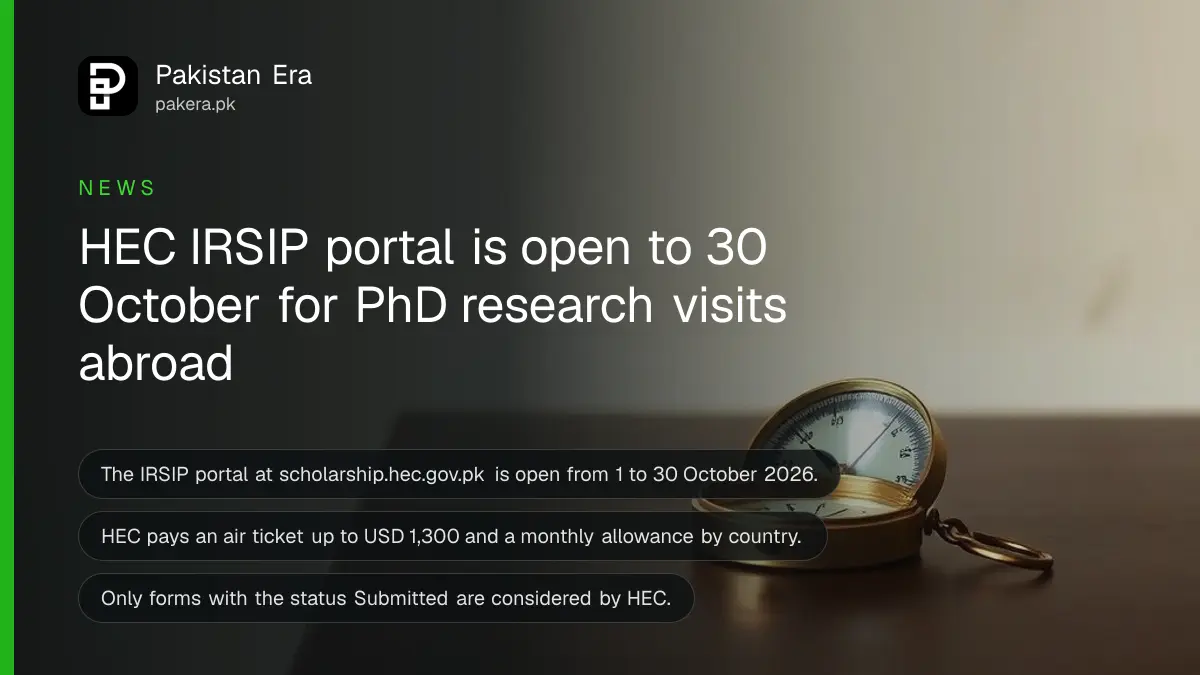
Short answer: HEC says the portal for its International Research Support Initiative Program (IRSIP) stays open from 1 October to 30 October 2026, at scholarship.hec.gov.pk. IRSIP is a six month research visit abroad for full-time PhD students in Pakistan. A second HEC programme with the same package takes applications by Google form, so do not mix the two.
A PhD student in Lahore finishes her coursework, finds a professor abroad who will host her, and then hears that "HEC fellowship forms close on 30 October". Two programmes carry that date. They look alike, and they use different application channels.
We opened every page of HEC's IRSIP section on 12 October 2026: the introduction, eligibility, how to apply, terms, package, FAQs and contact pages. We also opened the page of the Quaid-e-Azam Memorial Fellowship to compare the two. We did not log in to the portal, because that needs a real student account.
IRSIP Batch 60 takes applications from 1 to 30 October 2026
HEC's How to Apply page says the portal remains open from 1 October 2026 to 30 October 2026. Eligible candidates are asked to apply online at scholarship.hec.gov.pk. The page names no closing hour, so treat the afternoon of 29 October as your real deadline.
The programme sends a PhD student abroad for six months of research. Your PhD stays at your Pakistani university. HEC says the aim is to raise the quality of doctoral research and to build links between Pakistani and foreign institutions.
The page also warns about one detail that sinks applications. Only forms with the status "Submitted" are considered. A form left in "Saved" status is treated as incomplete.
Only PhD students with 18 months to 3.5 years of enrolment are eligible
You must be a Pakistani or AJK national and a full-time PhD student at a recognised Pakistani university. You need 18 credit hours of coursework, 18 months of enrolment and no more than 3.5 years. For Batch 60, enrolment must fall between Spring 2023 and Spring 2025.
The page adds more conditions. You need to have passed the GAT Subject Test or your university's admission test when you joined the PhD. Your research topic and synopsis must be approved by BASR, DASR or an equivalent university body.
You also need an official acceptance letter from a foreign university or research institute. That university must rank among the top universities overall or by subject in the QS or Times Higher Education tables. Your foreign supervisor must be a full-time Assistant Professor or above, and must not be a former supervisor of your local supervisor.
HEC pays an air ticket, a monthly allowance and a capped bench fee
The package page lists an economy return air ticket up to USD 1,300, paid once, plus a monthly living allowance by country. HEC also reimburses a bench fee, which is the fee a foreign lab charges for research space, up to a stated cap and only if the offer letter asks for it.
| Host country | Living allowance per month | Six months (our arithmetic) |
|---|---|---|
| United Kingdom | GBP 750 | GBP 4,500 |
| Austria, Germany, Netherlands | EUR 975 | EUR 5,850 |
| Rest of Europe | EUR 900 | EUR 5,400 |
| USA | USD 1,500 | USD 9,000 |
| Korea, China, Malaysia | USD 800 | USD 4,800 |
| Rest of the world | USD 1,200 | USD 7,200 |
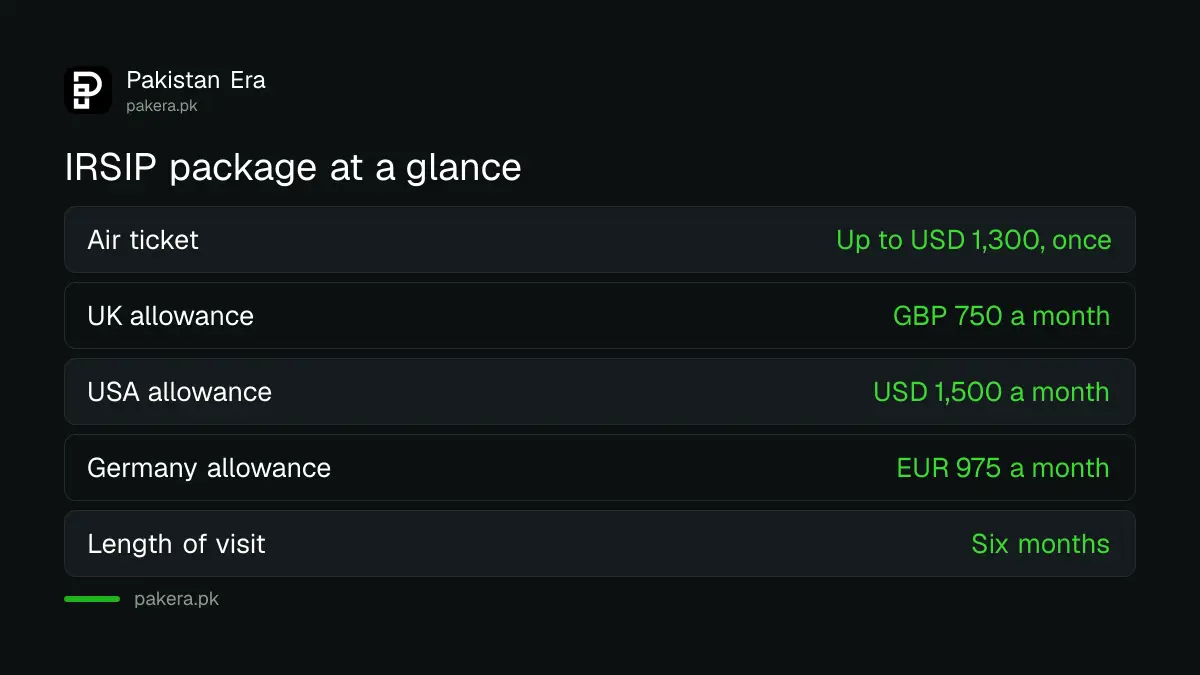
The bench fee caps are USD 3,500, GBP 1,750, EUR 2,550, AUD 4,100 and CAD 3,700. HEC says a bench fee is awarded only if the acceptance letter demands it at selection. You pay first and HEC reimburses you against the paid invoice. The page says a waiver of the fee "will be appreciated".
The FAQ page is clear on what HEC does not cover. It does not pay visa fees or health insurance. The six month stipend is paid in advance by cross cheque before you leave, and no money is released before visa endorsement.
IRSIP and the Quaid-e-Azam fellowship are two channels with the same package
Both HEC programmes accept PhD students enrolled between Spring 2023 and Spring 2025, and both close on 30 October. They differ in where you submit, when the window opened and what the research is meant to be about.
| Point | IRSIP Batch 60 | Quaid-e-Azam Memorial Fellowship |
|---|---|---|
| Window | 1 to 30 October 2026 | 6 to 30 October 2026 |
| Where to apply | scholarship.hec.gov.pk portal | Google form linked on HEC's page |
| Focus stated by HEC | Doctoral research quality in general | Research on Quaid-e-Azam's life, thought and legacy |
| Contact | irsip@hec.gov.pk | qamf@hec.gov.pk |
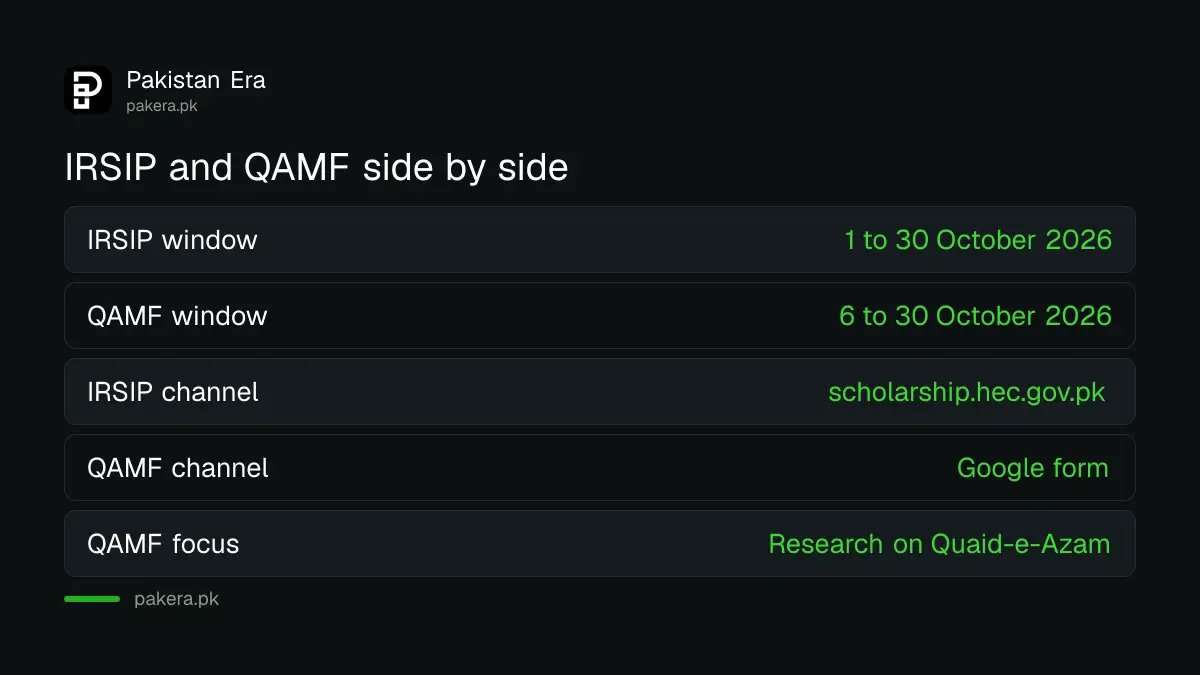
Our guide to the Quaid-e-Azam Memorial Fellowship covers that programme in full. HEC's pages do not say whether one student may apply to both at once. Ask the project office by email before you file twice.
How to prepare and submit the IRSIP application
Start with the foreign acceptance letter, because every other document depends on it. Then collect the HEC proforma signed by your foreign supervisor, your approval letter from the university and your local supervisor's recommendation. Submit online and confirm the status reads "Submitted".
- Get an acceptance letter from a head of department or senior professor at the foreign host. A letter signed by a lecturer or lab instructor is not accepted.
- Make sure the letter gives an overview of the work, the lab facilities, a plan of activities, the duration in months and any bench fee amount.
- Ask your foreign supervisor to fill in the HEC proforma and send you a current CV.
- Collect your BASR or DASR approval, the full synopsis, your local supervisor's signed and stamped letter and CV.
- Attach your CV, passport copy or token slip, academic documents from bachelor's onwards, the coursework transcript and the GAT or admission test result.
- Add an NOC from your HEC officer if you hold another HEC scholarship, and an NOC from your department if you are employed or on study leave.
- Submit on the portal and check that the status is "Submitted", not "Saved".
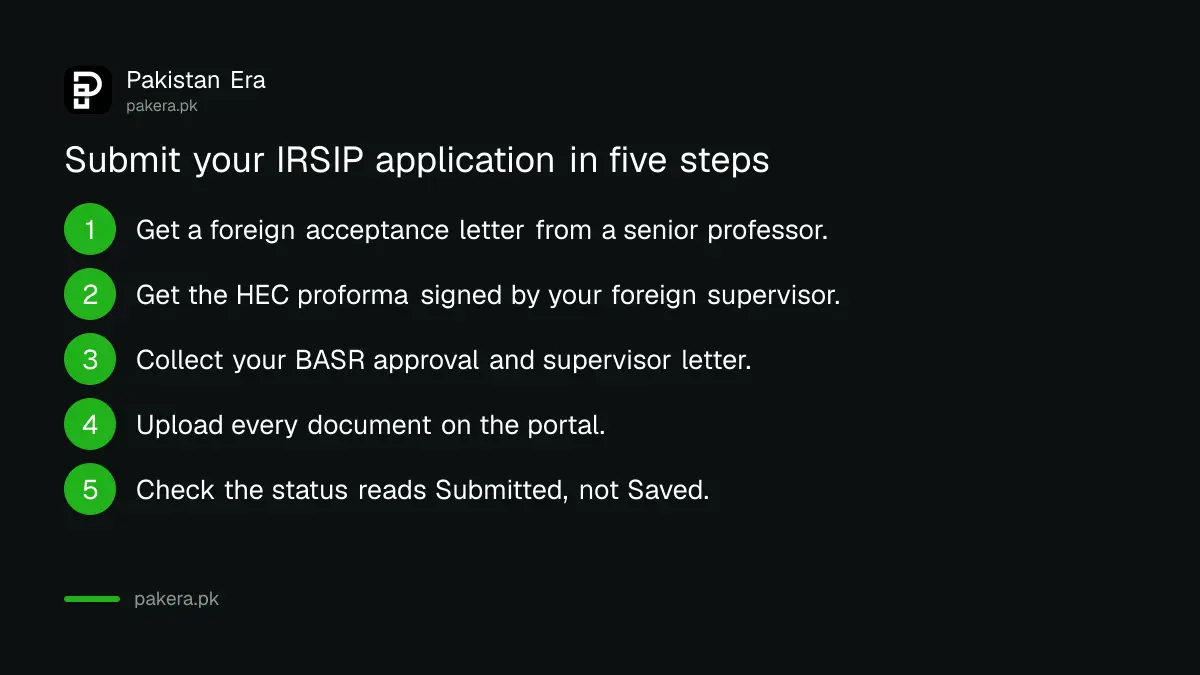
Use only the address HEC prints on its own pages. Our note on fake HEC sites shows how to read a domain ending before you sign in anywhere.
What happens after you apply
HEC's FAQ says processing and results take about 3 to 6 months. A selection committee meets quarterly. Selected scholars get about one month to submit a surety bond, a bench fee invoice and university account details. After that HEC issues the award letter.
The terms page says selected candidates sign a bond with HEC to return and finish the PhD at their parent university. You must start the fellowship within six months of the award letter. HEC says it may cancel an award at any stage if a document is false.
HEC's FAQ says no money moves before visa endorsement. It then gives 2 to 3 weeks for the advance stipend and ticket and 4 to 5 weeks for the bench fee. No PhD student can use the scholarship twice. If you miss this window, check every HEC and other scholarship date closing in October for another option.
Common questions
When does the IRSIP portal close?
HEC's page says 30 October 2026. It names no closing hour, so submit by the afternoon of 29 October.
Where do I apply for IRSIP?
Apply on scholarship.hec.gov.pk. The page lists the documents to upload, and hard copies are asked for only from selected candidates.
How much does IRSIP pay for a visit to the UK?
The package page lists GBP 750 a month for the UK, plus an air ticket up to USD 1,300. Six months comes to GBP 4,500 by our arithmetic.
Does HEC pay my visa fee?
No. HEC's FAQ says it does not pay visa application fees or health insurance. It issues an award letter you can use as a supporting document.
Can I use IRSIP twice during my PhD?
No. HEC's FAQ says no PhD student can use the scholarship a second time.
Who do I email with questions?
HEC's contact page lists irsip@hec.gov.pk and the Project Director (IRSIP) at HEC in Islamabad.
How we verified this
What we checked, where we read it, and what we could not confirm.
We read HEC's IRSIP pages and the Quaid-e-Azam Memorial Fellowship pages on 12 October 2026, at hec.gov.pk. We did not open the application portal itself. The pages give no closing hour, and we could not confirm whether a student can apply to both programmes. HEC may change the dates, so check the page before you submit. A related option for PhD students is the HEC US-Pakistan Knowledge Corridor PhD scholarship.
About the author

Public Services and Education Journalist
Fajr Riaz is a journalist and content writer at Pakistan Era, based in Lahore. She covers the questions people meet in everyday life in Pakistan: how a public service works, what a change in the rules means, and where to find a reliable answer.