Every Deadline Worth Knowing in Pakistan's Year
Token tax by 31 August, tax returns by 30 September, and the rebates that quietly expire. The dates that cost money if you miss them.
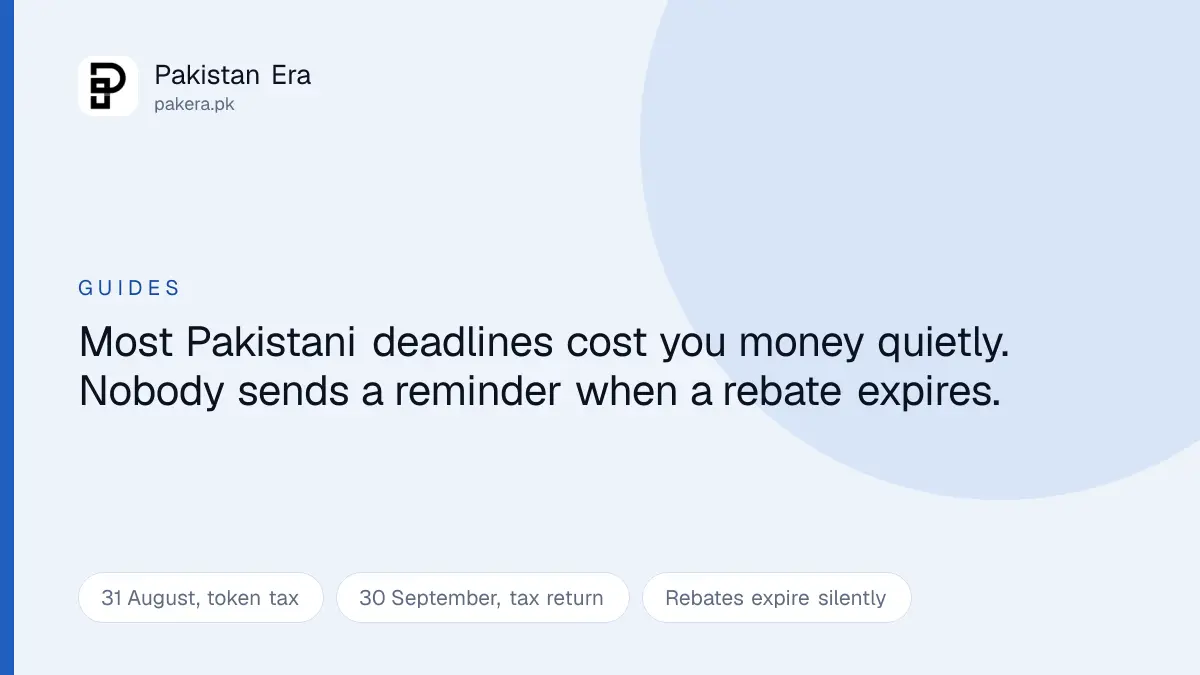
Almost every expensive mistake in dealing with Pakistani officialdom is a date, not a rule somebody failed to understand.
Rebates expire. Surcharges start. Nobody sends a reminder, because the system has no reason to. Here are the dates that actually cost money, and what each one is.
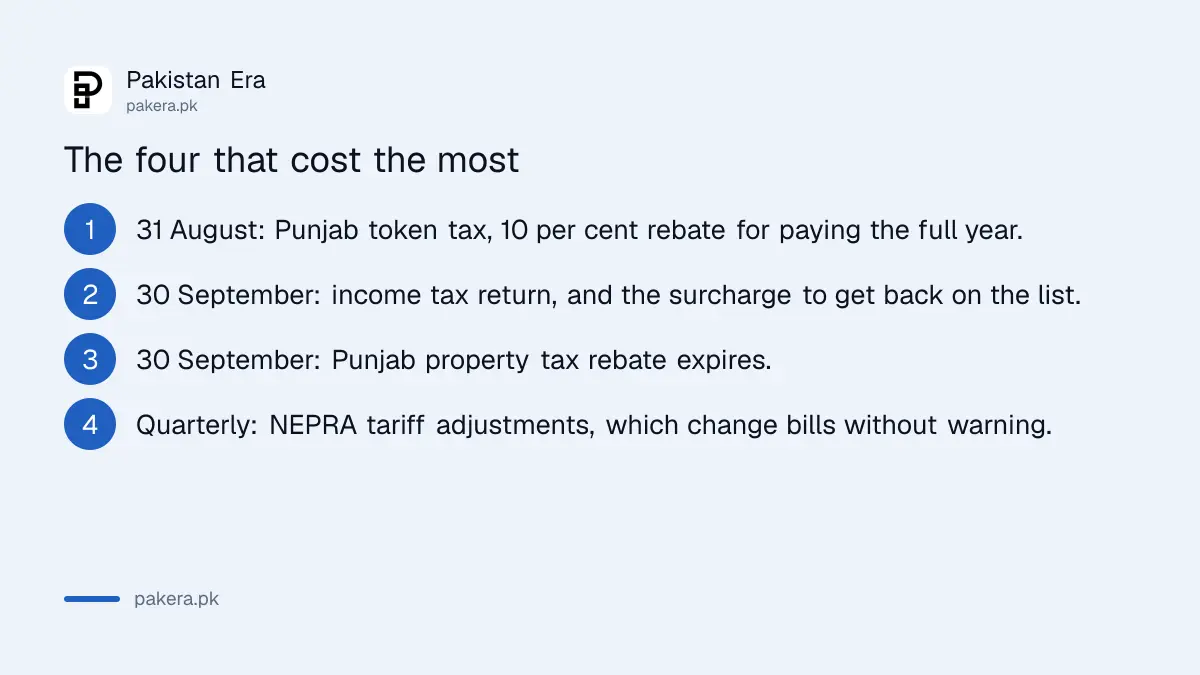
The four that cost the most
| Date | What happens | What it costs to miss |
|---|---|---|
| 17 August | Hajj 2027 first instalment collection begins | Your place in the 2027 queue |
| 19 August | Punjab matric second annual form, single fee | The fee doubles, then triples |
| 25 August | Punjab matric second annual form, double fee | The fee triples after this |
| 29 August | Punjab matric second annual form, last date | No listed option after this |
| 31 August | Punjab token tax rebate ends | 10 per cent of your annual token tax |
| 30 September | Income tax return due, individuals | Rs 25,000 surcharge to get back on the ATL |
| 30 September | Punjab property tax rebate ends | 5 per cent of the bill |
| 1 October | Active Taxpayer List published | Non filer rates until you fix it |
The tax one is the big change this year. The surcharge to restore your name to the Active Taxpayer List went from Rs 1,000 to Rs 25,000 for individuals under the Finance Act 2026, and Rs 50,000 for Associations of Persons. Missing 30 September used to be an inconvenience. It is now expensive.
Details are in our guides to Punjab token tax and becoming a tax filer.
The ones that recur rather than fall on a date
- Monthly, LPG. OGRA notifies a new rate at the start of each month. Covered in the guide to LPG cylinder prices.
- Monthly, fuel cost adjustment on electricity. Applies to one month's bills only, then goes.
- Quarterly, NEPRA tariff adjustment. Spread over the following three months of bills, and it moves in both directions.
- Quarterly, BISP payments. Amounts and eligibility are checked against your CNIC.
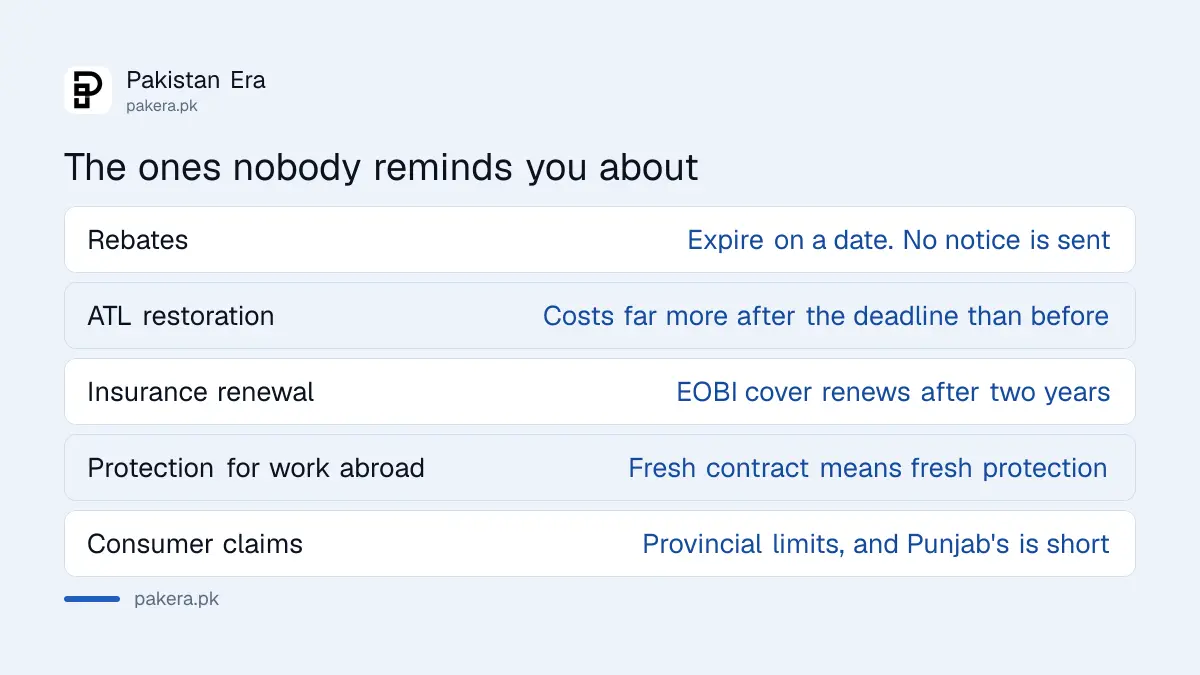
- Every two years, EOBI insurance renewal.
- Every five years, a solar net billing agreement. Down from seven under the old rules.
The electricity ones catch people out repeatedly, because a bill can rise with no change in your usage at all. We set out the three separate mechanisms in the piece on what actually moves your tariff.
Deadlines that only exist once you are in the process
These do not appear on any calendar until they apply to you, and they are the ones people discover too late.
- Six months, EOBI backdating. An old age pension claim is backdated six months and no further. Claim late and the rest is simply never paid. See our guide to checking and claiming an EOBI pension.
- Forty five days, bank complaints. Your bank has that long to answer before you can go to the Banking Mohtasib, and the clock only starts if your letter says you intend to. See complaining about your bank.
- Thirty days, government departments. An agency is bound to respond before the Wafaqi Mohtasib takes over. See complaining to the Wafaqi Mohtasib.
- Sixty days, the Mohtasib's own limit for deciding a complaint.
- Consumer claims. Provincial, and short in Punjab, where guidance points to roughly a month from the dispute. See taking a shop to consumer court.
- Fresh emigrant protection whenever you sign a new foreign contract. See emigrant protection.
The documents that expire quietly
Nothing warns you, and each one blocks something else when it lapses.
- Your passport. Many countries want six months of validity beyond travel, and Hajj registration has its own requirement.
- Your CNIC. An expired one stops bank transactions, SIM registration and property matters.
- Your NICOP, if you live abroad. Since July 2026 an expired one means you need a visa to enter Pakistan. See NICOP and POC.
- Your driving licence.
- Vehicle token tax, which accrues whether or not you drive.
The habit that covers most of it
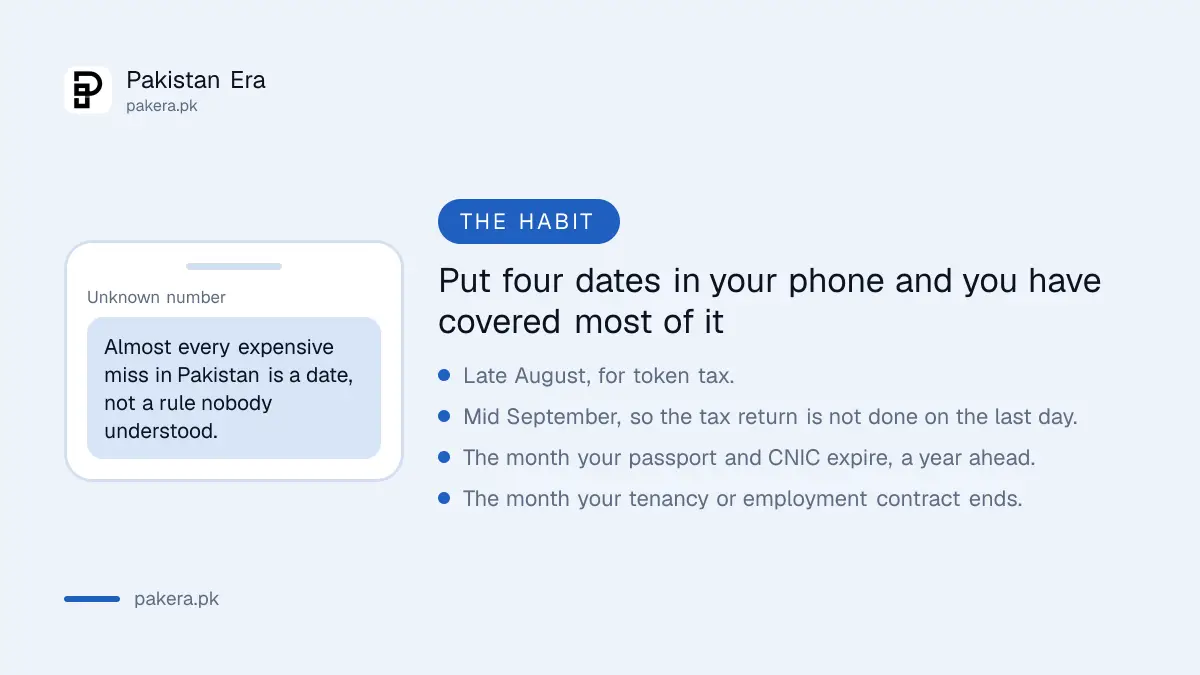
You do not need a system. Four reminders in your phone will catch most of the money.
- Mid August, for token tax before the rebate goes.
- Mid September, so the tax return is not being done on 30 September at midnight.
- The month your passport and CNIC expire, set a year ahead.
- The month your tenancy or work contract ends, set two months ahead.
A note on what is not here
We have deliberately left out things that change every year, such as board result dates, public holidays and Hajj application windows. Those are worth following as news, and a calendar that carries them goes stale within months.
Tax, property and tenancy are also provincial subjects, so a date that applies in Punjab may not apply in Sindh. Where we name a province, we mean that province.
Questions readers are asking
What is the last date for Punjab token tax?
31 August of the financial year, to get the 10 per cent rebate for paying the whole year. It is a standing provision, not a one off offer.
When is the tax return deadline in Pakistan?
30 September for individuals for Tax Year 2026. Companies generally have until 31 December.
What happens if I miss the tax deadline?
You fall off the Active Taxpayer List and pay non filer rates. Restoration now costs Rs 25,000 for individuals under the Finance Act 2026, up from Rs 1,000.
How far back can an EOBI pension be claimed?
Six months. Anything earlier is not paid, which makes claiming promptly the single most valuable date on this page for a retiring worker.
Do rebates come back every year?
The Punjab token tax rebate is a standing provision in the rate schedule and returns annually. Others vary, so check rather than assume.
Why are these dates different in my province?
Tax, property and tenancy are provincial subjects. Punjab, Sindh, Khyber Pakhtunkhwa and Balochistan set their own rates and dates.
About the author

Senior Writer, Public Services and Technology
Shahid joined us in 2024 as an author. He is a senior contributor to Pakistan's leading technology websites. He writes detailed articles, mostly covering his expertise in the latest tech, mobiles, apps, gadgets, and step-by-step guides. His ideology is to help people understand the latest trends and explain complex methods through very easy-to-understand guides.