Buy Electricity From a Private Supplier in Pakistan: The 1 MW Rule, Grid Charges and Steps
Only users of 1 MW or more can buy power from a private supplier in Pakistan. See the grid charges from Rs 6.23 a unit, the ISMO steps and what to check first.
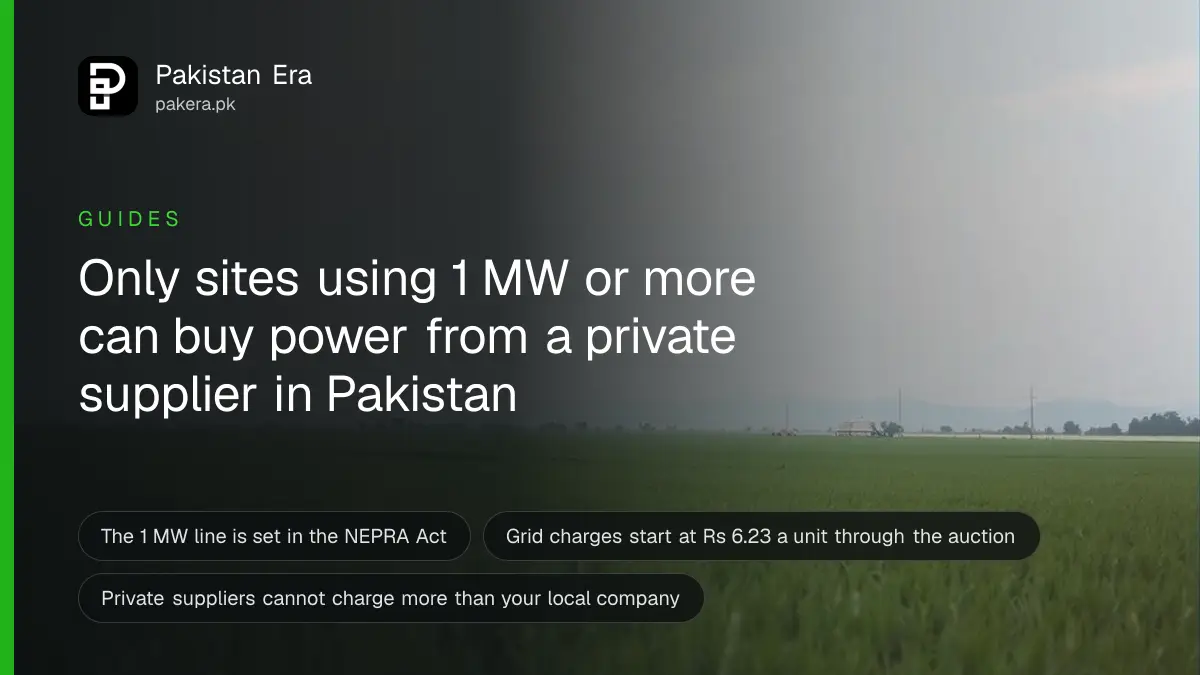
In Pakistan, only a bulk power consumer can buy electricity from a private supplier instead of its local power company. That means a user taking 1 megawatt or more at one premises, under the NEPRA Act. Homes, shops and small factories cannot switch. A qualifying buyer still pays the grid charge, which NEPRA made uniform on 9 October 2026, from Rs 6.23 a unit for a large factory at 11 kV.
We read the NEPRA Act definition, NEPRA's page on the new market, the supplier licence rules and the new grid charge decision on nepra.org.pk. We also read the market operator's registration steps. Here is who can switch, what it costs, and how the process works.
The 1 MW rule decides who can switch
The NEPRA Act defines a bulk power consumer as one who buys or receives power "at one premises, in an amount of one megawatt or more". NEPRA can set other amounts and voltage levels, but 1 MW is the line in the Act. Below it, you buy from your distribution company and pay the regulated tariff.
One megawatt is a large load. A typical home has a sanctioned load of a few kilowatts, and 1 MW is 1,000 kilowatts. In practice, this covers textile mills, cement plants, steel units, large hospitals and similar sites, usually connected at 11 kV or higher.
If your site is below 1 MW, your route to cheaper power runs through your own roof instead. Rooftop solar under the 2026 net billing rules is open to any three-phase consumer.
The new market gives large buyers a choice of supplier
NEPRA approved the Competitive Trading Bilateral Contract Market in November 2020. Its aim, in NEPRA's words, is to give bulk power consumers with 1 MW or more a choice to buy "from the DISCOs or a competitive supplier of their choice". The Power Division told NEPRA that commercial market operations were declared on 22 January 2026.
The old system had one buyer. A government agency bought all power for the state-owned companies, and every consumer bought from their local company. The new market lets licensed suppliers sell directly to large users at negotiated rates.
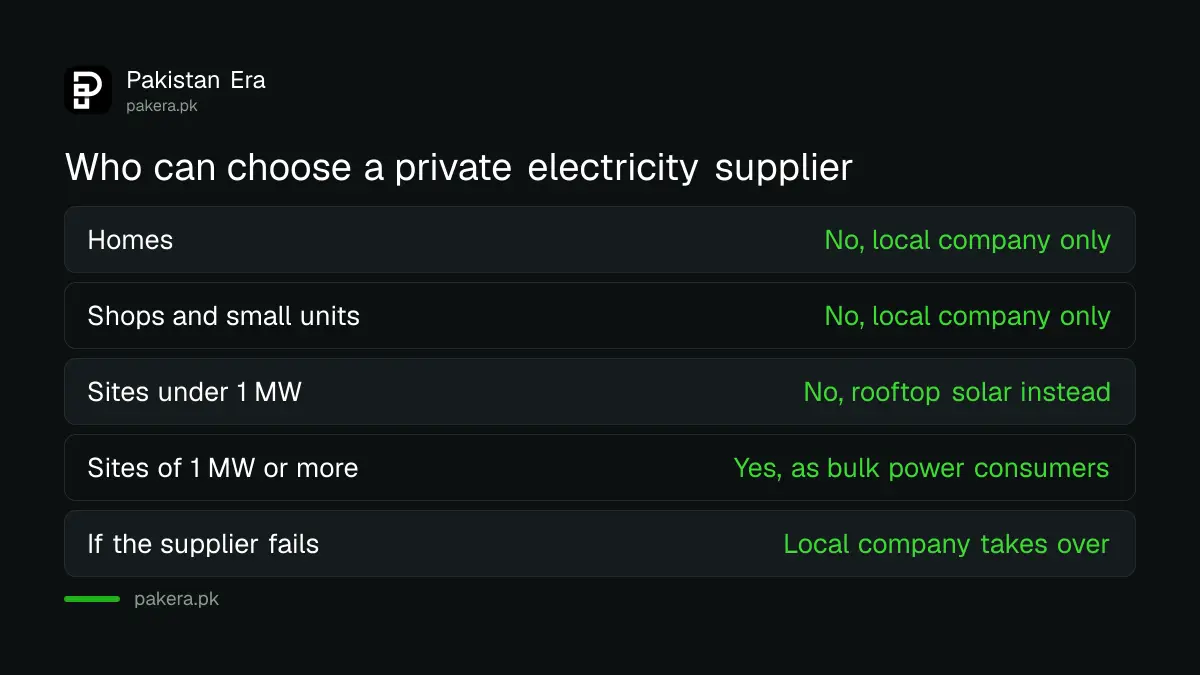
NEPRA built in one protection. Its market page says competitive suppliers "are not allowed to charge higher tariff than the tariff of regulated suppliers of last resort". The supplier of last resort is your local company, which must keep supplying anyone who needs it, including a bulk buyer whose private supplier defaults.
What a bulk buyer still pays the grid
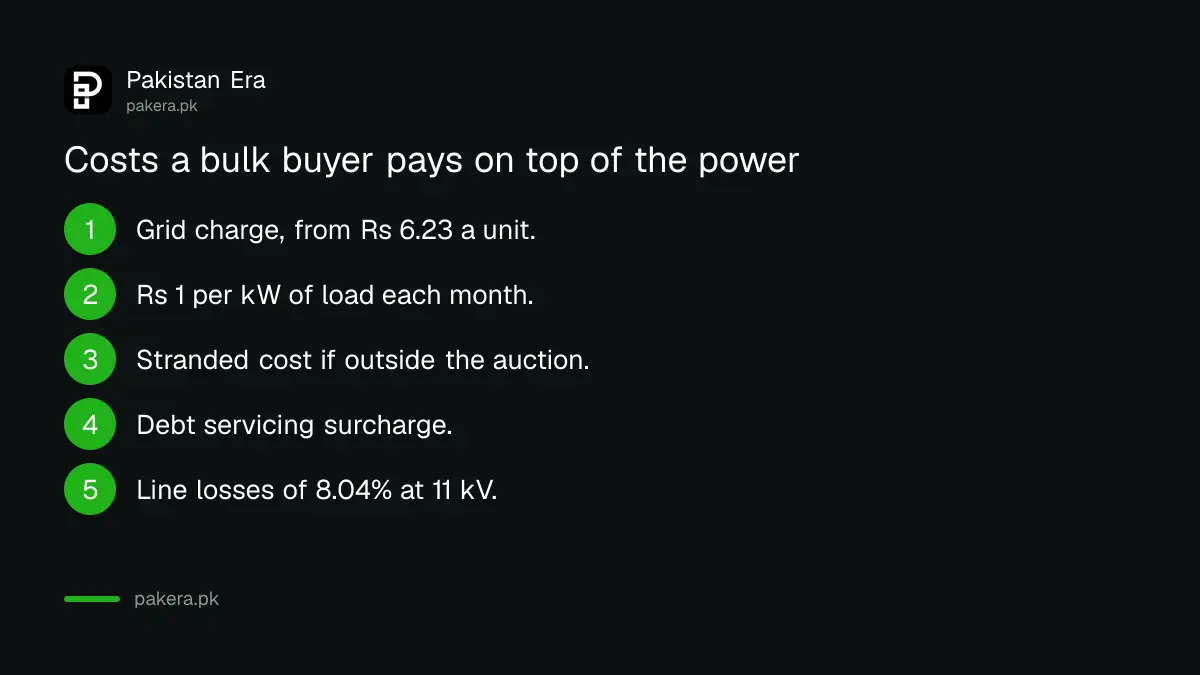
Switching supplier does not take you off the wires. You pay a grid charge for transmission, distribution and a cross-subsidy share, plus Rs 1 per kW of sanctioned load a month. NEPRA notified one uniform set of these charges for the whole country on 9 October 2026.
| Category | Grid charge through auction | Without auction (adds stranded cost) |
|---|---|---|
| B-3, industry at 11 kV | Rs 6.23 a unit | Rs 19.17 a unit |
| B-4, industry at 66 or 132 kV | Rs 9.09 a unit | Rs 25.45 a unit |
| C-3, bulk supply at 66 kV and above | Rs 14.95 a unit | Rs 31.30 a unit |
| C-2 (a), bulk supply at 11 kV | Rs 19.62 a unit | Rs 32.56 a unit |
The gap between the two columns is the stranded cost, Rs 12.94 a unit at 11 kV and Rs 16.35 at 132 kV or 66 kV. It covers power plants the country pays for whether they run or not. Buyers who come in through the market operator's wheeling auction do not pay it. The full list of categories is in our report on NEPRA's uniform grid charges.
On top of this, NEPRA agreed that open access users pay the government's debt servicing surcharge, the same as regular consumers. Line losses are also fixed: your generator must send 8.04 per cent extra at 11 kV, or 1.51 per cent extra at 132 kV, to cover what is lost on the way.
How the route to a private supplier works
There are two parts: finding a licensed supplier or generator, and getting capacity on the network. The Independent System and Market Operator, ISMO, runs the market and the wheeling auctions. Suppliers and generators register with ISMO as market participants.
- Confirm your premises takes 1 MW or more, from your sanctioned load and recent bills.
- Talk to a supplier holding, or applying for, a NEPRA electric power supplier licence.
- Check ISMO's Auction Hub for the next wheeling auction and its rules.
- Compare the supplier's price plus grid charges against your current tariff.
- Keep your local company as the supplier of last resort if the deal fails.
ISMO's registration takes ten steps. An applicant fills in the online form, sends a signed application with documents to ISMO's Islamabad office, answers any queries, and then signs a Market Participation Agreement. After that, ISMO issues a login for its portal.
Capacity is limited for now. ISMO has said the total wheeling quantity is 800 MW, with a cap of 20 per cent for any single party, and announced its first 2026 auction at 200 MW. We could not confirm on ISMO's site whether that auction has taken place. A supplier needs a NEPRA licence: the rules require a company supplying only bulk buyers to be registered with the SECP for that purpose alone. In July 2026, NEPRA invited comments on one such application, from Reon One (Private) Limited.
Do the sum honestly before you switch. A cheap generator price can disappear once you add the grid charge, the surcharge and losses. Large users with time-of-use meters should also weigh what they pay now in peak hours against a flat private price.
Common questions
Can a home buy electricity from a private company in Pakistan?
No. Only a bulk power consumer, taking 1 MW or more at one premises, can choose a competitive supplier. Homes buy from their local company.
What is a bulk power consumer?
Under the NEPRA Act, it is a consumer that buys or receives 1 megawatt or more of power at one premises, or another amount NEPRA specifies.
Can a private supplier charge more than my local company?
No. NEPRA says competitive suppliers cannot charge a higher tariff than the regulated supplier of last resort.
What happens if my private supplier goes bust?
Your local company, as supplier of last resort, must take over supply to bulk buyers of a supplier that defaults, under NEPRA's supplier licence rules.
Who runs the wheeling auction?
The Independent System and Market Operator of Pakistan, ISMO, runs the market and its wheeling auctions.
How we verified this
What we checked, where we read it, and what we could not confirm.
Last checked 10 October 2026. We read the bulk power consumer definition in the NEPRA Act, NEPRA's market page, the Eligibility Criteria (Electric Power Supplier Licence) Rules, 2023, and NEPRA's grid charge decision of 7 September 2026 notified on 9 October 2026, all on nepra.org.pk. We read the registration steps and wheeling auction notices on ismo.gov.pk. The checklist in the numbered list is our own advice.
About the author

Global Affairs & Political Economy Writer
Muhammad Hatim is a book lover who started writing because he enjoys it. At Pakistan Era he writes about international relations, geopolitics and the global economy, with a particular interest in South Asia and the forces behind current events.