NEPRA Notifies One Grid Charge Across Pakistan for Factories Buying Private Power
NEPRA notified uniform grid charges on 9 October 2026 for open access users, from Rs 6.23 a unit. See the rates, who pays, and the part that could reach bills.
NEPRA has notified one set of grid charges for factories and other large users that buy electricity from a private supplier in Pakistan. The notification, S.R.O. 1780(I)/2026, is dated 9 October 2026. It puts into force a decision NEPRA signed on 7 September 2026. For a large factory at 11 kV that buys power through the market auction, the grid charge is Rs 6.23 a unit plus Rs 1 per kW a month.
We downloaded the notification and the full decision from nepra.org.pk and read both. The rates below come from the order at the end of the decision. Home bills do not change today. But one part of the decision can reach every bill later, and we explain it below.
NEPRA notified one grid charge for the whole country on 9 October
NEPRA published the notification on 9 October 2026, which puts the 7 September decision into force. Every bulk buyer in the open market now pays the same grid charge, whichever company's wires carry its power. Before this, NEPRA had set a different charge for each of the 11 government-owned companies.
A grid charge, which NEPRA calls a use of system charge, is the fee for using the wires. A factory buying from a private generator still needs the grid to receive that power. The charge also carries a cross-subsidy, the share large users pay to keep other tariffs lower.
The December 2025 charges varied widely. HESCO's for one industrial category was Rs 36.57 a unit, against FESCO's Rs 5.52. The Power Division asked for one rate on 25 May 2026, and NEPRA held a hearing on 11 June.
The uniform rates run from Rs 6.23 to Rs 19.62 a unit
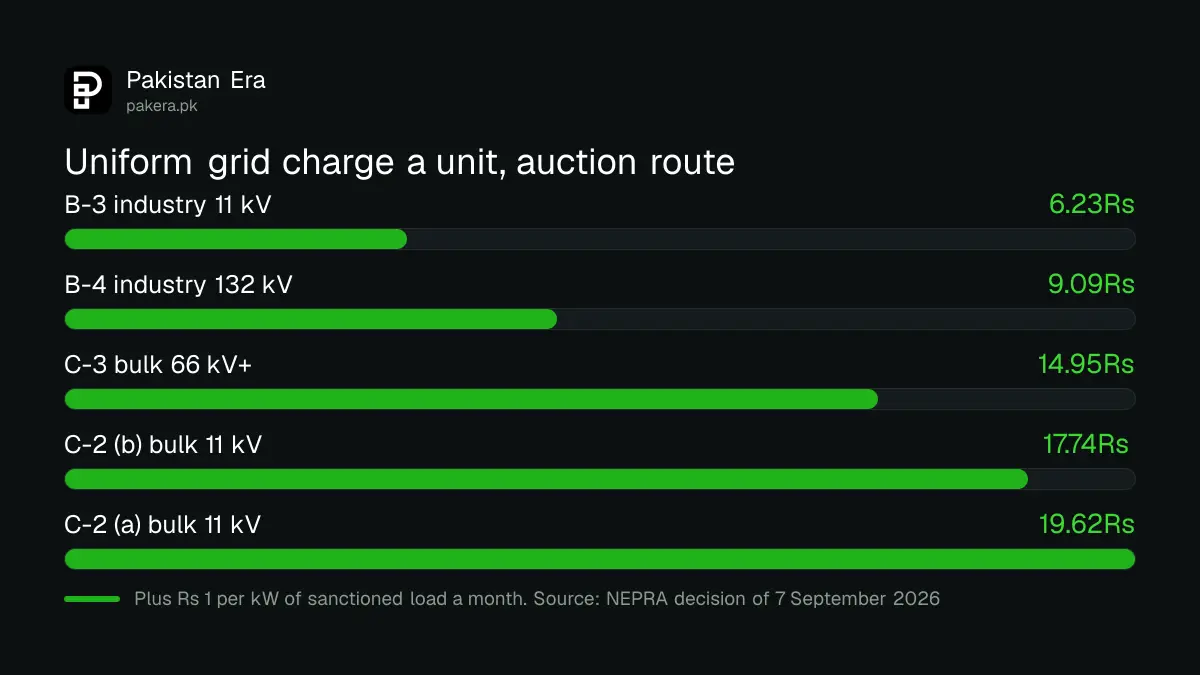
For buyers who enter the market through the wheeling auction, the charge is Rs 1 per kW of sanctioned load a month plus a per-unit rate. The per-unit rate is lowest for large industry and highest for bulk supply at 11 kV. Wheeling means sending power you bought from one place through someone else's network to your own premises.
| NEPRA category | Transmission | Distribution | Cross-subsidy | Total a unit |
|---|---|---|---|---|
| B-3 (industry, 11 kV) | Rs 1.60 | Rs 1.99 | Rs 2.63 | Rs 6.23 |
| B-4 (industry, 66 or 132 kV) | Rs 1.26 | Rs 2.78 | Rs 5.05 | Rs 9.09 |
| C-3 (bulk supply, 66 kV and above) | Rs 1.60 | Rs 1.99 | Rs 11.36 | Rs 14.95 |
| C-2 (a) (bulk supply, 11 kV) | Rs 1.26 | Rs 2.78 | Rs 15.58 | Rs 19.62 |
| C-2 (b) (bulk supply, 11 kV) | Rs 1.26 | Rs 2.78 | Rs 13.70 | Rs 17.74 |
| A-2 (c) | Rs 1.26 | Rs 2.78 | Rs 15.09 | Rs 19.14 |
| A-3 | Rs 1.26 | Rs 2.78 | Rs 15.05 | Rs 19.10 |
| D-2 (b) | Rs 1.26 | Rs 2.78 | Rs 2.68 | Rs 6.72 |
We checked each row by adding the three parts, and every total matches to within one paisa. The descriptions in brackets are ours.
The cross-subsidy column explains most of the gap between categories. Network costs are close for everyone, about Rs 3.59 to Rs 4.04 a unit. The rest is the subsidy share each category carries. That is why the same wires cost a bulk buyer at 11 kV three times what they cost a large factory.
Buyers outside the auction pay a further Rs 12.94 or Rs 16.35
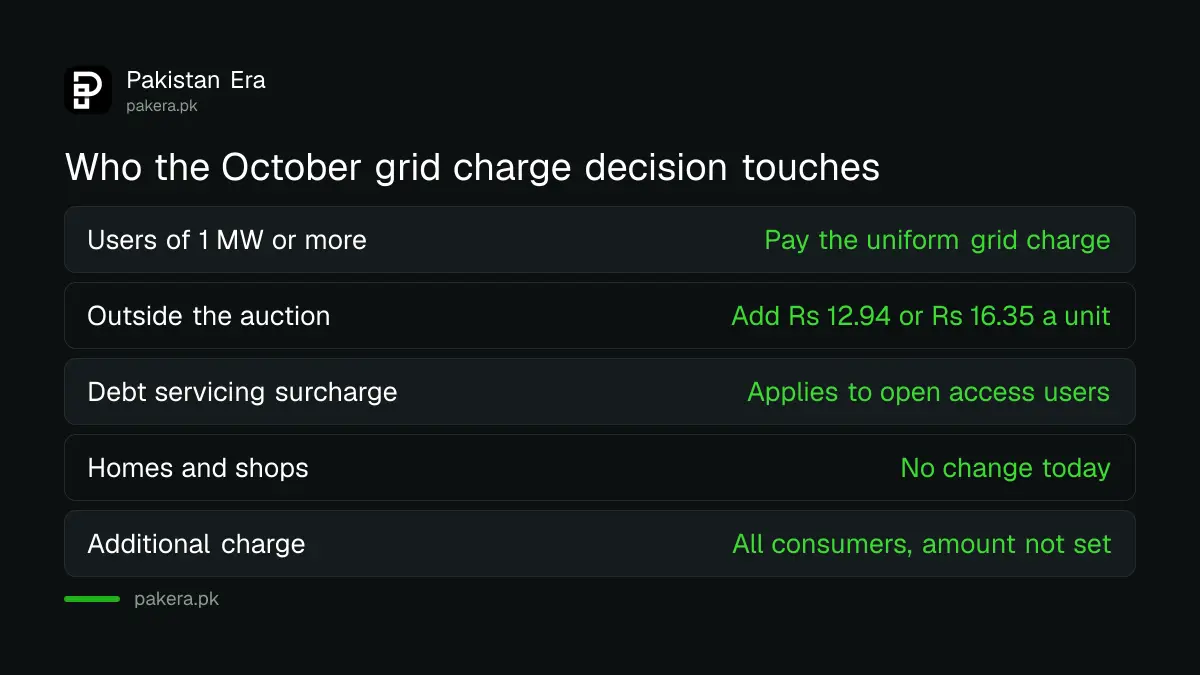
A bulk buyer that takes open access without going through the auction pays an extra stranded cost. It is Rs 12.94 a unit at 11 kV and Rs 16.35 a unit at 132 kV or 66 kV. Stranded cost is the price of power plants the country already pays for, whether anyone uses them or not.
With that added, the totals rise sharply. A B-3 factory pays Rs 19.17 a unit instead of Rs 6.23. A B-4 factory pays Rs 25.45. Bulk supply at 66 kV and above, C-3, reaches Rs 31.30. The highest figure in the order is Rs 32.56, for C-2 (a).
Open access users also pay the debt servicing surcharge, which clears power sector debt. NEPRA said it rests on section 31(8) of the NEPRA Act.
Who this affects, and why home bills could still feel it
This decision is for bulk power consumers, meaning users who take 1 megawatt or more at one premises. Homes, shops and small workshops cannot buy from a private supplier, so their bills do not change today. They keep paying the normal home slab rates or the commercial unit price.
One part could still reach ordinary bills. K-Electric's own grid charges were not used to work out the uniform rate. Applying the uniform rate in Karachi can leave a gap. The Power Division wanted that gap recovered from open access users only.
NEPRA disagreed. It approved an "additional charge" to cover the gap, and ruled it must apply to all consumers, both open access users and regular consumers of the power companies. NEPRA said charging only open access users would break the level playing field the national electricity policy requires.
The decision gives no rupee figure for this charge. It says the gap is "if any" and will be handled as a prior period adjustment, meaning a past cost added in a later tariff decision. So there is nothing to pay yet, and the amount, if any, is unknown.
What NEPRA also decided on losses and settlement
NEPRA set uniform line losses for wheeled power. The figure is 8.04 per cent at 11 kV, lower than the 8.42 per cent the Power Division asked for, and 1.51 per cent at 132 kV. A generator must send that much extra power to cover what is lost on the way.
Gaps between companies will be settled the same way as under the uniform consumer tariff. NEPRA did not approve a mechanism for energy surpluses or shortfalls from the uniform loss figure, and asked the parties to report on it at the next case.
- The 11 companies must file fresh grid charge petitions based on their 2026 tariffs without delay.
- Companies and K-Electric must share data on maximum demand and sales for the categories that want to join the market.
- Any later change to a grid charge component will follow the same periodic adjustments that apply to regular consumers.
The notification adds one line of caution. CPPA-G and K-Electric must "strictly comply with the orders of the courts" while applying the decision. That matters because K-Electric's own tariff is now before the Sindh High Court.
The market itself is still small. The Independent System and Market Operator has said the overall wheeling quantity is 800 MW, and its first auction for 2026 was announced at 200 MW. We could not confirm on its website whether that auction has been held. Separately, NEPRA hears the 2027 tariff requests of ten power companies from 13 to 15 October, and its review of the Rs 22.98 a unit rate for extra factory and farm use is still pending.
Common questions
What did NEPRA notify on 9 October 2026?
It notified S.R.O. 1780(I)/2026, which puts into force a uniform grid charge for open access users across Pakistan. The decision itself was signed on 7 September 2026.
Does this change my home electricity bill?
Not now. Only users of 1 MW or more can buy from a private supplier. An additional charge for any K-Electric gap could later apply to all consumers, but no amount has been set.
What is the grid charge for a large factory?
For a B-3 factory at 11 kV that enters through the auction, it is Rs 6.23 a unit plus Rs 1 per kW a month. Outside the auction it rises to Rs 19.17 a unit.
Do open access users pay the debt servicing surcharge?
Yes. NEPRA agreed with the Power Division that the surcharge applies to them in the same way it applies to regular consumers.
Does the uniform charge apply in Karachi?
Yes. The government decided the uniform charge should also apply to K-Electric's area, with any shortfall covered by the additional charge.
How we verified this
What we checked, where we read it, and what we could not confirm.
Last checked 10 October 2026. We opened NEPRA's notification S.R.O. 1780(I)/2026 dated 9 October 2026 and NEPRA's decision of 7 September 2026 on the Federal Government motion for uniform use of system charges, both on nepra.org.pk. The rates, losses, surcharge ruling and additional charge ruling come from that decision. We also read the bulk power consumer definition in the NEPRA Act, and the wheeling auction notices of the Independent System and Market Operator. The category descriptions and the check that each row adds up are our own work.
About the author

Global Affairs & Political Economy Writer
Muhammad Hatim is a book lover who started writing because he enjoys it. At Pakistan Era he writes about international relations, geopolitics and the global economy, with a particular interest in South Asia and the forces behind current events.