Shop Electricity Rate in Pakistan 2026: Commercial Unit Price and Fixed Charges
Shops in Pakistan pay Rs 37.44 a unit for electricity in 2026 plus Rs 1,000 a month under 5 kW. See bigger shop rates, Time of Use and two worked bills here.
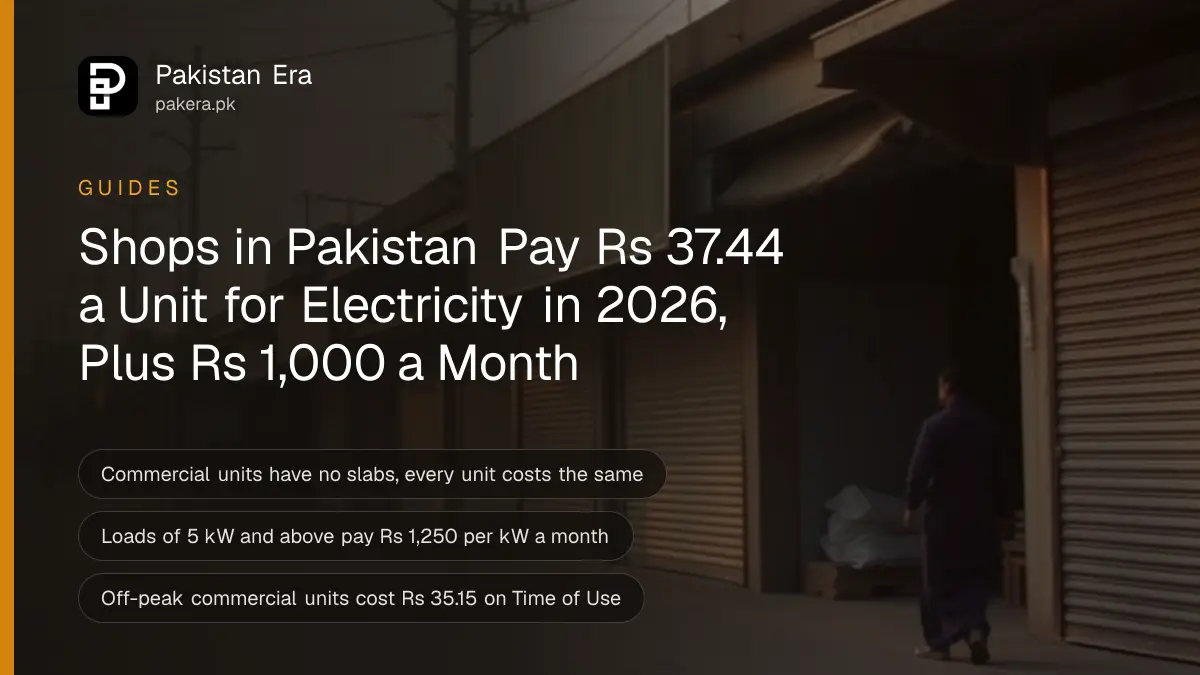
A shop or office in Pakistan with a load under 5 kW pays Rs 37.44 a unit for electricity in 2026, plus a fixed Rs 1,000 a month. Bigger commercial connections pay Rs 1,250 per kW a month in fixed charges and Rs 35.15 to Rs 43.82 a unit on Time of Use. Taxes and adjustments come on top.
These are the commercial rates in the federal government's notification of 12 February 2026, which apply alike to LESCO, IESCO, MEPCO, the other state companies and K-Electric. We read the schedule itself and worked out what a small shop and a larger store pay.
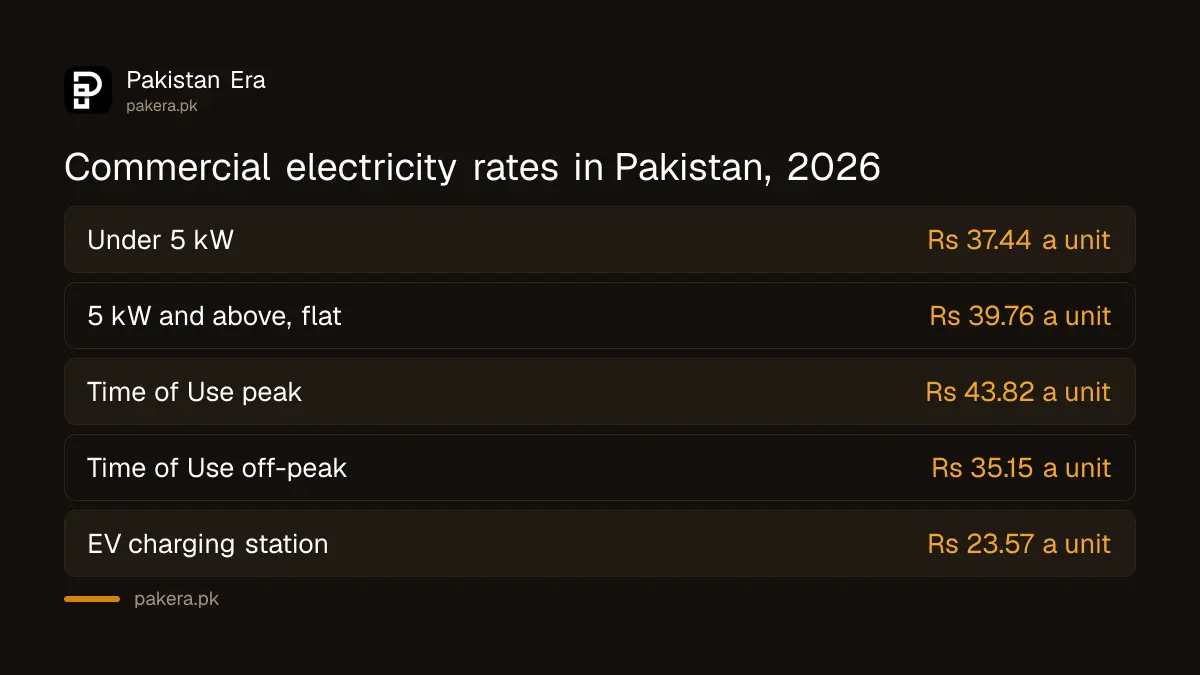
Commercial electricity rates for 2026
NEPRA's A-2 commercial schedule has one flat rate for small shops and separate rates for loads of 5 kW and above. A small shop pays Rs 37.44 a unit, against Rs 22.44 to Rs 47.20 for homes depending on the slab.
| Commercial connection | Fixed charge | Rate per unit (Rs) |
|---|---|---|
| Sanctioned load under 5 kW | Rs 1,000 a month | 37.44 |
| 5 kW and above | Rs 1,250 per kW a month | 39.76 |
| 5 kW and above, Time of Use peak | Rs 1,250 per kW a month | 43.82 |
| 5 kW and above, Time of Use off-peak | Same | 35.15 |
| Electric vehicle charging station | None | 23.57 |
| General services (A-3) | Rs 1,000 a month | 42.48 |
Commercial units have no slabs. Every unit costs the same, whether the shop uses 50 units or 5,000. That is the biggest difference from a home bill, where the rate climbs with each slab.
General services (A-3) is a separate category in the schedule, not the tariff for an ordinary shop.
A small shop pays a flat Rs 1,000 fixed charge
For a commercial connection under 5 kW, the fixed charge is Rs 1,000 for each connection every month, whatever the load. A 2 kW shop and a 4 kW shop pay the same Rs 1,000.
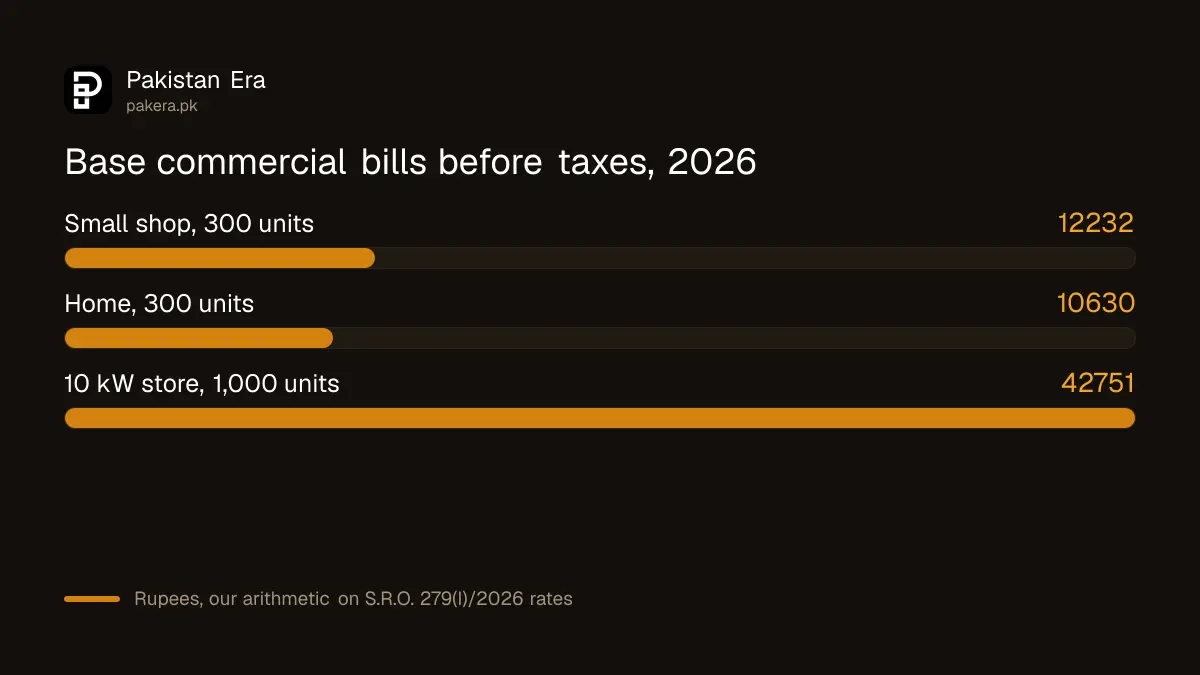
So a small shop using 300 units in a month pays 300 times Rs 37.44, which is Rs 11,232, plus Rs 1,000, for a base bill of Rs 12,232 before taxes and adjustments.
A home using the same 300 units, unprotected and with 2 kW sanctioned, would pay Rs 33.10 a unit and Rs 700 in fixed charges, or Rs 10,630. The shop pays about Rs 1,600 more for the same electricity. How the home slabs work is set out in electricity unit prices for 2026.
Bigger shops pay fixed charges on 25% of load or actual demand
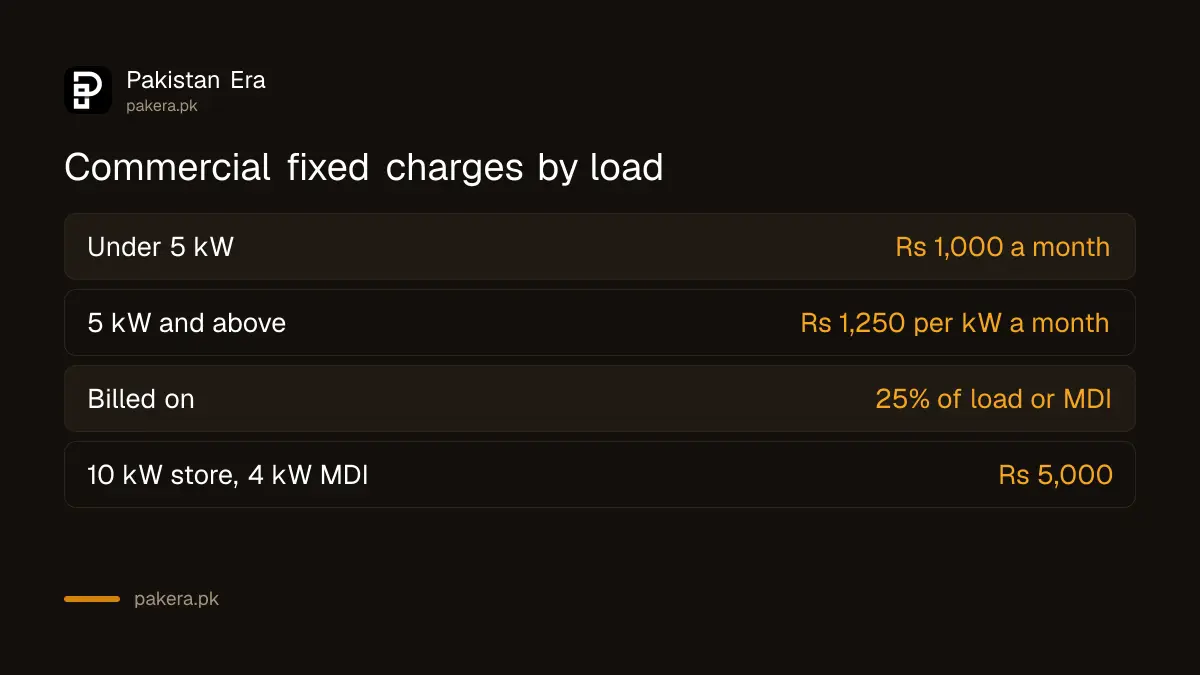
For 5 kW and above, the fixed charge is Rs 1,250 per kW each month. It is billed on 25% of the sanctioned load or the highest demand the meter recorded that month, whichever is higher.
That highest demand is called MDI, the maximum demand indicator. It is the most power your shop drew at any one time in the month, in kW, and it is printed on the bill.
Take a store with 10 kW sanctioned. A quarter of that is 2.5 kW. If the meter recorded 4 kW at its busiest moment, the fixed charge is worked out on 4 kW: 4 times Rs 1,250 is Rs 5,000.
Time of Use rates reward shops that close early
On a Time of Use meter, a commercial unit costs Rs 43.82 in the evening peak hours and Rs 35.15 at other times. A shop that does most of its business by day pays less per unit than the flat Rs 39.76.
The schedule lists both the flat Rs 39.76 and the Time of Use rates for loads of 5 kW and above. Your bill shows which meter you have.
Here is the 10 kW store again, on Time of Use, using 1,000 units in a month:
- 300 units in peak hours at Rs 43.82: Rs 13,146.
- 700 units off-peak at Rs 35.15: Rs 24,605.
- Fixed charge on 4 kW MDI: Rs 5,000.
- Base bill before taxes: Rs 42,751.
Moving 100 units from peak to off-peak saves Rs 867 a month on these rates. Running cold stores, pumps or ironing outside the evening peak is the easiest change.
Running a shop on a home meter can cost you later
Using a residential connection for a shop is misuse of tariff under clause 7.5 of NEPRA's Consumer Service Manual. The company can change your tariff after a seven day notice and charge the difference for past months.
Without documentary proof of how long the misuse ran, the manual limits that back charge to two billing cycles. The safer route is to apply for a commercial connection or a tariff change in the first place, which is set out in changing an electricity tariff between commercial and residential.
For October bills, NEPRA added a fuel charge of Rs 1.1086 a unit for all these categories, set out in the fuel charge decision for October bills.
Common questions
What is the commercial electricity rate per unit in Pakistan in 2026?
Rs 37.44 a unit for loads under 5 kW. For 5 kW and above, Rs 39.76 flat, or Rs 43.82 peak and Rs 35.15 off-peak on Time of Use.
Do commercial connections have slabs?
No. Every commercial unit is charged at the same rate, however many units the shop uses.
What is the fixed charge on a shop electricity bill?
Rs 1,000 a month for a load under 5 kW. For 5 kW and above, Rs 1,250 per kW on 25% of sanctioned load or the month's MDI, whichever is higher.
Are K-Electric commercial rates different?
No. The government's uniform schedule gives K-Electric the same commercial rates as the state companies.
Do these rates include sales tax?
No. Sales tax, other taxes, the fuel charge and quarterly adjustments are added separately on the bill.
How we verified this
What we checked, where we read it, and what we could not confirm.
Last checked on 9 October 2026. The rates, fixed charges and the 25% or MDI rule are from the Ministry of Energy's S.R.O. 279(I)/2026 of 12 February 2026, which notifies NEPRA's decision of 11 February 2026. The misuse rule is from clause 7.5 of NEPRA's Consumer Service Manual. Every worked example is our own arithmetic.
About the author

Tax, Bills and Technology Writer
Ali Akhtar is a young and curious voice here at Pakistan Era. He is currently pursuing his A-Levels and has a growing interest in Pakistan’s changing industrial landscape and educational trends. Ali likes to write in a way that helps him explain and explore the world around him. His writing reflects the perspective of the new generation navigating the evolving trends of Pakistan where technology, youth innovation, and shifting opportunities are reshaping the country’s future.