Fake Online Job Offers in Pakistan: 6 Signs, and What to Do if You Paid
Asked to pay a fee by JazzCash or Easypaisa for an online job? Six signs of a fake job offer in Pakistan, how to check the employer, and what to do if you paid.
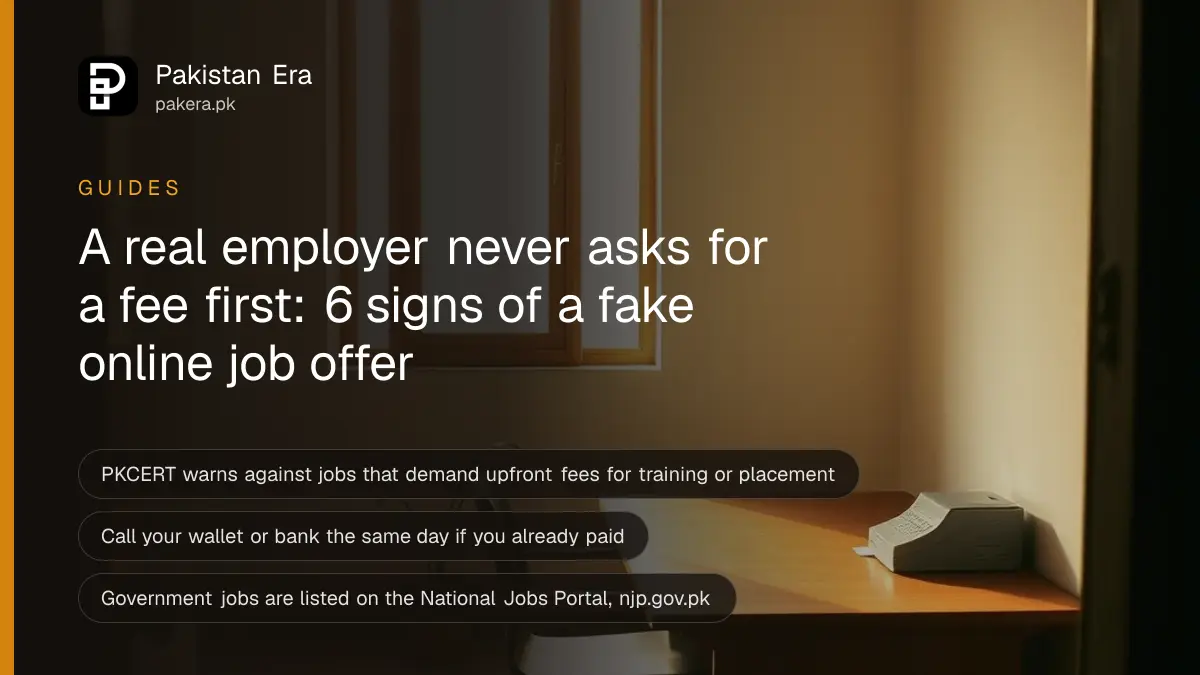
A real employer in Pakistan does not ask you to pay a registration, training or "security" fee by JazzCash or Easypaisa before you start. If a job offer on WhatsApp, Telegram or Facebook asks for money first, stop. If you have already paid, call your wallet or bank the same day, keep every screenshot, and file a cybercrime complaint.
The message usually arrives in the evening. "Online data entry job, Rs 3,000 a day, work from home, no experience." Then comes a small fee to "activate your ID" or buy a training kit. Once you pay, a bigger fee appears, or the group goes silent.
The National Cyber Emergency Response Team (PKCERT), which works under the Ministry of IT, runs a public awareness page on job scams. Its first warning is about job offers that demand upfront payments for processing fees, training material or placement. We read that page on 9 October 2026 and built this check around it.
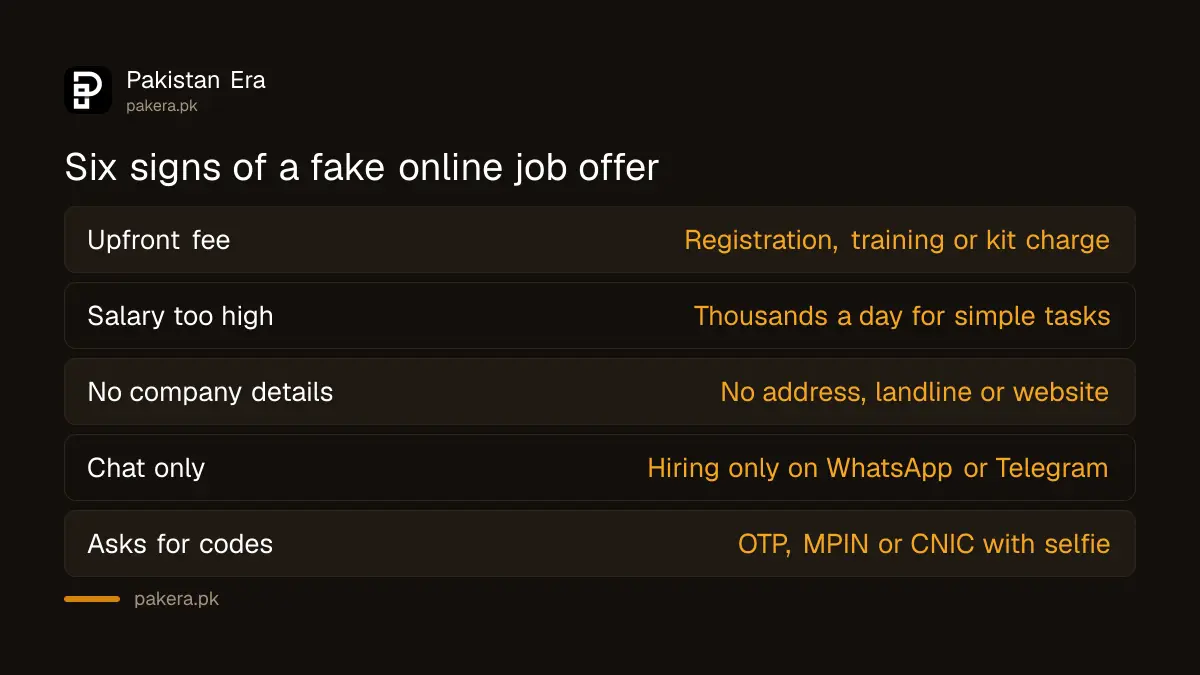
An upfront fee is the clearest sign of a fake job
PKCERT tells job seekers to be careful of offers that demand money for processing, training material or placement, and to avoid "advance fee" scams where the scammer disappears after payment. If a job needs your money before it pays you any, treat it as a scam until proved otherwise.
Scammers rarely call it a fee. They call it registration, an ID card charge, a laptop deposit, a "refundable" security amount, or a training course. The name changes. The direction of the money does not.
Government recruitment can carry a test fee paid through a bank challan to a named testing body. That is a different thing from a stranger on WhatsApp asking you to send Rs 1,500 to a personal JazzCash number.
Six signs that a job offer is fake
PKCERT lists the warning signs as unrealistic salaries, vague job descriptions, unsolicited messages, requests for personal or banking details, and offers promising easy money. Put together, they make a quick test you can run in two minutes.
| Sign | What it looks like | What to do |
|---|---|---|
| Upfront payment | Fee for registration, training, kit or "activation" | Do not pay. Stop replying. |
| Salary too high | Rs 3,000 to Rs 10,000 a day for typing or liking posts | Compare with the real work asked. |
| No company details | No registered name, office address or landline | Ask for them in writing. |
| Chat only | Hiring happens only on WhatsApp or Telegram | Ask for an email from a company domain. |
| Rush | "Only 10 seats left, pay today" | Wait 24 hours. Real jobs can wait. |
| Asks for codes | OTP, MPIN, CNIC photo with selfie | Never share. No employer needs your OTP. |
The last one is the most dangerous. A job "verification" that asks for a WhatsApp code or a wallet OTP is not about a job at all. It is an attempt to take over your account and use it to scam your contacts.
Task jobs are a close cousin. You are paid small amounts to like videos or rate products, then asked to "deposit" to unlock bigger tasks. The money you see on the screen is not real until it reaches your wallet. We explained that pattern when we looked at whether online earning apps in Pakistan actually pay.
How to check a job offer before you reply
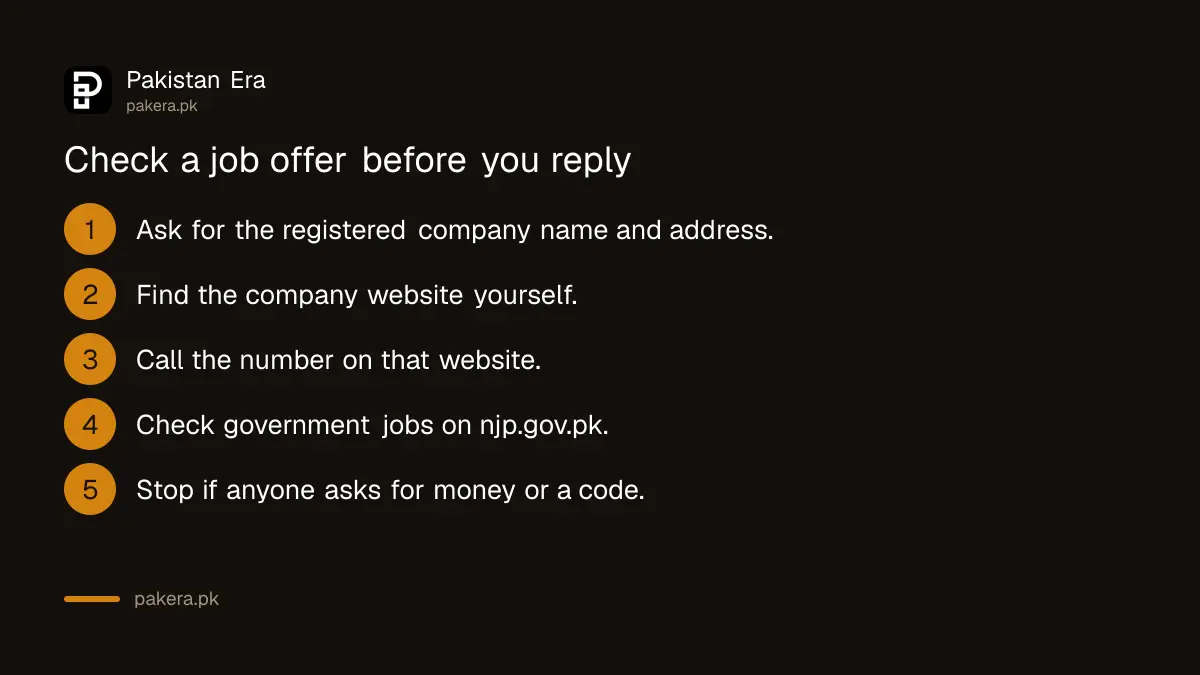
Check the employer, not the message. Search the company's registered name, find its own website and phone number, and confirm the vacancy there. For government jobs, use official portals such as the National Jobs Portal rather than links forwarded on WhatsApp.
- Ask for the company's full registered name, office address and a landline. A real employer will give them.
- Find the company's own website yourself. Do not use the link in the message.
- Call the company on the number from its website and ask if the vacancy is real.
- For government posts, look for the job on the National Jobs Portal or a provincial portal such as the Punjab Job Portal.
- If anyone asks for money or a code at any step, stop and report the number.
The National Jobs Portal is run by the federal government and says its postings are verified. Its home page showed 82 active jobs and more than 2.29 million users when we opened it on 9 October 2026. It is a small list, but every job on it comes from a government department.
Overseas job offers carry their own rules. A licensed overseas employment promoter and the protector fee are part of a legal route, and the checks for an Oman work visa from Pakistan show how that works in practice.
If you already paid, act on the same day
Call your wallet or bank at once and report the transfer as fraud. Ask them to block the receiving account if they can. Save the chat, the number, the transaction ID and any receipts, then file a cybercrime complaint with the National Cyber Crime Investigation Agency (NCCIA).
- JazzCash: call 4444 from your JazzCash number.
- Easypaisa: call 3737 from your Easypaisa number.
- Bank account: call the number on the back of your card.
Speed matters because money moves fast between wallets. A quick call can sometimes catch funds before they are withdrawn. A call two days later usually cannot. The process for an unauthorised Easypaisa or JazzCash transfer sets out the timelines wallets work to.
Be honest with yourself about one thing. If you sent the money willingly, the wallet may treat it as an authorised payment. You can still report it, and the receiving account can still be flagged, but a refund is not guaranteed.
For the criminal complaint, the steps to report a cybercrime in Pakistan cover the NCCIA routes and what to attach. Under section 14 of the Prevention of Electronic Crimes Act 2016, electronic fraud can carry up to two years in jail, a fine of up to Rs 10 million, or both.
Protect your accounts after a job scam
If you shared any code, assume the account is at risk. Change your wallet MPIN, turn on two-step verification on WhatsApp, and warn your contacts that messages from you may be fake. PKCERT's 2026 advisory on WhatsApp hijacking says taken accounts are used to impersonate victims and ask their contacts for money.
PKCERT also warns against sharing personal details with unverified sources. A CNIC copy and a selfie are enough for a criminal to try opening accounts in your name. If your WhatsApp has already been taken, the steps to recover a hacked WhatsApp account start with re-registering your number.
Common questions
Do real online jobs ask for a registration fee?
No. A genuine private employer does not charge you to start work. PKCERT warns specifically against jobs that demand upfront payment for processing, training or placement.
Is a job offer on WhatsApp always a scam?
Not always, but treat it with care. Confirm the company through its own website and phone number before you share anything or pay anything.
Can I get my money back from a job scammer?
Sometimes, if you report it to your wallet or bank very quickly and the money is still in the receiving account. If you sent it yourself, a refund is not guaranteed.
Where do I report a fake job offer in Pakistan?
Report the transfer to your wallet or bank first. Then file a cybercrime complaint with the NCCIA, and report the number inside WhatsApp or Telegram.
How do I find real government jobs online?
Use the National Jobs Portal at njp.gov.pk and provincial job portals. Check that any test fee is paid by bank challan to a named testing body.
How we verified this
What we checked, where we read it, and what we could not confirm.
Last checked on 9 October 2026, Pakistan time. We read PKCERT's Combatting Job Scams page and its infographic, its 2026 WhatsApp hijacking advisory, and opened the National Jobs Portal home page. The JazzCash helpline 4444 is from JazzCash's own privacy notice, read on 9 October 2026. The Easypaisa helpline and the PECA penalty were checked at source in earlier articles and not re-tested today. NCCIA's websites refused automated requests, so we did not read them for this page. We did not contact any scammer or test any fake job.
About the author

Technology Journalist & Multimedia Producer
Ahmad Ali is a technology journalist and multimedia producer at Pakistan Era, joining the team in October 2026. He covers consumer technology and digital life for Pakistani readers, combining research with hands-on product testing.