How to Report a Cybercrime in Pakistan
Cybercrime moved from the FIA to NCCIA in 2026. What we could confirm, the evidence to collect first, and why to call your bank too.
The body that handles cybercrime in Pakistan has changed, and most advice online has not caught up. Cybercrime investigation has moved from the Federal Investigation Agency's cyber crime wing to the National Cyber Crime Investigation Agency (NCCIA).
NCCIA's helpline is 1799, and it takes complaints through an online portal. The table below shows where each kind of problem goes.
Where to report each kind of problem
| Your problem | Where to go |
|---|---|
| Cybercrime, blackmail or impersonation | NCCIA, helpline 1799 |
| Money taken from your account | Your bank first, then NCCIA |
| A telecom or SIM complaint | PTA complaint portal, complaint.pta.gov.pk |
| A general FIA complaint or a status check | FIA public services portal, complaint.fia.gov.pk |
Older advice still lists the FIA cybercrime helpline 1991. For cybercrime, use NCCIA instead.
Here is how it works in a typical case. Someone takes money from your account through a fake link. Call your bank first, because the speed of that call affects whether anything can be held. Then collect screenshots, the account name, the link and the transaction record, and report to NCCIA on 1799 or through its portal. Keep the complaint number you are given. If you are being blackmailed or are in danger, treat it as urgent and tell one trusted person as well as reporting.
Evidence is the part you control
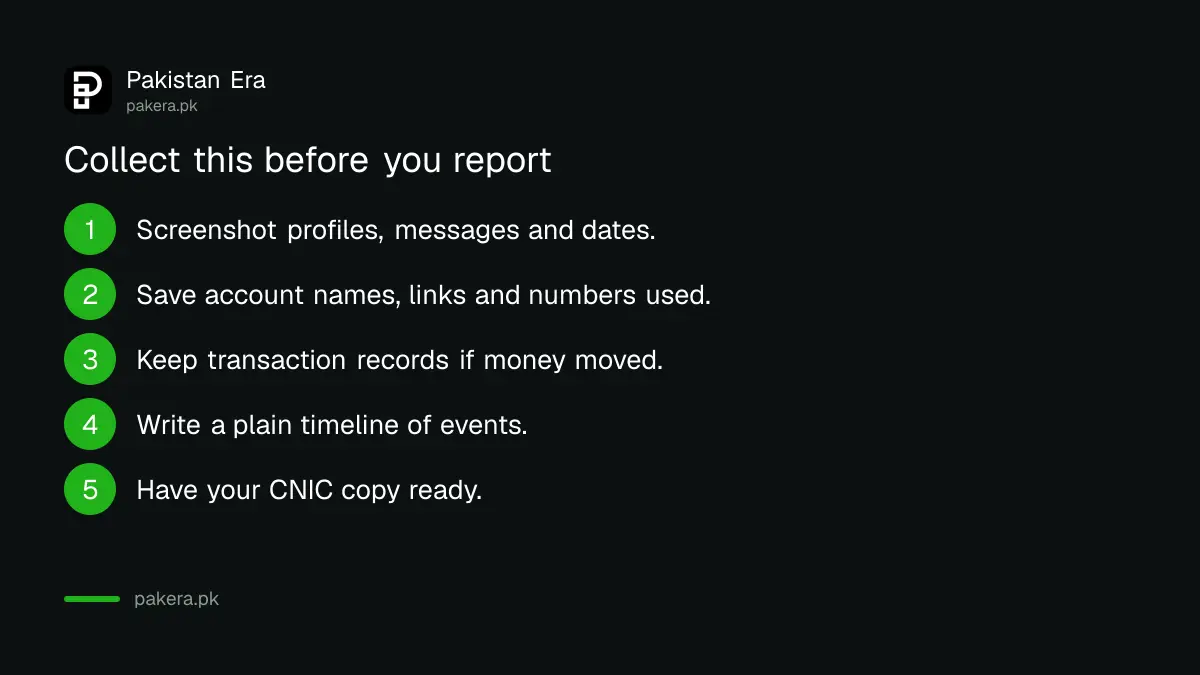
Whatever the agency is called, a complaint succeeds or fails on what you can show. Collect before you report, because accounts get deleted and chats disappear.
- Screenshot everything, including the profile, the messages and the dates.
- Save the account name, the link and any phone number or email used.
- Keep transaction records if money moved, with dates, amounts and the receiving account.
- Write a plain timeline of what happened and when.
- Keep your CNIC copy ready, since a written complaint normally needs it.
Do not edit or crop evidence to make a point. Provide it as it is, because altered material weakens an otherwise good complaint.
If money has moved, act on two tracks at once
A cybercrime complaint does not freeze a bank account. If you have been defrauded, contact your bank immediately as a separate and parallel step, because the speed of that call affects whether anything can be held.
Bank contact numbers are collected in our list of bank helplines, and the route for disputing a transaction with the bank is set out separately in our guide to unauthorised transactions. Report to the police or the cybercrime agency as well, but do not let it replace the call to the bank.
Harassment, blackmail and impersonation
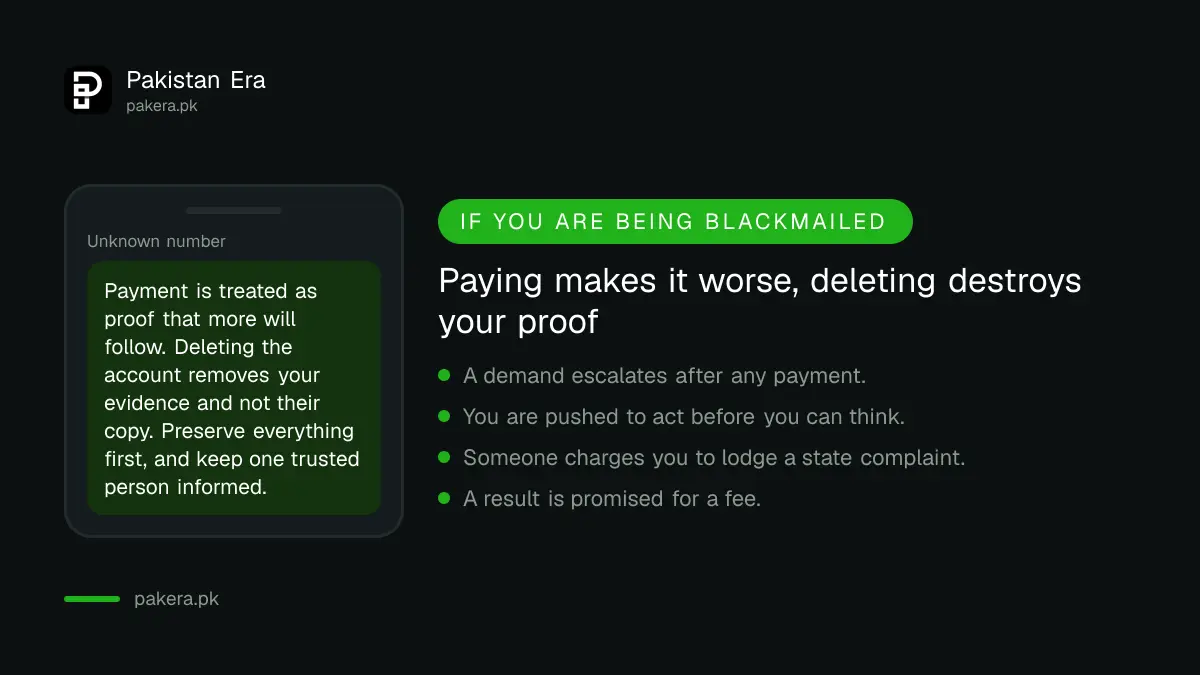
These are the complaints people delay for reasons that are entirely understandable, and delay usually makes them worse. A few practical points that apply regardless of which agency takes the file.
Do not pay a blackmailer. Payment is treated by people who do this as proof that more will follow. Do not delete the account or the messages before you have preserved them, because deleting removes your evidence and not their copy. Keep one trusted person informed, since handling it alone is what makes it unbearable.
If an account is impersonating you, report it to the platform as well as to the agency, because the platform can act on its own timeline. If your own account has been restricted in the process, our guide on a WhatsApp account under review covers that separate problem.
If your identity has been used
Where a CNIC has been misused, the damage often shows up as connections or accounts opened in your name. Check what is registered against your identity rather than assuming, and our guides to checking SIMs registered on your CNIC and reporting an unknown SIM cover the telecom side, which is the quickest thing to verify.
Keep the complaint number
Whatever channel you use, get a reference and keep it. A complaint you cannot identify later is very hard to follow up, and the first question at any follow up is the number.
Note the date, the channel used, and the name of anyone you spoke to. If you file in person at a reporting centre, ask for an acknowledgement of the written application rather than leaving with nothing.
Common questions about reporting cybercrime
Is it still the FIA that handles cybercrime?
Cybercrime complaints now go to NCCIA, which took over the function in 2026. Older advice still lists the FIA helpline 1991, so use 1799 and the NCCIA portal.
What is the cybercrime helpline number?
The NCCIA helpline is 1799.
Does a complaint cost anything?
Filing a complaint with a state agency is not a paid service. Anyone charging you to lodge one, or promising a result for a fee, is not part of the process.
Can I report anonymously?
A formal complaint normally requires your identity and a CNIC copy. If your safety is the concern, take advice before filing rather than filing and hoping.
How long does it take?
How long it takes depends on the case. Keep your reference number and follow up rather than waiting silently.
How we verified this
What we checked and where we read it.
Last checked 26 August 2026. Sources: the FIA public services complaint portal at complaint.fia.gov.pk, which offers complaint registration and a status check, the PTA complaint portal, and reports of the move of cybercrime functions to NCCIA. This is general information and not legal advice. If you are being blackmailed or are in danger, treat it as urgent and get help from someone you trust as well as from the authorities.
About the author

Public Services and Education Journalist
Fajr Riaz is a journalist and content writer at Pakistan Era, based in Lahore. She covers the questions people meet in everyday life in Pakistan: how a public service works, what a change in the rules means, and where to find a reliable answer.