How to File a Restitution of Conjugal Rights Suit in Punjab: Rs 15 Fee, Family Court and the Khula Reply
File a restitution of conjugal rights suit in a Punjab family court: Rs 15 fee, two reconciliation rounds, six months to decide, and the wife's khula reply.
A restitution of conjugal rights suit asks the Family Court to order a spouse who has left to come back and live together. In Punjab it is filed as a plaint in the Family Court with a court fee of Rs 15, and the court must try to reconcile the couple before and after the evidence. The case should end within six months.
Restitution of conjugal rights is item 4 in Part I of the Schedule to the Family Courts Act, 1964, the list of cases only a Family Court can hear. A typical case is a spouse who has gone back to their parents' home. The 2015 Punjab amendments changed how it fits with divorce and maintenance cases, and that link is the part to understand before you file.
What a restitution of conjugal rights suit is
It is a family suit asking the court to direct a spouse to return to the marital home. Either spouse can file it. It is one of ten matters in Part I of the Schedule, alongside dissolution of marriage, dower, maintenance, custody and guardianship.
| Family Court matter | Schedule entry | How it links to restitution |
|---|---|---|
| Dissolution of marriage, including khula | Item 1 | A wife can claim it in her reply to a restitution suit |
| Maintenance | Item 3 | A husband can claim restitution in his reply to her maintenance suit |
| Restitution of conjugal rights | Item 4 | The suit itself |
| Custody and visitation | Item 5 | Often filed in the same dispute |
| Dowry and personal belongings | Items 8 and 9 | Often filed in the same dispute |
How to file a restitution suit in Punjab
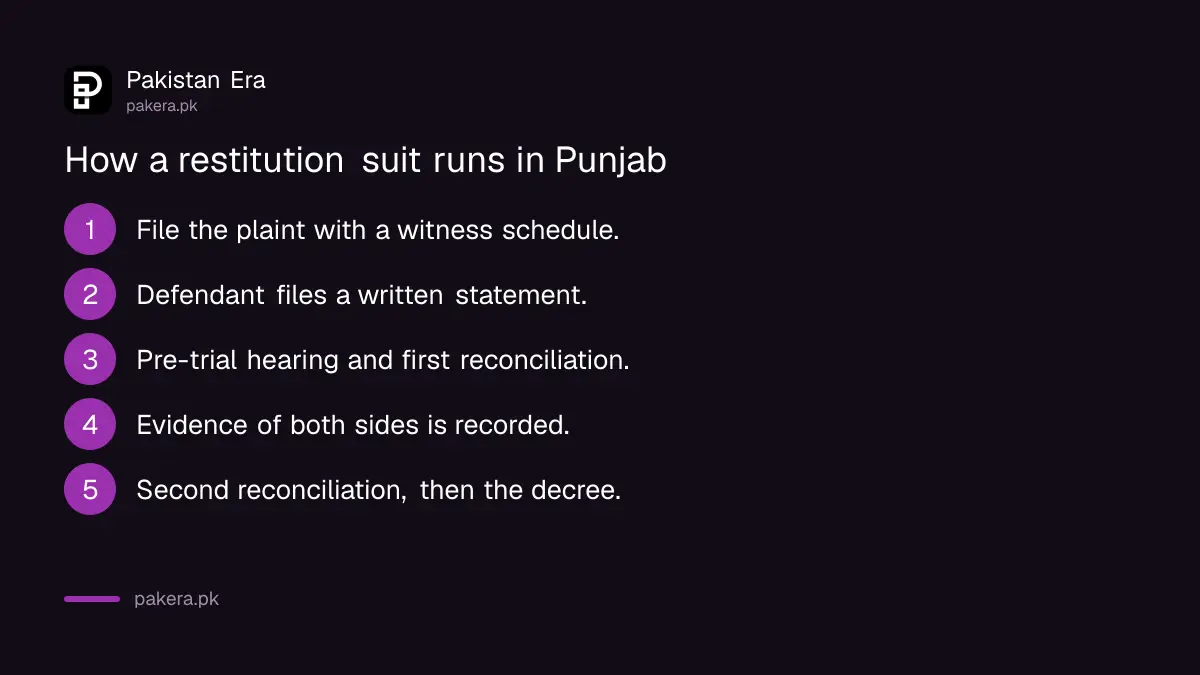
Present a plaint in the Family Court with all the material facts, a schedule of your witnesses with names, addresses and what each will say, and copies of the documents you rely on. The court fee is Rs 15 under section 19.
- Collect the nikah nama and any proof of where you lived together. A copy of the nikah nama from the union council works if the original is with the other side.
- Write the plaint with the date of marriage, when and why your spouse left, and what you have done to bring them back.
- Add the schedule of witnesses required by section 7(2): their names, addresses and a short summary of what each will say.
- Pay the Rs 15 court fee and file in the Family Court.
- Attend every date. The defendant files a written statement, list of witnesses and gist of evidence on the first date, or within 15 days if the court allows.
The general steps for any family case, from filing to the six month deadline, are in filing a family court case in Pakistan.
No separate suit when a case is already running
Since 2015, a husband sued for dissolution or maintenance must claim restitution inside his written statement, not in a new suit, as long as no earlier restitution suit is pending. A wife sued for restitution can claim dissolution or khula in her written statement the same way.
Section 9(1a) and 9(1b) treat that claim as a plaint, and say no separate suit lies for it. This saves time and stops parallel cases in different courts. It also means a restitution suit often turns into a divorce case. If a wife answers with a khula claim, the court can decide the marriage itself in the same file.
So before filing, think about the likely reply. A husband who files for restitution should be ready for a claim of dissolution, dower and maintenance in the same proceedings. The grounds for a wife to seek divorce show what she may raise.
Reconciliation comes twice
The Family Court must try to settle the dispute at a pre-trial hearing after the written statement, and again within 15 days after all the evidence is heard. Only if both attempts fail does the court give judgment and a decree.
At the pre-trial hearing under section 10, the judge looks at the plaint, the written statement and the evidence summaries, finds the real points of dispute, and attempts a compromise. If that fails, the court frames the issues and records evidence. Witness statements can be recorded by audio or video.
After the evidence closes, section 12 requires one more effort at compromise within 15 days. Restitution cases are where these hearings matter most. A couple that agrees terms here, such as a separate home or a fixed monthly amount, ends the case on their own terms.
Time limits, appeals and what a decree means
Section 12-A says the case should be decided within six months of filing. If not, either side can apply to the High Court for directions. An appeal goes to the High Court or District Court depending on the judge's rank.
| Point | Rule in the Family Courts Act |
|---|---|
| Court fee | Rs 15 for any suit or appeal, section 19 |
| Written statement | On the first date, or within 15 more days if allowed |
| Decision | Within six months of filing, section 12-A |
| Appeal from a District or Additional District Judge | High Court |
| Appeal from any other Family Court judge | District Court |
| Interim orders | No appeal or revision |

The appellate court must decide within four months. On enforcement, section 13 of the Act deals with decrees for money and the delivery of property. The Act sets out no separate method for enforcing a restitution decree, so take advice from a family lawyer on what the decree will do in your case, including its effect on claims such as maintenance.
Common questions
Where is a restitution of conjugal rights case filed in Punjab?
In the Family Court. Restitution of conjugal rights is item 4 in Part I of the Schedule to the Family Courts Act, 1964, which the Family Court alone can hear.
What is the court fee for a restitution suit?
Rs 15. Section 19 sets Rs 15 as the court fee for any kind of suit or appeal under the Act.
Can a wife file for khula in reply to a restitution suit?
Yes. Section 9(1b) lets her claim dissolution, including khula, in her written statement. It counts as a plaint, and no separate suit lies for it.
Can a husband file restitution after his wife files for divorce?
He claims it in his written statement to her suit, if no earlier restitution suit of his is pending. Section 9(1a) says no separate suit lies.
How long does a restitution of conjugal rights case take?
The Act says six months from filing. If it runs longer, either party can apply to the High Court for directions.
Can a pardah nashin woman send someone in her place?
Yes. Section 18 lets the Family Court allow a pardah nashin lady to be represented by a duly authorised agent, except as a witness.
For the money side of a separation, see claiming maintenance in a Punjab family court.
How we verified this
What we checked and where we read it.
We checked this page on 15 November 2026 against the Family Courts Act, 1964 on the Punjab Code, as amended up to the Punjab Family Courts (Amendment) Act 2015 and the 2019 Schedule notification: sections 5, 7, 9, 10, 11, 12, 12-A, 13, 14, 18, 19 and Part I of the Schedule.
About the author

Public Services and Education Journalist
Fajr Riaz is a journalist and content writer at Pakistan Era, based in Lahore. She covers the questions people meet in everyday life in Pakistan: how a public service works, what a change in the rules means, and where to find a reliable answer.