How to Claim Maintenance in a Punjab Family Court
Interim maintenance is fixed at the first hearing, and a payment missed past the fourteenth strikes out the defence. What the Act sets out.
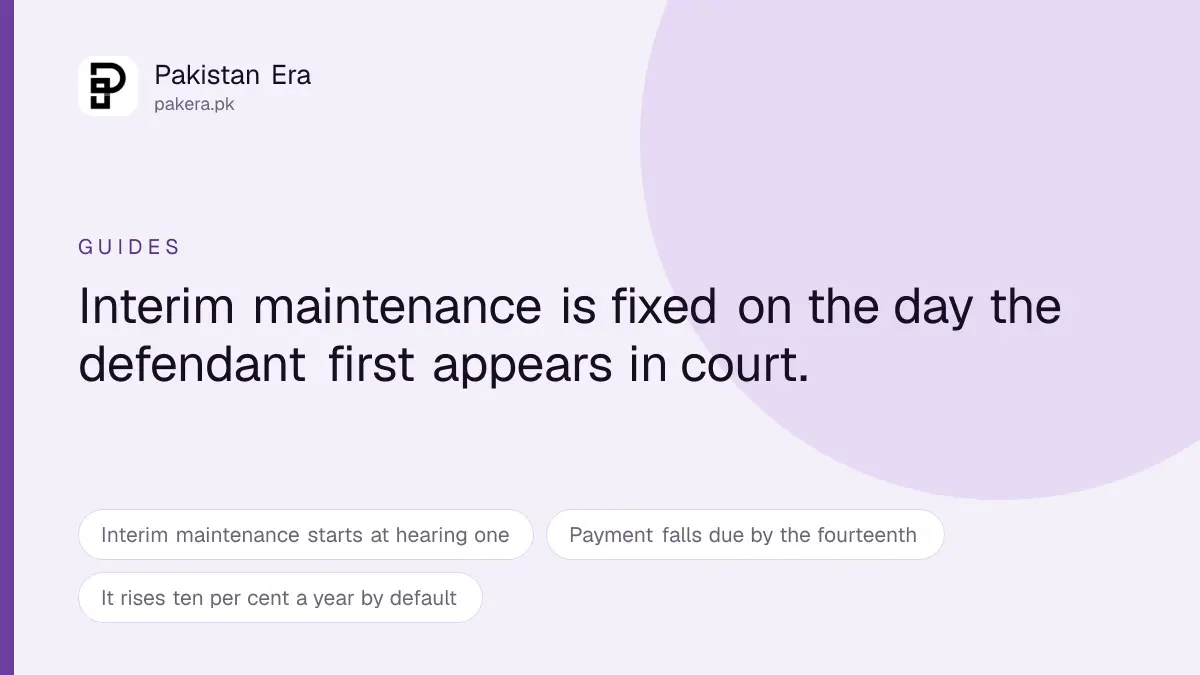
A family court in Punjab must fix interim monthly maintenance on the day the defendant first appears, and if he fails to pay by the fourteenth of the month his defence is struck off. The court then decrees the suit on the basis of the plaint alone.
We read that in the Family Courts Act, 1964 on 29 August 2026, in the text published by the Law and Parliamentary Affairs Department of the Government of the Punjab on its own law portal. The provisions below are quoted from section 17-A and the Schedule.
Interim maintenance starts at the first hearing
Section 17-A(1) does not leave this to the judge's discretion. In a suit for maintenance, the family court shall, on the date of the first appearance of the defendant, fix interim monthly maintenance for a wife or a child.
That matters because the usual fear about going to court is the delay. Under this section the money is meant to be ordered at the start of the case rather than at the end of it, so the household is not left waiting for a final decree.
Missing a payment strikes out the defence
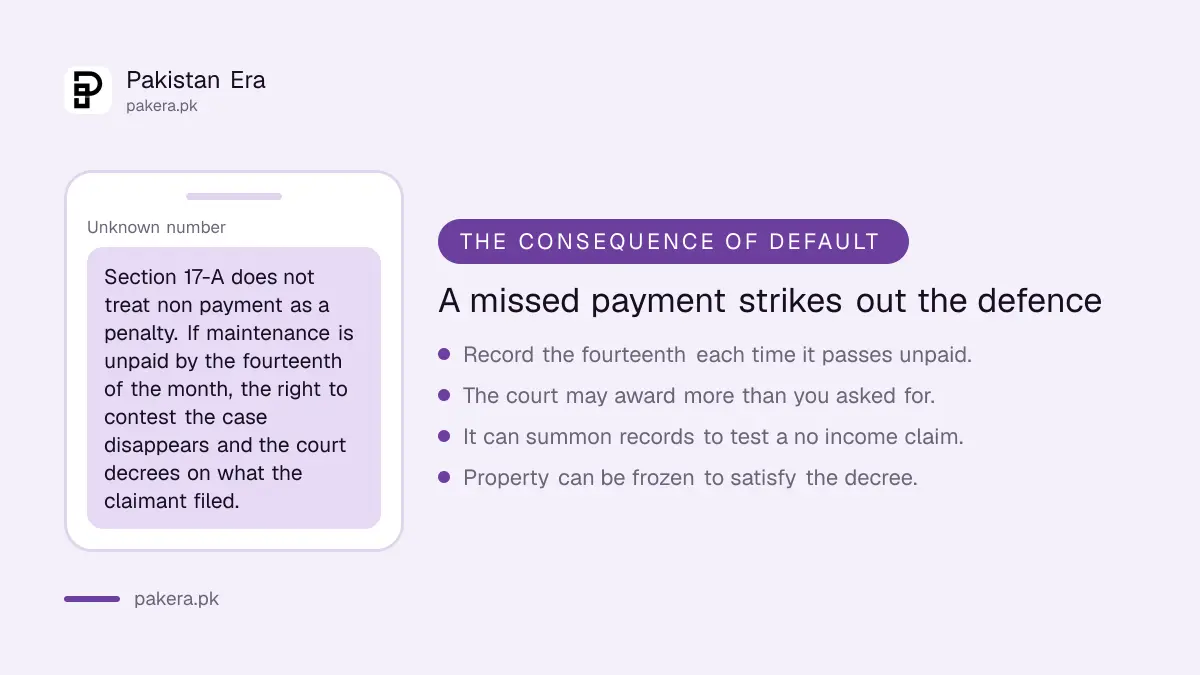
The second half of the same subsection is the part almost nobody knows. If the defendant fails to pay the maintenance by the fourteenth day of each month, the defence of the defendant stands struck off, and the family court shall decree the suit for maintenance on the basis of the averments in the plaint and other supporting documents on the record.
Read that carefully. It is not a penalty or a warning. The right to contest the case disappears, and the court then decides on what the claimant filed. For anyone owed maintenance, the fourteenth of the month is the date to record every time it passes unpaid.
The amount rises ten per cent a year by default
Section 17-A(2) lets the court fix an amount higher than the one asked for in the plaint, because of the passage of time or any other relevant circumstance, and it lets the court prescribe an annual increase.
Subsection (3) then covers the case where the court says nothing about that. If the family court does not prescribe an annual increase, the maintenance fixed by the court automatically stands increased at the rate of ten per cent each year.
| Point | What section 17-A says |
|---|---|
| When interim maintenance is fixed | On the date of the defendant's first appearance |
| Payment deadline | The fourteenth day of each month |
| If payment is missed | The defence stands struck off |
| Amount awarded | May exceed the amount prayed for |
| Annual increase | Ten per cent a year if the court fixes none |
So an order made three years ago is not frozen at the figure written on it. If the decree is silent on increases, the statutory ten per cent has been running the whole time, and the arrears should be calculated on that basis rather than on the original number.
The court can go looking for his income
The commonest defence in a maintenance case is that there is no money. Section 17-A(4) addresses it directly: for the purpose of fixing maintenance, the family court may summon the relevant documentary evidence from any organisation, body or authority to determine the estate and resources of the defendant.
That is a wide power and it is worth using rather than arguing. If you know where he banks, who employs him, or what is registered in his name, say so in the plaint so the court knows what to summon.
Section 21A adds a second tool. The family court may pass an interim order to preserve and protect property in dispute, and any other property of a party, where preserving it is considered necessary to satisfy the decree if and when it is passed. In plain terms, property can be frozen so it is still there at the end.
What else a family court decides
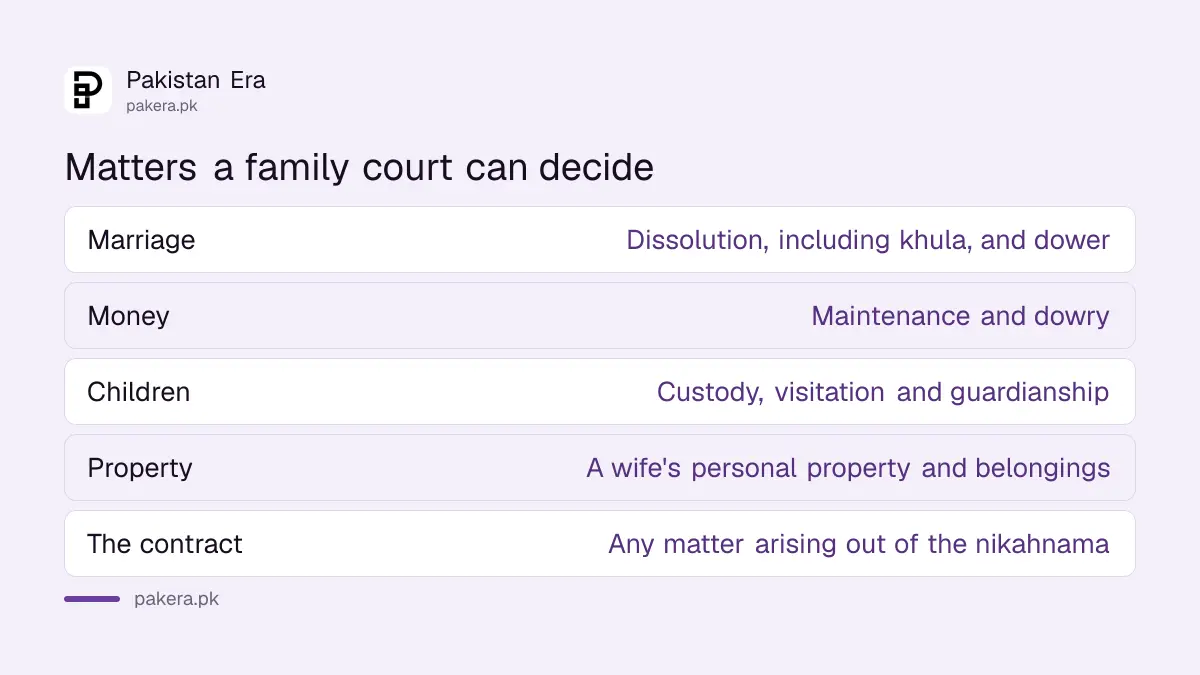
Maintenance is one entry in a list. Part I of the Schedule sets out what these courts handle, and knowing the list stops you filing separate cases for things that belong together.
- Dissolution of marriage, including khula, and dower.
- Maintenance, and restitution of conjugal rights.
- Custody of children, and the visitation rights of parents to meet them.
- Guardianship, and dowry.
- The personal property and belongings of a wife, and of a child living with his mother.
The Schedule also covers jactitation, matters concerning the return of a child under the Hague Convention on the Civil Aspects of International Child Abduction, 1980, and any other matter arising out of the nikahnama. That last entry is broad, and it is the reason the nikahnama itself is worth reading before you file anything.
Our guide to nikah registration covers the document and what the clauses in it do. If the marriage is being dissolved rather than maintained, our guide to the khula procedure sets that out separately.
After a decree of dissolution
Section 21-B sets a deadline on the court rather than on you. Where a family court decrees the dissolution of a Muslim marriage, it must send a certified copy of the decree to the Arbitration Council immediately, and not later than three days from the decree.
Keep your own certified copy as well, and check that the Arbitration Council received theirs. Later steps, including remarriage and any correction to records, run off that paperwork rather than off the fact of the decree.
This is the Punjab statute, not a national one
The Act we read states that it extends to the whole of the Punjab. Family law is administered provincially, and the other provinces have their own family courts legislation with their own amendments and their own section numbering.
The broad shape is similar across the country, but do not quote a section number outside Punjab without checking the version that applies there. Nothing on this page is legal advice, and a maintenance claim is a matter for a family lawyer, many of whom take these cases at low cost or through legal aid.
Common questions about maintenance in Punjab
When will the court order maintenance?
Section 17-A says interim monthly maintenance is fixed on the date of the defendant's first appearance, not at the end of the case.
What happens if he does not pay?
If payment is not made by the fourteenth day of the month, the defence stands struck off and the court decrees the suit on the plaint and the supporting documents.
Does the amount ever go up?
The court may prescribe an annual increase. If it does not, the amount automatically rises ten per cent each year under subsection (3).
He says he has no income. What can the court do?
It may summon documentary evidence from any organisation, body or authority to determine his estate and resources.
Can I claim custody in the same court?
Yes. Custody, visitation, guardianship, dower, dowry and maintenance all sit in Part I of the same Schedule.
How we verified this
What we checked, where we read it, and what we could not confirm.
Last checked 29 August 2026. We read the Family Courts Act, 1964, Act XXXV of 1964, in the text published by the Law and Parliamentary Affairs Department, Government of the Punjab, on the Punjab Code portal at punjablaws.punjab.gov.pk, and downloaded the department's own PDF of the Act from that site. Section 17-A on interim maintenance at the first appearance, the fourteenth day deadline, the striking off of the defence, the power to award more than prayed for, the automatic ten per cent annual increase where none is prescribed and the power to summon documentary evidence from any organisation, body or authority are all taken from that text. So are section 21A on interim orders preserving property, section 21-B on the three day intimation to the Arbitration Council, and the Part I Schedule list of matters. The Act states that it extends to the whole of the Punjab, so it is the Punjab statute and the other provinces administer their own. Amounts of maintenance are set case by case on the parties' circumstances, so no rupee figure appears here. This is a summary of what the statute says and not legal advice.
About the author

Public Services and Education Journalist
Fajr Riaz is a journalist and content writer at Pakistan Era, based in Lahore. She covers the questions people meet in everyday life in Pakistan: how a public service works, what a change in the rules means, and where to find a reliable answer.