Khula in Pakistan: You Can Now File Where You Live
The Lahore High Court has ruled a woman can file khula in her own district. What the process involves and when haq mehr must be returned.
Khula is the route by which a Muslim woman can end her marriage through the Family Court. It does not require the husband's agreement.
Two things about it are widely misunderstood in Pakistan, and both matter to women deciding whether they can afford to start.
You can file where you live
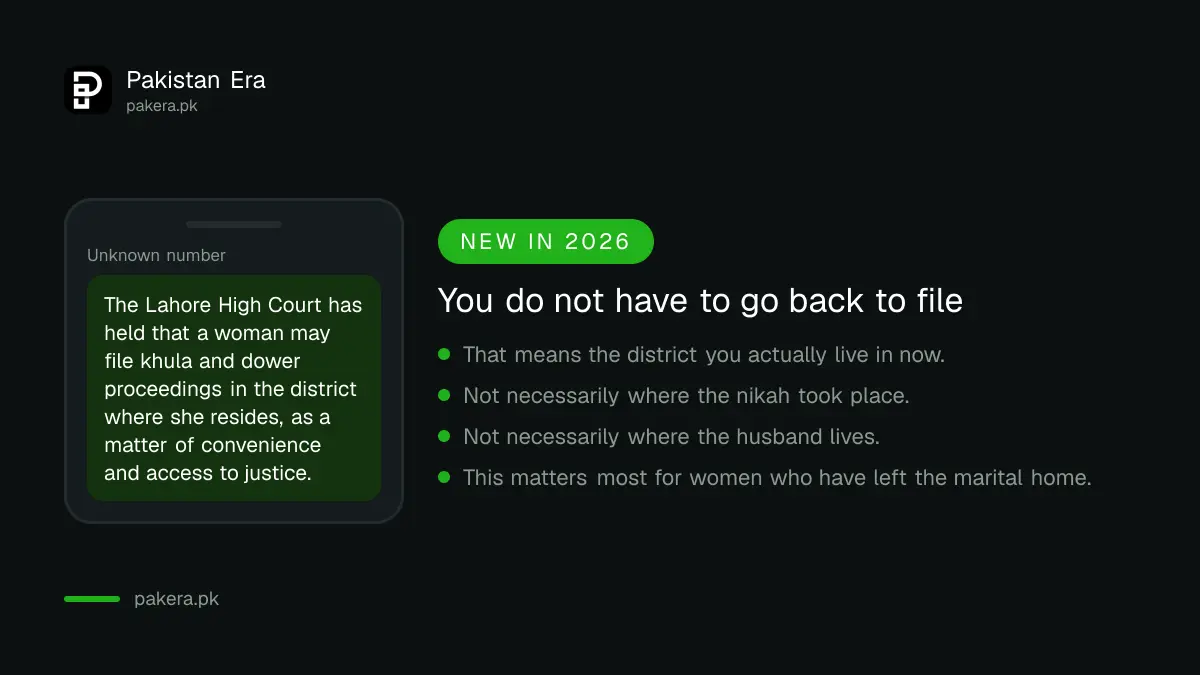
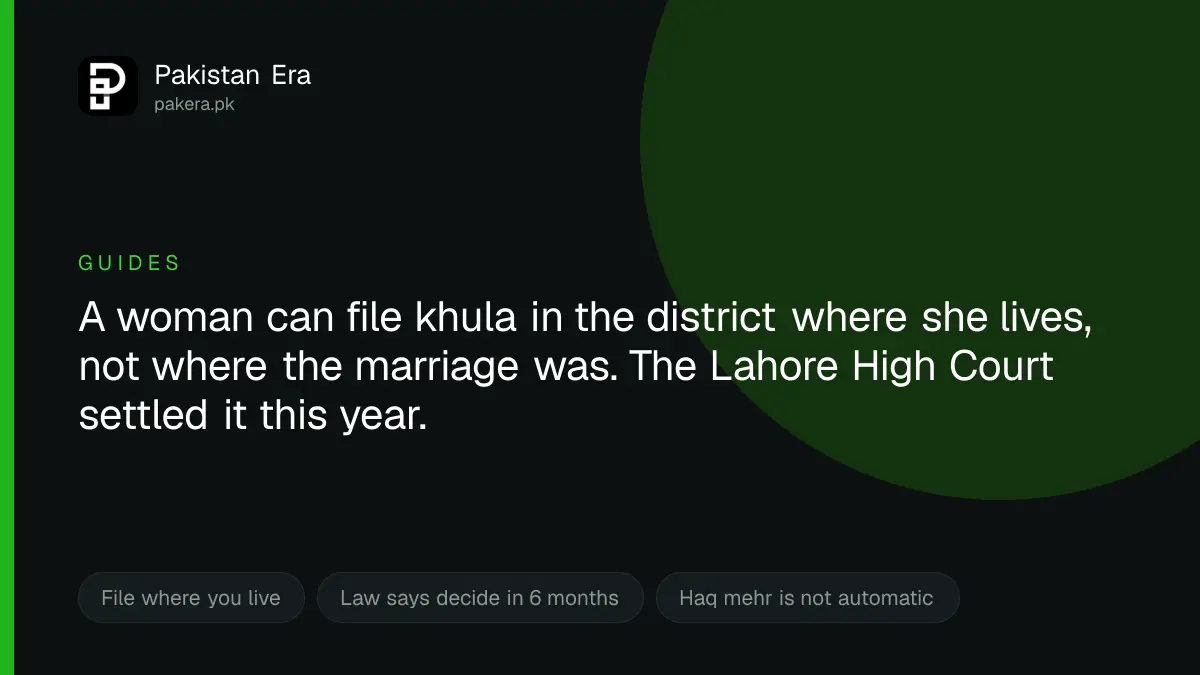
The Lahore High Court has held that a woman may file khula and dower proceedings in the district where she resides, framed by the court as a matter of convenience and access to justice.
That is a practical change. A woman who has left the marital home and returned to her parents, often in another city, previously faced travelling back to file and then attending hearings there. Filing where she actually lives removes an obstacle that stopped some women starting at all.
This is a Lahore High Court ruling, so it binds Punjab. If you are elsewhere, ask a lawyer what applies in your province rather than assuming.
Haq mehr is not automatically returned
The near universal belief is that a woman must hand back everything to obtain khula. That belief keeps women in marriages they want to leave, because they think the price is impossible.
The actual position is discretionary.
| Your situation | What the court may do |
|---|---|
| You received the haq mehr | May ask you to return it, fully or in part |
| It was never actually paid | May simply waive the claim |
| There has been cruelty or abuse | May excuse return altogether |
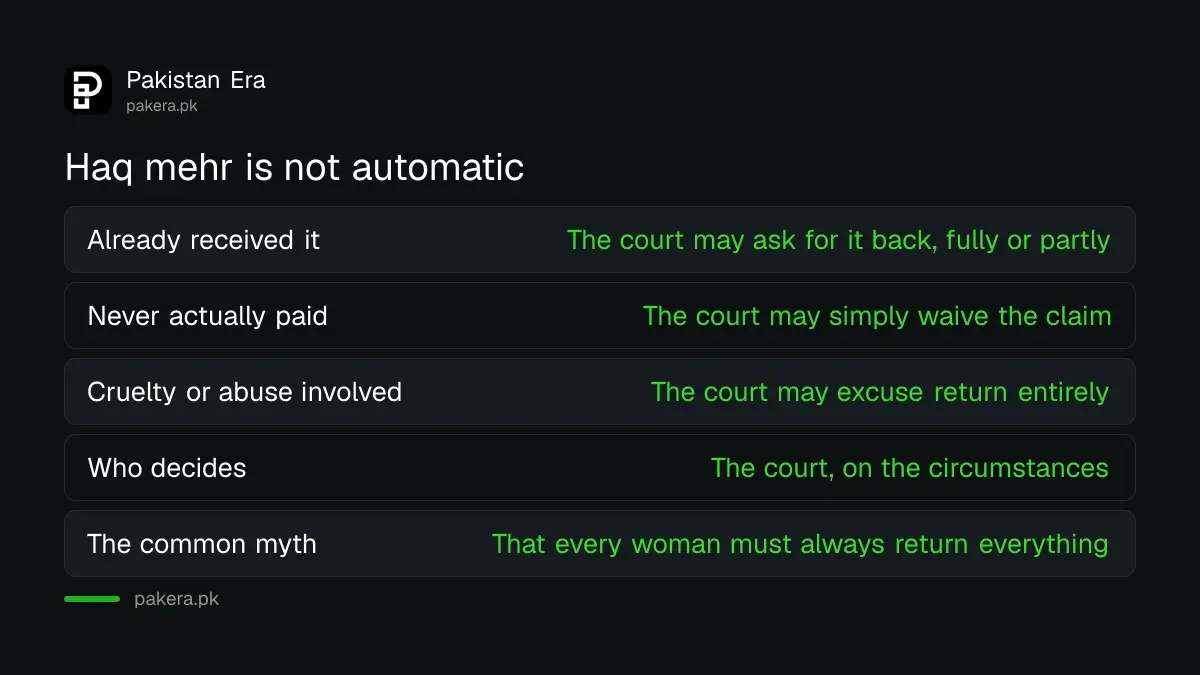
The court decides on the circumstances. Nobody can promise you an outcome, and this page is not doing so. But "I will have to give back money I never received" is not the rule, and if that is what is stopping you, it is worth asking a lawyer before accepting it as fact.
How the process runs
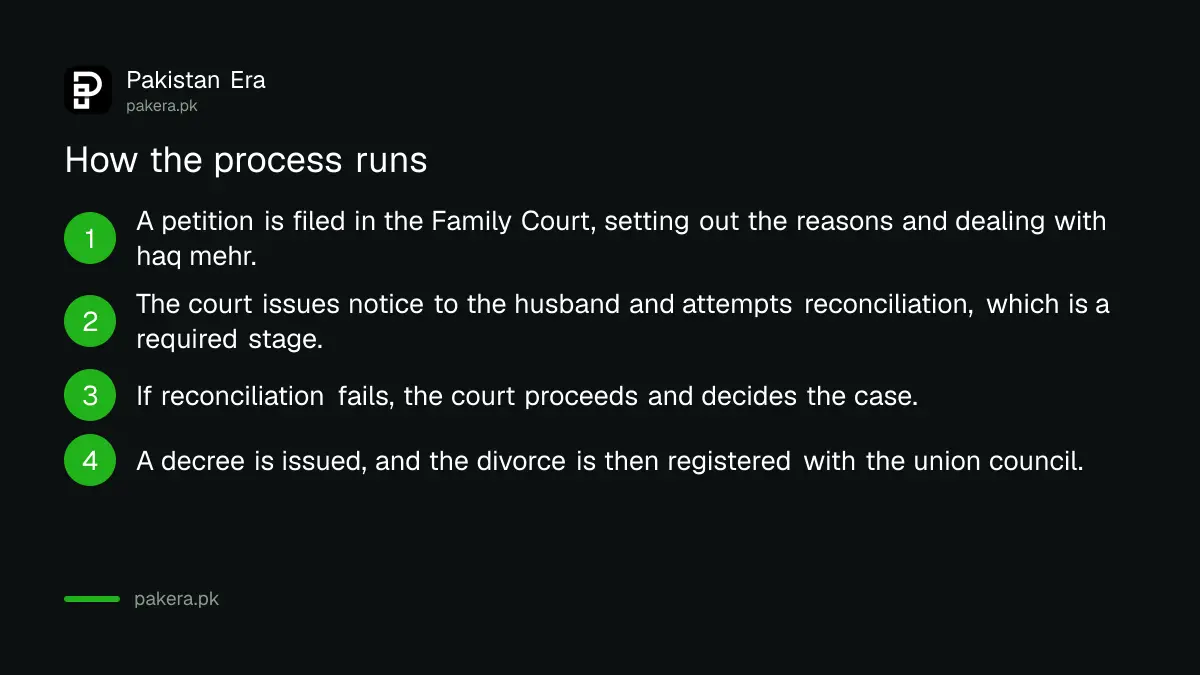
- A petition is filed in the Family Court, setting out the reasons and dealing with haq mehr.
- The court issues notice to the husband.
- Reconciliation is attempted. This is a required stage, not an optional one, and it is not a judgement about your decision.
- If reconciliation fails, the court proceeds and decides the case.
- A decree is issued, and the divorce is then registered with the union council. That registration is what makes it provable afterwards.
Do not skip the last step. A decree that was never registered creates exactly the same problem later that an unregistered nikah does.
How long it takes, honestly
The law and the reality are different, and you should plan on the reality.
Under the Family Courts Act the court is required to decide a khula case within six months. In practice, uncontested cases are commonly reported at three to six months, and a contested case can run one to two years or more depending on the court's backlog.
The statutory six months is the standard the system sets itself. It is not a promise, and knowing that in advance is better than discovering it at month eight.
What you will need
- The registered nikah nama. The union council and the family court require it to process the filing.
- Your CNIC.
- Details of haq mehr, what was agreed and what was actually paid.
- Any documentation relevant to your reasons.
- Your current address, which now determines where you can file.
If the nikah was never registered, that has to be dealt with first, and late registration is possible. We set out how in the guide to registering a nikah.
What this guide is not
This explains what the process is and corrects two things people commonly get wrong. It is not legal advice.
It does not cover grounds, evidence or strategy, it cannot tell you what a court will decide in your case, and it is not a substitute for a lawyer. Family law is provincial and fact specific, and khula cases turn on details that a web page cannot see.
If cost is the barrier, ask about legal aid. District bar associations and several non governmental organisations run free legal aid for family matters, and the Punjab and Sindh governments operate legal aid schemes. That is worth asking about before concluding you cannot proceed.
If you are in immediate danger, that is a police matter first. The court process is slow by design and it is not a protection mechanism. Provincial women's helplines exist alongside the emergency numbers.
Questions readers are asking
Where can a woman file for khula in Pakistan?
The Lahore High Court has ruled she may file in the district where she resides, as a matter of convenience and access to justice. That ruling binds Punjab; check locally elsewhere.
Does khula need the husband's consent?
No. Khula is the wife's right to seek dissolution through the Family Court, and the court decides. Notice is issued to the husband and reconciliation is attempted, but his agreement is not the deciding factor.
Do I have to return the haq mehr?
Not automatically. If you received it the court may ask for it back fully or partly, if it was never paid the court may waive the claim, and in cases of cruelty or abuse the court may excuse return entirely. The court decides.
How long does khula take?
The law requires a decision within six months. In practice uncontested cases are reported at three to six months and contested ones can take one to two years or more.
Do I need the nikah nama?
Yes. The registered nikah nama is required to process the filing. If the marriage was never registered, that has to be sorted out first.
Do I need a lawyer?
Family cases turn on facts and evidence, and a lawyer is strongly advisable. If cost is the obstacle, ask about legal aid through the district bar association or provincial schemes.
About the author

Public Services and Education Journalist
Fajr Riaz is a journalist and content writer at Pakistan Era, based in Lahore. She covers the questions people meet in everyday life in Pakistan: how a public service works, what a change in the rules means, and where to find a reliable answer.