Apostille or Attestation: Which One Your Documents Actually Need
Pakistan runs two systems. Apostille costs Rs 3,000 to Rs 12,000 and covers 112 countries. Ordinary attestation costs nothing at all.
If you are sending a Pakistani document abroad, for a job, a visa, a university or a marriage, there are two different systems and they cost very different amounts.
Apostille costs between Rs 3,000 and Rs 12,000 a document and covers 112 countries.
Ordinary attestation costs nothing at all.
Which one you need depends on where the paper is going, and almost nobody explains that before you have already paid.
What apostille costs
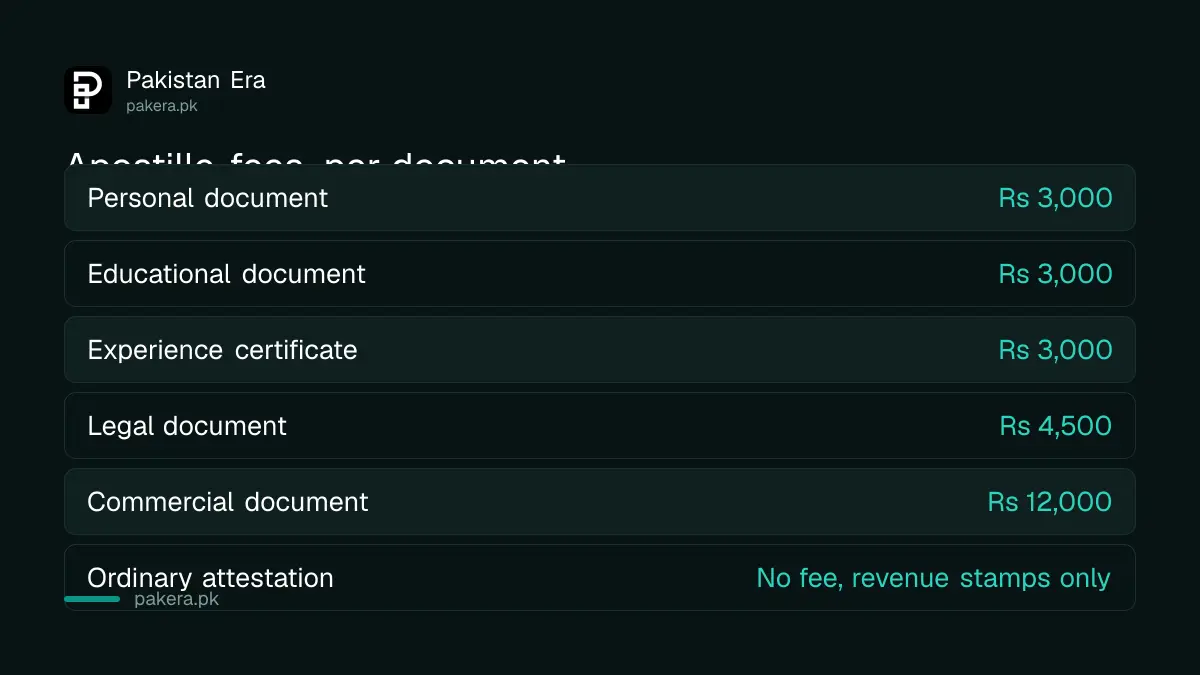
These are from the Ministry of Foreign Affairs own fee page, read on 23 August 2026.
| Document type | Fee per document |
|---|---|
| Personal document | Rs 3,000 |
| Educational document | Rs 3,000 |
| Experience certificate | Rs 3,000 |
| Legal document | Rs 4,500 |
| Commercial document | Rs 12,000 |
Note that it is per document. A family of four sending personal documents is not paying Rs 3,000, and a commercial file with several papers in it adds up fast.
Against that, the Ministry states plainly that no fee is charged for any type of attestation by the Ministry or its camp offices. Ordinary attestation costs only the prescribed revenue stamps.
So the first question is not how to apply. It is which of the two your destination country actually requires, because one of them is free.
What apostille is, in plain terms
An apostille replaces a chain of stamps with a single certificate.
Under the Apostille Convention, a document authenticated once by the designated authority in the country where it was issued can be presented directly to the authorities in the destination country. No embassy step, no second legalisation.
Pakistan's designated authority is the Ministry of Foreign Affairs, and it lists 112 countries as covered.
If your destination is on that list, apostille is the route and it is worth the fee, because it removes the embassy stage. If it is not on the list, the older attestation route applies and the embassy of that country will usually want to stamp it afterwards.
Check the country list before choosing. It is published on the Ministry's apostille portal alongside the fee page.
The order this has to happen in
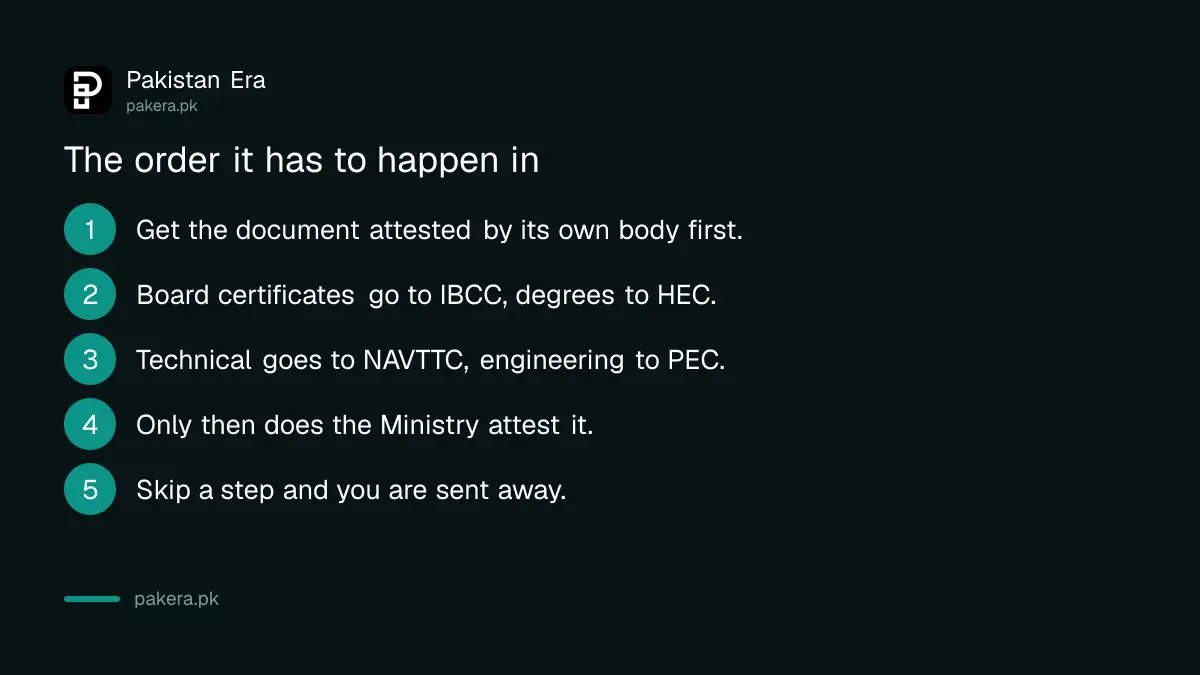
This is where most wasted journeys come from. The Ministry is the last step, not the first.
- Board certificates from a BISE must be countersigned by the IBCC first.
- University degrees must be attested by the HEC first.
- Technical certificates go through NAVTTC.
- Engineering diplomas go through the Pakistan Engineering Council.
- Commercial agreements are signed by company executives and countersigned by the local Chamber of Commerce and Industry.
Only after that does the Ministry attest or apostille the document. Arriving without the prior stamp means being sent away, and the queue does not care that you did not know.
The degree route through HEC is covered in our HEC attestation guide, and if your qualification is a foreign one needing equivalence first, that is in the IBCC equivalence guide.
The papers that cannot be attested at all
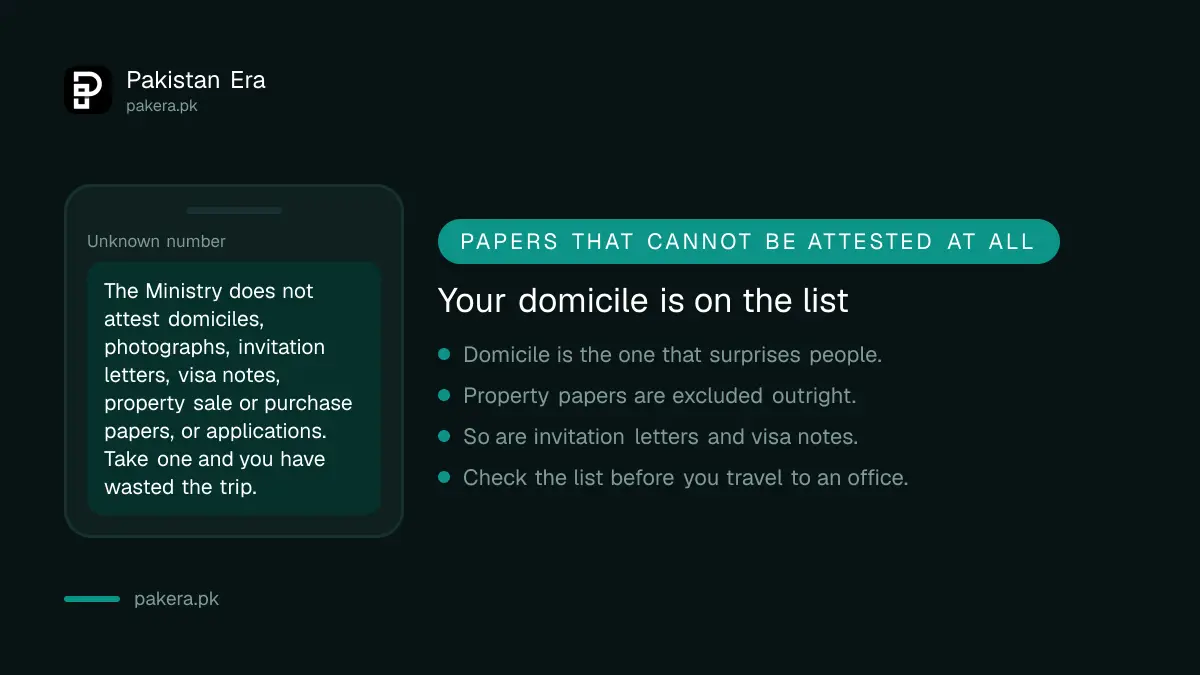
Some documents are simply outside the system, and one of them catches people constantly.
Domiciles cannot be attested. Neither can photographs, invitation letters, visa notes, property sale or purchase papers, or applications.
The domicile is the painful one, because it is a document people are often asked for and reasonably assume can be stamped like any other. It cannot.
If a foreign employer or university has asked for an attested domicile, that request cannot be met as stated, and it is better to go back and ask them what they actually need than to spend a day discovering it at a counter.
Where to go, and when
The Ministry runs a consular hall in Islamabad and camp offices in four other cities.
| City | Where | Phone |
|---|---|---|
| Islamabad | Consular Services Hall, Constitution Avenue, G-5 | 051-9215803-4 |
| Lahore | 43-N, Gulberg III | 042-99268247-8 |
| Karachi | Main Shahrah-e-Faisal, next to FTC Building | 021-99204989-90 |
| Peshawar | 18-c/2, Gul Mohar Lane, University Town | 091-9218126 |
| Quetta | Room 28, Block 07, Civil Secretariat | 081-9203155 |
Hours are Monday to Friday, 8:30am to 4:30pm, with shorter hours during Ramadan.
You will need your original identity card and a photocopy of the document for the Ministry's records. A blood relative can go in your place with proof of the relationship, and somebody living abroad can send an authority letter attested by the Pakistani mission there.
Five courier companies are authorised to handle apostille door to door: Gerry's International, Leopards, TCS, M&P and ECS. They charge their own service fee on top.
Two official pages that disagree
We have to flag this, because it will affect what you find when you look.
The Ministry's consular page carries a notice dated 5 March 2026 saying the Apostille Online Portal has been suspended over cybersecurity threats, and that applicants cannot book online appointments until further notice.
The apostille portal itself, opened on 23 August 2026, is live and says the opposite: that the Ministry has started online apostille attestation, with a sign up link, a fee page, a country list and a verification tool.
We cannot reconcile those from outside, so we are reporting both. Expect either, and if the portal will not take a registration, the walk in route for legal documents is what the notice describes.
One practical note from testing. The portal returns nothing to an ordinary automated request and loads normally in a browser, so if a link checker or an app preview tells you the site is down, open it in a real browser before believing that.
The verification tool nobody mentions
The portal carries a Verify Apostille function.
That is worth knowing in both directions. If you are receiving a Pakistani document that carries an apostille, you can check it. And if somebody abroad doubts the certificate on your paperwork, you can point them at an official checker rather than arguing.
For overseas Pakistanis, which identity document you hold changes what you can do at a mission, and that is set out in our NICOP and POC guide.
What we could not verify
Fees came from the Ministry's own apostille fee page, and the process, offices and exclusions from its consular page, both read on 23 August 2026.
We did not lodge an application, so this describes the published process rather than a transaction we completed.
We have not read the full list of 112 countries, so check yours on the Ministry's country list rather than assuming.
We could not confirm processing times for either route, and nothing on the pages we read gave them.
We could not resolve the contradiction between the suspension notice and the working portal.
Questions readers are asking
What does an apostille cost in Pakistan?
Rs 3,000 for personal, educational and experience documents, Rs 4,500 for legal documents and Rs 12,000 for commercial documents, per document.
Is ordinary attestation free?
The Ministry states that no fee is charged for any type of attestation by it or its camp offices. Only prescribed revenue stamps are required.
Do I need apostille or attestation?
It depends on the destination country. Apostille covers 112 countries and removes the embassy step. If your country is not on the list, the older attestation route applies.
Can I get my domicile attested?
No. Domiciles are on the list of documents the Ministry does not attest, along with photographs, invitation letters, visa notes and property papers.
What do I need to do before going to the Ministry?
Get the prior attestation first. Board certificates need IBCC, degrees need HEC, technical certificates need NAVTTC and engineering needs PEC.
Is the apostille portal working?
It loaded for us on 23 August 2026 and invited registration, although the Ministry's consular page still carries a March notice saying it is suspended. Try it, and expect either.
Can somebody else submit my documents?
A blood relative can, with proof of relationship. Five authorised courier companies also offer a door to door service for a fee.
About the author

Tax, Bills and Technology Writer
Ali Akhtar is a young and curious voice here at Pakistan Era. He is currently pursuing his A-Levels and has a growing interest in Pakistan’s changing industrial landscape and educational trends. Ali likes to write in a way that helps him explain and explore the world around him. His writing reflects the perspective of the new generation navigating the evolving trends of Pakistan where technology, youth innovation, and shifting opportunities are reshaping the country’s future.