Federal Technical Education Moves to One Curriculum: The Trade Routes Nobody Explains
Federal technical institutes are being unified under one curriculum. What the trade routes are, where a DAE leads, and why the Gulf cares.
The government has brought all federal technical education institutions under a single curriculum. It is the kind of announcement that gets one paragraph and disappears, and it sits on top of a system that a very large number of young Pakistanis pass through without anyone ever explaining it to them.
So here is the map: what the technical routes are, what each one leads to, and how to tell a real institute from one selling paper.
Why this track exists, and who it is actually for
Pakistan's education conversation is dominated by matric, FSc, university. Meanwhile the economy runs on electricians, welders, machinists, technicians, air conditioning engineers and heavy vehicle operators, and a large share of the country's remittance income comes from exactly those trades working abroad.
The technical track is not the consolation route for people who could not do FSc, whatever anyone told you at school. It is a shorter path to a wage, and in several trades a better one than a general degree that ends in a queue.
The routes
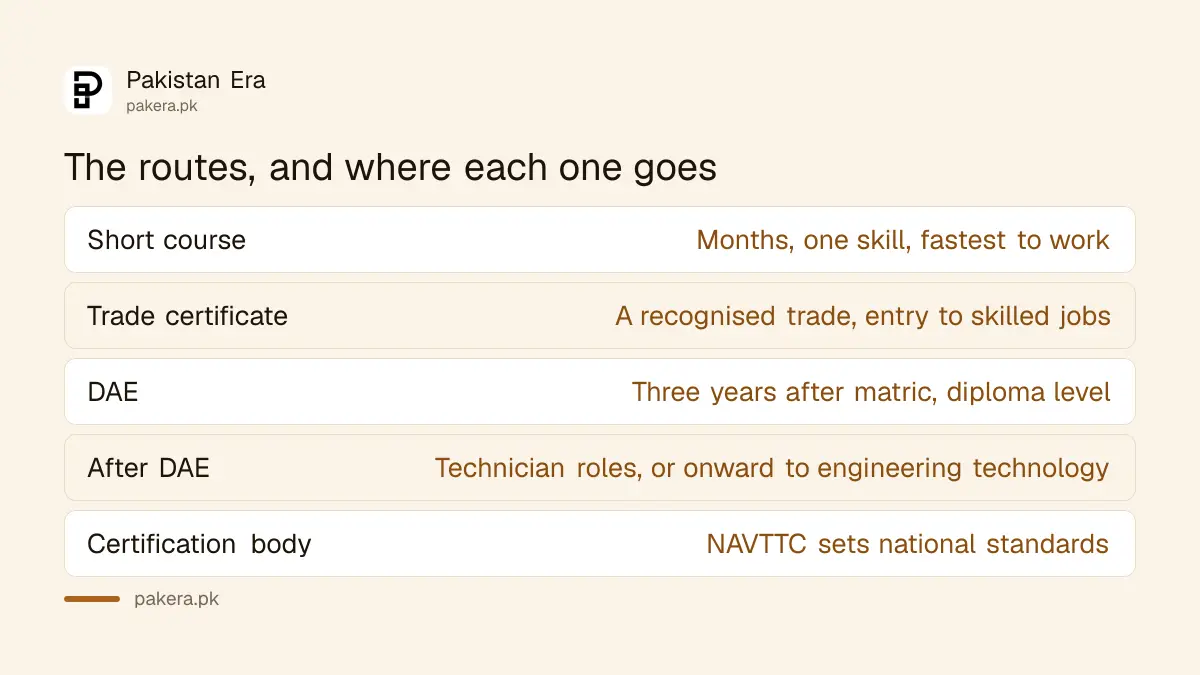
| Route | Roughly | Leads to |
|---|---|---|
| Short course | Weeks to months | One specific skill, quickest to earning |
| Trade certificate | Months to a year | Entry into a recognised skilled trade |
| DAE, Diploma of Associate Engineering | Three years after matric | Technician roles across industry |
| After a DAE | Varies | Employment, or onward study in engineering technology |
The DAE is the one most misunderstood. It is a three year diploma taken after matric, it is a qualification in its own right that employers hire directly from, and it is also a bridge onward rather than a dead end. Families who treat it as a fallback often do not know the second half of that sentence.
Standards across all of this are set nationally by NAVTTC, the National Vocational and Technical Training Commission, whose site we opened before writing this. That body matters for the section below more than any other detail on this page.
Choosing a course that is worth the year
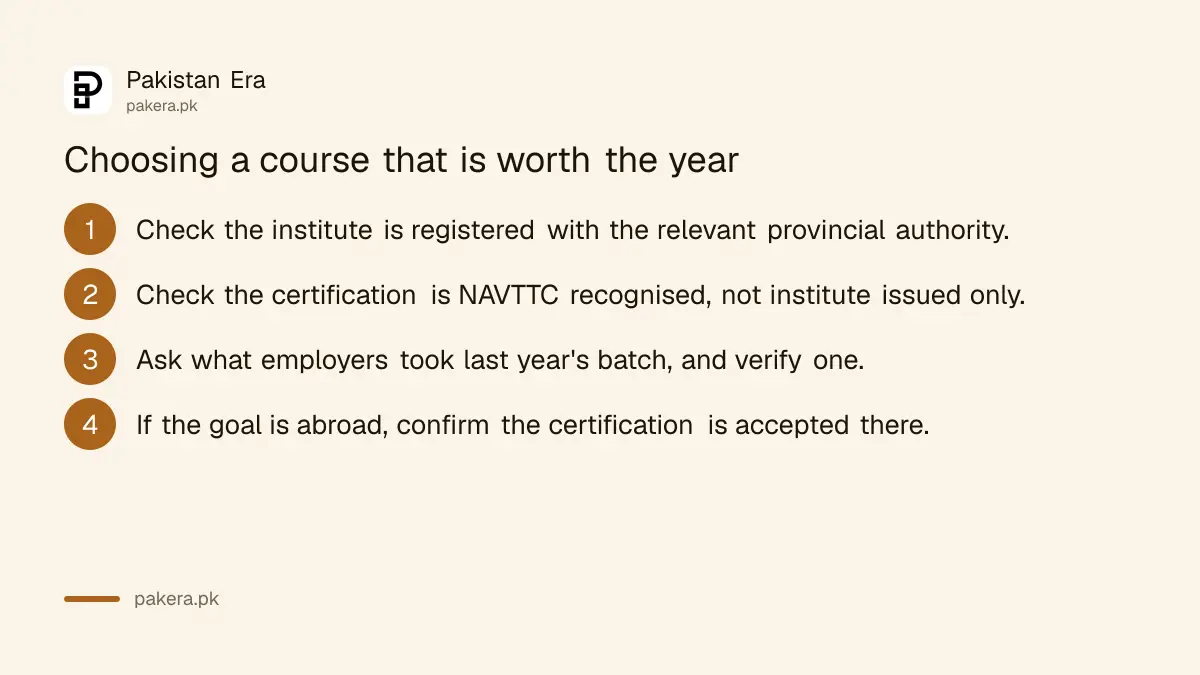
- Check the institute is registered with the relevant provincial technical education authority. Every province runs one, and registration is verifiable before you pay anything.
- Check the certification, not the course. A NAVTTC recognised qualification is portable. An institute's own certificate, however impressive the paper, is worth whatever that institute's name is worth, which outside its own city is usually nothing.
- Ask where last year's batch went, and then verify one of the answers independently. Employers who actually hire from an institute are happy to confirm it.
- If the goal is working abroad, confirm the certification is recognised in the destination before enrolling, not after.
The Gulf question, which is the real reason many people enrol
Be honest about the motivation: for a lot of students, technical training is a route to a job in the Gulf, and the certification is the visa's foundation.
That makes recognition the whole game. A trade certificate that a UAE or Saudi employer's system accepts opens a door; one that does not is an expensive year. The rules on the destination side move too, as we covered in the UAE's labour visa changes, and the paperwork underneath every one of these routes is the same: a valid passport, which tracks by token number, and increasingly a police character certificate, which moved online this week.
If Europe rather than the Gulf is the ambition, skilled trades are also the basis of the German work visa route, which is built around recognised vocational qualifications in a way most Pakistani applicants underestimate.
The institutes that sell paper
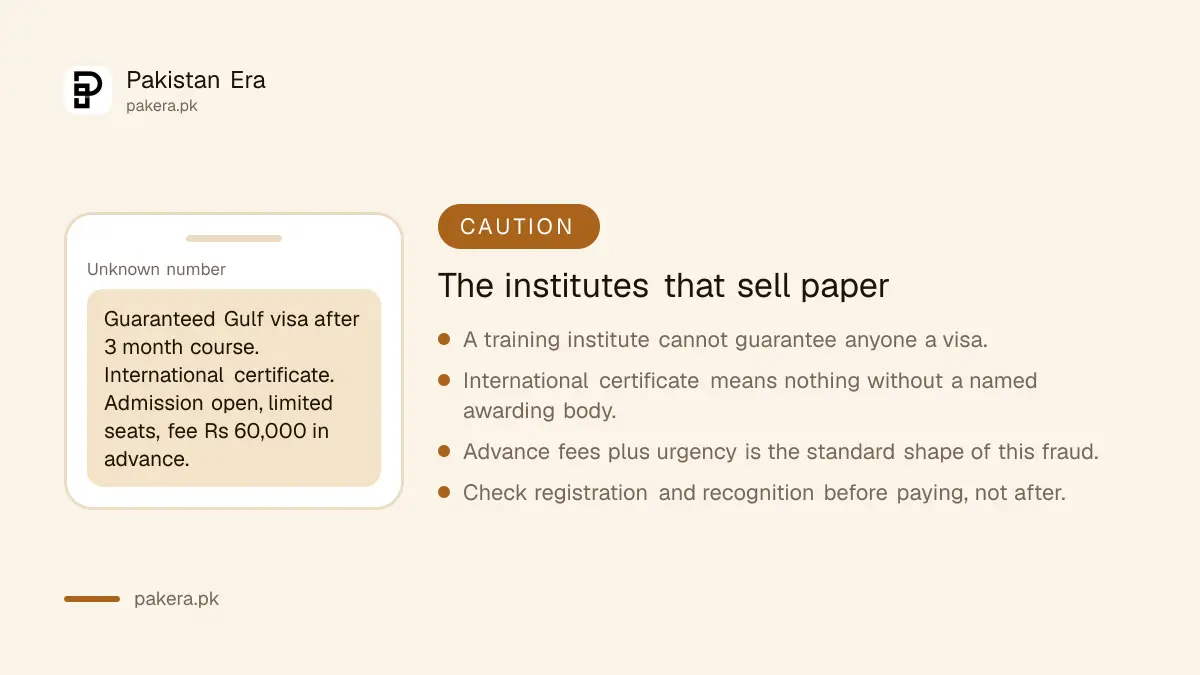
Where there is a route to a foreign wage, there is a market selling shortcuts to it, and this one has a standard shape: guaranteed Gulf visa after a three month course, international certificate, admission open, limited seats, fee in advance.
Take those apart. No training institute can guarantee a visa, because visas are issued by states to people with employers, and an institute is neither. International certificate is meaningless without a named awarding body you can check. And advance fees plus urgency is the same structure as every other fraud we document, from fake scheme selections onward.
The cost here is heavier than money. A year spent on an unrecognised certificate is a year of earning gone, taken from families who could least afford the gamble and were told it was the safe one.
What the curriculum change might actually fix
One national curriculum across federal institutions addresses a genuine problem: a certificate from one institute meaning something different from the same-named certificate elsewhere, which is exactly what makes employers distrust the whole category and forces graduates to prove themselves from scratch.
Whether it works depends on things not in the announcement: assessment being standardised as well as syllabus, employers being brought into the design, and equipment in workshops matching what industry now uses. We will cover the detail when there is detail rather than an approval. For now, the thing a student can act on is the checklist above, which holds regardless of what the curriculum says.
Questions readers are asking
What is a DAE?
A Diploma of Associate Engineering, a three year technical diploma taken after matric. It qualifies you for technician roles directly and can also lead onward to further study in engineering technology.
What is NAVTTC?
The National Vocational and Technical Training Commission, which sets national standards for technical and vocational qualifications. Recognition by it is what makes a certificate portable beyond the institute that issued it.
How do I check an institute is genuine?
Verify its registration with your provincial technical education authority, and verify that the certification is nationally recognised rather than issued by the institute alone. Do both before paying.
Will a trade certificate get me a job in the Gulf?
It can be the foundation of one, provided the certification is recognised in the destination and you have an employer. No institute can guarantee a visa, and any that does is lying.
Is technical education only for those who cannot do FSc?
No, and that belief costs people money. Several trades pay better and sooner than a general degree, and the DAE route continues into higher study for those who want it.
What changed on 5 August?
Federal technical education institutions were brought under a single curriculum. The detail beyond that unification was not announced, and the practical advice for choosing a course is unaffected by it.
About the author

Tax, Bills and Technology Writer
Ali Akhtar is a young and curious voice here at Pakistan Era. He is currently pursuing his A-Levels and has a growing interest in Pakistan’s changing industrial landscape and educational trends. Ali likes to write in a way that helps him explain and explore the world around him. His writing reflects the perspective of the new generation navigating the evolving trends of Pakistan where technology, youth innovation, and shifting opportunities are reshaping the country’s future.