Check Your NVQF Level: What Pakistan's 8 Skill Levels Mean for Your Certificate
NVQF has eight levels: certificates 1 to 4, a diploma at 5 and degrees at 6 to 8. See what each level means and how to check your skills certificate now.

Pakistan's National Vocational Qualifications Framework (NVQF) has eight levels. Levels 1 to 4 are National Vocational Certificates, Level 5 is a Diploma, and Levels 6 to 8 are university degrees accredited by the Higher Education Commission (HEC). NAVTTC says only certificates from its approved awarding bodies are valid for jobs and study.
A skills certificate is only as useful as its level. An employer, a Gulf recruiter or a university will ask what the paper is worth, and "course completed" does not answer that. NVQF does. We read the framework on the National Vocational and Technical Training Commission (NAVTTC) site, navttc.gov.pk, on 15 October 2026. This guide shows how to read your own level.
NVQF has eight levels, from certificate to doctorate
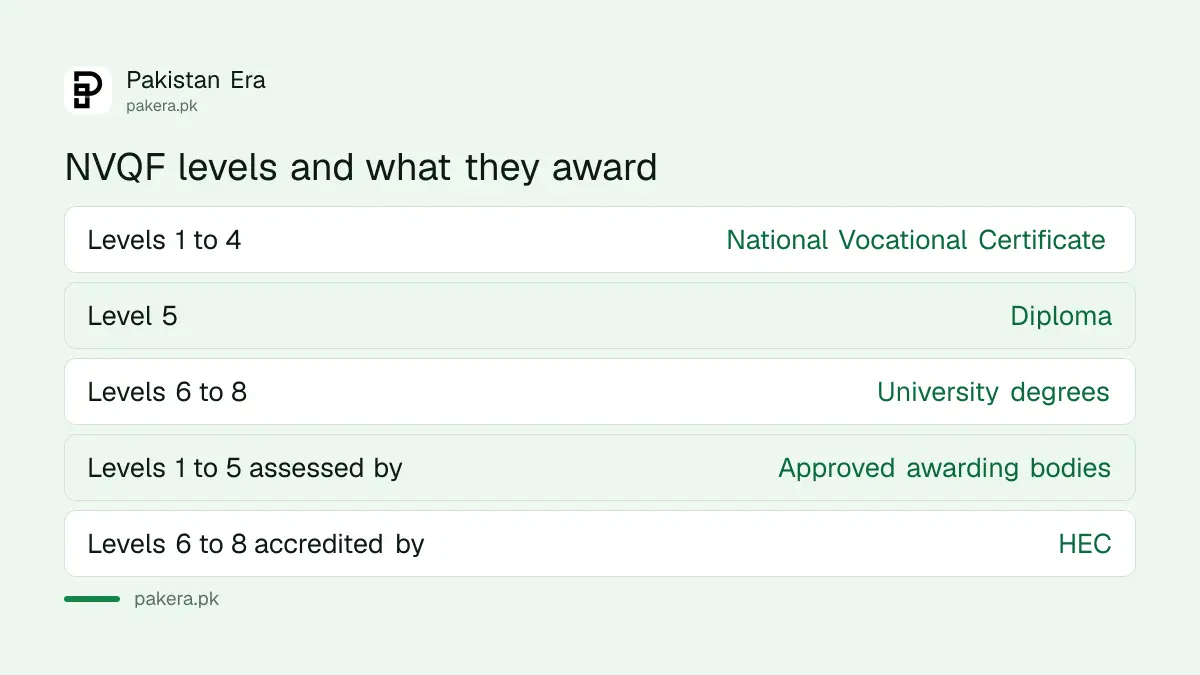
NAVTTC introduced NVQF in 2013 to define the skills behind a qualification, decide equivalence, guide the recognition of prior learning and keep training quality steady. It spans eight levels. Levels 1 to 4 are certificates, Level 5 is a diploma and Levels 6 to 8 are degrees.
| NVQF level | Award | Who assesses or accredits it |
|---|---|---|
| Levels 1 to 4 | National Vocational Certificate | Qualification awarding bodies (QABs) |
| Level 5 | Diploma | QABs |
| Levels 6 to 8 | University degrees | Accredited by HEC |
The framework text does not say which degree sits at Level 6, 7 or 8. It only says those three levels are university degrees accredited by HEC. Do not assume a bachelor's, master's or doctorate match until you see it in writing.
Each level asks for more knowledge, skill and responsibility
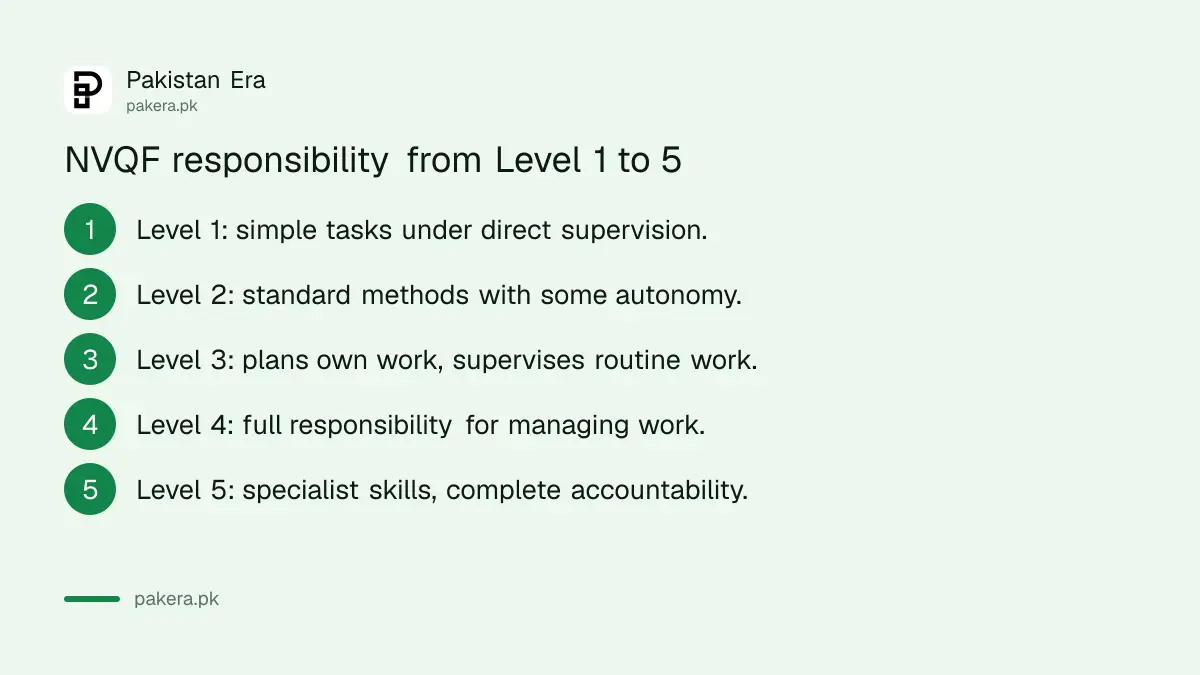
NAVTTC describes every level in three parts: knowledge, skills and responsibility. At Level 1 a worker has limited practical skills, does single-process tasks and works under direct supervision. At Level 4 the worker has comprehensive skills and takes full responsibility for managing and supervising work or study.
- Level 1: elementary knowledge, simple tasks, direct supervision.
- Level 2: basic knowledge, standard methods, some autonomy under indirect supervision.
- Level 3: broad knowledge, multi-stage tasks, plans own work and may supervise routine work.
- Level 4: comprehensive skills, complex tasks, full responsibility for managing and supervising.
- Level 5: specialist skills, variable and complex tasks, planning with complete accountability.
In short, the higher the level, the less someone needs to watch you. A welder who can only follow instructions is not at the same level as one who plans a job and supervises the crew. Level 3 is the first level that mentions supervising others, and only for routine work.
Only certificates from approved awarding bodies count
NAVTTC's affiliation page says only certificates and diplomas issued by its approved Qualification Awarding Bodies are valid for employment within and outside the country and for further education. Its home page says there are 13 approved bodies. The affiliation page itself shows 14 names, so count them yourself.
The names listed there include the provincial technical boards of Punjab, Sindh and Khyber Pakhtunkhwa, the trade testing boards of Punjab, Sindh, Khyber Pakhtunkhwa and Balochistan, Azad Jammu and Kashmir Trade Testing Board, NAVTTC itself, PVTC, NBTPE, NUMS, FBISE and NTB. If your certificate came from a private "academy" with no body on this list, ask the issuer which one it affiliates with.
Read your certificate in four checks
You cannot find your NVQF level by guessing from the course name. Look at what is printed on the paper and who signed it. The aim is to prove two things: the issuer is an approved body, and the level is stated.
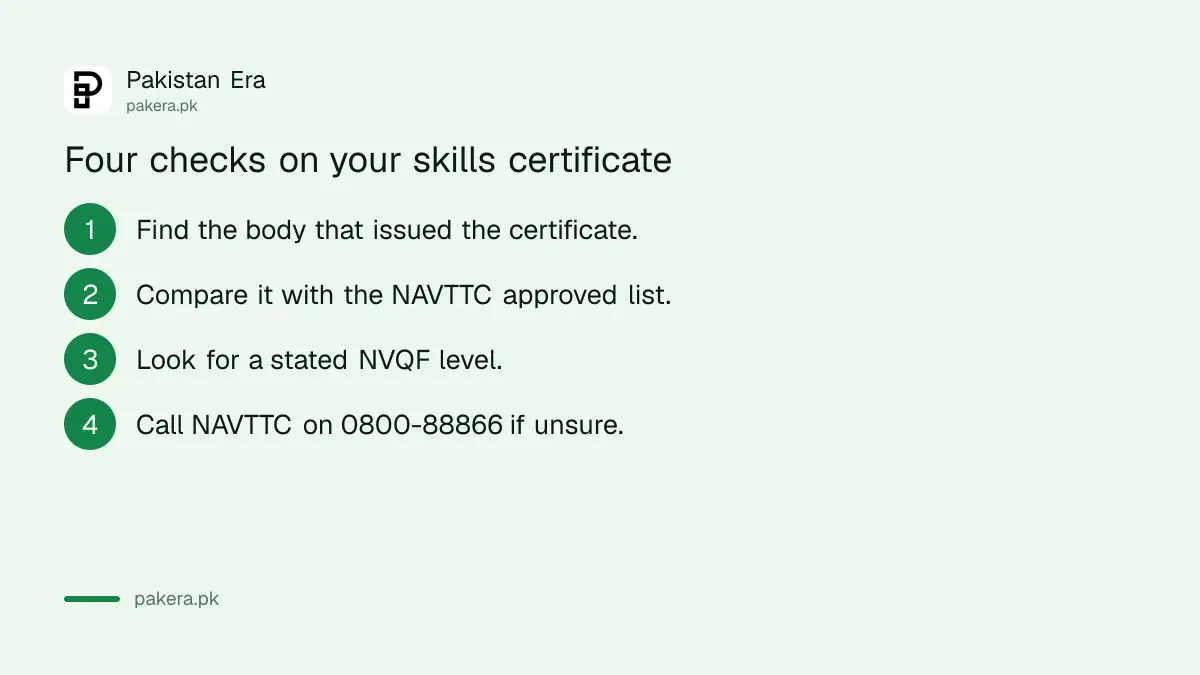
- Find the name of the body that issued the certificate.
- Compare it with the approved list on the NAVTTC affiliation page.
- Look for an NVQF level on the paper, or ask the institute to confirm it in writing.
- Call NAVTTC on 0800-88866 (listed on its site, Monday to Friday, 8 am to 4 pm) if the paper and the list disagree.
If you already work in a trade but hold no paper, the route is Recognition of Prior Learning (RPL), which gives an NVQF-recognised certificate without classes. For Saudi work, the Takamol skill test is a separate route.
NAVTTC links training with international certification
NAVTTC says its Prime Minister's Youth Skills Development Program is in its latest batch with more than 75,000 trainees in 866 institutes, learning 103 trades. Those figures are NAVTTC's own, shown on its home page. A recent tender for international certification of trainees is covered in NAVTTC international certification for PMYSDP trainees.
A level does not guarantee a job abroad. Employers and foreign recruiters set their own tests. Still, a certificate with a clear level from an approved body gives you a record that is easy to verify, which is half of what any recruiter asks for.
Common questions about NVQF levels
How many levels does NVQF have?
Eight. Levels 1 to 4 are certificates, Level 5 is a diploma and Levels 6 to 8 are university degrees.
Who accredits Levels 6 to 8?
The Higher Education Commission (HEC). NAVTTC says those levels are university degrees accredited by HEC.
When was NVQF introduced?
In 2013, according to NAVTTC. It also supports recognition of prior learning.
Does every skills certificate have an NVQF level?
Not necessarily. Only qualifications from NAVTTC's approved awarding bodies are described as valid. Ask the issuer to state the level in writing.
Can a private institute award an NVQF certificate?
Only through affiliation with an approved awarding body. NAVTTC says an institute must affiliate with one to award nationally recognised qualifications.
Where do I call NAVTTC?
NAVTTC lists 0800-88866 and info@navttc.gov.pk, open Monday to Friday, 8 am to 4 pm.
How we verified this
What we checked, where we read it, and what we could not confirm.
Last checked 15 October 2026. We read the NVQF Framework page, the Affiliation page and the home page on navttc.gov.pk on 15 October 2026. We did not test the certificate verification tool the home page advertises, because we could not find its address. The home page says 13 approved bodies, while the Affiliation page names 14. NAVTTC's trainee numbers are its own claims, which we did not verify.
About the author

Public Services and Education Journalist
Fajr Riaz is a journalist and content writer at Pakistan Era, based in Lahore. She covers the questions people meet in everyday life in Pakistan: how a public service works, what a change in the rules means, and where to find a reliable answer.