Your Matric Result Is Out. Here Is How to Choose FSc, ICS or DAE.
Pre-medical, pre-engineering, ICS, commerce or DAE. What each one opens, what it closes off, and the mistake most students make.
Your matric result is out. The choice you make in the next few weeks decides what you can study for the rest of your life.
That sounds dramatic. It is simply true. Pick pre-engineering and you cannot become a doctor. Pick pre-medical and engineering is closed. Almost nobody explains this before students choose, so here it is in plain terms.
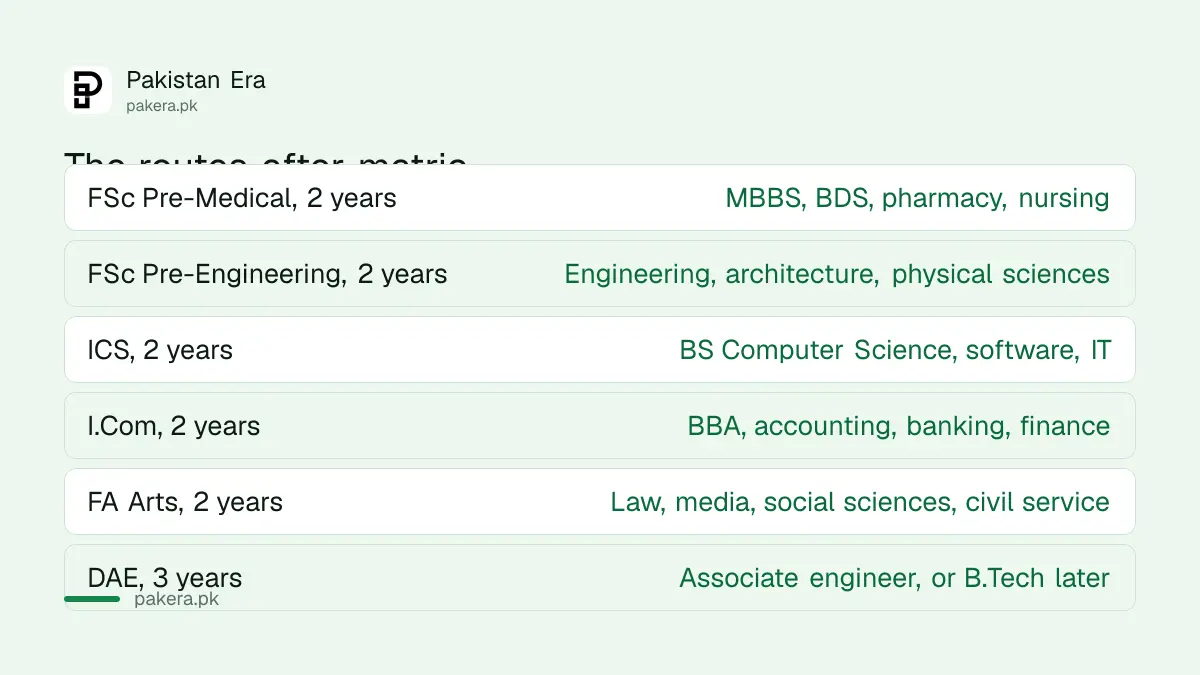
The five routes after matric
| Route | Length | Leads to |
|---|---|---|
| FSc Pre-Medical | 2 years | MBBS, BDS, pharmacy, nursing, biological sciences |
| FSc Pre-Engineering | 2 years | Engineering, architecture, physical sciences |
| ICS, Computer Science | 2 years | BS Computer Science, software, IT |
| I.Com, Commerce | 2 years | BBA, accounting, banking, finance |
| FA, Arts and humanities | 2 years | Law, media, social sciences, teaching, civil service |
| DAE, technical diploma | 3 years | A job as an associate engineer, or B.Tech later |
Notice DAE is three years, not two. That is the first thing most people do not know about it.
The doors each choice closes
This is the part that matters and the part nobody says out loud.
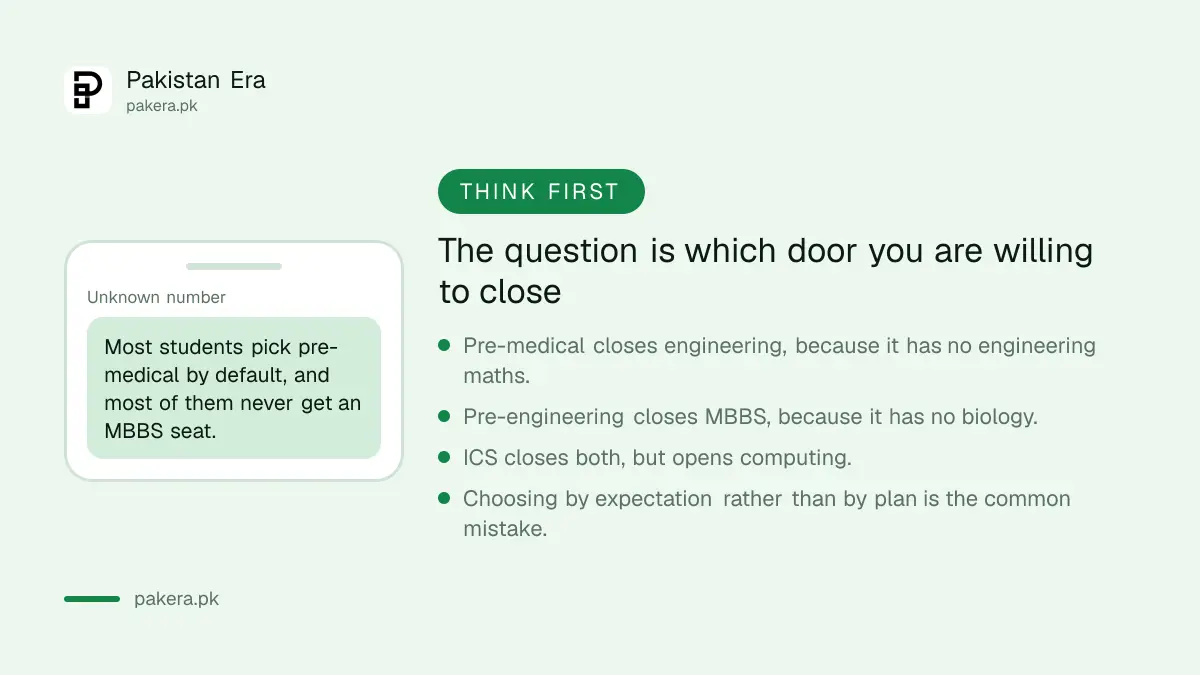
Pre-Medical closes engineering. You will not have the mathematics that engineering universities require. Some students do a bridge later, but it costs a year and it is not simple.
Pre-Engineering closes MBBS. You will not have biology, and medical colleges will not consider you.
ICS closes both. It is an excellent route into computing, but it is not a route into medical or engineering university programmes.
Commerce and Arts close the science routes, and they open law, business, media and the civil service.
So the honest question is not "which is best". It is: which door am I willing to close?
Most students pick pre-medical without thinking
Pre-medical is the default in Pakistan. Families expect it, schools push it, and a good matric result almost automatically becomes a pre-medical admission.
Look at the arithmetic before you follow it. There are far more pre-medical students each year than there are MBBS seats in the country. Most people who start pre-medical do not become doctors. They finish FSc with biology and then choose something else anyway, having spent two years preparing for a seat they never got.
If you genuinely want medicine, pre-medical is right and you should work for it. If you are choosing it because it is what people expect, you are closing the engineering and computing doors for a reason you have not examined.
DAE is the route nobody mentions
The Diploma of Associate Engineering runs three years instead of two, and it is technical rather than academic.
Two things make it different. First, it ends with an actual skill: electrical, mechanical, civil, electronics and other trades. Second, a DAE holder can work as an associate engineer, or continue to a B.Tech degree later.
It suits a student who learns by doing rather than by memorising, and it suits a family that needs earning to start sooner. It is not a lesser choice. It is a different one, and in a country short of skilled technicians it is often the more employable one.
We set out the technical and vocational routes in more detail in the piece on technical education in Pakistan.
How college admission works
Admission is on merit, which means your matric marks decide where you can go.
- Colleges publish a merit list. They rank applicants by marks and cut off at the number of seats they have.
- The first list is usually provisional. Students can raise objections, and a final list follows.
- There are several lists, not one. If you miss the first, seats open as selected students go elsewhere. Do not give up after one list.
- Apply to more than one college. Applying only to the best one in your city is how students end up with nothing.
- Keep your documents ready. Result card, matric certificate, CNIC or B-Form, photographs and domicile where required.
The exact schedule comes from your own board and the colleges you apply to. We are not printing dates here because they differ by board and by year, and a wrong date costs a seat. Take them from your board's own announcement, which you can reach from the board results guide.
Four questions to ask before you decide
Sit down for ten minutes and answer these honestly.
What did you actually enjoy in matric? Not what you scored highest in. What you did not mind spending time on.
Are you choosing this or is your family choosing it? Both can be fine. Knowing which one is happening is not.
How long can your family support your study? If money is tight, a three-year DAE that ends in a job may serve you better than a degree path you cannot finish.
What happens if the plan does not work? If pre-medical does not lead to MBBS, what is your second option, and does this choice leave you one?
If you took O Levels
Different route, same decision. Your grades need to be converted into Pakistani marks before a local university will consider you, and that is done by IBCC. We set out the full conversion table and both application routes in the IBCC equivalence guide.
Questions readers are asking
What should I study after matric?
It depends on which career doors you want left open. Pre-medical leads to MBBS and health sciences, pre-engineering to engineering, ICS to computing, I.Com to business and finance, FA to law and social sciences, and DAE to technical work as an associate engineer.
Can I do engineering after pre-medical?
Not directly. Pre-medical does not include the mathematics engineering programmes require, so the route is closed without extra study that costs time.
Can I become a doctor after pre-engineering?
No. Medical colleges require biology, which pre-engineering does not include.
How long is DAE?
Three years, compared with two for FSc. It ends with a technical qualification and can lead to work as an associate engineer or to a B.Tech degree.
How are college seats decided?
On merit, using your matric marks. Colleges publish a merit list, usually provisional first, and further lists follow as selected students take places elsewhere.
What if I miss the first merit list?
Wait for the later lists. Seats open up as students accept places at other colleges. Applying to several colleges rather than one is the safest approach.
Is ICS a good choice?
It is a strong route into computing and software. Be aware that it does not lead to medical or engineering university programmes.
About the author
Public Services and Education Journalist
Fajr Riaz is a journalist and content writer at Pakistan Era, based in Lahore. She covers the questions people meet in everyday life in Pakistan: how a public service works, what a change in the rules means, and where to find a reliable answer.