How to Get an IBCC Equivalence Certificate for O and A Levels
An A is 85 Pakistani marks and a B is 75. The full IBCC conversion table, the online and courier routes, and what A star actually means.
An A grade converts to 85 Pakistani marks. A B is 75. A C is 65. Those three numbers decide most O and A level students' university admissions, and they come from the Inter Boards Coordination Commission's own conversion rules.
Update, 11 October 2026: You can check an IBCC QR equivalence certificate without extra attestation.
Here is the full table, both routes for applying, and the one thing about A star that catches people out every year.
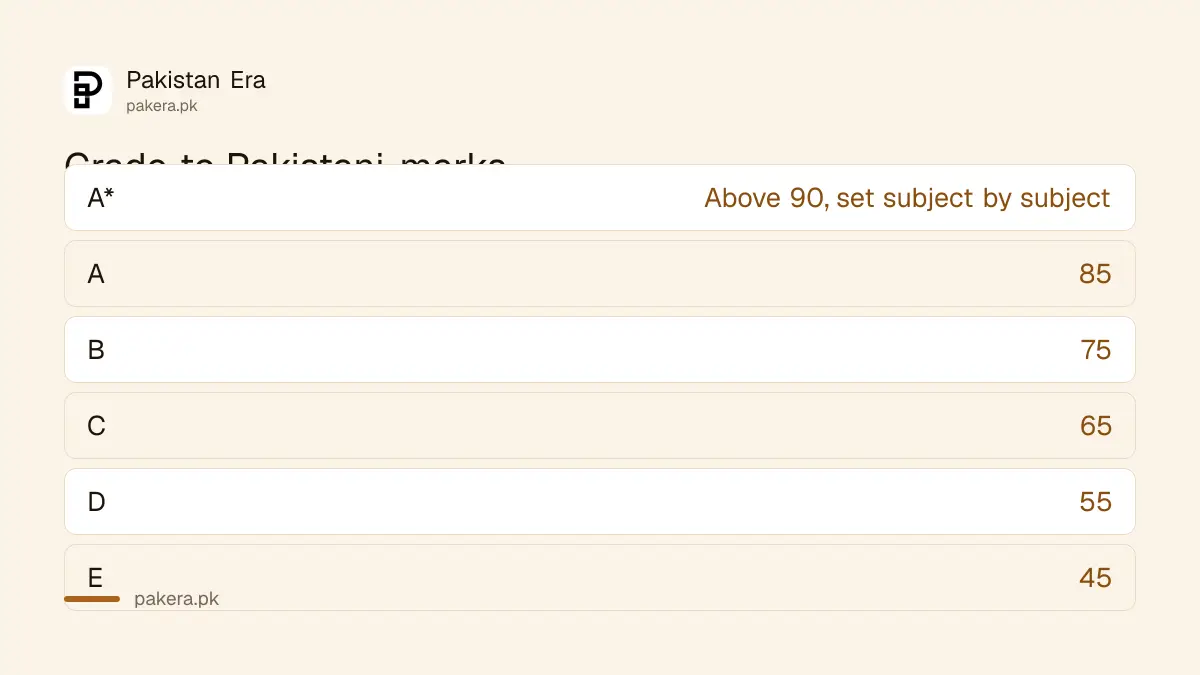
The conversion table
For GCSE, IGCSE, GCE O Levels and GCE A Levels, converted into Pakistani marks:
| Grade | Pakistani marks |
|---|---|
| A* | Above 90, from Examination Session 2021 onwards |
| A | 85 |
| B | 75 |
| C | 65 |
| D | 55 |
| E | 45 |
| F and G | Not applicable for IBCC equivalence |
For the numeric 9 to 1 grading used in reformed GCSEs:
| Grade | Pakistani marks |
|---|---|
| 9 | Above 90, from Examination Session 2021 onwards |
| 8 | 87 |
| 7 | 82 |
| 6 | 77 |
| 5 | 70 |
| 4 | 60 |
| 3 | 50 |
| 2 | 40 |
| 1 | Not applicable for IBCC equivalence |
A star is not a fixed number, and this is where people miscalculate
Every other grade on that table is a flat figure. A* is not. It is above 90, and the actual mark is set subject by subject, for each examination session separately.
IBCC publishes those subject-wise A* equivalent marks per session, and there are separate lists for O Levels and A Levels. Sessions including 2022, 2024, 2025 and 2026 each have their own published tables.
So a student estimating their aggregate by putting 90 or 95 against every A* is guessing. Two A* grades in different subjects, in the same session, can convert to different marks. If your admission depends on a decimal, find the table for your session and your subject rather than assuming.
The other consequence: your session matters. Do not use a friend's calculation from two years ago.
For Year 2026 papers we have the actual figures. IBCC notification 1409, dated 27 July 2026, sets them out:
| Subject | O Level | A Level |
|---|---|---|
| Physics | 94 | 95 |
| Chemistry, Biology, Mathematics | 94 | 94 |
| Computer Science | 94 | 93 |
| English, Urdu | 93 | Not listed |
| Pakistan Studies, Islamiyat | 94 | Not listed |
| Other elective subjects | 94 | 94 |
We go through what these mean, and the IB and AP position, in the 2026 A star marks. To apply them to your own grades, use our IBCC equivalence calculator.
The two ways to apply
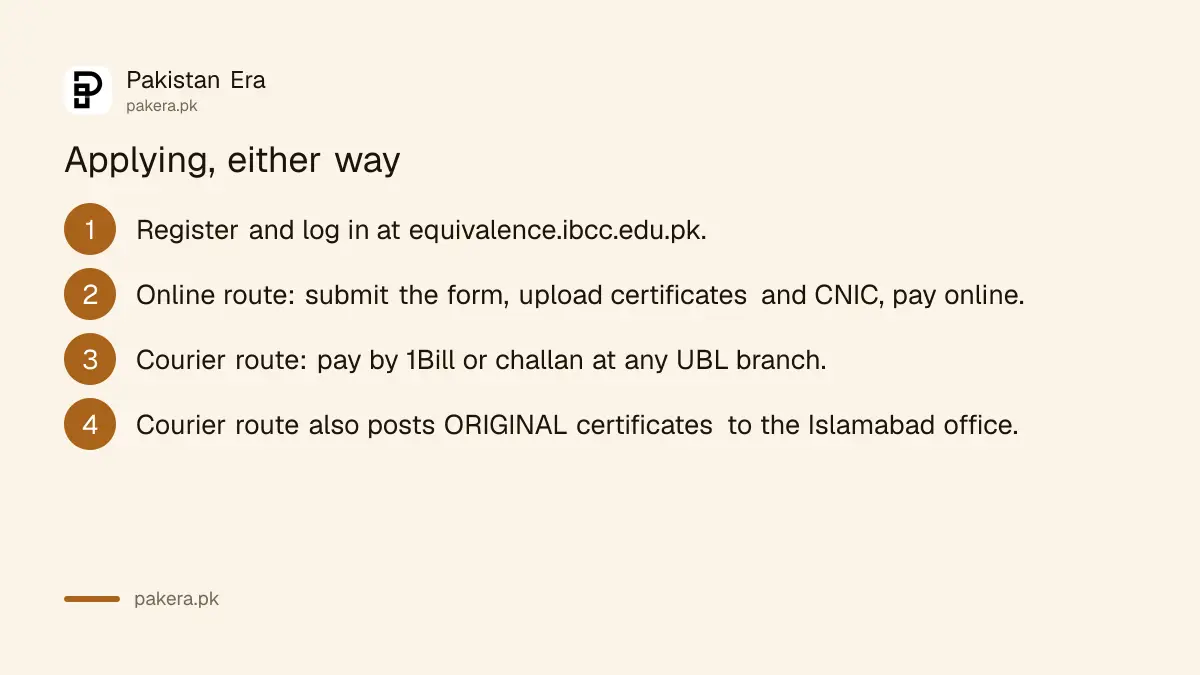
Applications run through the IBCC equivalence portal at equivalence.ibcc.edu.pk. Both routes start with an account there.
Fully online
- Register on the IBCC equivalence portal.
- Log in with those credentials.
- Submit the online application, providing your personal information and uploading your educational certificates and a copy of your CNIC.
- Pay the equivalence fee by following the online instructions.
- Track the application through your dashboard.
Through courier
- Sign up at equivalence.ibcc.edu.pk and log in.
- Submit the application via courier, providing the required information and uploading documents.
- Pay the fee using a 1Bill link, or download the challan form and pay at any UBL branch.
- Dispatch the documents to the IBCC office: the completed application form, the payment receipt, your educational certificates in original and photocopy, and a photocopy of your CNIC.
- Track the application through your dashboard.
The difference that matters is in step four of the courier route. It asks for originals. If you are mid-admission and need those certificates in your hand, plan around that rather than discovering it after posting them.
What IBCC actually is
Worth knowing because it explains why this body and not your university decides your marks.
The Inter Boards Coordination Commission was established in 1972 as the Inter Boards Committee of Chairmen and reconstituted in April 2023 through the IBCC Act, Act XIII of 2023. It is a national body under the Ministry of Federal Education and Professional Training, and it is the platform on which the heads of Pakistan's examination boards set unified standards for academic evaluation, examination and assessment.
It handles foreign qualifications beyond the British system too: the International Baccalaureate, the US High School Diploma, and Australian qualifications each have their own equivalence rules on the same site. It also runs an attestation service and registers Qualification Awarding Bodies.
Practical notes before you apply
- Office hours are Monday to Thursday, 08:00 to 16:00, per IBCC's own published timing. Plan a call or a courier delivery around that rather than a normal five day week.
- The helpline is (051) 111 114 222.
- The head office is in Islamabad, and courier applications go there.
- There is a verification facility on the equivalence portal, which is what universities and employers use to confirm a certificate is genuine. That cuts both ways: a forged equivalence certificate fails at the first check.
We are deliberately not printing a fee figure. Fees change, they differ by qualification type and service, and the portal generates the amount for your specific application. Take it from the challan the system produces, not from a blog, including this one.
The timing mistake that costs a year
Equivalence is not something to start when an admission portal opens. It is a document a university asks for, and processing takes time regardless of which route you choose.
Students coming through the Pakistani board system do not need equivalence at all, since their marks are already in the national format, and their route is simply the result itself, which we cover in the guide to checking any board result by roll number. Equivalence exists specifically to put foreign qualifications on the same scale. If you are looking further ahead, an equivalence certificate is also part of the paperwork for several overseas scholarship routes, including the one we set out in the Chevening guide.
If you sat A Levels in a session and intend to apply to Pakistani universities in the same cycle, begin the equivalence application as soon as your results are issued. Students who wait for a university deadline to prompt them are the ones filing appeals, and an appeal does not move an admission deadline.
Questions readers are asking
How many marks is an A in IBCC equivalence?
85 Pakistani marks. A B is 75, a C is 65, a D is 55 and an E is 45. F and G are not applicable for IBCC equivalence.
How many marks is an A star?
Above 90, but not a fixed figure. IBCC publishes subject-wise A* equivalent marks separately for each examination session, with different lists for O Levels and A Levels, so the exact number depends on your subject and your session.
What are the numeric 9 to 1 grades worth?
9 is above 90, 8 is 87, 7 is 82, 6 is 77, 5 is 70, 4 is 60, 3 is 50 and 2 is 40. Grade 1 is not applicable for IBCC equivalence.
Where do I apply for IBCC equivalence?
At equivalence.ibcc.edu.pk. You register, log in, and then choose either the fully online submission or the courier route.
Do I have to send original certificates?
For the courier route, yes. It requires educational certificates in original along with photocopies, plus the completed application form, payment receipt and a photocopy of your CNIC. The fully online route uploads documents instead.
How do I pay the equivalence fee?
Online through the portal's instructions, or for the courier route by 1Bill link or by downloading the challan and paying at any UBL branch.
Does IBCC handle qualifications other than O and A Levels?
Yes. The International Baccalaureate, US High School Diploma and Australian qualifications each have their own equivalence rules on the IBCC site.
What are IBCC's office hours?
Monday to Thursday, 08:00 to 16:00, per its published timing. The helpline is (051) 111 114 222.
About the author

Senior Writer, Public Services and Technology
Shahid joined us in 2024 as an author. He is a senior contributor to Pakistan's leading technology websites. He writes detailed articles, mostly covering his expertise in the latest tech, mobiles, apps, gadgets, and step-by-step guides. His ideology is to help people understand the latest trends and explain complex methods through very easy-to-understand guides.