Protector of Emigrants in Pakistan: Get the Protector Stamp Before You Work Abroad
Every Pakistani on a work visa must get the protector stamp first. The steps, the papers, where to complain and why the stamp protects you.
Every Pakistani going abroad on a work visa must be "protected" before leaving, under the Emigration Ordinance 1979. You do this at the Protectorate of Emigrants office: it countersigns your Foreign Service Agreement, and a protector sticker and stamp go into your passport. It applies whether a licensed promoter found the job or you found it yourself.
Most people treat it as one more stamp an agent arranges. It is more than that. It is the step that gives you a Pakistani office to complain to if the employer breaks the contract.
What protection actually is
Under the Emigration Ordinance 1979, every Pakistani proceeding abroad on a work visa has to get protected.
In the government's own words, protection is the Foreign Service Agreement signed between you and the foreign employer or promoter, and countersigned by the Protectorate of Emigrants, to ensure the terms and conditions of that contract are implemented. If the contract is violated, you can register a complaint.
That countersignature is the whole point. An agreement between you and an employer eight thousand kilometres away is worth what the employer decides it is worth. An agreement countersigned by a Pakistani government office gives you somewhere to go when the salary turns out to be lower than promised, or the job turns out to be a different job.
The two ways people get a foreign job
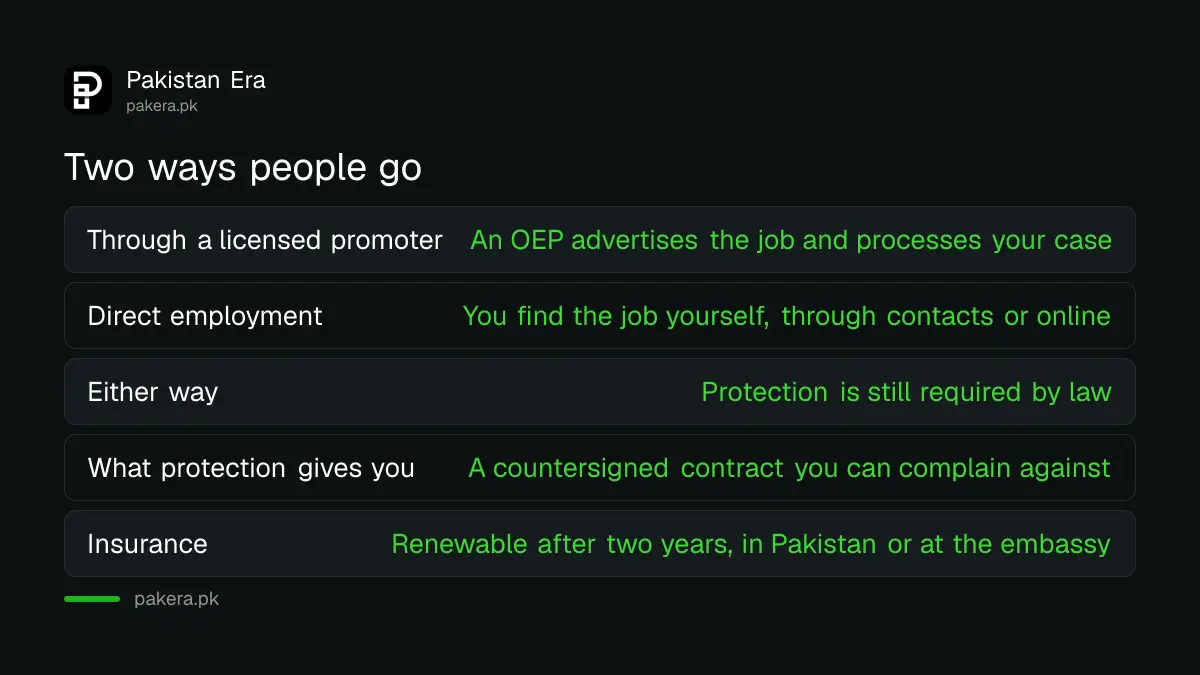
Either through a licensed Overseas Employment Promoter, who advertises jobs in newspapers and processes your case, or through direct employment, where you find the job yourself through relatives, friends or online.
Both are legitimate. Protection is required either way. Direct hires often assume the requirement applies only to agency cases. It does not.
Five checks before you pay anyone
These are the precautions the government publishes itself, and they are the cheapest protection you will ever buy.
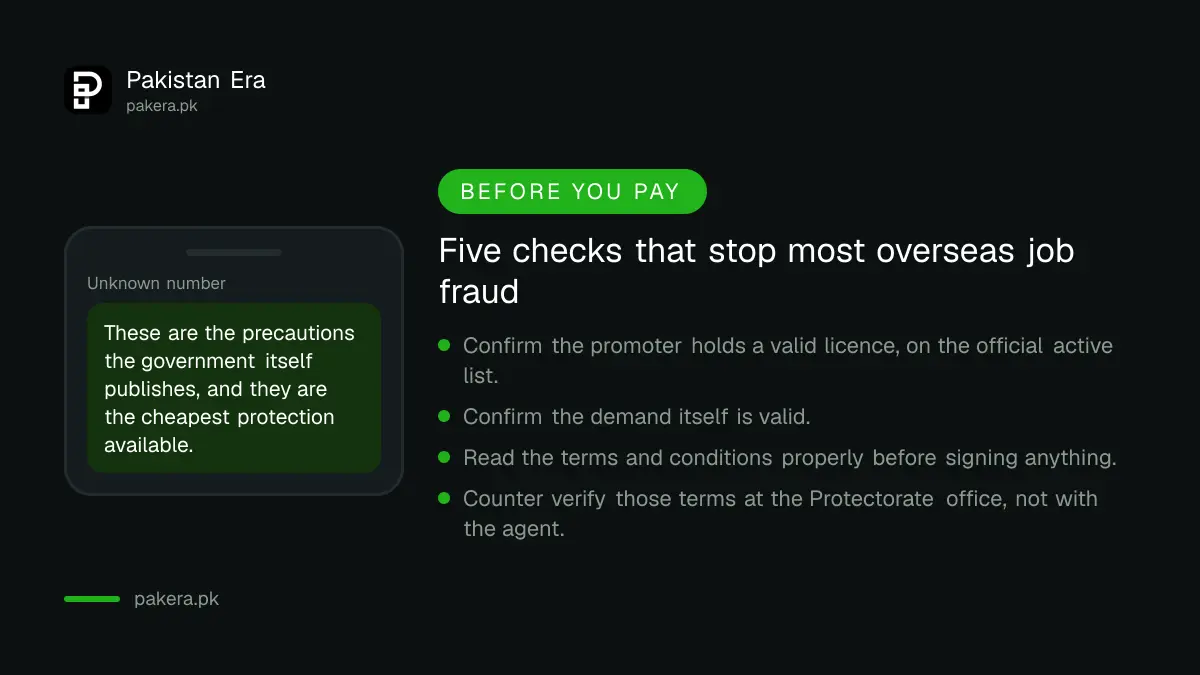
- Check the promoter's licence is valid. An OEP must hold a licence from the federal government, and the Bureau publishes a list of active licence holders. You can also confirm at the Protectorate office.
- Check the demand is valid. A licence alone does not mean the specific job exists.
- Read the terms and conditions. Properly, before signing, including salary, hours, accommodation and who pays for the return ticket.
- Counter verify the terms at the Protectorate office. Not with the agent who gave them to you. This is the check that catches a contract that says something different from what you were told.
- Insist on a receipt for every payment. Every one, however small.
The single most useful of those is the first. Overseas job fraud in Pakistan almost always involves someone operating without a valid licence, and the list is public.
What you need to bring
For registration through a promoter, the documents are:
| Document | Note |
|---|---|
| Permission number | Issued for the specific foreign demand |
| Passport | The protector sticker and stamp go into it |
| CNIC | |
| Insurance certificate | Renewable after two years |
| Welfare fund slip | |
| Protector fees slip | |
| Bank certificate or service charges | The OEP portion is refundable |
| Registration fees slip | |
| Adhesive stamp fee | |
| Foreign Service Agreement | The contract itself |
Fees are paid on separate slips. Ask at the Protectorate office for the current amounts and get the slip for each one.
What happens at the office
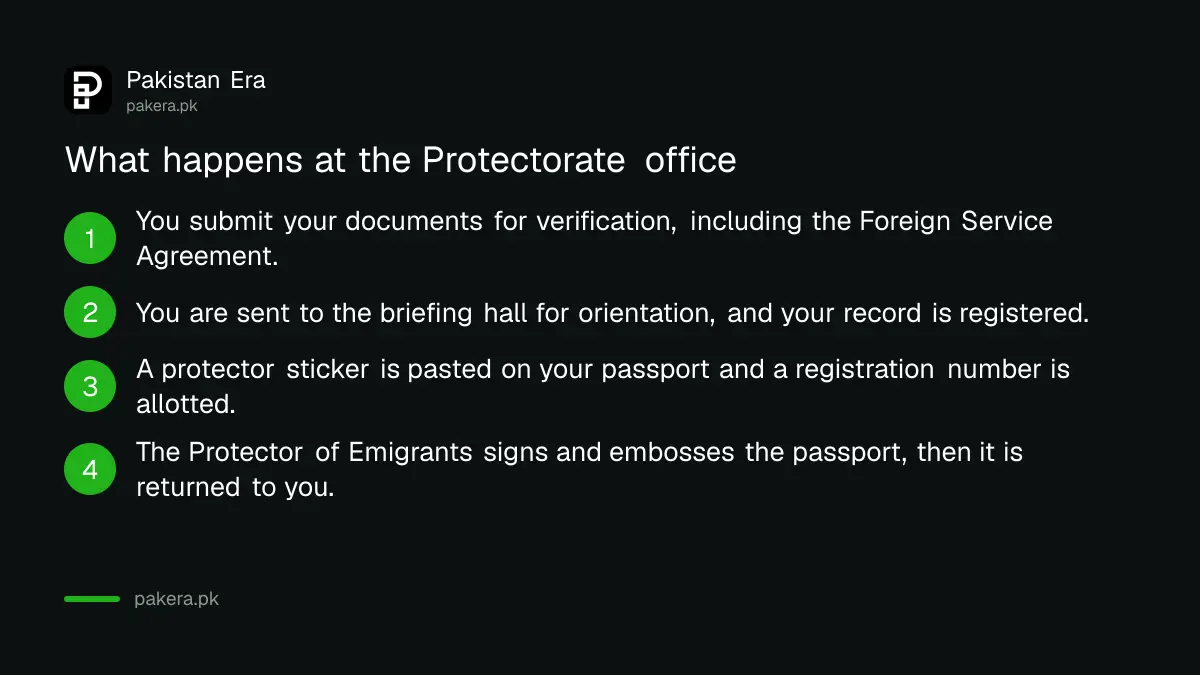
- Your documents are verified by the concerned section.
- You are sent to the briefing hall for orientation. At the same time your record is registered and a registration number is allotted.
- A protector sticker is pasted on your passport and the case goes to the Protector of Emigrants.
- The Protector signs and embosses the passport.
- An orientation officer briefs you on health, legal rights and other necessary aspects, then guides you to collect your passport and documents.
That briefing is not a formality to sit through. It is where you are told what your rights are in the destination country, and it is the one time somebody explains them to you before you are in a position where they matter.
Renewal, and insurance
Your protection stays valid as long as the terms and conditions of your agreement remain unchanged. If you sign a new contract, you need fresh protection, which means going back to the Protectorate office with the new agreement and the other documents.
Insurance can be renewed after two years, either at the Protectorate office in Pakistan or at the Pakistan Embassy in the country you are working in. If a worker dies within the insurance validity period, the nominee or a near relative can file the claim at the Protectorate office.
Tell your family which office holds your file and where your registration number is. That single conversation is what makes a claim possible later.
If something goes wrong
Each problem has its own office. Use the right one first, because writing to the wrong office costs weeks.
| Problem | Where to go |
|---|---|
| The employer abroad breaks the protected contract | The Protectorate office where you registered, as the ministry FAQ says |
| An agent with no licence took your money | Our guide to reporting an unlicensed job agent |
| A federal office in Pakistan, such as the Protectorate itself, delays or refuses you | The Wafaqi Mohtasib's Grievance Commissioner for overseas Pakistanis |
| A problem at the airport on the way out or back | The One Window Facilitation Desk, where the Bureau of Emigration sits with 11 other agencies |
Before you go
Two other things are worth settling in the same fortnight. Your passport has to be valid well beyond your contract, and the fees for that are widely misquoted, so we published the official ones in the guide to what a Pakistani passport actually costs.
Many employers and embassies also ask for a police clearance certificate, which takes its own time and is worth starting early. The process is in our guide to getting a police clearance certificate. For Gulf jobs, check whether you need the PakSoftSkills certificate before Protector registration, and read how a protector stamp affects the OPF membership card fee.
The visa side depends on the country. Our guides cover applying for a Saudi visa, applying for a UAE visa and applying for a Germany work visa from Pakistan.
Questions readers are asking
Is protection compulsory for working abroad?
Yes. Under the Emigration Ordinance 1979, every Pakistani proceeding abroad on a work visa is required to get protected.
What is the protector stamp?
The Protector of Emigrants signs and embosses your passport, and a protector sticker is pasted in it, once your Foreign Service Agreement and documents are verified and registered.
Do I need protection if I found the job myself?
Yes. The requirement applies to direct employment as well as to jobs arranged through a licensed promoter.
How do I check if an agent is genuine?
Confirm the promoter holds a valid licence, using the Bureau's published list of active licence holders, and verify at the Protectorate office. Also counter verify your contract terms there rather than relying on the agent.
How much does it cost?
There are several separate slips, including protector fees, registration fees, welfare fund and an adhesive stamp fee. Ask at the Protectorate office for the current amounts and keep every receipt.
What if my employer breaks the contract?
Because the Foreign Service Agreement is countersigned by the Protectorate, you can register a complaint against a violation at the Protectorate office. That route exists only if you were protected before leaving.
How we verified this
What we checked and where we read it.
Last checked 8 November 2026. The process, documents, renewal and insurance rules come from the Bureau of Emigration FAQ published by the Ministry of Overseas Pakistanis and Human Resource Development, read in August 2026. The airport desk detail comes from the Wafaqi Mohtasib's overseas cell page, read on 8 November 2026.
About the author

Public Services and Education Journalist
Fajr Riaz is a journalist and content writer at Pakistan Era, based in Lahore. She covers the questions people meet in everyday life in Pakistan: how a public service works, what a change in the rules means, and where to find a reliable answer.