SSGC Gas Connection for Flats and Apartment Buildings in Karachi: 5 Builder Documents, Then Each Flat Applies
Get an SSGC gas connection for a flat in Karachi: the 5 documents the builder files, the site survey, house line rules, each flat form and the common line risk.
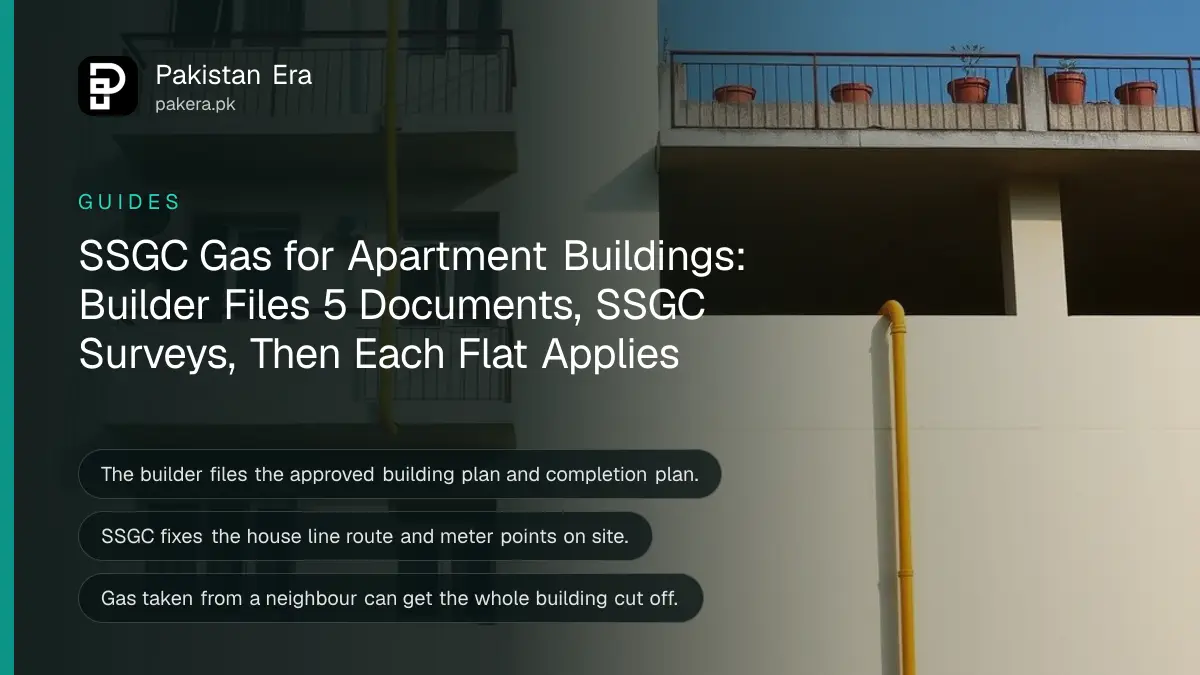
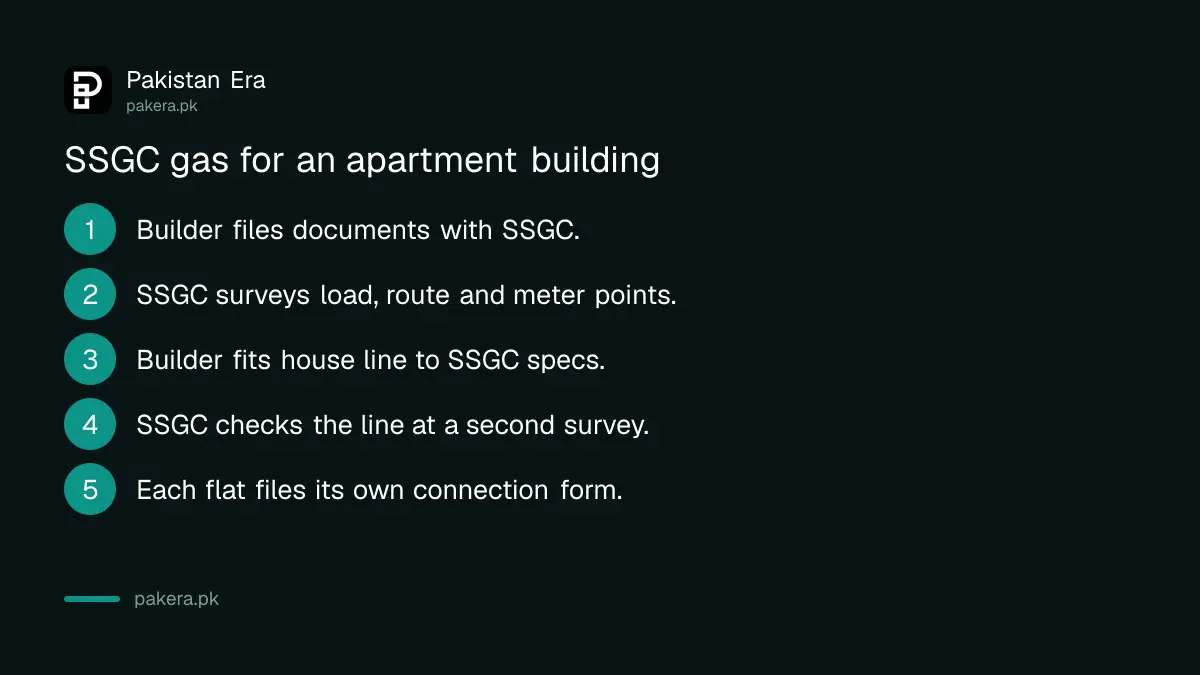
For gas in a new apartment building in Karachi, the builder or owner first applies to SSGC with the builder's CNIC, ownership documents, the approved building plan and completion plan, an undertaking and NOCs from the authorities concerned. SSGC surveys the building, approves the house line route and meter points, and only then processes the individual connection form for each flat.
That order trips up many flat buyers. A resident cannot get a separate meter for a flat until the building itself is cleared by Sui Southern Gas Company (SSGC). And once flats are connected, SSGC warns that taking gas from a common house line or a neighbour can lead to the whole building being cut off. This covers multi-storey buildings in Karachi, the rest of Sindh and Balochistan.
Gas in a flat comes in two stages
SSGC handles multi-storey buildings in two stages. The building stage is led by the builder or owner and covers documents, a site survey and the house line inside the building. The flat stage comes after, when each resident files an individual connection form for a meter.
| Stage | Who applies | What SSGC does |
|---|---|---|
| 1. Building approval | Builder or owner | Checks documents, surveys gas load, main size, house line route and meter points |
| 2. House line fitting | Builder, by its contractor | Allows internal pipes to SSGC specifications, then checks them again |
| 3. Individual connections | Each flat owner or occupant | Processes each form for payment and sends the job for meter installation |
The builder needs five documents
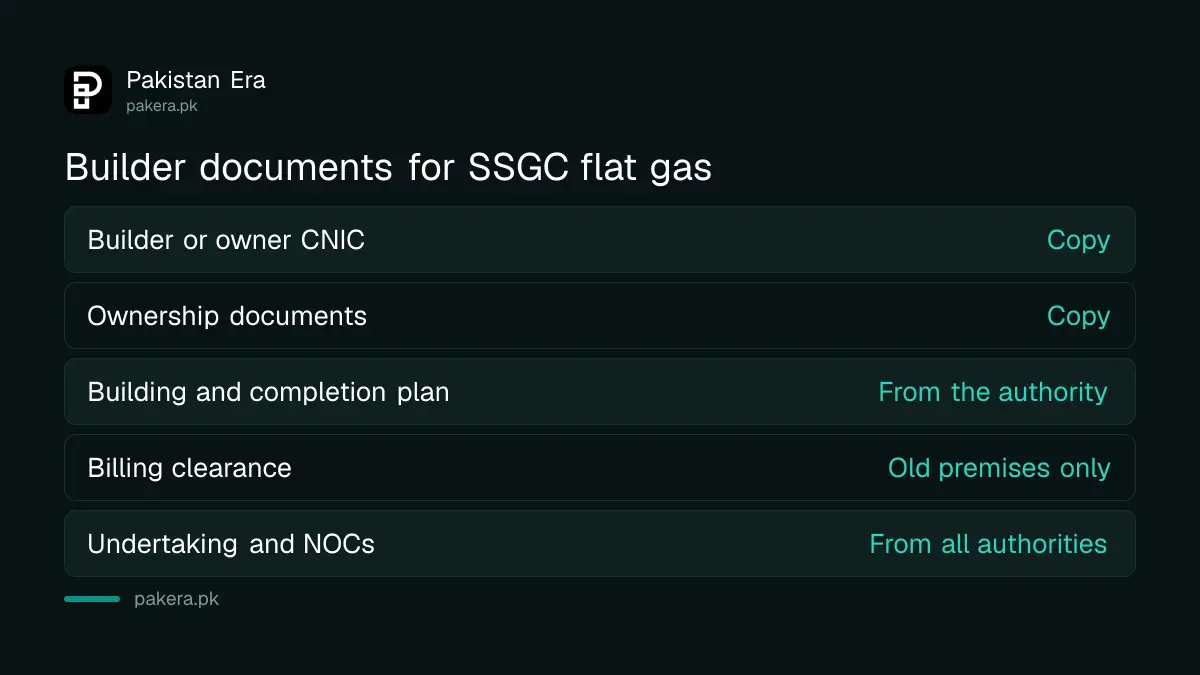
SSGC's Consumer Service Manual lists five documents for a domestic gas connection to a multi-storey building. They prove who owns the building, that it was built to an approved plan, that no old dues are pending, and that the builder accepts SSGC's conditions.
- Copy of the CNIC of the builder or owner.
- Copy of the ownership documents.
- Copy of the approved building plan and the completion plan from the competent authority.
- Billing clearance, if the premises is an old one with a previous connection.
- An undertaking from the builder or owner, and NOCs from all concerned authorities.
The completion plan is the one that holds many buildings back. It is issued by the building control authority once construction matches the approved plan. In Karachi that is the Sindh Building Control Authority. A building without it cannot clear the first stage, so ask the builder for it before you pay for a flat.
SSGC surveys the building before any pipe goes in
After the documents are checked, an SSGC sales engineer or officer visits the site in person. The survey sets the gas load the building needs, confirms the size and route of the gas main and house line, and fixes where each meter will go. Permission to fit the internal house line follows.
The builder's contractor then lays the internal house line to SSGC's approved specifications. SSGC checks that work again at a secondary survey, when the individual connection forms come in. Where the building needs an intermediate pressure line, SSGC issues a separate quotation. Otherwise the job is done through a common house line at the customer's cost, with a maintenance charge for that common line.
A house line built to the wrong standard will not be commissioned. SSGC's distribution department tests the line and commissions only pipes and fittings laid to its specifications. Pressing the builder to use an approved contractor saves months later. The house line certificate rules for Punjab are in the SNGPL approved contractor requirements, which follow the same idea.
Each flat then applies for its own meter
Once SSGC's head of department gives final approval to the building, the individual application form for each flat is processed for payment. After payment the case goes to SSGC's distribution department, which installs the meter and commissions the supply.
SSGC's website offers new domestic connections through an RLNG application. RLNG is imported gas, priced separately from the older domestic slabs. The steps and the fee are in how to apply for an SSGC RLNG domestic gas connection. After applying, you can follow the case with the SSGC new connection status check.
- Keep the flat's ownership or allotment papers ready for your own form.
- Ask the building committee for the SSGC approval letter or file number.
- Check that your flat's meter point was marked in the building survey.
Never take gas from the common line or a neighbour
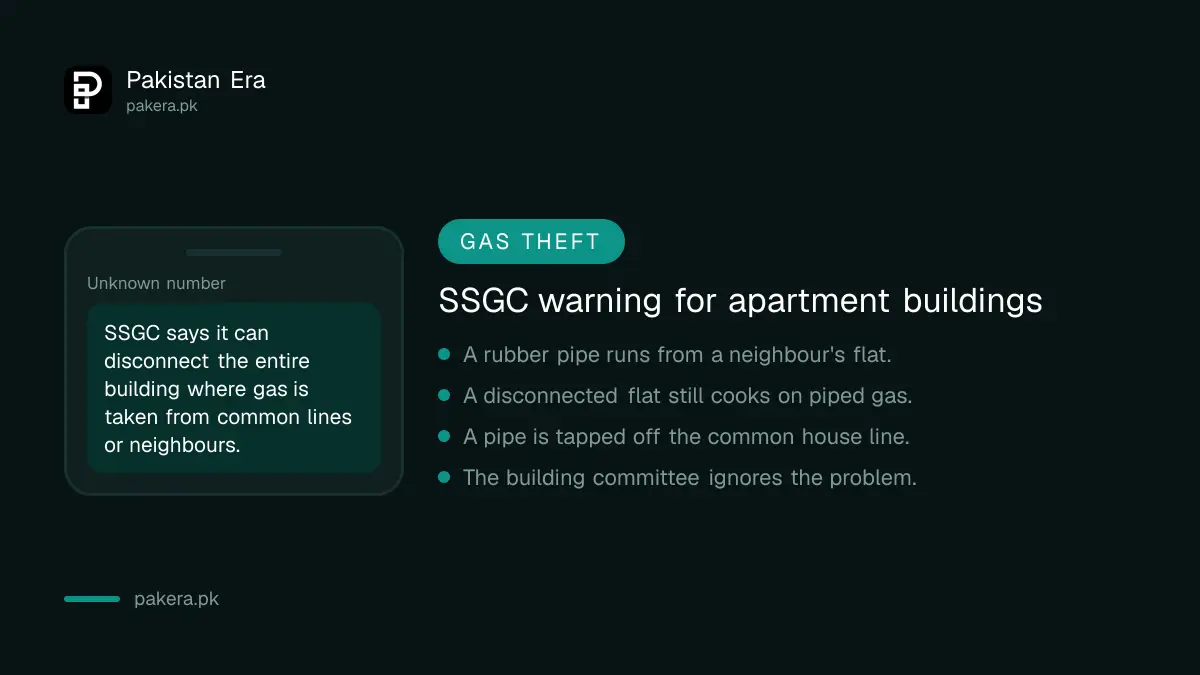
SSGC has warned publicly that in several apartment buildings, disconnected customers take gas from common house lines or from neighbours through rubber pipes. It calls this gas theft and very dangerous, and says it can disconnect the entire building where it finds the practice, and take legal action.
That warning is aimed at building committees and associations too. SSGC asks them to make sure residents stop. One flat's rubber pipe can leave every family in the block without gas. Rubber pipes also crack and leak, which is why SSGC tells every customer to use a GI pipe.
If a neighbour is doing this, report it rather than tolerate it. The routes are in how to report gas theft. If your own flat was disconnected, clear the dues and restore it properly through SSGC.
Common questions
Can I get an SSGC gas meter for my flat on my own?
Only after the building has SSGC approval. The builder or owner must clear the building stage first, then your individual form is processed.
What documents does a builder give SSGC for an apartment building?
The builder's CNIC, ownership documents, approved building plan and completion plan, billing clearance for an old premises, and an undertaking with NOCs from the authorities concerned.
Who lays the gas pipes inside the building?
The builder's contractor, to SSGC's approved specifications. SSGC checks the work at a secondary survey and tests it before commissioning.
What happens if residents take gas from a neighbour?
SSGC treats it as gas theft and can disconnect the entire building and take legal action.
Are new gas connections in Karachi on RLNG?
SSGC's website offers new domestic connections through its RLNG application, which has its own fee and rates.
How we verified this
What we checked and where we read it.
We checked SSGC's rules for multi-storey buildings on 15 November 2026 in the SSGC Consumer Service Manual, clause 2.1.25, "Domestic gas connection to multistorey buildings", and the clauses on house line testing and commissioning. The warning about unauthorised supply in apartment buildings is an SSGC public notice printed in the same manual. The GI pipe rule is from SSGC's Safety Education notice. The RLNG application route is listed on ssgc.com.pk.
About the author

Tax, Bills and Technology Writer
Ali Akhtar is a young and curious voice here at Pakistan Era. He is currently pursuing his A-Levels and has a growing interest in Pakistan’s changing industrial landscape and educational trends. Ali likes to write in a way that helps him explain and explore the world around him. His writing reflects the perspective of the new generation navigating the evolving trends of Pakistan where technology, youth innovation, and shifting opportunities are reshaping the country’s future.