How to Complain Against a Hospital or Doctor in Sindh: Sindh Healthcare Commission 30 Day Rule
Complain against a hospital, clinic or doctor in Sindh to the Sindh Healthcare Commission: 30 day limit, sworn complaint, fines, appeals and damages in court.
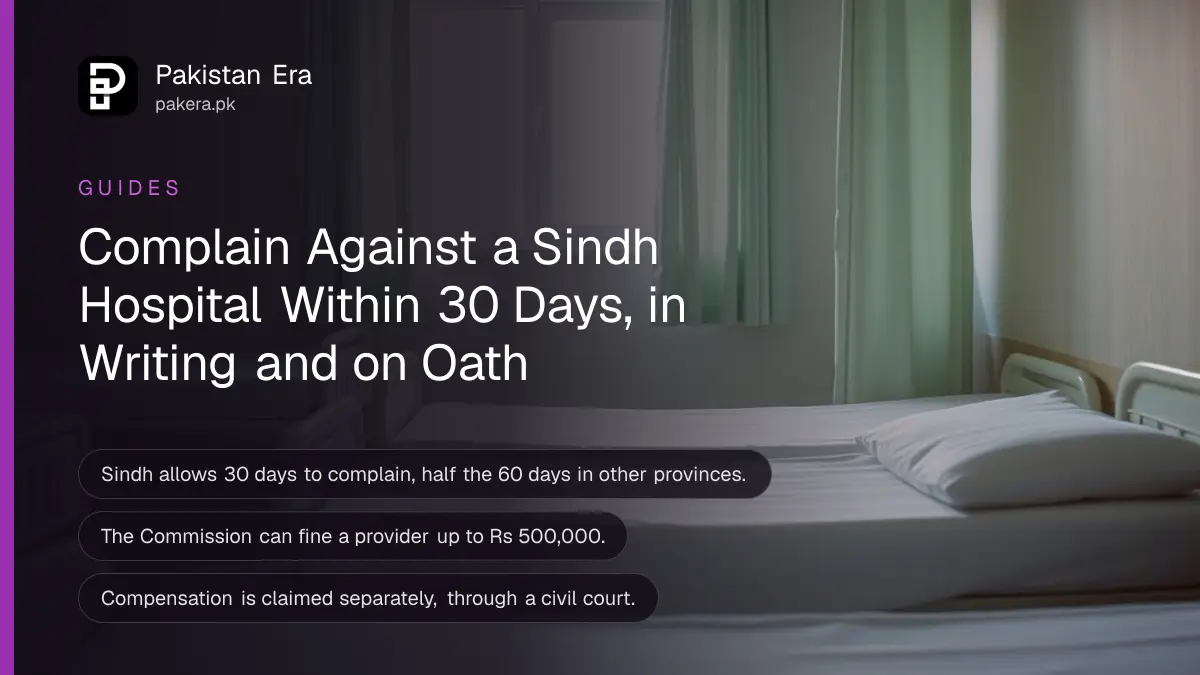
To complain against a hospital, clinic or doctor in Sindh, write to the Sindh Healthcare Commission (SHCC) within 30 days of first learning of the problem. The complaint must be on oath or solemn affirmation, signed by you, and lodged at the Commission's office or sent to it. Anonymous complaints are not accepted.
The 30 day limit is the shortest of any provincial healthcare commission. Punjab, Khyber Pakhtunkhwa and Balochistan allow 60 days. So in Karachi, Hyderabad, Sukkur or anywhere else in Sindh, start the paperwork in the first week. Here is what the Sindh Healthcare Commission Act, 2013 requires and what the Commission can do.
File within 30 days, on oath, in writing
Section 23 of the Act says a complaint must be made in writing, on solemn affirmation or oath, by the person harmed or, after their death, by their legal representative. It must be made within 30 days from the day the person first had notice of the matter.
"On oath" in practice means a sworn affidavit attested by an oath commissioner or notary. The Commission's own staff can also be authorised to administer oaths and attest affidavits under section 4 of the Act. Sindh High Court rulings on SHCC complaints refer to an affidavit stating that no case on the same matter is pending in any court.
Who can complain
- The patient who was harmed.
- The legal representative, if the patient has died.
- A health care service provider who was harmed, for example a doctor harassed at work.
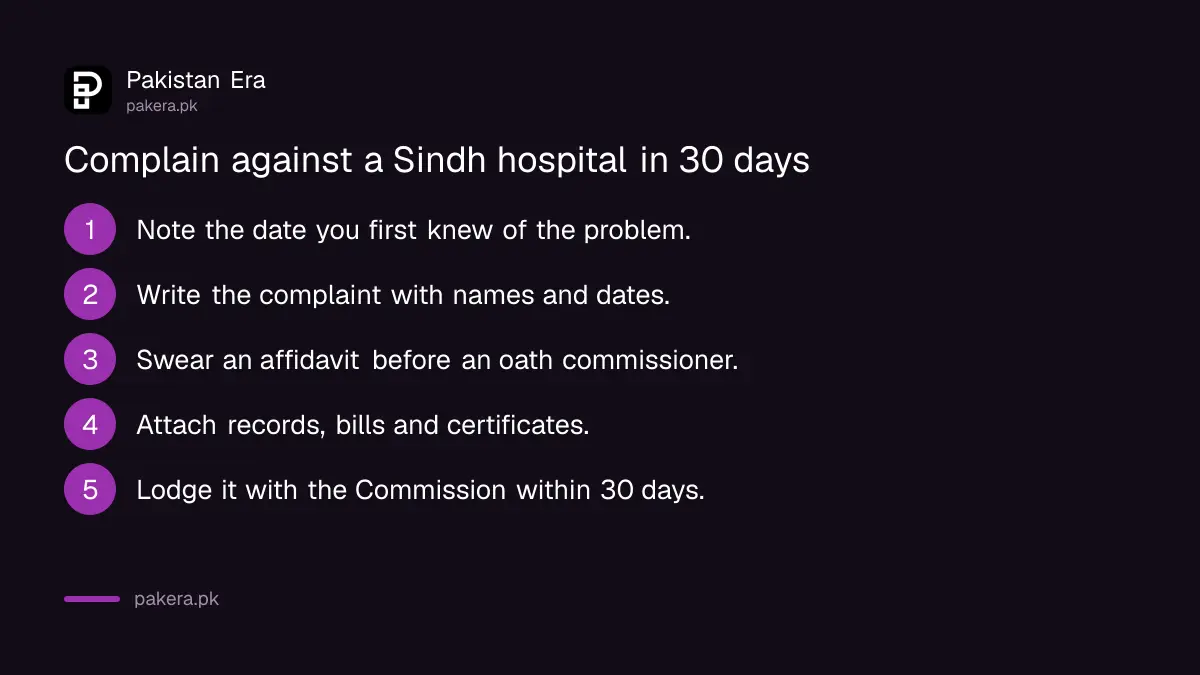
How to lodge the complaint, step by step
The Act lets you lodge the complaint in person at the Commission's office, hand it to the Chief Executive Officer in person, or send it by any other means of communication to the office. Keep a copy and proof of the date it reached the Commission.
- Write down the date you first knew something went wrong. Your 30 days start then.
- Write the complaint: your name, CNIC and address, the patient's name, the hospital or clinic, the doctors or staff involved, and what happened in date order.
- Say what you want: an inquiry, a fine, a licence action, or a refund of overcharges.
- Swear an affidavit that the facts are true and that no case on the same matter is pending in court.
- Attach copies of medical records, bills, the discharge or death certificate, and any reply from the hospital.
- Lodge it at the Commission's office in Karachi or send it there, and keep the receipt.
What counts as medical negligence in Sindh
Section 19 says a provider can be held guilty of medical negligence on one of two findings: the establishment did not have the staff and equipment it claimed to have, or the provider or an employee did not use the skill they had with competence. Known complications of treatment are not negligence.
The Act defines medical negligence as a case where a patient is injured or dies because of improper treatment at a health care establishment. In a death, the finding is based on a medical autopsy report. That makes a post-mortem important in a fatal case, so raise it early.
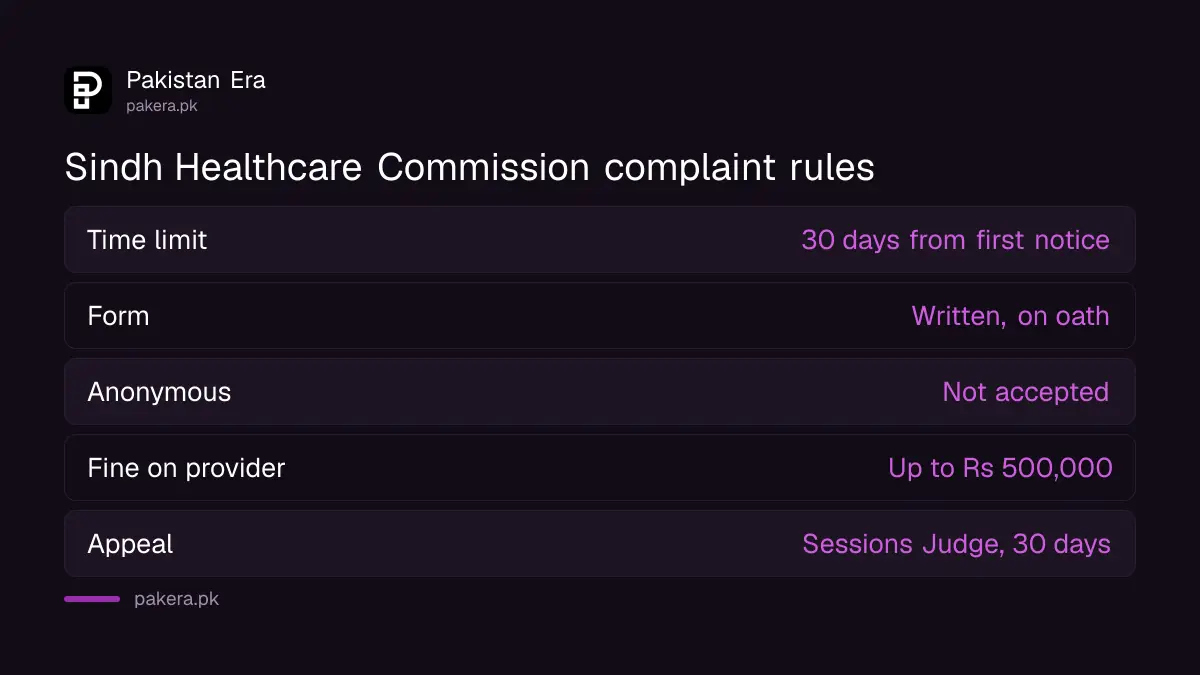
| Rule | Sindh Healthcare Commission Act, 2013 |
|---|---|
| Time limit | 30 days from first notice of the matter |
| Form | In writing, on oath or solemn affirmation |
| Anonymous complaint | Not accepted |
| Fine on provider | Up to Rs 500,000 |
| False complaint | Fine up to Rs 200,000 on the complainant |
| Appeal | District and Sessions Judge within 30 days |
What the Commission can do, and what it cannot
The Commission can investigate maladministration, malpractice and failures in care, inspect the facility, summon people and documents like a civil court, and fine a provider up to Rs 500,000. It must suspend a licence after repeated negligence of the same kind. It cannot award damages.
That last point comes from the Sindh High Court. In a February 2025 judgment, the court held that the Commission has no power to grant damages to a patient, and that a family can sue for compensation in a civil court without first getting a Commission finding. So a complaint to SHCC and a civil claim for money are two separate routes. A lawyer can advise on the civil claim.
The Act also bars suits and prosecutions about health care services against a provider except under the Act. It is one more reason to file with the Commission on time.
Appeals and false complaints
A person affected by a Commission order, such as a fine, licence suspension or closure, can appeal in writing to the District and Sessions Judge within 30 days of receiving the order. A complainant whose complaint is proved false can be fined up to Rs 200,000.
Write only what you can support with records or witnesses. Strong words do not help a case. Dates, names and documents do.
Before you visit a new private clinic or lab, check it is licensed with the Sindh Healthcare Commission. For a complaint about the doctor personally, PMDC's Disciplinary Committee is a separate route. In other provinces, see complaints against a hospital in Punjab and complaints in Balochistan.
Common questions
How many days do I have to complain to the Sindh Healthcare Commission?
Thirty days from the day you first had notice of the problem, under section 23(4) of the Sindh Healthcare Commission Act, 2013.
Can I complain anonymously to the SHCC?
No. Section 23(3) says the Commission shall not entertain anonymous or pseudonymous complaints against a provider or health care establishment.
Can the Sindh Healthcare Commission get me compensation?
No. The Sindh High Court held in February 2025 that the Commission cannot grant damages. Compensation is claimed through a civil suit.
Does the SHCC cover government hospitals?
The Act regulates health care establishments and service providers in Sindh, and allows complaints against any health care service provider or its employees for maladministration, malpractice or failures.
Is a known side effect of surgery negligence?
No. Section 19(2) says recognised and known complications of medical or surgical treatment are not medical negligence.
How we verified this
What we checked and where we read it.
Last checked 15 November 2026. We read the Sindh Healthcare Commission Act, 2013 (Sindh Act VII of 2014) as published by the Provincial Assembly, sections 2, 4, 18, 19, 23, 28, 29 and 31, and the Sindh High Court judgment in Suit No. 51 of 2021, announced 24 February 2025, which quotes the Commission's complaint regulations. The Commission's own website, shcc.org.pk, returned a server error (503) on 15 November 2026.
About the author

Public Services and Education Journalist
Fajr Riaz is a journalist and content writer at Pakistan Era, based in Lahore. She covers the questions people meet in everyday life in Pakistan: how a public service works, what a change in the rules means, and where to find a reliable answer.