How to Complain Against a Hospital or Doctor in Punjab
The complaint goes to the Healthcare Commission within sixty days, in writing, with your affidavit. Anonymous complaints are not entertained.
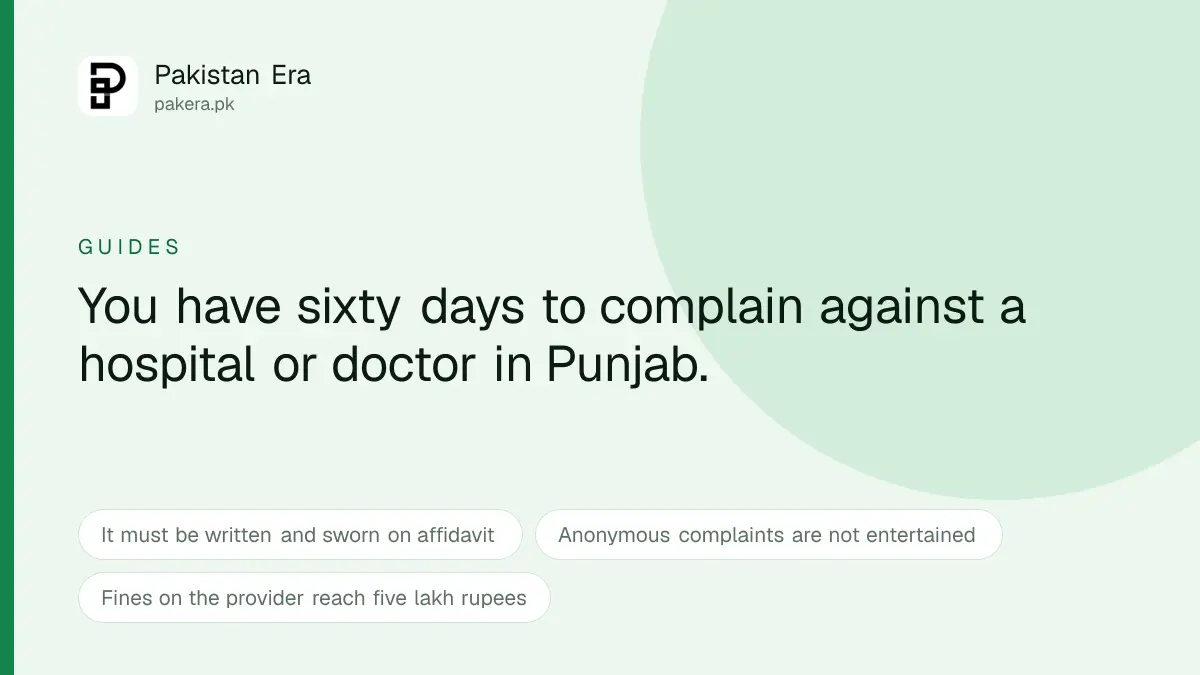
You have sixty days to complain against a hospital or doctor in Punjab, the complaint must be in writing with your affidavit, and it cannot be anonymous. Miss the deadline and the route closes.
The Punjab Healthcare Commission is the body that hears it, and the Act gives it a fine of up to five hundred thousand rupees. It also gives a false complaint a price of up to two hundred thousand rupees, which nobody mentions.
We read the Punjab Healthcare Commission Act 2010 on 6 September 2026 in the text published by the Law and Parliamentary Affairs Department, Government of the Punjab.
What the Act sets out
| Point | What the Act says |
|---|---|
| Deadline | Sixty days from the date of knowledge of the cause of action |
| Form | Written application supported by your affidavit |
| Anonymous | Not entertained |
| Fine on provider | Up to five hundred thousand rupees |
| False complaint | Fine up to two hundred thousand rupees on you |
| Appeal | Thirty days, to the District and Sessions Judge |
The sixty days run from when you knew, not from the treatment date, which matters when harm shows up later.
The test for medical negligence
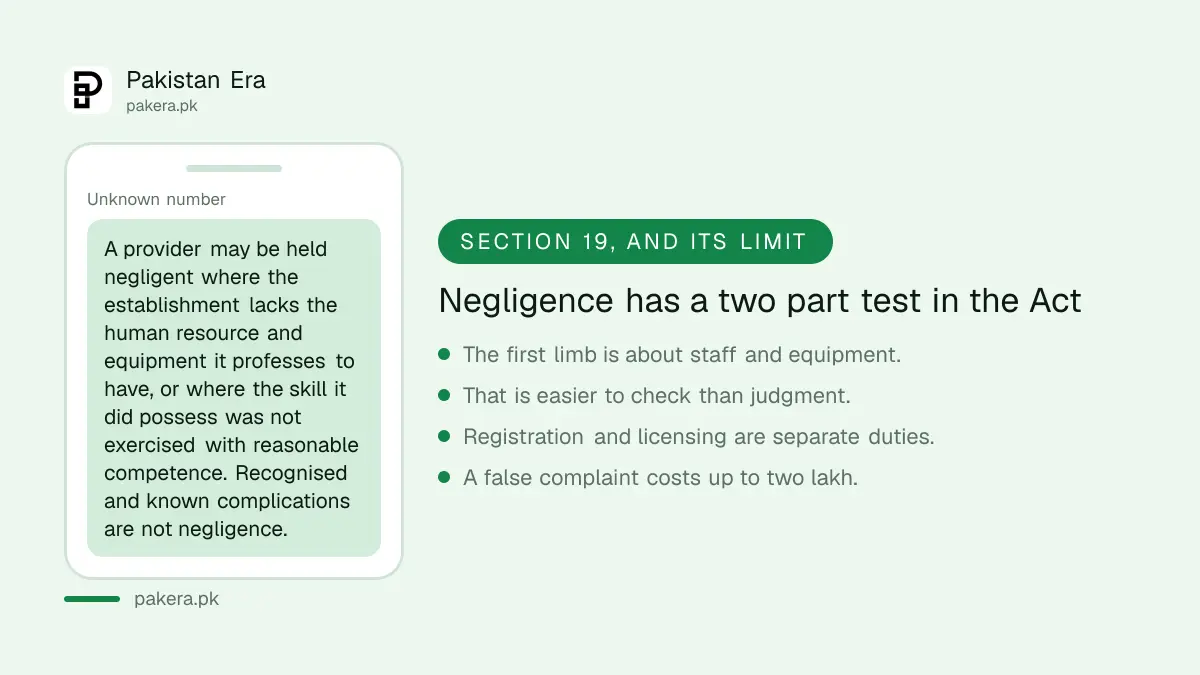
Section 19 is unusually clear for a statute, and it is worth reading before you decide whether you have a case.
A healthcare service provider may be held guilty of medical negligence on one of two findings. Either the establishment does not have the human resource and equipment which it professes to possess. Or the provider or an employee did not, in the given case, exercise with reasonable competence the skill they did possess.
Then comes the limit. Subsection 2 says the recognised and known complications of a medical or surgical treatment are not considered medical negligence.
So a bad outcome is not the question. The question is whether the place had what it claimed to have, or whether the skill that was there was used competently.
The first limb is easier to prove than people think
Most complaints go straight at the second limb, which needs expert opinion about clinical judgment.
The first limb does not. It asks whether the establishment had the staff and equipment it presented itself as having. A hospital advertising a specialist service without the specialist, or an intensive care unit without working equipment, is inside that wording.
That is a fact about the building and the roster, not a fact about a doctor's decision, and it is the limb worth checking first.
How to file
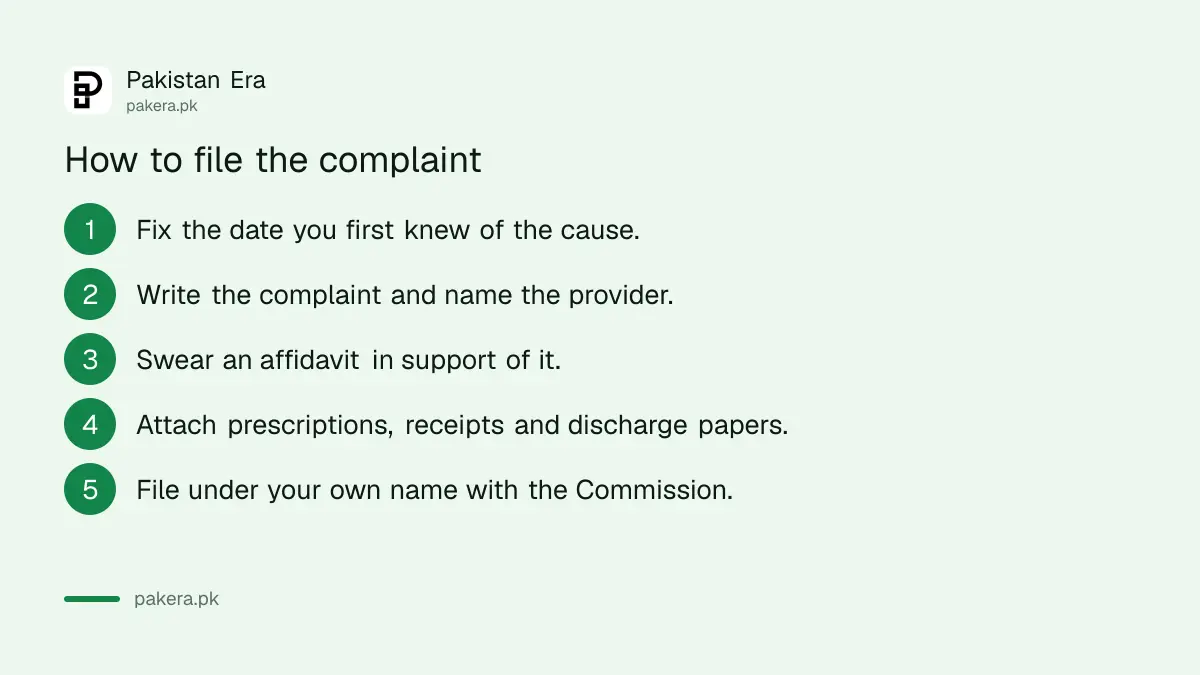
- Fix the date you first knew of the cause of action, because the sixty days run from it.
- Write the complaint, naming the healthcare service provider or the establishment.
- Swear an affidavit in support, which the Act requires.
- Attach the records you hold, including prescriptions, receipts and discharge papers.
- File it with the Commission, under your own name, because anonymous complaints are not entertained.
Section 23 also says the Commission prescribes its own investigation procedure, so the forms it asks for may go beyond the statute. The three fixed points are the sixty days, the writing and the affidavit.
Registration, licensing and quacks
Two duties sit behind every complaint, and checking them is free.
Section 13 says a healthcare service provider shall not provide healthcare services without being registered, and a fine up to five hundred thousand rupees applies to anyone providing services, or pretending to, without registration. Section 14 says a healthcare establishment shall not be used except under a licence, with the same maximum fine.
The Act defines a quack as a pretender providing health services without registration of the Medical and Dental Council, the Council for Tibb, the Council for Homeopathy or the Nursing Council. Banning quackery is written into the Commission's functions in section 4.
Our guide to medical help from Bait-ul-Mal covers assistance with treatment costs, and our guide to a refused insurance claim covers the separate route when an insurer will not pay.
What the Commission can do, and what it costs to be wrong
Section 28 lets the Commission impose a fine up to five hundred thousand rupees for a contravention, after giving the person an adequate opportunity of hearing.
The same section then turns the other way. If a complaint submitted by an aggrieved person or by a provider is proved false, the Commission may fine the complainant up to two hundred thousand rupees.
Section 29 closes the alternatives. No suit, prosecution or other legal proceeding related to the provision of healthcare services lies against a healthcare service provider except under this Act. So this is the route, not one of several.
An appeal against a refusal, suspension, revocation, closure order or fine goes to the District and Sessions Judge within thirty days of the order being communicated. Our guide to checking a court case online covers the tracking side once it reaches that stage.
Common questions
How long do I have to complain against a hospital in Punjab?
Sixty days from the date of knowledge of the cause of action, under section 23.
Can I complain anonymously?
No. The Commission does not entertain anonymous or pseudonymous complaints.
What counts as medical negligence?
Either the establishment lacking the staff and equipment it professes to have, or the skill possessed not being exercised with reasonable competence.
Is a known complication negligence?
No. Section 19 says recognised and known complications of treatment are not considered medical negligence.
How much can the Commission fine a hospital?
Up to five hundred thousand rupees, after an opportunity of hearing.
What if my complaint is found false?
The Commission may fine you up to two hundred thousand rupees.
How we verified this
What we checked, where we read it, and what we could not confirm.
Last checked 6 September 2026. We downloaded the Punjab Healthcare Commission Act 2010 from the Punjab Code portal at punjablaws.punjab.gov.pk, in the text published by the Law and Parliamentary Affairs Department, Government of the Punjab, and read it. Section 4 listing the functions of the Commission including enquiry into maladministration, malpractice and failures and steps to ban quackery, section 13 requiring registration and setting a fine up to five hundred thousand rupees for providing or pretending to provide services without it, section 14 requiring a licence for a healthcare establishment with the same maximum fine, section 19 setting the two findings on which medical negligence may be held and excluding recognised and known complications, section 23 requiring an aggrieved person to file within sixty days of the date of knowledge of the cause of action by written application supported by an affidavit and barring anonymous or pseudonymous complaints, section 25 setting a fine up to fifty thousand rupees for obstructing an inspection team, section 28 allowing a fine up to five hundred thousand rupees for a contravention and up to two hundred thousand rupees on a complainant whose complaint is proved false, section 29 barring other proceedings against a healthcare service provider, and section 31 giving a thirty day appeal to the District and Sessions Judge, are all taken from that text. The definition of a quack as a pretender providing health services without registration of the Medical and Dental Council, Council for Tibb, Council for Homeopathy or Nursing Council is from the definitions in section 2. Health is a provincial subject and this is the Punjab Act, so check the law that applies where you live. Nothing here is legal advice, and nothing here is medical advice.
About the author

Senior Writer, Public Services and Technology
Shahid joined us in 2024 as an author. He is a senior contributor to Pakistan's leading technology websites. He writes detailed articles, mostly covering his expertise in the latest tech, mobiles, apps, gadgets, and step-by-step guides. His ideology is to help people understand the latest trends and explain complex methods through very easy-to-understand guides.