How to Get Medical Help from Pakistan Bait-ul-Mal
Support of up to Rs 1 million for major illness, with an income limit of Rs 74,000 a month. Who qualifies, who cannot, and where to start.
Pakistan Bait-ul-Mal offers support of up to Rs 1 million towards treatment for a major illness, and the income limit is Rs 74,000 a month. That threshold is far higher than most people assume, so families rule themselves out who would in fact qualify.
We read this on the Pakistan Bait-ul-Mal website at pbm.gov.pk on 30 August 2026. It is a federal body, and the detail below is taken from its own pages.
What the medical scheme covers
The programme is called Individual Financial Assistance (Medical). Its own description says it supports the poor, widows, destitute women, orphans and disabled persons for treatment of major illnesses.
| Detail | What the site states |
|---|---|
| Maximum support | Up to Rs 1 million for treatment |
| Monthly income limit | Rs 74,000 or less |
| Conditions covered | Cancer, heart disease, hepatitis, tuberculosis, vital organ surgeries, kidney dialysis |
| Basis of release | Recommendation of the hospital committee, specialist doctor or Medical Superintendent |
| Allocation | Needy individuals on a first come, first served basis |
The conditions listed are the expensive ones, and the site says help is given based on hospital recommendations. So this is aimed at the illness that empties a household's savings rather than at routine care.
The route runs through the hospital, not around it
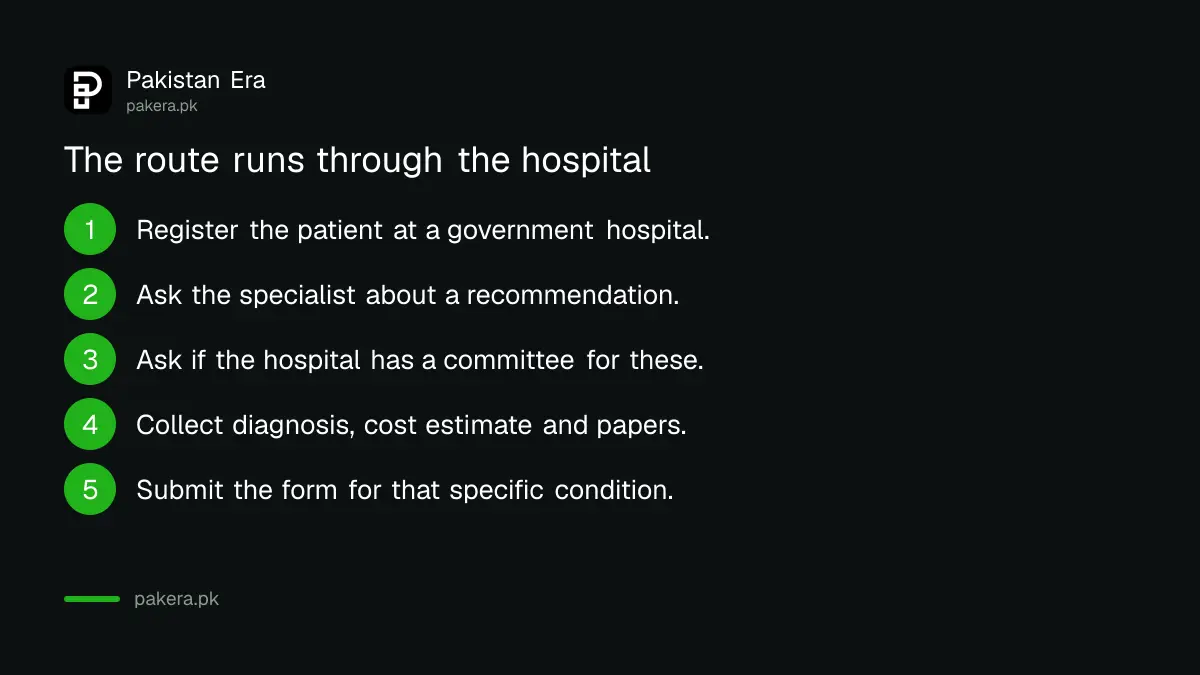
This is the part that changes what you should do first, and it is the detail most accounts leave out.
The site states that funds are released based on recommendations by the hospital committee, the specialist doctor, or the Medical Superintendent of the government hospital. The recommendation is not something you supply. It comes from the hospital treating the patient.
- Get the patient admitted or registered at a government hospital.
- Ask the treating specialist about a Bait-ul-Mal recommendation.
- Ask whether the hospital has a committee that handles these cases.
- Collect the diagnosis, estimate of cost and the hospital's paperwork.
- Submit the form for your condition with that recommendation attached.
Approaching the Bait-ul-Mal office first, without the hospital behind you, is the common wasted journey. Start with the specialist and the Medical Superintendent's office.
Who cannot apply, and this catches people out
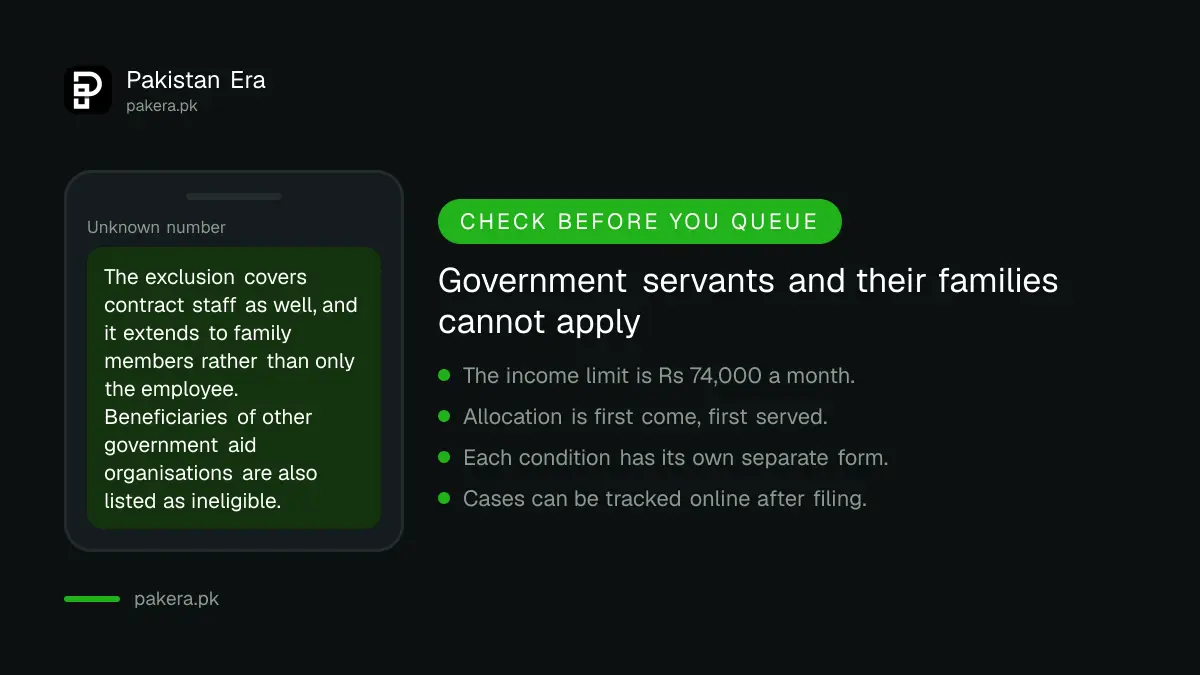
Two categories are listed as ineligible, and both are worth checking before anybody spends a day queueing.
The first is government servants, including contract staff, and their family members. That is a wide exclusion in a country where a great many households have one member in government service, and it applies to the family and not only to the employee.
The second is beneficiaries of other government aid organisations. If the household already receives support from another state programme, ask directly whether that blocks this one before you build a plan around it. Our guide to what BISP actually pays covers the largest of those programmes.
Who the criteria are written for
The enrolment criteria on the site describe the situations the scheme is meant to reach, and they are broader than the word destitute suggests.
They name persons facing suffering beyond their means, victims of a sudden economic downfall, people with severe physical or mental disability who are unable to earn, widowed or divorced women raising children alone, and invalid or infirm people with no family support.
A sudden economic downfall is the one worth pausing on. A family that was managing until a diagnosis arrived is inside the wording, not outside it, provided the income test is met.
The other programmes, and the separate forms
Medical assistance is one item on a longer list. The site sets out education scholarships, an Orphan and Widow Support Programme, Women Empowerment Centres, rehabilitation of child labour, Pakistan Sweet Home for orphans, shelter homes, an old home, a cochlear implant programme, the Pakistan Thalassaemia Centre, and Special Friend Person, which provides assistance and wheelchairs for disabled people.
The forms page lists a separate form for each situation, including disabled persons, the Thalassaemia Centre, Pakistan Sweet Home for orphans, hepatitis C patients, surgical patients, artificial limbs, cancer patients and heart patients. Download the one that matches the condition rather than a general form, and read its requirements list before you start collecting papers.
Tracking, and what this is not
The site carries a case tracking facility, so once a case is submitted its status can be checked online rather than by travelling to an office.
This is not health insurance and it is not a card. It is discretionary assistance, allocated first come first served, released on a hospital's recommendation. If you are looking for treatment cover rather than a grant, our guides to what the Sehat Card covers now and to free health programmes in Punjab beyond it cover that side. And because state schemes are opened and closed regularly, our guide to which government schemes have stopped is worth a look before you rely on any of them.
Common questions about Bait-ul-Mal assistance
How much can I get?
The site states support of up to Rs 1 million for treatment, subject to the hospital's recommendation and available funds.
What is the income limit?
Monthly income of Rs 74,000 or less is listed in the enrolment criteria.
Can a government employee apply?
No. Government servants including contract staff, and their family members, are listed as ineligible.
Which illnesses qualify?
Cancer, heart disease, hepatitis, tuberculosis, vital organ surgeries and kidney dialysis are named, based on hospital recommendations.
Where do I start?
At the government hospital treating the patient, with the specialist and the Medical Superintendent, because the recommendation comes from there.
How we verified this
What we checked, where we read it, and what we could not confirm.
Last checked 30 August 2026. We read the Pakistan Bait-ul-Mal website at pbm.gov.pk on that date. The description of Individual Financial Assistance (Medical) as supporting the poor, widows, destitute women, orphans and disabled persons for treatment of major illnesses, the named conditions of cancer, heart disease, hepatitis, tuberculosis, vital organ surgeries and kidney dialysis, the statement that PBM offers support of up to Rs 1 million for treatment, the release of funds on recommendations by the hospital committee, specialist doctor or Medical Superintendent of the government hospital, the enrolment criteria including a monthly income of Rs 74,000 or less and the first come first served basis, the ineligibility of government servants including contract staff and their family members and of beneficiaries of other government aid organisations, the list of programmes including cochlear implants, the Pakistan Thalassaemia Centre, Special Friend Person, Pakistan Sweet Home, shelter and old homes, education scholarships, the Orphan and Widow Support Programme, Women Empowerment Centres and rehabilitation of child labour, the separate downloadable forms by condition, and the case tracking facility, are all taken from that site. We did not visit a Bait-ul-Mal office or speak to the organisation, and we cannot say how long a case takes or how often assistance is granted. Amounts and criteria can change, so confirm both at the office handling your district before relying on them.
About the author

Tax, Bills and Technology Writer
Ali Akhtar is a young and curious voice here at Pakistan Era. He is currently pursuing his A-Levels and has a growing interest in Pakistan’s changing industrial landscape and educational trends. Ali likes to write in a way that helps him explain and explore the world around him. His writing reflects the perspective of the new generation navigating the evolving trends of Pakistan where technology, youth innovation, and shifting opportunities are reshaping the country’s future.